MOSAIC. - In Latin opus musivum (opere museo, in CIL, VIII, 1323), in Greek μοῦσα, μουσάκιον, μουσόμα, in later times metallica. It is a painting executed with small cubic tesserae or dice (abaculi) of stones, glass paste, marbles, terracotta by workers whom the Theodosian Code distinguishes into tessellarii and musivarii (CIL, IV, 4502 and 7044). Sometimes the artist is called musearius (CIL, III, 1934 ff.). In the inscription of Felix IV (526-30) in S. Stefano Rotondo one read musivo (G. B. De Rossi, Inscr. christ. Urbis Romae, II, 1, Rome 1888, p. 152, n. 32).
Later one finds the expression metalla, as in SS. Cosma and Damiano under Felix IV (526-30): aula Dei claris radiat speciosa metallis, or under Honorius I (625-38) in S. Agnese: virginis aula micat variis decorata metallis; or also metallum, as in the oratory of S. Venanzio from the time of John IV (640-42). With the expression metalla, sometimes, as in the case of the cited inscription of Felix IV at SS. Cosma and Damiano, is understood not only the gold and the enamels of the resplendent mosaic, but also the works in opus sectile marmoreum, or tessellatum, that is panels of marble with fillets, carvings and friezes of porphyry, serpentine, etc. of which there are conspicuous examples, among those surviving in the chapel of SS. Rufina and Seconda of the Lateran Baptistery and in S. Sabina (G. B. De Rossi, I m. cristiani, Rome 1899, pls. II, III, XI, XII, XV, XVIII, XXXIX).
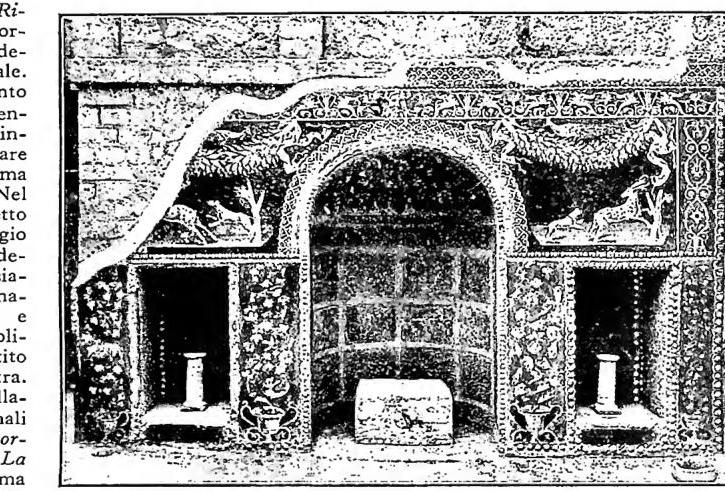
(Int. Attracti)
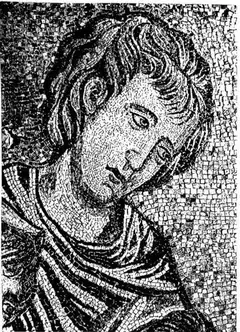
Its origin is certainly Eastern, and the mosaic was spread by the Greeks, who had attained great perfection in this art. The mosaic decoration was applied to the wall over a layer of stucco, on which, while it was still fresh, the outlines were marked with a stylus and then sketched either in red chalk (for example, at S. Maria Maggiore) or in a single color (for example, at S. Lorenzo in Milan) or in various colors; then the small tesserae were set into the layer of stucco. R. Kanzler observed the outlines sketched in red with a brush on the still-fresh stucco in the cemetery of Pretestato, and in red and black in that "inter duas lauros" (Osservaz. sulla tecnica dei m. nei cimiteri crist., in N. Bull. arch. crist., 4 [1898], pp. 209-11). Even in the oldest Christian mosaics known thus far, discovered in a mausoleum of the Roman necropolis beneath the Constantinian Basilica in the Vatican, the tesserae of various sizes were sunk into a layer of stucco 3-4 cm thick, on which the subjects had been sketched lightly, but with precision and with various tones of color (B. M. Apolloni-Ghetti, A. Ferrua, E. Josi, E. Kirschbaum, Esplorazioni sotto la confessione di S. Pietro in Vaticano, Vatican City 1951, p. 41). In the mosaics of the arch of S. Maria Maggiore the tesserae are irregular, mostly cubic, between 7 and 10 mm per side, with an uneven conchoidal surface, all of Alexandrian glass enamel of various qualities; they offer an abundant palette consisting of 33 shades of blue, 39 of green, 9 shades for flesh tones in a warm key and 5 in a cold key, and great variations in opacity. The dimensions of the tesserae vary. Christian mosaics generally have larger tesserae than profane ones: G. Wilpert observed that in Rome the abaculi for faces generally do not exceed 2 mm² in surface area, while those of the clothing rise to as much as 8 mm²; at Ravenna, on the other hand, the former reach even 3 mm². At Thessalonica, in the dome of St. Demetrius, 40,000 tesserae were counted in 1 m² of surface, and for the whole dome 34,000,000 were needed. Later, in the small apse of Germigny-des-Prés (Loiret), 130,000 tesserae were used. The enamels generally consist of a mixture of silicates of lead, calcium and potassium, with a light coating of calcium phosphate, then colored. Gold enamels have a special working; onto the glassy surface a very thin gold leaf is applied, which is then heated in order to deposit the enamel upon it in fusion. At Parenzo and at St. Irene in Constantinople, the gold background is formed of enamels placed very close together, not arranged flat, but inclined forward, at an angle of about 30°, to prevent glare. The artist, or artists, of S. Maria Maggiore display great technical experience and an exquisite decorative sense in the proportions of the figures. In the ancient Basilica Ursiana at Ravenna four artists worked, namely Eusebius and Paul for the mosaic decoration of the wall reserved for the women, while Sazius and Stephen for that of the wall reserved for the men (Agnello, Liber pontif. excl. Ravennatis, in MGH, Script. rerum Langobard., I, p. 289).
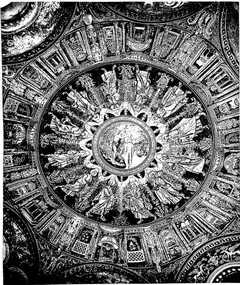
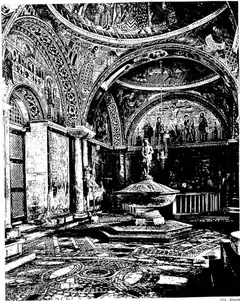
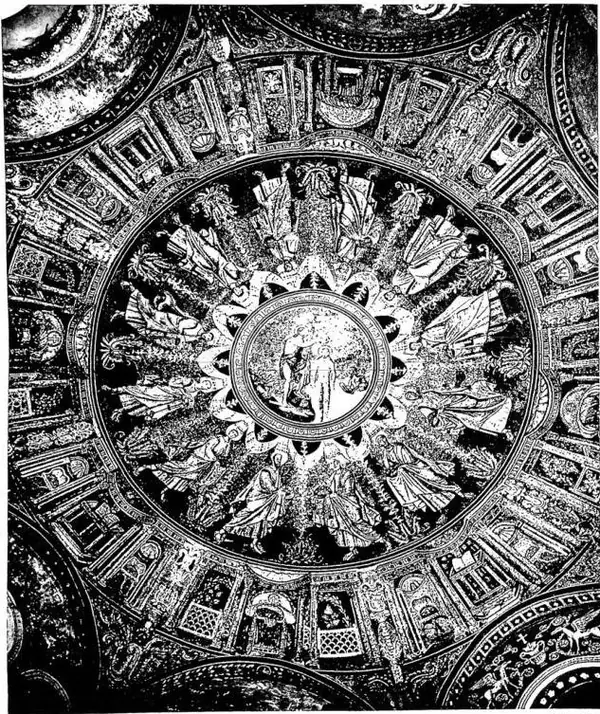
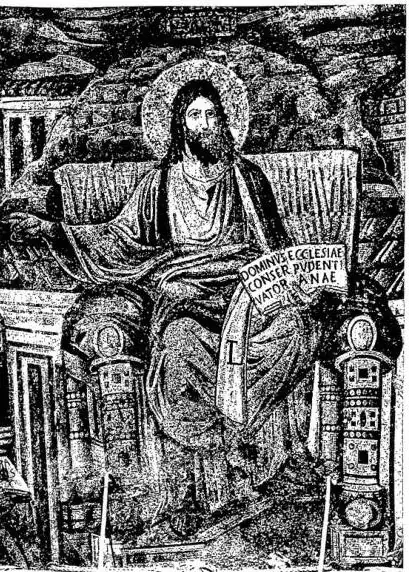
The themes found in the apses of the Roman basilicas are: in that of the ancient Vatican Basilica, Jesus Christ teaching between the princes of the Apostles; in S. Pudentiana, Christ in majesty between the Apostolic College, the heavenly city, the four living creatures of the Apocalypse, the Church "ex circumcisione" and that "ex gentibus" (Wilpert, Mosaiken, pls. 42-44). At Sts. Cosmas and Damian the Lord, standing, no longer seated, receives the martyrs presented by the princes of the Apostles, and the founding pope Felix IV (526-30) appears; or the martyrs approach the Redeemer seated on the globe, as in the Pelagian mosaic of S. Lorenzo and in S. Teodoro, or between the angels as in the oratory of S. Venanzio (G. B. De Rossi, I m. cristiani, Rome 1899, pls. 15, 16, 17, 19). At S. Agnese, the martyr occupies the place of Jesus Christ, between the two Pontiffs who glorified her tomb, Symmachus and Honorius I (id., ibid., pl. 18). From the description of St. Paulinus of Nola, F. Wickhoff attempted a reconstruction of the apse mosaic (Das Apismosaik in der Basilika des hl. Felix zu Nola, in Röm. Quartalschr., 3 [1889], p. 169 ff.). On the triumphal arch, the throne with the cross, the crown and the purple, that is, the insignia Christi, between Peter and Paul (Wilpert, op. cit., pls. 70-72) as in S. Maria Maggiore, or the bust of Jesus Christ, between the four living creatures or the twenty-four elders of the Apocalypse, as at S. Paolo (G. B. De Rossi, I m. cristiani, pl. 13). Later, as at Sts. Cosmas and Damian, instead of the bust there is the exaltation of the divine Lamb. In S. Paolo the beams of the ceiling were covered with gold mosaic; Prudentius attests that in the interior all the light is golden as at sunrise, and the arches are all covered with magnificent glass mosaics, as varied in color as the flowers that enamel the meadows in spring (Peristephanon, XII, 50-54). It suffices then to recall, besides the mosaic cycles of the basilicas of Milan (v.), Parenzo (v.), Ravenna (v.), Constantinople (v.), those in S. Matrona near S. Prisco at Capua Vetere (Wilpert, Mosaiken, pls. 74-76) and at Casaranello (v.) in Apulia, in Thessalonica (v.), etc., at Sinai in the monastery of St. Catherine. The mosaic decoration in gold gave rise to the name of various churches, such as S. Martino in caelo aureo at Ravenna (today S. Apollinare nuovo), S. Pietro in caelo aureo at Pavia, S. Vittore in caelo aureo near S. Ambrogio at Milan, St. Germain-le-doré (St-Germain-des-Prés) in Paris, the Ecclesia deaurata (la Daurade) at Toulouse. Egeria recalls that Constantine adorned the sacred buildings of Jerusalem auro, musivo et marmore pretioso (P. Geyer, Itinera Hierosolymitana [CSEL, 39], Vienna 1898, p. 76). In a synodal letter sent to the emperor Theophilus it is related that St. Helena had caused the Nativity of the Lord and the Epiphany to be represented on the west facade of the basilica of Bethlehem (Ch. Bayet, Recherches pour servir à l'hist. de la peinture chrét. en Orient avant la querelle des images, Paris 1879, p. 77); this is not, however, the primitive basilica, but that of the 6th century (Revue bibl., 45 [1936], pp. 544, 555-57 and 569). To the baptisteries is reserved the theme of the traditio legis, certain biblical scenes, the Apostles bearing crowns as in the two baptisteries of Ravenna (Wilpert, Mosaiken, pl. 78, 1; M. Van Berchem and J. Cluzot, Mosaïques chrét. du IVe au IXe siècle, Geneva 1924, p. 172, fig. 219) and at Naples (Wilpert, op. cit., pls. 33, 1-2; 34-35). In Gaul, at the beginning of the 6th century, on the hill dominating the left bank of the Seine, Clovis began, at Paris, the basilica in honor of the apostles Peter and Paul, completed by Clotilde who was buried there together with Clovis. The building was decorated with mosaics representing patriarchs, prophets and martyrs; it later changed its name to that of St. Genevieve and was burned in 857. Also at Paris, Childebert began in 542 the basilica in honor of the Holy Cross and of the martyr St. Vincent of Saragossa; the construction was completed in 558 and was dedicated by St. Germain, from whom it later took its name (St-Germain-des-Prés). It was so resplendent with mosaics that, in the expression of Fortunatus, it shone without need of the sun: atque suis radiis et sine sole micat. At the beginning of the 6th century the bishop Avitus adorned with mosaics the baptistery of Vienne and Agricola, in 583, the basilica and the baptistery of Chalon-sur-Saône. At Toulouse (v.) a church was called de la Daurade (mid-6th century) for the splendor of its gold mosaics, of which nothing remains but a description written in the 17th century by the monk Odon-Lamothe (Paris, Bibliothèque nationale, ms. lat. 12608). At Autun, at the end of the 6th century, Queen Brunhild transformed the church of St. Martin into a sumptuous basilica covered with mosaics, which in the following century inspired Bishop Desiderius of Auxerre to embellish his basilica in honor of St. Stephen. At Nantes (v.) the basilica erected by Bishop Felix (567). The baptistery of Damasus in the Vatican Basilica was covered with mosaics and contained the scene of the Good Shepherd with the flock, described by Prudentius (Peristephanon, XII, 39-44), as in the ancient Lateran Baptistery; there are then the rich decorations of the baptisteries of Albenga (v.), of Naples (Wilpert, Mosaiken, pl. 30 ff.), of the numerous ones of North Africa, from Sbeitla (v.) in Byzacena to those of Timgad (v.) in Numidia.
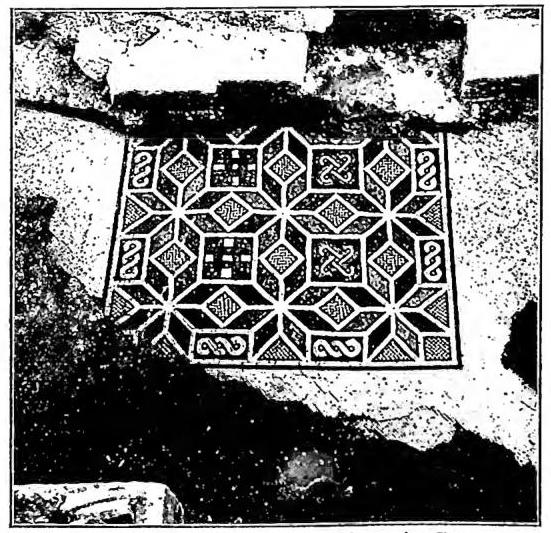
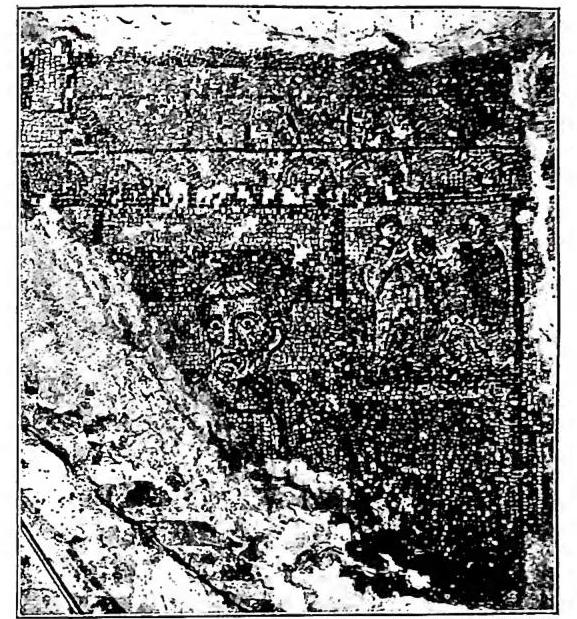
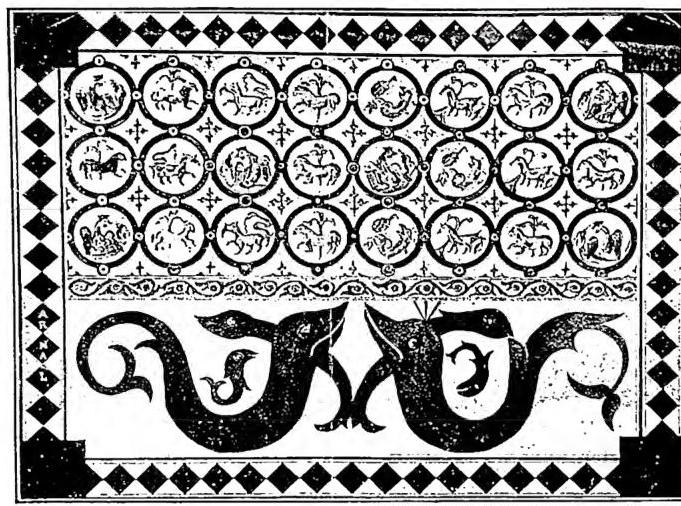
In the underground Christian cemeteries mosaic decoration was little used; there are examples of it at Rome in the cemeteries of Bassilla, of Callistus, of Praetextatus, of Priscilla, in that "inter duas lauros"; at Naples in S. Gaudioso, in cubicula and in arcosolia; sometimes on tiles, like the scenes of Jonah found in a cemetery of the Via Latina, now in the Lateran Christian Museum, or for epitaphs, as in the cemetery of Pamphilus (v. MARTIRIO E MARTIRE, col. 243). Mosaic portraits of the deceased were also executed, such as those of Fl. Iulius Iulianus or of Maria Simplicia Rustica, found in the cemetery of S. Lorenzo in 1656, now in the Lateran Christian Museum. Mosaic revetment on open-air tombs was much used in North Africa and in Tarragona in Spain; an example is found near Teano (v. CALVI E TEANO), now in the Museum of S. Martino in Naples. Mosaic decoration was also employed to decorate Christian mausoleums such as the small Christian cell of the 3rd century in the Vatican necropolis, the mausoleums of S. Costanza, of S. Helena and that of Cencelles near Tarragona. It was then much used in the floors of cemetery buildings, as in the basilica of S. Felix near Nola erected by St. Paulinus, in the cemetery basilicas of Africa, of Salona, of Sabaria, etc. The floor mosaic (Σαββατοσπον) is called opus tessellatum at Aquileia, at Brescia, at Setif, at Trieste, at Verona; the expression tessellavit is employed. Often such polychrome revetment, like a dazzling carpet, is offered by the faithful as a votive gift, as the inscriptions of Aquileia, of Brescia, Grado, Pola, Verona, Vicenza in Italy, Setif in North Africa attest. Floor mosaics have been discovered in great number, besides in the places just cited, in Bethlehem, in the Constantinian octagon and in the grotto of the Nativity (5th century) and in other places of Palestine (v.), especially at Madaba (v.); at Ravenna in S. Vitale, at Parenzo, at Orsera, at Zuglio Carnico, in S. Apollinare in Classe; throughout proconsular Africa, in Byzacena, in Numidia, in Mauretania, in Tripolitania, in Cyrenaica, in Syria.
Enrico Josi
Christian mosaics from the 7th to the 13th century.
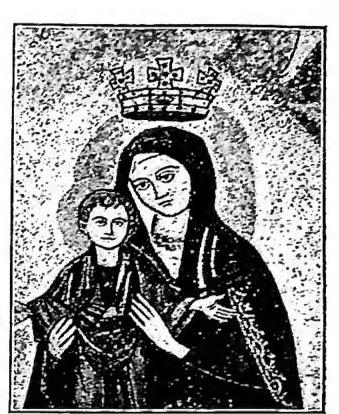
- With the introduction and predominance of Oriental forms, the classical current loses its last positions and the mosaic moves toward assuming new aspects. In S. Agnes and in the oratory of S. Venantius at the Lateran, executed in the time of John IV (640-42) with the depiction of the Dalmatian martyrs, there is the persistence of a local tradition identifiable in the characterization of the faces, as in the mosaics of the small apse of S. Stefano Rotondo and in the S. Sebastian of S. Pietro in Vincoli, a work of the middle of the 7th century. At the beginning of the 8th century, thanks above all to the Greek John VII (705-707), a particular artistic rebirth is perceived in Rome, as in the New Testament mosaic cycle of the oratory dedicated to the Virgin by the same pope, formerly in the ancient Vatican Basilica, now dispersed in various places: in S. Marco in Florence; in the cathedral of Orte and at Rome in the Vatican Grottoes and in S. Maria in Cosmedin: the new technique has as its characteristic the accentuation of the contours and the use of luminous harmonies marked by brown lines, which detach the figures from the gold background. Such technique preludes that proper to the Roman mosaics of the 9th century, whose first complete manifestation is found on the triumphal arch of the church of Sts. Nereus and Achilleus. The mosaic of Leo III, with the scenes of the Administration, of the Transfiguration and of the Virgin with the Child, asserts a new manner in which white predominates over blue and zones of shadow furrow the faces, albeit still much attenuated. More harmonious compositions are offered by the triumphal arch and the apse of S. Maria in Domnica, a work of Paschal I (817-824). The procession of the elders toward the Christ enthroned within the luminous mandorla and the candid throng of angels, who bow slightly before the Theotokos, accentuate the contrast of the light tones against the dark tones of the Christ and of the Virgin. In S. Prassede and in S. Cecilia in Trastevere the mosaicist has kept in mind the figurations of the apse of Sts. Cosmas and Damian, but without that plastic vigor and that admirable web of lights. More restrained and harmonious is the chapel that the Pontiff erected in the same church for to bury his mother Theodora there. A very fine carpet of tesserae covers every space of the front and of the walls, and the light reverberates in the small space, animating the array of figures, of scenes, of the great beloved angels who beneath the vault support Christ within a golden crown. Neither the apse mosaic of S. Cecilia, nor that of S. Marco (827-44), which repeat the scheme of SS. Cosmas and Damian, can be compared to the compositions of S. Prassede.
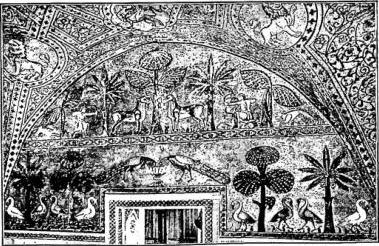
In the East, from the 9th century begins the second golden age of Byzantine art, that of the great mosaics of St. Sophia of Thessalonica and of St. Sophia in Constantinople. Even if the forms are at first contaminated, as in St. Sophia of Thessalonica, by deformations of Syriac art, already in the church of Hosios Lukas in Phocis (end of the 10th century) all the characteristics of the mosaics of St. Sophia of Kiev, of the Catholic of Daphni, dedicated to the Koimesis of the Virgin like the church of the same name at Nicaea, and in the Nea Mone of Chios, are announced.
In the 10th and 11th centuries new characteristics take shape, which synthesize the monumental Byzantine solemnity and the tormented vision of the barbarian world. Thus in Sicily, in Venice, in Parenzo and in Torcello, where the two currents, the Eastern and the Roman, persist with elements of their own alongside the new ones, until they merge in that marvelous crucible of forms that is the Venetian decoration of S. Marco.
In Rome the traditional current reasserts itself in the apse mosaic of S. Clemente at the beginning of the 12th century, where, alongside the classical acanthus scrolls, appear the scene of Calvary, the Eternal, the Apostles, the saints, the Prophets, the Eucharistic Christ and the triumphant Christ, the little sheep, the holy cities and the symbols of the Evangelists.
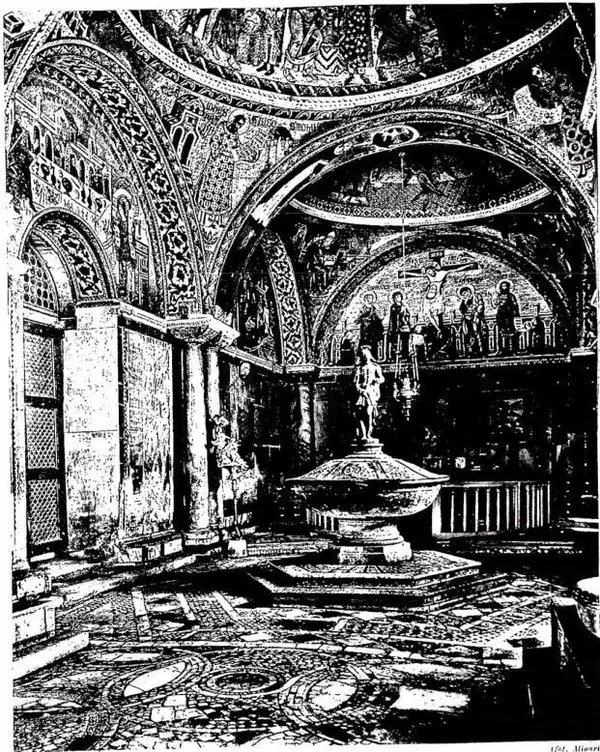
The apse mosaics of S. Maria in Trastevere and of S. Francesca Romana, almost contemporary and yet different in the artists who executed them, show the persistence of one and the same manner. But the dryness and hardness of the forms in S. Francesca Romana find no counterpart in the soft drapery of the figures of the Trastevere Basilica. Meanwhile in Sicily, with the favor of the Norman kings, within the brief span of some sixty years, an immense profusion of tesserae adorns the walls of S. Maria dell'Ammiragliato (or della Martorana) and of the Palatine Chapel in Palermo (v.), the cathedral of Cefalù (v.), all datable between 1140 and 1160, and the cathedral of Monreale (v.) of the end of the 13th century. The mosaics of S. Marco in Venice are disputed between the 11th and 13th centuries, although all agree that they are the work of different masters, now Byzantine in style, but with marked regional characteristics, now purely faithful to the aulic Eastern style. To the first manner belong perhaps the Stories of Genesis narrated in the narthex and certain mosaics of the interior (the scenes of the Life of the Virgin, the Symbolic Virtues, in the dome of the Ascension, and the Scenes of the Passion of the nearby major arch), which recall the magnificent Last Judgment of the cathedral of Torcello and to a lesser degree the Madonna in Glory with two angels in the apse of S. Giusto in Trieste. To the pure forms are linked instead the dome of Pentecost (a little less so the other lateral one), the beautiful group of the inner lunette of the main portal, the scenes of the arch toward the right arm, etc. More severe and less mannered are the Virgin of the apse of S. Maria e Donato in Murano and the Christ in Glory at Torcello, in the apse of the chapel of the Sacrament. In the 13th century, the contamination of Byzantine forms with the new Romanesque orientations becomes ever more frequent. Nor will the new wave of Byzantinism, brought to Rome by the Venetian mosaicists of Honorius III (1218), have serious consequences in this evolutionary process. And one can see it in the mosaic medallion of Jacopo and Cosma in the portico of Civita Castellana, in the Virgin on the altar of the chapel of S. Zenone, in S. Prassede, in the beautiful Madonna della Clemenza in S. Maria in Trastevere (mid-13th century) and, finally, in the apse mosaic of the Liberian Basilica (1295), where Jacopo Turriti announces, in the guise of the most classical Byzantinism, the new conception of Cavallini. The mosaic of Turriti, commissioned by Nicholas IV, is the most complete work of this master. In the apse conch, Christ and the Virgin enthroned in a starry globe: around them stand ranks of angels, saints, acanthus scrolls and, above, a polychrome fan; in the lower face: the Annunciation, the Nativity, the Purification; the Adoration of the Magi and the Dormition of the Virgin. In every scene, in every zone he made use of two qualities of tesserae: splendid those of the stalks and of the garments of the figures; muted, without reflections, those of the faces. Thus a chromatic plasticism of strong effect springs forth. Inferior to Turriti is Filippo Rusuti, who in the mosaics on the front of S. Maria Maggiore narrates the Stories of the foundation of the Basilica and composes a Christ enthroned among a procession of Saints. His manner is in any case close to Cavallini, of whom he was a disciple, and in certain shadings of faces the Romanesque consciousness is already felt to be mature in him. To Cavallini (v.) belong mosaics composed by him in the lower zone of the apse of S. Maria in Trastevere: they are also, in order of time, the last great mosaic composition in Rome and in Italy.
During the 14th century the art of mosaic is ever less practiced after ancient themes (Naples, S. Restituta, mosaic of Lello da Velletri) or used as a decorative element of architectural schemes (Andrea Orcagna, mosaics later for the most part redone, in the facade of the cathedral of Orvieto). Likewise in the 15th century, when Mantegna and Gianbellino supplied cartoons for mosaics destined to complete the cycles of the basilica of S. Marco in Venice. For this building during the 16th century other mosaicists, by now mere craftsmen, copied in mosaic paintings executed with intentions very different from those proper to mosaic art, works of Tintoretto and Veronese, while still in the 18th century Leopoldo del Pozzo, a Roman, copied in mosaic a painting by Sebastiano Ricci depicting the arrival of the body of St. Mark, and in the 19th century Liborio Salandri the Last Judgment of Lattanzio Querena that is seen in the middle of the facade. Meanwhile, in Rome, Raphael, in 1516, had one of his compositions translated into mosaic for the lantern of the dome of the Chigi Chapel in S. Maria del Popolo and then Baldassarre Peruzzi his for the vault of the chapel of S. Elena in the church of S. Croce in Gerusalemme. But even these, like the subsequent ones, represent nothing but an accurate yet mechanical reproduction, in a technique different from that with which those works of art had been born. The same can be said in the greatest part of cases of the works still produced during the 19th and 20th centuries by the school of the Vatican mosaic (funerary chapel of Pius IX in S. Lorenzo fuori le mura, etc.). Nevertheless in recent times some artists have sought to bring mosaic back to its original function of a decorative element clearly distinct in character from fresco painting. Thus Guido Cadorin in the mosaics of S. Giusto in Trieste and Ferruccio Ferrari in a mosaic on the facade of a house in Tivoli. - See plates CII-CIV.
Bibliography34 works
Pasquale Testini