
ETHIOPIA. - A state in the interior of northeastern Africa, embracing, together with the Ethiopian plateau proper, some of the neighboring regions, with an area estimable at around 1.1 million sq km.
IV. Theology
V. The Ethiopian rite. - VI. Christian antiquities.
I. GEOGRAPHY.
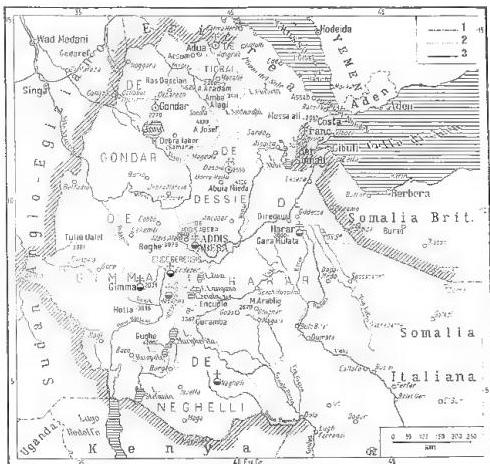
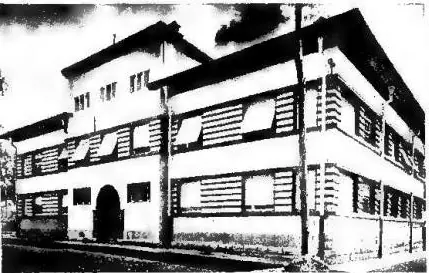
The plateau, intersected by deep valleys, is subdivided into well-distinct regions, as a rule isolated from one another: from the low marginal lands (quellà), with a tropical climate, largely covered with forests but often malarial, one passes to the higher regions (degà, above 3300 and up to 4600 m.), where summers are cool and winters relatively harsh, through territories of medium altitude (1800-2400 m.; voina degà), which the healthful climate, subtropical or temperate in character with slight thermal variations and abundant precipitation, makes more habitable. Most of the country lends itself above all to grazing (cattle, sheep, horses and mules), with scattered cereal crops (wheat, millet, maize, barley) and industrial crops (coffee), while in the lower plains the forest is interrupted here and there by oases that yield durra, cotton, tobacco, etc. Mineral resources are not lacking (platinum, gold, rock salt), but they enter only modestly into the country's economy. The deficiency and difficulty of communications are the most serious obstacle to the development of E., to which the brief Italian occupation (1936-41) had given a formidable impulse. Unfortunately the recent war has halted and perhaps compromised this promising development.
Of the 10 million inhabitants living in the country, about a third are Abyssinians (from the Eritrean border to the Auase), a third Galla (the southern part of the plateau) and the remainder Somali, Sidama, Negroes and Negroid peoples. The ancient Ethiopian language, in ge'ez, is preserved by the Monophysite Coptic Church, to which the Amharic and Tigrinya peoples belong; from it derive Amharic, which is the official language, and the Tigrinya dialects. Islam is widespread among the Galla and predominant among the Somali and Duncali; pagans are also numerous.
The capital Addis Ababa (160,000 inhabitants) in Shoa, and Harar (25,000 inhabitants), in the region of the same name, are the most important urban centers.
The Empire of Ethiopia is a hereditary monarchy whose origins are very remote, and which, in its modern form, heads a feudal administration of semi-independent territories, governed by kings (negni) and by vassals (var).
Bibliography3 works
Giuseppe Caraci
II. HISTORY.
I. THE DAWN OF CHRISTIANITY IN ETHIOPIA
Christianity, to which E. has remained faithful for some sixteen centuries now, was the fundamental factor in the political and cultural history of that African region. Already the extreme southern limit of the territories of St. Mark's preaching - in East Africa, E., after the fall of Christian Nubia in the 14th century, remained a Christian island everywhere surrounded by Muslims. The struggle to preserve political independence was therefore identified, in Ethiopian history, with the defense of the Christian Church against the alam. This explains why, for example, in Amharic atammana means both "to convert" (and this is its etymological value) and "to convert (politically)," a new meaning assumed in history. For this reason also, from the cultural point of view, E., though an African country and geographically cut off from Mediterranean cultural currents, has historically always maintained, through Christianity and its own Christian Church, the greatest contacts with the countries of the Near East (and often also of the West), so that Ethiopian culture in many respects reveals itself more each day as having developed on the margins of the Mediterranean one. In this sense one can say that Christianity gives E. its historical individuality.
Small Christian communities already existed at least in the first decades of the 4th century A.D. in the commercial emporia of the Kingdom of Aksum, which in the port of Adulis had both the starting point of its maritime communication with the opposite Arabian shore of the Red Sea and a stopover on the trade route between the Greco-Roman world and India. The beginnings of the spread of Christianity in E. are precisely linked to this situation.
The sole source for these events is Rufinus, who in a passage of his Church History (PL 21, 478-79) narrates how two Syrian youths, Frumentius and Aedesius, shipwrecked on a return voyage from India, are reduced to slavery by the king, whose confidence they then manage to win. When the king died, Frumentius, having become minister of the queen regent, "requirere sollicitus est si qui inter negociatores Romanos Christiani essent" and grants them the right to build churches and celebrate the rites. Later, when the young king reached his majority, Frumentius and Aedesius returned to the Mediterranean. Aedesius went back to Tyre, where the historian Rufinus himself would later meet him. Frumentius, however, "Alexandriam pergit dicens sequum non esse opus occultare dominicum" and informs St. Athanasius of the successes obtained ("nam is [Athanasius] nuper sacerdotium sosceperat"). St. Athanasius ordains Frumentius himself bishop of the country of the new preaching.
Rufinus was writing in 403 and had spoken with Aedesius himself. But he does not name the country to which his narrative refers. This emerges only from comparison with a contemporary document: the letter that the emperor Constantius, shortly before 356, wrote to the two brother lords of Aksum: Aizanas and Sazanas. This letter is preserved in the Apologia of St. Athanasius (PG 25, 656-657); and in it the Emperor invites the Aksumites to send back to Egypt "the bishop Frumentius," who had been ordained by Athanasius, so that he might submit to the (pro-Arian) patriarch George, devoted to the Emperor.
To these Western documents correspond the Aksumite inscriptions; the most ancient group of them refers in fact to King 'Ezanà, who declares himself, in the protocol, "son of Mahrem not vanquished by an enemy" (Mahrem is the Mars of the South Arabian paganism imported into Aksum). In his most recent inscription, however, King 'Ezanà abolishes the reference to the pagan god and invokes "the power of the Lord of heaven, who is in heaven and on earth, victor over everyone who is." The conversion to Christianity of the sovereign of Aksum thus occurred during the reign of 'Ezanà. As for chronology, it suffices here to recall that St. Athanasius was elected bishop of Alexandria on 7 June 328 (the consecration of St. Frumentius as first bishop of the Ethiopian region, according to Rufinus, took place shortly afterward); and that the pro-Arian "bishop" George, to whom St. Frumentius was supposed to submit according to the letter of the emperor Constantius, took possession of the office on 24 February 357 (and fled from Alexandria at the end of August 358).
II. THE DEPENDENCE OF THE ETHIOPIAN CHURCH ON ALEXANDRIA-
SANDRIA. - The question has been raised, of no slight historical importance, of the reasons why Frumentius, who was himself a Syrian, went to present himself at Alexandria and not at Antioch; and, receiving episcopal consecration from St. Athanasius, thus placed Ethiopia under the dependence of the Alexandrian patriarchate. These reasons have been sought in possible pre-existing hierarchical ties between the Greco-Roman Christian communities of Adulis (and the neighboring regions) and the nearby episcopal sees of Egypt. That the Alexandrian see was anxious to affirm its jurisdiction over the communities along the maritime route to the Indies is entirely natural, when one recalls that this route started from Khyama in the Gulf of Suez, in territory on this side of Rhinokolura (al-'Arif), a boundary that had become traditional between Alexandria and Antioch. But, above these historical reasons, one must certainly take into account a substantial fact, from the religious point of view: namely, the very grave crisis which, in the fervor of the struggle undertaken by St. Athanasius against the Arian heresy, then divided Alexandria from Antioch. It seems natural, then, that St. Frumentius should have requested the intervention of St. Athanasius in Ethiopian affairs, rather than have recourse to the pro-Arian circles of Antioch
III. CHRISTIANITY IN ETHIOPIA UP TO THE 7TH CENTURY AND
THE INFLUENCE OF THE SYRIANS. - Once an episcopal see had thus been established in Ethiopia, dependent on Alexandria, and even though from the beginning it was entrusted to a prelate foreign to the country, Christianity, after the conversion of the sovereign, became the official religion of the Kingdom of Aksum. It has been supposed that 'Ezanà's decision was also influenced by the opportunity of doing something pleasing to the Emperor of the East; nevertheless the very letter of Constantius, mentioned above, is proof of Aksum's independent attitudes toward Byzantium in matters of religion.
The ties with Egypt seem for the time being strengthened at the time of the Council of Chalcedon, if one accepts a recent conjecture that sees in one of the Eastern signatories "the bishop of Koptos and Adulis" (Koptos is the modern Qift, in Egypt). Also from the 5th century is the bishop Moses of Adulis, whose brief account of a journey to India has been preserved for us, inserted in the Book of Alexander the Great of Pseudo-Callisthenes.
At the beginning of the 6th century the solidarity of Ethiopian Christianity with the Christian communities of southern Arabia asserted itself with the expedition of King Kalèb Ella Asbeha to avenge the Christians who were victims at Nağrân (Yemen) of a violent persecution. Cosmas Indicopleustes was present at the departure of the expedition from Adulis (in the early years of the reign of the emperor Justin [518-27]), and he mentions it in his Topographia Christiana. The Ethiopian intervention ended with the conquest of Yemen, which lasted from 525 to 572; and it had notable consequences because, with the expedition of the Ethiopian lieutenant Abraha toward Mecca in the famous 'am al-fil ("the year of the elephant"), it inserted these historical Ethiopian figures into the Meccan traditions in celebration of the sanctuary of the Ka'bah and therefore of early islām (Muhammad was born in Mecca precisely in 570).
Meanwhile there are the first indications of a curious function that the distant Ethiopia came to assume: namely, that of a place of refuge and, at times, of preservation for dissidents whose stay had become impossible in the nearby East. Thus Longinus, sent to evangelize Nubia, meets at 'Alwah, in 580, "certain Aksumites who had fallen into the phantasiast heresy of Julian (of Halicarnassus) and declare that Christ suffered the Passion in an impassible and immortal body" (John of Ephesus, Ecclesiastical History, IV, in Corpus Script. Chr. Or., Scriptores Syri, 3rd series, III, Louvain 1936, p. 239 [trans. by E. W. Brooks, p. 180]). Alongside these phantasiasts, the existence in Aksum of Melitians has also been supposed, inasmuch as the connection has been conjectured of the liturgical dances, singularly preserved to this day in the Ethiopian Church, with a cathartic rite of the Melitians described by Theodoret (PG 83, 425).
To a similar movement is due the immigration into Ethiopia of a number of monks coming from Syria and of Monophysite belief: an immigration that local tradition shadows forth, for example, in the tale of the "nine saints," whose Acts, however late they were composed, preserve references to the origin of the "saints" from the Eastern Empire (Rom) and to names of persons or places of Syria. This immigration of propagandists of Monophysitism was probably not the sole cause determining the adherence of the Ethiopian Church to the doctrine of Dioscorus, because it is very probable that, rather, without explicit adherence, this passage occurred with the prevailing of Monophysitism in the Alexandrian patriarchate. But the contacts that this immigration brought about certainly contributed to making the position of the Ethiopian Church active and polemical in the Christological question.
That, moreover, missionary work was still necessary within Ethiopia in the 6th and 7th centuries is proved not only by the hagiography, which reconstructs the deeds of the monks for the conversion of the pagans: the very circumstances mentioned above of the introduction of Christianity, which began by being among the Ethiopians the religion of the sovereign, made it necessary to impose a work of diffusion and apostolate. The same 'Ēsānā designates the Divinity with the periphrasis "Lord of heaven and earth," a designation that recent studies have traced back to a similar periphrasis of South Arabian inscriptions, where, however, what is recognizable is not Christianity but a vague monotheism. Later the Divinity is designated in Ethiopia (and still to this day) by the name Egnī'abehēr "the Lord of the earth," not without some reference (at least in popular psychology) to the victory of the one God of Christianity over the Earth (Behēr), who was one of the principal pagan divinities in Ethiopia. Similar significant uncertainties still last at the end of the 7th century, when the Ethiopian translator of Sirach renders in two passages (Eccl. 31, 8; 37, 2) the name of the Lord with the Ethiopian name 'Astar, that is, the well-known pagan Semitic divinity Astarte.
IV. FROM THE DECLINE OF THE AKSUMITE KINGDOM TO
FIRST SALOMONIDS (END OF THE 13TH CENTURY). - There follows the long period of the decline of the Kingdom of Aksum (7th-12th centuries), the transfer of the capital to the central E., in the region of Lāstā, with the Zāguē dynasty, until in 1270 the center of the Ethiopian State shifts still further south with the subsequent dynasty of the Solomonids, which has
its political origin
in the country of the
Amara. Of this period of Ethiopian
medieval history
there are still very
few direct documents
and its history therefore remains largely
obscure, also because the study of the monuments
(and particularly
that of the churches
of Lālibelā, in Lā-
stā) is today at a stage little more than
initial. Nevertheless,
from the point of view
of religious history,
it is possible to notice some important facts that are certainly established:
1. The Ethiopian Church continues to depend hierarchically on the patriarchate of Alexandria. The metropolitan
of E. is chosen and consecrated by the patriarch. His office
is for life. On the death of a metropolitan, the Ethiopian
sovereign sends an embassy to Egypt to request a new
metropolitan, offering the patriarch gifts of homage. The
metropolitan of E. is always an Egyptian and not an Ethiopian.
This is justified by an (apocryphal) canon of the Council
of Nicaea (no. 42 in the Ethiopian compilation), included
also later in the Nomocanon of Ibn al-'Assāl (mid-13th
century), a juridical compilation for the use of the
Coptic Church (of Egypt).
The evangelization of the pagan countries of E. is rendered
even more intense by the transformation of the Kingdom of Ak-sum, an offshoot of the South Arabian kingdoms, into a State that
now has a strictly Ethiopian character and penetrates
into the African plateau. The Acts of certain Zāguē sovereigns,
considered saints of the Ethiopian Church, and the legendary
figure of the apostle of the south, Gabra Manfas Qeddus, have
preserved for us echoes, albeit distant in time, of
this activity.
2. Islam was born in the 7th century; and, if the Ethiopian sovereign,
victorious champion in Arabia itself of the religion of the
one God, enters Muslim tradition in the figure of a generous
host of the Muslims forced to flee to the
African shore by the persecutions of the pagan Arabs,
on the other hand historically the Muslim expansion hinders E. in its routes of communication with the West and,
forming small Muslim states on the same eastern African
coasts and later on the Ethiopian plateau itself, obliges
the negus to a long and bloody struggle that will last until
the contemporary era. In this sense, in the Christian
Kingdom of E. for centuries and centuries the stubborn defense of the
independence of the country coincided with the heroic religious
existence, within the Ethiopian Church, against Islam. Thus
the national character of Ethiopian Christianity and its significance in the life and
structure of the country are to be assessed historically.
3. Once the Muslim Empire was constituted, E.'s
contacts with the other Eastern Christianities and with the West continue, albeit reduced, through only two channels: Egypt, through the aforementioned bond with the patriarchal see, and Jerusalem, where, because of the pilgrimage to the Holy Places, an Ethiopian community was established. This community, whose presence is documented for us only from the Fifth Crusade onward, acquires rights to its own chapel in the apse of the basilica of the Holy Sepulchre. As early as 1237 the Ethiopian monk Thomas, requesting to be consecrated metropolitan of E., gives rise to an incident between the patriarch of Antioch, Ignatius II, and that of Alexandria, Cyril III. And the presence of the Ethiopians in the Holy Land brings to Europe the first news about the distant Christian African sovereign, news that will later help to stimulate daring enterprises of navigators.
V. THE SOLOMONIDS UP TO THE MUSLIM INVASION
The dynasty of the Solomonids continues, indeed intensifies, the struggle against the Muslims in Ethiopia. The sultanate of Shewa surrenders in 1285, and its territory is for the most part annexed to Christian Ethiopia; the sultanate of Ifāq, which succeeds Shewa, is, shortly afterwards, under the reign of the negus 'Amda Sejon I (1314-44), defeated in a difficult campaign. And the victorious enterprises of Dāwit I (1382-1411), Jeshāq (1414-22) and Zare'a Ja'qob (1434-68) lead the Ethiopian State to its greatest external expansion and to good conditions of internal political consolidation. This new situation of Ethiopia does not fail to have consequences also in the history of the Church in this same period. The characteristics of this period are:
1. the metropolitan, an Egyptian, appointed by the Alexandrian patriarch, is at the head of the Ethiopian Church, although, under the reign of Zare'a Ja'qob, there is a covert hint of some Ethiopian aspiration to a national metropolitan. In 1430 the patriarch sent to Ethiopia, unusually, two associated metropolitans and a bishop, all Egyptians, and this gesture and the more frequent special missions made relations with Alexandria regular.
Meanwhile, however, a hierarchy of the regular clergy had established itself, which in an initial period came to recognize the supremacy of the abbot of St. Stephen of Hajq. The personality of the abbot Ijesus Mo'a (of the second half of the 13th century), later venerated as a saint by the Ethiopian Church, also contributed to this recognition. Later, as the capital of the Solomonids gradually shifted towards the south into the region of Shewa, the abbot of the Shewan monastery of Dabra Libānos replaced that of Hajq at the head of the regular clergy (first half of the 15th century). The abbot of Dabra Libānos took, in his new capacity, the title of eżagē and asserted and maintained his power over the Ethiopian monasteries, which he has preserved for five centuries down to the present day, not without struggles against the crown and against the opposition of the northern monasteries, which claimed descent from Eustathius (Ewostātēwos), a monk of the 14th century venerated as a saint in Ethiopia.
2. The period in question is rich in theological disputes in Ethiopia, disputes that agitate that Church with grave consequences. First of all, the three major heresies: of Mount Zion, of the Mikaelites and of the Stiefanites. The first heresy, in the form of a «denial of the banquet of Mount Zion», already appears documented, albeit vaguely, at the end of the 14th century, and was directed against the eucharistic institution itself. The Mikaelites, disciples of Za-Mikā'āl, a contemporary of Zare'a Ja'qob (first half of the 15th century), started from a false interpretation of «Deum nemo vidit unquam» (Jn 1:18) to maintain that God has no human form, but only the form that he alone knows. Hence the denial, or rather the allegorical interpretation, of the creation of man (Gen 1:26-27) in the image and likeness of God. Furthermore, the Mikaelites maintained the impossibility of representing the formless Trinity in three distinct Persons and therefore recognized in the Trinity «three names, but one Person, one Hypostasis, one image». Thus, on the other hand, at least according to their adversaries, the Mikaelites, refusing to see in the Trinity anything but three names, also adhered to the heresy «of Mount Zion», that is, to the denial of the Eucharist, being unable (in the indistinction of the Persons) to admit transubstantiation, in which the bread and wine are changed into the Body and Blood of the Son through the descent of the Holy Spirit invoked upon the Father and the Son in the epiclesis of the Eastern liturgies.
The Stiefanites, on the other hand, «refused to venerate Mary and the Cross of her Son». This heresy, which earned its followers the name of sara Mārjān («enemies of Mary»), was harshly repressed by the negus Zare'a Ja'qob, but traces of it are still found during the reign of Nā'od (1494-1508).
VI. THE CRISIS OF THE 16TH CENTURY AND THE JESUIT MISSION
This period of prosperity of E. was followed in the 16th century by the greatest crisis of the Ethiopian State, owing to the Muslim invasion led by the "left-handed one" (Amharic: Grāhī), the imām Ahmed ibn Ibrāhīm, and the subsequent victorious enterprise of the emir Nūr ibn Muǧāhid, who defeated and killed the negus Claudius in battle in 1559. The attack of the Muslims, which in a few years led to the occupation of almost all of E., was followed by the invasion of the Galla (pagans), who, moving from the southern regions still inhabited today by the Borana tribes, succeeded in overpowering the Christians and Muslims of E., prostrated by the long struggle between them. The resistance, in every sense truly heroic, against the Muslim threat led E. to request the intervention of Portugal, which after the great maritime discoveries of the end of the 15th century had entered into relations with E. The military valor of the Portuguese and the glorious martyrdom of Cristóvão da Gama (son of Vasco), their first commander in E., beheaded by order of the "left-handed one" on 30 Aug. 1542 at the age of 26, strengthened the ties between the two countries; and at the same time E. also maintained active relations with the Holy See, notably from the pontificate of Clement VII (who solemnly received in Bologna in 1533 the Portuguese Francisco Alvarez, ambassador of the negus) to that of Paul III.
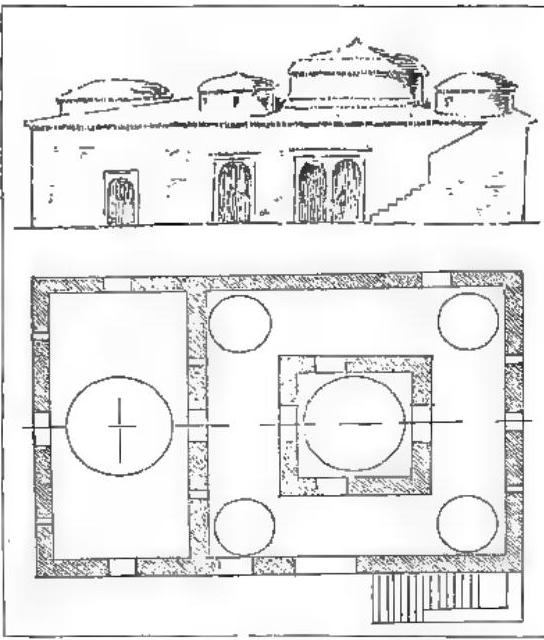
(from U. Monarret de Tillard, Un Duo di chiesa etiopeia, in Africa Italiana, 6 (1851), p. 2)
Meanwhile, upon the death in 1530 of the metropolitan Márqos, an interesting and adventurous figure of the Portuguese expedition, João Bermudes attempted to have himself recognized as metropolitan both by the Ethiopian sovereign and by the Holy See. But in 1555 the first group of missionaries of the Society of Jesus set out from Lisbon for E., led by Fr. Andrea Oviedo, a Castilian; St. Ignatius of Loyola addressed to those departing his "Recuerdos que podran ayudar para la reduction de los reynos del Preste Juan a la union de la Iglesia y religion catholica", a document fundamental also for the delicate understanding of the Eastern psychology, which the supreme prudence and discretion of the Saint also admirably reveals. The arrival of the Jesuit mission constitutes an essential event for the religious and cultural history of E. The mission, after a difficult period of struggle and distress under the patriarchate of Oviedo (d. 9 July 1577) and even more in the following twenty years, when the three sole remaining missionaries (Manoel Fernandez, Antonio Fernandez and Francisco Lopez) had to face the harshest conditions of life, flourished again with the arrival (on 26 Apr. 1603 at Massawa) of Fr. Pietro Paes, also a Castilian. This man, an exceptional figure of missionary, scholar and explorer, obtained with his apostolate the greatest triumph, inducing the negus Susenyos to proclaim his adherence to Catholicism, as the negus himself announced with his letter of 3 July 1614 to Fr. Claudio Acquaviva, general of the Jesuits. The union lasted until 1632, when a political movement led by Fásilidas, son of the negus Susenyos, forced the sovereign to abdicate, and then the Monophysite doctrine was restored by decree of the new sovereign.
During this period of grave political and religious crises, the Ethiopian Church had to rely even more on the particular power of resistance of its regular clergy. The vicissitudes of the monks during the Muslim invasion, obliged to emigrate passing from region to region against the enemy troops, yet ready to sustain morally the resistance of the country (the monastery of Dabra Libános itself was set on fire and destroyed by the Muslims in July 1530); the energy and the doctrine of the abbots (etogé) of Dabra Libános, such as 'Enbēqom (ca. 1515-26), an active translator of works of Arab-Christian religious literature, and John I, who fell together with the negus Claudius in the battle of 23 March 1559 against the Muslims; and, in general, the wholly fervent and disciplined activity of the monks contributed to raise still further the position of Ethiopian monasticism. This historical situation also made the Ethiopian regular clergy the major opponent that the Jesuit mission had to face in internal discussions; and in this line of conduct, accentuated by the two etogé Za-Wangel (1612-23) and Batra Gijorgia, his successor, it is easy to see, at least in an initial period, also the continuation of the historical tendency of the regular clergy and of its head (attested since the 14th century) to acquire nationally from the non-Ethiopian metropolitan (first Egyptian [Monophysite] and then European [Catholic]) a notable part of the hierarchical powers.
VII. FROM THE RESTORATION OF MONOPHYSITISM TO THE END OF THE POLEMIC OF UNCTION AND UNION IN 1878
From the middle of the 17th century until contemporary times E. falls into a long isolation, consequent upon the crises mentioned above. This political decadence of the country, which, with the exception of some attempts by sovereigns such as Ijásu I (1682-1706), Baláffá (1730-55), keeps barely alive its formal independence, concludes much later with the reign of the energetic Theodore II (1855-68), who, though often with fire and sword, succeeds once again in unifying the State. With John IV (1872-80) and Menelik II (1889-1913) contacts are reopened with Europe, which the colonizing movement of the 19th century has by now brought to the borders of E. itself.
The two centuries of which we speak here are dominated, from the religious point of view, in E., by the polemic of "Unction" and of Union, a theological dispute (which more than once passed into political struggles) that conditions the very life of the Ethiopian Church. One of the fundamental arguments used, on the Catholic side, in the discussions with the Monophysites in E. had been the kávokis (Ethiopic: vardai "abasement") of the Incarnate Word, with the obvious citation of the passages of Scripture (and particularly Phil. 2, 6-10; Rom. 3, 10; Hebr. 2, 9; Act. 3, 15) that are interpreted with reference to the human nature. There then appeared the importance of Act. 10, 38 and of the rigorous value to be attributed to the Union ("unxit cum Deus Spiritu Sancto et virtute"). As the discussion continued, two opinions were formed: that of the unionists (with the formula ba-geb'at waldia bābre) for the Union (Jesus was) the consubstantial Son, proclaimed in 1645) and that of the unctionists (proclaimed in 1663). The unionists maintained that the Union of the Word with the Flesh in Christ was effectively operated when "unxit cum Deus Spiritu Sancto et virtute", in parallel with the transubstantiation that occurs (in the Ethiopian liturgy) when, through the epiclesis, the Father, invoked together with the Son, sends the Holy Spirit to transform the eucharistic species. The Union of the Holy Spirit, insofar as it makes of the Word and of the Flesh μία φάκε, is thus the essential operation for our redemption. The unctionists, on the other hand, maintained that the Incarnation occurs and becomes operative by the Word's own virtue, and not through the intervention of the Holy Spirit who is equal to the Son in the mystery of the Most Holy Trinity. The Unction (of Act. 10, 38) was only as "our honor", that is, to restore to the Humanity of the Incarnate Word that dignity which human nature had lost through original sin. It follows that, in the fervor of the polemic, the unionists were accused by their adversaries of being "Arians" insofar as they would have diminished the dignity of the Word in comparison with the Holy Spirit; and instead the unctionists were called "Nestorians" as a term of reproach insofar as their positions came to be of a less rigid Monophysitism.
The question became complicated by completely extraneous elements, such as the traditional rivalry of the northern monasteries (of Tigré), which were ardent unionists, against the southern monasteries and especially Dabra Libānos, supporters of the unionist doctrine. Later, in 1763, the abbot Enoch (Hénok) of Dabra Libānos had published under his auspices a pamphlet (entitled
Kārrō "Knife", whence the followers were called Kārroč,
almost "knifers"), which formulated a new doctrine
on the aforementioned passage of Aet.: "the Son, consubstantial with the
other two persons of the Trinity, does not receive from them separately what is already in His divine nature:
" He is therefore together the Only-begotten, the Anointed and the Anointing".
The new doctrine led to the deposition and excommunication
(by the metropolitan) of the abbot Enoch and to the condemnation of the aforementioned pamphlet.
At the beginning of the 19th century (between 1798 and 1803) the ancient
dispute was transformed into two new forms: that of the two
births (Amharic: Halat ledat), upheld by the monks of the
north, formerly unionists and the like, according to which "the Son had
two births"; that ab aeterno from the Father and that from
the Virgin Mary, in which, it is meant, at the very moment
of the Nativity, there was the Union of the natures through the anointing
of the Holy Spirit (pure unionists) or through the anointing
of the Son himself" (Kārroč, "knifers"). The other doctrine, called that of the three births (Amharic: Sast ledat), upheld by the monks of Dabra Libānos and generally of the
south, declared that "the Son had three births"; that
ab aeterno from the Father; that from the Virgin Mary; and the third
when the Flesh of Jesus at the moment of its union
with the Word received in "grace" the Holy Spirit, becoming thus primogenitus omnis creaturæ. This "grace" (by which Jesus is called [in Amharic] ja-saga
lāg "Son of grace") is not to be understood in the Augustinian concept, but as γῶσις divina for the Humanity of the
newborn son of the Virgin Mary at the point when this
Humanity was about to unite itself totally with the divine nature of the Word. In this sense the "Grace" was a new
interpretation of the doctrine of the Unction understood as
"honor", "already, as has been seen, upheld by the monks of
Dabra Libānos.
The long struggle ended, through the intervention of the
negus John IV, in the assembly of Boru-mēdā
of May 1878, when the sovereign, with his
noted violence of feeling, declared himself for the doctrine of the two births in the formulation of the kārroč
and the ečagē Theophilus, then abbot in office of Dabra Li-
bānos, was forced to adhere to that doctrine.
Even today, moreover, in the Ethiopian theological
schools the polemical arguments against
the doctrine of the three births, which was defeated,
are still taught.
VIII. I TEMPI RECENTISSIMI IN ERITREA ED E
In the most recent times, on the other hand, the genarchic question has been the most discussed in E. Already the negus John IV, taking up again what had been done by Quat-
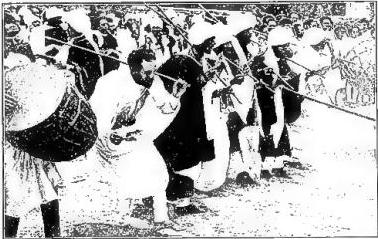
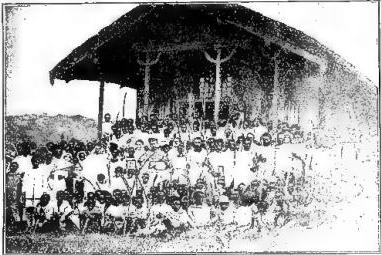
ETHIOPIA. — Solemn reading of the Bible in the Ethiopian Church.
(from M. Hildi, Wie ich Abessinien Sak, Berlin 1803, p. 3.)(from M. Hildi, Wie ich Abessinien Sak, Berlin 1803, p. 3.)
three centuries earlier the negus Zare'a Jā'qob, obtained in
1878 from the Alexandrian patriarch, in addition to the metropolitan,
also three bishops, though all Egyptians. On the death
in Dec. 1926 of the metropolitan Matthew, the party known as
the "black jackets" (Amh. jeqar hot), the "young
Ethiopians," raised the question of an Ethiopian metropolitan.
The Ethiopian Church at the outset maintained, on the whole,
an attitude of great prudence and rather cold reserve
toward these requests for innovations in its age-old
ordinances. The discussions lasted more than two years,
both in E. (between the "young
Ethiopians" and the conservatives) and with the patriarchate
of Alexandria. In the end, in June 1929, a compromise was
reached, according to which the Alexandrian patriarch appointed
a new Egyptian metropolitan for E., the abuna Cyril, but at the same time
conferred episcopal consecration on four Ethiopian
prelates, to whom was added months later the abbot of Dabra Libānos,
head of the regular clergy in E.
Eritrea was then removed from the jurisdiction of the
metropolitan of E. and, by an agreement concluded between the
Italian government and the Alexandrian patriarchate, was declared directly subject to the see of Alex-andria.
This regime lasted until Dec. 1936, when,
upon the withdrawal to Egypt of the Egyptian metropolitan of E.,
Cyril, after the annexation of E. by Italy, an assembly of the Ethiopian clergy gathered in Addis Abeba
elected as metropolitan one of the Ethiopian bishops already
consecrated at Alexandria, the abuna Abrehām. On the death
in 1939 of the abuna Abrehām, a second Ethiopian metropolitan,
the abuna Johannes, was elected to succeed him.
When E. was occupied by the English in 1941, the Ethiopian metropolitan was deposed and the Egyptian one,
Cyril, returned to office. But a new difficult negotiation between the Ethiopian
government and the Alexandrian patriarchate led to
a new compromise, in July 1948, by which the patriarchate, having consolidated and again recognized the bond of hierarchical dependence of the Ethiopian Church on the see of Alexandria, on its part for the first time admitted the principle of the choice of the metropolitan of E. from among the native bishops of that State.
The fate of Eritrea is still undecided, because the agreement of 1929 was considered implicitly terminated by the appointment of the metropolitan Abrehām, in Dec. 1936, since the jurisdiction of that metropolitan was recognized also over Eritrea, for which indeed a bishop was appointed. The decision on the fate of Eritrea from the political point of view was subsequently postponed by the negotiations of the Paris peace conference until today, and therefore the problem also of the ecclesiastical hierarchies (Monophysite) remains open.
For the bibliography see below: LITERATURE.
Enrico Cerulli
IX. THE CATHOLIC MISSIONS
After the first and second missions of the Jesuits it may be said that between Ethiopia and Rome an abyss opened up. There were, however, attempts by certain missionaries, especially Capuchin and Observant Franciscans, to whom the Holy See entrusted the undertaking, but they failed at their inception, and the few who managed to set foot in the forbidden kingdom paid for their audacity with their blood (thus the two French Capuchins Agathangelus and Cassian were martyred on 7 Aug. 1638).
Only the Lazarist G. Sapeto succeeded in entering Ethiopia and establishing himself at Adwa (1838), winning the goodwill of the people and of the local clergy; by means of an embassy, missionaries were requested from Rome: thus in 1839 the first true mission was erected under the title of apostolic vicariate of Abyssinia. The tireless Italian Lazarist Giustino de Jacobis, the first pastor of the mission, immediately founded a seminary for the native clergy, from which, in 1852, no fewer than 15 priests came forth. The work was carried on especially among the schismatics of Tigray and Adwa, and almost 5,000 conversions were obtained.
With the martyrdom of the first native priest (Abba Guebrè Michael, 1885), with the exile of De Jacobis and his death (1860), following the persecution of the emperor Theodore, that first missionary experience came to an end.
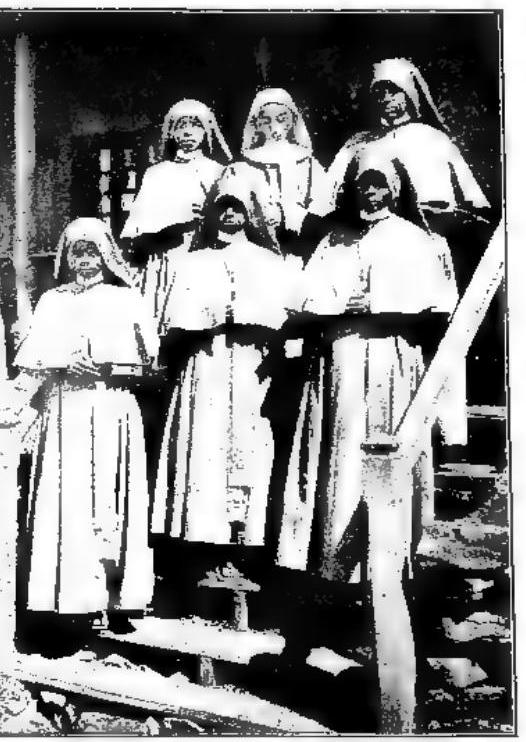
In the meantime a new mission had been created, following the request of the French explorer A. D'Abbadie, namely the apostolic vicariate of the Galla (30 Apr. 1826), entrusted to the care of the Italian Capuchin Friars Minor. Guglielmo Massaia (later a cardinal) was the great figure of apostle and pastor of that mission; only after six years of wandering did he reach the territory entrusted to him (1852). But his apostolic work was carried on especially among the Kaffa, and, a unique example in missionary history, he created a traveling seminary from which 10 native priests came forth. Following the persecution of the Negus Theodore and the suppression of the religious Orders in Italy, those two missions passed to the respective families of French nationality (in 1863 the vicariate of the Galla; in 1865 that of Abyssinia). Massaia, however, returned as head of the French confreres and worked for 11 years in Shewa, from which he was expelled during the persecution of John IV (1876). In 1881 Massaia's successor, Fr. Taurin Chagne, fixed his residence in Harar: the attempts to return to Shewa were fruitless, and there were new persecutions, especially on the part of the schismatics and the Mohammedans. Schools and a leper hospital were founded. In 1915 Fr. Marie-Bernard founded the Congregation of the native Sisters.
The vicariate of Abyssinia, having passed to the French Lazarist Fathers, reorganized itself; a seminary for the native clergy was created. In 1894 a part of its territory passed to form the apostolic prefecture of Eritrea (v. ERITREA).
In 1913 the apostolic prefecture of Kaffa was erected, entrusted to the Institute of the Consolata.
(by courtesy of Fr. U. Vishnu)
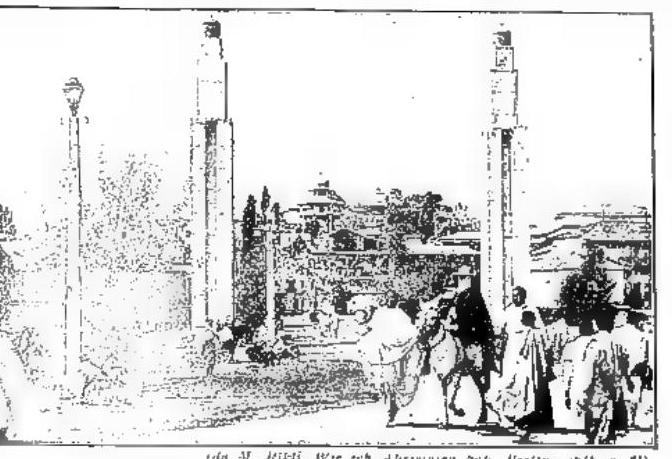
ETHIOPIA - Function on Palm Sunday with the bishop, H. E. Msgr. Santa, visiting the Mission of the Sacred Heart of Jesus at Umbi. - Apostolic Vicariate of Gimma.
of Endeber and Hosanna. The territory north of the apostolic vicariate of Adda Abeba depends on the S. Congregation for the Oriental Churches and the rest on Propaganda Fide.
As a result of this new organization and through the zeal of the missionaries, the missions of E. gave hope of great fruits when the Second World War swept everything away: some of the missionaries were driven out, others interned or imprisoned.
In 1947 the Holy See appointed a new apostolic delegate. In conclusion, it can be said that since 1836 the missionary effort in E., although it has not been entirely fruitless, certainly has not achieved the hoped-for fruits. The moral difficulties are immense; the missionaries have always clashed both with a schismatic nation, where people, clergy and civil power are identified with one another, and with an altered Christianity. The extreme resistance of the Ethiopian schism is due to the extreme cohesion of three forces: the distrust of a people bound to its traditions, the hostility of leaders steeped in prejudices against Catholicism, the opposition of the dominant clergy attached to its position and its possessions.
Bibliography3 works
Carlo Santi
III. LITERATURE.
I. GENERAL CHARACTERISTICS
Ethiopian literature is, for the most part, religious in subject matter, with the principal exception of the Royal Chronicles, which moreover — until the contemporary era — are also the work of ecclesiastics. It is likewise commonly said that Ethiopian literature is essentially one of translation, and this may be considered accurate, in general terms, although original works by Ethiopian authors are not lacking in the various periods, and although, on several occasions, the translations are also reworkings and therefore likewise reveal certain interesting aspects of the Ethiopian psyche. The translations were generally made, in an earlier and more ancient period, directly from Greek; in a subsequent period, from Arabic.
It has been doubted whether, beyond these two, translations directly from Coptic should not also be admitted, which, however, has not been proven for any work; and some indication to the contrary has been explained by the bilingualism (Coptic-Arabic) of the manuscripts of certain books in use in the Coptic Church.
Here below, notice is given of the principal works of Ethiopian religious literature, divided by categories. Scripture was in fact translated into Ethiopic from Greek: the New Testament, according to preliminary research, follows the Syro-Western version (rather than that in use in the patriarchate of Alexandria), and this is regarded as proof of the intervention of Syrian monks who emigrated to Ethiopia. Scripture, however, was subjected, at the hands of the metropolitans, to more than one revision. It is highly desirable that research on Scripture in Ethiopic be resumed by scholars.
II. PATRISTICA
The Ethiopian schools have received three anthologies of writings of the Holy Fathers (all aimed at defending the Monophysite doctrine):
1. the Qirillos (St. Cyril). It comprises three opuscules of St. Cyril of Alexandria (De recta fide ad Theodosium; Prophoneticus ad Reginum; Quod Christus sit unus) and a collection of 25 homilies attributed to various Fathers (from the Council of Nicaea to that of Ephesus). The texts were translated from the Greek.
2. Timothy Aelurus. It comprises two pastoral letters of Timothy Aelurus, patriarch of Alexandria, from Gangra to his faithful and to the city of Constantinople. To the letters are joined extracts of the Fathers and a summary (by Timothy Aelurus himself) of the "acts or definitions of the Council of Chalcedon." The Greek original of the letters is lost to us; and Timothy Aelurus survives only in this Ethiopian version and in the Armenian (and fragments in Syriac).
3. The Confazio Patrum (Arabic: l'itirāf al-abā'), an anthology of passages of the Fathers from St. Francis to the Alexandrian patriarch Christodulus (1047-77 A.D.). The collection was translated from Arabic into Ethiopian, probably in the first half of the 16th century. In Ethiopian it bears the title Hājmānota Abas (Fides Patrum); and from the 16th century to the present it has been of the greatest importance in theological teaching.
III. APOLOGETICS
The polemic against Muslim religious propaganda was the subject, in the 16th century, of a work by the abbot 'Enbāqom (of Dabra Libānos) entitled Anqāṣa Amīn ("Gate of the Faith"). Later various polemical pamphlets in defense of Monophysitism were composed by Ethiopian ecclesiastics during the discussions with the Jesuit missions; thus the Maqāṣa Hājmānōs ("Treasure of the Faith"); the Ṣamāna nafs ("Refuge of the Soul") and the Fehḥārē Malakot ("Exposition of the Divinity"). To this same category can be traced the two books of the negus Zare'a Jā'qob (1434-68): Maṣḥafa Berhān ("Book of the Light") and Maṣḥafa Milād, in which are combated not only local Ethiopian heresies, but above all the remnants of paganism still vigorous in those times.
IV. DOGMATICS AND ASCETICS
The original Ethiopian work on heresies under the title Maṣḥafa Mettīr ("Book of the Mystery") was composed at the beginning of the 15th century by George of Saglā. But a characteristic of religious literature is given by the short works and treatises of dogmatic theology (the greatest part of these is, in questions and answers, in the form of a catechism), composed by Ethiopian ecclesiastics during and after the mission of the Jesuits. These works, which set out precisely the doctrine accepted in the Ethiopian Church, owing to the impulse of contacts with the Catholic world that induced a rethinking of the fundamental truths of the Faith, are also written, in greater number, in the common language (Amharic), indeed rather than in Ethiopic. This catechetical tradition has been preserved to this day. Translations from Arabic, on the other hand, are the Maṣḥafa Hassi, an encyclopedia of moral theology (the Arabic, in turn, is a translation of the Greek original of the monk Nicon, a Palestinian of the 11th century); the Talmīd ("Disciple"), another treatise De haeresibus translated from Arabic by the work of George, a disciple of Anthony Eiro. Both these treatises entered Ethiopia in the second half of the 16th century.
A place apart is held by the so-called Books of the Monks (Maṣḥafta Manakunāt), which also reached Ethiopia through the Arabic version: Fīkēsijos ("Philoxenus") on the monastic life, a work of the Syriac author Philoxenus of Mabbūz (of the 6th century); Mār Jeshāq ("Blessed Isaac"), that is, the third book of the ascetic works of Isaac of Nineveh (a Syriac of the 6th century); Aṛgāxī Manfauhā (The spiritual old man), a treatise on ascetics by the Syriac writer (also of the 6th century) John Saba.
V. LAW
The two great collections of canons, the "Synod" (Senodos), translated from Arabic into Ethiopic perhaps at the end of the 13th century, and the "Didssalīja" (Didesqaljā), which has also preserved for us the so-called Canons of St. Hippolytus of Rome, were at a later period completed with the translation (again from Arabic) of the Nomocanon of Ibn el-'Assāl, which in Ethiopic bore the title Fethā Nāgast ("Laws of the Kings") and was legendarily attributed to the Fathers of the Council of Nicaea.
VI. HAGIOGRAPHY
A very singular work is the Ethiopian book of the Miracles of Mary (Ya'amra Mārṣām), which consists of a collection of pious tales from Western Europe, formed (12th century) in northern France and later enriched with Italian and Spanish contributions. This collection was translated from French into Arabic, in the Latin East, between 1237 and 1286; and with the addition of other tales relating to Syria, the Holy Land and Egypt it reached Ethiopia, where it was translated from Arabic into Ethiopic at the end of the 14th century. From the reign of Zare'a Jā'qob onward, readings from this book are ritual in the Ethiopian Church. Numerous are the Acts of saints, translated into Ethiopic from Greek, such as the Life of St. Paul the Hermit and the Life of St. Anthony, a work of St. Athanasius; and for the most part from Arabic, such as the Acts of Sts. Quirica and Iulitta, martyrs; of St. Cyrus the physician; of St. Basilides; of St. Barbara; of St. Athanasius, etc. But the original hagiographic literature is also rich: from that relating to the major saints of the Ethiopian Church, such as the Acts of Takla Hajmānot, the Acts of Eustathius, those of Gabra Manfas Geddus, to those of the "nine saints", to the cich relating to local saints of the individual provinces, such as that of the region of Lāsiā, cradle of the Zaguē dynasty (Acts of King Lalibolā; Acts of King Na'akueto La-Ab; Acts of King Jemerbanna Krestos; Acts of Queen Masqal Kebrā), or that of the region of Lake Tānā (Acts of Jāfgeranna Krestos; Acts of Batra Mārjām; Acts of Krestos Samrā; Acts of Zamada Mārjām).
The Ethiopian Synaxarium is a translation, made from Arabic in the 14th century, of the Synaxarium of the Coptic Church; but several notices relating to Ethiopian saints have been inserted, some of which are not without importance for local history.
VII. APOCALYPTIC AND VARIOUS WRITINGS
The predilection of the Ethiopians for apocalyptic writings meant that Ethiopian literature welcomed (and in some cases is the only one to preserve in the Christian East) many works on this subject. The following are cited: the Apocalypse of St. Peter; the Vision of Mary; the Qalēmenas, a collection of pseudo-Clementine writings; the Testament of Our Lord; the Book of the Testament; the Wisdom of the Sibyls; the Epistola Apostolorum; the Apocalypse of Sceumte; the Apocalypse of Abba Nabjūd; the Fehkārē Ijasus, "Declaration of Jesus."
A place apart is deserved by the Book of the Mysteries of the Cycle and of the Earth, an original work by the Ethiopian Ba-hājla Mikā'el, from the 15th century, which has disparate sources not yet well studied.
For the Ethiopian versions of the Bible, v.: ALESSANDRIA D'EGITTO: 3. Storia del patriarcato di Alessandria; copri.
Bibliography17 works
Enrico Cerulli
IV. THEOLOGY.
I. ETHIOPIAN WRITERS
I. Guidi distinguishes four periods in the religious literature of the Ethiopian Church. The first, called Aksumite, runs from the 5th century to the 7th century; the second begins in the 13th century under the dynasty of the Solomonids; the third comprises the 15th century, dominated by the literary activity of the im-
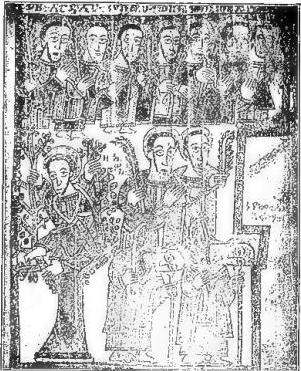
[from C. Conti Rossini, Un codice illustrato editore del sec. XV, in Altar, Helman, I (1881), pp. 1]
ETHIOPIA - Part of a representation of Christ's triumphal entry into Jerusalem. The inscription at the top: 1) 12 of His disciples with Him, and Zacchaeus climbed up into a sycamore tree; in the center: "Zacchaeus": at the bottom right; "Behold the elders": - Miniature from a 15th-century Ethiopian manuscript - Paris, National Library, ms. abb. no. 105, f. 9.
of Emperor Zara Yaqob; the fourth embraces the 16th-19th centuries. For the principal works see above: 3. LITERATURE.
II. CHARACTERISTICS OF ETHIOPIAN THEOLOGY
Unlike what happens in the other Monophysite Churches, the theology of the Ethiopians is totally foreign to the direct influence of philosophy. Nor can one speak among them of theological schools properly so called. The Ethiopians show themselves instead most attached to their more or less traditional formulas, corresponding to the texts of Scripture and of the Holy Fathers; this gives rise within their midst to frequent and interminable disputes.
Also characteristic in Ethiopian theology is the predominant power of imperial authority in settling controversies. This is explained by the constitution of the Ethiopian Church, which was deprived, until 1937, of a supreme ecclesiastical authority.
III. DOCTRINE
In 1936 the Anglican canon Douglas published a complete summary of Ethiopian beliefs, based on the answers given by the leading debterà (doctors) to the questions posed by Anglican missionaries in 1922. Since it is not possible to treat the individual questions here, it will suffice to mention their teaching on the Union of the two natures in Christ, on the Trinity and on the Madonna, the three fundamental truths of their faith graphically attested by Zare'a Ja'qob, when he ordered everyone to have engraved on their forehead the names of the Father, of the Son and of the Holy Spirit; on the right arm: "I renounce the devil and become a servant of Mary"; on the left: "I adore Christ my God."
1. Monophysitism
It is not known exactly when the Ethiopians took their position among the opponents of the Council of Chalcedon. Some maintain that this happened at the end of the 5th century with the arrival of Byzantine monks; others prefer a date later than 637. Be that as it may, they refuse to use the Christological formula: one Person in two Natures. But how far does their Monophysitism go? According to the Jesuit missionary Father Paez, whom the old Catholic writers follow, the Ethiopians profess a true Monophysitism. According to the moderns, theirs would be only a nominal Monophysitism. And in fact, Zare'a Jā'qob already renewed in his time the condemnation of Eutyches; and Claude in his Confession does not fear to say: "As regards the two natures (of Christ), they, according to our doctrine, do not exist separately, but are united in one alone, yet without confusion and without any alteration." Indeed, the Ethiopian Catholic priest Abba Jalou-Socquar is of the opinion that not even nominal Monophysitism or Severianism exists among them; everything reduces to a linguistic impossibility of expressing oneself, since the term Bahrej — "nature" also has the meaning of Hēlāq — "essence." Among the consequences of Monophysitism in E. is to be counted the dispute over the Unction of Christ (v. above: s. History).
2. Anthropomorphitism
Toward the middle of the 15th century the opinion already appears deeply rooted among the Ethiopians that God has a human form like ours, since he made man in his own likeness. Against it intervened the priest Za-Mhā'di, followed by a certain Gamaliel and by several others, who proclaimed "God has no face." In 1459 they were condemned by the Council of Amhara, presided over by Zare'a Jā'qob, who proposed the formula: "The Father has no other likeness except the human one. The Son has no other likeness except that of the Father. The Holy Spirit has no likeness different from that of the Father and of the Son." Such is the formula that has been repeated down to our own days in Ethiopian catechisms.
3. Mariology
The Ethiopians have always been ardent devotees of the Virgin Mother of God. They even use, on the feasts of the Virgin and on that of St. Dakesio (St. Ildephonsus of Toledo), a special Marian anaphora, of which are known: an ancient text published in 1937 by Abba Tekle Sambaraj and the text still in use, translated and commented on by S. Euringer. Both in this anaphora and in the very rich Marian hymnography, the privileges of the Virgin are set forth, or rather asserted, namely the Divine Maternity, the Co-redemption, the fullness of Grace, the Assumption into heaven in body and soul, the perpetual Virginity and also, quite clearly, the Immaculate Conception.
In the field of Mariology the dispute concerning the cult of the Madonna is famous, on which the doctors of Tigré taught: "To the Mother of God belongs honor or glory, and to her Son (wa-la-Waldā) adoration." The monks of Dabre Libānos in Shoa maintained instead: "To the Mother of God, equally with her Son (za-māela Waldā), belongs adoration." The words wa-la-Waldā and za-māela Waldā became like the banners of two opposing armies, which fought bitterly, until John IV, at the Council of Vello (1878), prescribed for all to hold the opinion of Tigré.
Bibliography5 works
Maurizio Gordillo
V. THE ETHIOPIC RITE.
The Ethiopic rite is a branch of the Coptic rite; it differs from it only in the general traits of its physiognomy, and in some particulars.
I. GENERAL CHARACTERISTICS
One is struck by a certain exuberance, a youthful spontaneity, a naive search for novelties, produced by an accumulation of texts and by the indiscriminate adoption of strange ways of dressing and acting that sometimes cause disorder; all this is due, more than to a less reflective level of culture, to the lack of central control. Some prayers at the beginning of the Mass are not taken from the eucharistic liturgy of the Coptic rite, but from the blessing reserved to the bishop; at the first incensation, it has four prayers, instead of one as in the Coptic rite; the Oratio post Evangelium is recited before the Gospel; in the hours of the divine Office there are two or three dismissal prayers before the final prayers. The deacon wears on his head a tiara, a gift of the kings and queens of the country; the liturgical dance, still in use for solemn feasts, gives a particular character to the processions, no less than the accompaniment of the chant with sistra and with the beating of feet.
One characteristic is the influence of Judaism, due to the advent of the Solomonic kings (from the 13th century), an influence that manifests itself in the internal construction of the church: a small, closed central shrine containing the altar represents the sancta sanctorum where only the priest penetrates; around it there is a circular space separated from the rest of the church, where only the clergy and the singers may stand; the faithful therefore see nothing of the eucharistic liturgy and often remain outside. The influence of Judaism is also noted in the celebration of the Sabbath, to the point of taking it for a sacred being, as in the anaphora of St. Athanasius, and in the numerous allusions to the Old Testament and its patriarchs. For the sacred vestments cf. T. M. Sambaraj, De indumentis sacris ritus Aethiopici, Rome 1930.
II. PARTICULAR CUSTOMS
For the Mass, the text of 19 anaphoras is known; the ordinary one is that of the Sts. Apostles, derived from the Traditio apostolica of St. Hippolytus. In many anaphoras the words of consecration, through an excessive desire for clarity, are defective. Since vines are lacking in the region, the eucharistic wine is prepared with grape berries placed in water and then pressed. In Baptism, milk and honey are given to the newly baptized. The anointing of the sick has fallen into disuse.
Three types of orologion exist or have existed in different regions, besides the Coptic one.
The rite comprises a rich variety of liturgical hymns. For the degguā, a kind of antiphonary for the whole year, attributed to Jared, cf. C. Conti Rossini, Aethiopica, II, in Riv. Studi Orient., 10 (1923-25), p. 515. For Marian hymnography cf. A. Grohmann, Aethiopische Marienhymnen, Leipzig 1919. To the calendar and the synaxarion the "proper" of the Ethiopian saints was added in the 16th and 17th centuries.
The chant and music of the Ethiopian liturgy have no relation to the other Christian liturgies and are little studied and little known: cf. E. Wellesz, Studien zur äthiopischen Kirchenmusik, in Oriens Christ., 9 (1920), pp. 4-106, with the observations of S. Euringer, ibid., 10-11 (1923), pp. 151-54.
The liturgical language is the ancient language of the kingdom of Axum, Ge'ez.
Bibliography4 works
Alfonso Raes
VI. CHRISTIAN ANTIQUITIES.
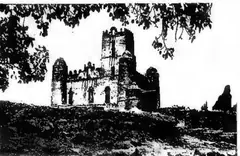
The Ḥabašat, a population of southwestern Arabia, having moved into E. at the time of the kingdom of Saba, constituted there a powerful State that reached a high degree of civilization, an artistic development and a most remarkable technical organization, as the monuments of the-
of the pagan era still existing at Aksum. When and how the kingdom passed from South-Arabian-style paganism to Christianity we do not know exactly, but this must have occurred in the second quarter of the 4th century and through the work of missionaries who set out from Syria. The first bishop known is a Frumentius, consecrated by Athanasius of Alexandria, therefore after 328; but the account of his adventures, as Rufinus has transmitted it to us, is too stuffed with folkloristic motifs to be considered a reliable historical document. The Syrian origin of the mission is, however, confirmed for us by the considerable number of Ethiopian terms concerning religion, the Church or the liturgy that derive precisely from Syriac, and still more and better by the architectural type of the most ancient Christian religious monuments of Abyssinia. These are found along a very ancient road that starts from the port of Adulis, follows the valley of the Haddash to climb onto the plateau, and through Qohayto, Tahonda, Kaskase, Yeha reaches Aksum. Our knowledge of the monuments of the Aksumite era is far from satisfactory: all and almost everything we know is gathered in the great publication of the German archaeological mission (which, however, dealt mainly with the monuments of the pagan era), except for Adulis where incomplete excavations were carried out by the Paribeni-Gallina mission and by the Swede Sundström.
Despite this summary documentation, the most ancient type of church is fairly well defined. Externally it forms a rectangle, since the apse never projects but is hidden behind the eastern wall: the sanctuary consists of an apse enclosed between two chambers, according to the most widespread Syrian type. The apse is always square or rectangular according to a type quite widespread in Syria, except at Adulis where it is semicircular in the eastern basilica and horseshoe-shaped in the northern one: this latter form has its parallels in Syria at the church of Burg Hedar (eastern church), at the western church of Zebed dated to the year 512 and at the eastern one of the same locality. The body of the church is divided into three naves by two rows of generally monolithic and square pillars with chamfered corners. At most such pillars are six per side (ruin 6 of Qohayto, church excavated by Sundström at Adulis), but one arrives at very short naves where the pillars are only one per side (ruin 7 of Qohayto, northern church of Adulis). The western part of the religious building is sometimes constituted by a rectangular room (narthex) as we certainly have at the north church of Adulis or at ruin 5 of Qohayto, but at other times by three rooms as at Sundström's church at Adulis or at ruin A of Tahonda (where the northern room seems to contain a staircase), preceded by one or three other outer rooms. The construction is always in stone and, in a characteristically Aksumite manner, the external facing of the walls is never flat but made up of very large offsets. To these ground plans there are two special exceptions: at the eastern church of Adulis we do not have the division into three naves, but in the center of the body of the church we have a ring of eight square pillars that would suggest they supported a dome; and at the most ancient cathedral of Aksum there is a quite complex ground plan reproduced in a drawing by Alvarez that seems confirmed by some recent soundings. We must, however, await complete excavations. The presence of stairs suggests the existence of galleries (matronea), as will be found later at Debra Damo or at Lalibela. Nothing is preserved for us of the detailed and decorative forms of the constructions, which probably must have been similar to those of the great pagan stelae of Aksum: insofar as reflections of the methods, we still find them in the constructions of the full Middle Ages.
During this period the center of Abyssinian civilization shifted south of the properly Aksumite region, toward the center of the Ethiopian plateau and more precisely into Lasta. An exception is the ancient church of Aamara (demolished in the 19th century) located in the northern region. This, like the church of Debra Damo, shows the persistence of Aksumite ground-plan forms: the second of these can be compared with ruin A of Tahonda and in elevation it presents galleries that look into the central nave, which receives no light from outside, that is, according to a type also found in Nubia. It should be noted that the decorative forms of Debra Damo and especially the carved wooden ceilings belong to a much more recent era. The church of Imraha, in Lasta, presents instead a new structure: it is a basilica without the usual narthex nor anterior chambers on the western side, with the body of the church divided into three naves by two rows
(296. Museum of Italian Africa)
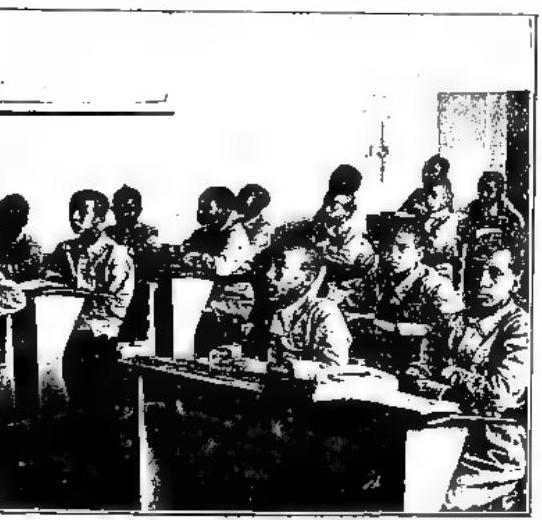
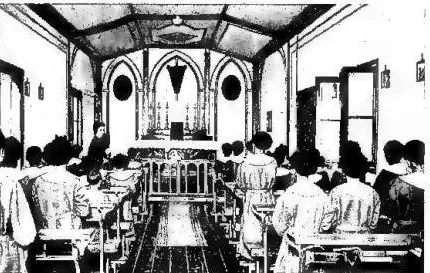
ETHIOPIA - A classroom of an Italian school for natives - Amara.
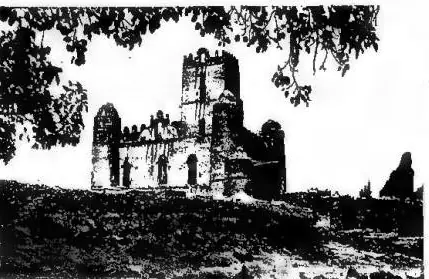
by constructed pillars and no longer monolithic and supporting the arcades, something completely new, with the sanctuary formed by three chambers of which the two lateral ones communicate only by means of arcades with the central one, which is covered with a small dome. Another important novelty is that the central nave is raised above the lateral ones and receives direct light. Arcades on pillars, dome and direct lighting of the nave are three characteristics that indicate new influences on Abyssinian architecture. A small dome over the sanctuary is also presented by the church of Gammadu Mariam, which seems to be of the same period. But the most important monuments of the Zagwe period are the churches carved into the rock in a very particular way, that is, by isolating by means of a wide trench a rocky block in the stone bed and working it not only internally but also externally, so as to give it the complete appearance of a constructed building. Churches carved into the rock are found in many parts of the Christian world (mainly in Cappadocia), but the procedure of isolating the rocky block and working it also externally appears only in India, several centuries before the execution of the Zagwe churches. It cannot be excluded that this concept came from there, but only the concept, inasmuch as, both in the plan and in the decorative and constructional forms reproduced, the Zagwe churches clearly show the persistence of Aksumite traditions. And the people who accomplished the technical prodigy of cutting, decorating, transporting and erecting the great pagan stelae of Aksum demonstrate with these churches that they had preserved their skill of execution even late. From the point of view of plan these churches present the most diverse forms. With the Aksumite structure are connected the church of Emanuel, of Libanos and of Mary or Lalibela, that of Bilbola Chirchos and of Mascale Chirchos; and with five naves that of the Savior of the World also at Lalibela; without the tripartition of the western part is the church of the Four Animals near Bilbola Ghiorghis. Other churches present a simpler form, without the triple division of the sanctuary, such as the churches of St. Michael and of Mercury at Lalibela and the church of Bilbola Ghiorghis. A wholly special form is presented by the church of St. George at Lalibela, which is cruciform, a structure that is absolutely not found in Egypt but which is represented in Nubia by a church of Tami. Several of these churches are surrounded by an external portico on pillars that makes the complete circuit of them and that is found only on two or three sides. Generally they have arcades on pillars and present matronea in the church of Mary, of Emanuel and of Libanos at Lalibela. That of Emanuel has a small dome over the sanctuary. The church of Golgotha at Lalibela also presents sculptures of saints (life-size) under arcades and an altar with the representation of the four animals of the Evangelists in human figures with the heads of the lion, the bull, the eagle and the angel: unique examples of medieval Abyssinian sculpture. Churches of the same type as those of Lasta are also found at Wogoro in Tigre and much further south at Yakki Mikä'el near Addis Ababa and at Adadi Mariam southwest of this city. These churches of the Zagwe period represent the point of maximum artistic and technical development reached by the Abyssinians.
The decline is very great with the fall of the Zagwe and the advent of the Solomonic dynasty; so great that it is no longer appropriate to speak of architectural art but simply of buildings intended for religious purposes. A profound transformation must also have occurred at that time from the ritual and liturgical point of view, inasmuch as the church assumes new forms, with no relation to those of the preceding periods. The origins, the modalities and the reasons for such transformations have not yet been elucidated.
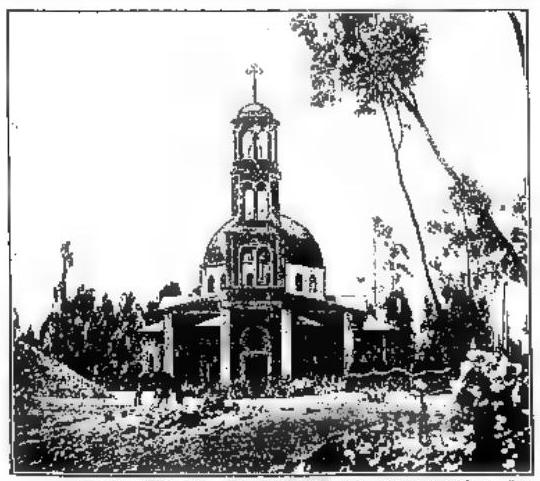
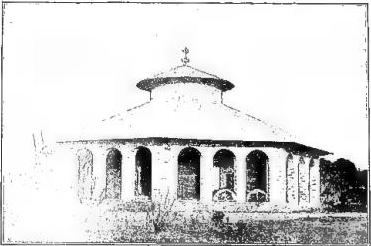
The apse disappears both as a liturgical concept and as an architectural form: the religious sacrifice is performed within a small rectangular chamber provided with doors on three sides except the eastern one, which are always kept closed during the function, so that this is withdrawn from the sight of the people, who are not admitted into the little chamber itself. This stands at the center of a building that can take two different forms. In the first case it is rectangular, so that between the outer walls of the little chamber (which is the Sancta Sanctorum) and the inner walls of the building enclosing it there is nothing but an ambulatory, more or less wide, running along the four sides: a form that genetically can be compared with the ancient structures derived from the temple of the Mazdaean fire and all its derivations, or with the Jewish temple of Jerusalem. Examples of this type of church are found at Abba Liqāns of Aksum, at 'Enda Qaddus Mikä'el of Çeffa, at 'Enda Georgia of Fremono, and in the transformation of the ancient pagan temple of Yehā. In the second case, the little chamber of the Sancta Sanctorum stands instead at the center of a round building, sometimes consisting of a simple round enclosure, but which in the larger churches has two concentric ones. This is the most widespread type, which must not be without relation to the indigenous tucul. In both the one case and the other the construction technique is quite crude, and in it the use of timber prevails.
(per criteria ad p. D. Pujilal)
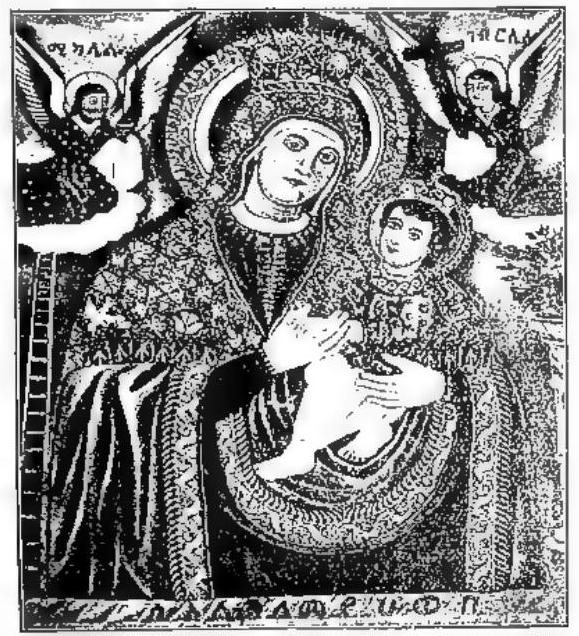
All medieval and modern churches generally have walls covered with paintings, executed directly on the plaster in the Zagwe period (of older ones we know none) or on canvas nailed to the wall in recent times. The oldest paintings known to us are those of the church of Mary at Lalibela, with decorative motifs, among which the double-headed eagle of Hittite origin, widespread in the painting of Central Asia and from there expanded throughout the world. In the Zagwe church of Imraha we also have painted wooden panels from a ceiling, with types closely connectable to forms of southern India. As for bas-relief sculpture, besides the already mentioned examples of the church of Golgotha at Lalibela, we must mention the carved wooden panels of the church of Debra Damo and those formerly in the demolished church of Asmara and now in the local museum. Quite abundant are the examples of richly ornamented metal liturgical furnishings, among which special mention should be made of the great crosses from the treasure of Magdala, now in the Victoria and Albert Museum in London, ornamented with engraved figures relating to the life of Christ. But the art that has handed down to us the greatest number of monuments is miniature painting. We know no very ancient monuments, because of the detestable Abyssinian habit of throwing away codices when they are worn out by use: the earliest miniatures that have come down to us are in cod. Borgiano etiop. 3 of the Vaticana, executed between 1314 and 1344; the Parisinus ethiop. 32 of 1344-72; the Borgiano etiop. 26 of the Vaticana of 1378-1408; the Tetraevangelium owned by Aharon of 1401. Besides these, fairly exactly datable, there belong to the 14th century, or the beginning of the 15th, that of Pistoia, Biblioteca Fortegueriana, fondo Martini 5, the Vindobonensis etiop. 21 and etiop. 3, the Vaticanus etiop. 50 and cod. Parisinus ethiop. 10. All present very archaic characteristics: for example, the Gospels are of the type of codices with multiple frontispieces, that is, having all the representations of the life of Christ in a series of full-page miniatures grouped at the beginning of the codex, while the type of marginal miniatures or those inserted in the text is lacking; the Parisinus ethiop. 32 has only three miniatures, referring to the cycle of the Redeemer's death and the Resurrection, and these are the three scenes that appear alone on the very ancient Palestinian ampullae of the treasure of Monza and on the plate of Perm; the representation of the little temple with the fountain of life. It should also be noted that in the cited Paris manuscript, as in the Aharon codex, in the scene of the Crucifixion the Cross of the Savior is empty, through a concept derived from the sect of the Phantasiasts, whose influence must have been notable on primitive Abyssinian Christianity. The study of the miniatures of all these codices demonstrates that they derive mainly from Oriental models and very little from those of Coptic Egypt. Later we find in Abyssinian miniatures Western, European influences. Thus cod. Parisinus ethiop. 81 of the 15th century presents a miniature of the Venetian-Cretan school, probably the work of an artist who emigrated to Abyssinia. The period of greatest artistic splendor, however, is the 17th century: it is then that the illustration of the Book of the Miracles of Mary is created (of which the oldest manuscripts that have come down to us are that of the British Museum, Or. 641, dated from the reign of Fasiladas [1632-67], that formerly owned by the late prince Johann Georg of Saxony, and the cod. of the Bibliothèque Nationale of Paris, D'Abbadie 114), when the iconography of the Virgin becomes fixed according to a type that would become canonical in Abyssinia, derived from the famous Madonna of S. Maria Maggiore in Rome, of which many copies had been spread by the missions of the Jesuits. It is precisely at the end of the reign of Fasiladas that the most beautiful Abyssinian illuminated manuscript was executed, namely the Tetraevangelium now in the British Museum, Or. 510, written by the calligrapher Takla Maryam in large letters over a centimeter in height, a calligraphic type that today bears the name of guelh, begun, it seems, in the second half of the 17th century at the royal court of Gondar. In it the illustrations are scattered through the text as a successive commentary on it, with a procedure that represents a clear break with the pure indigenous tradition, which is that of multiple frontispieces, still represented shortly before by the ms. of the British Museum, Or. 481 of the mid-17th century. To the same period, that is, probably to the reign of Yohannes I the Saint (1667-82), are also to be attributed the wall paintings on canvas, formerly in the church of St. Anthony near Gondar, and now in the Musée de l'Homme in Paris. With the 18th century another principle of European origin is introduced into Abyssinian pictorial art: that of chiaroscuro. But then a precipitous decline also begins, which soon leads us to the crudeness of modern works. - See plate XLIV.
Bibliography6 works
Ugo Monneret de Villard