
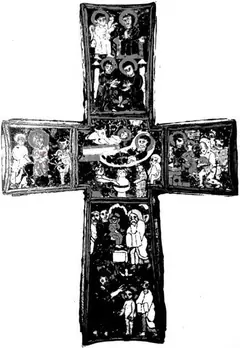

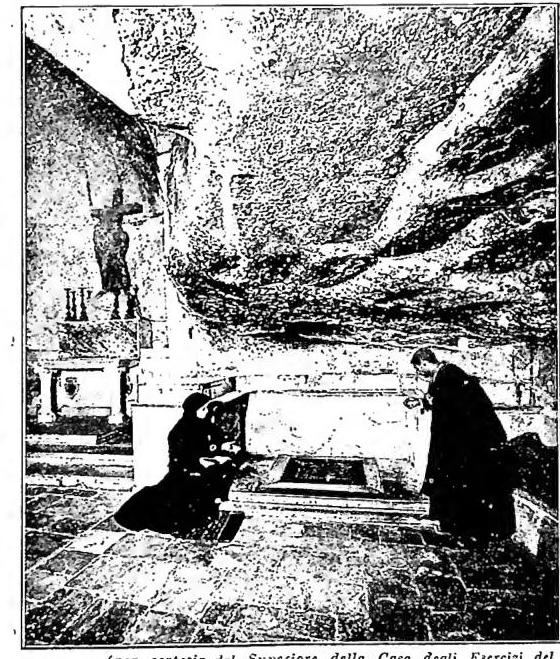
CROSS. - Instrument of torture, on which Jesus Christ died (Jn 19:17-31; Mt 27:32-42).
Since the Gospels are very sparing in details in narrating the passion of Calvary, because they supposed the horrors of crucifixion to be very well known to their readers, one must have recourse to Roman archaeology in order to know exactly the characteristics of this torture. Although proceedings were conducted in a very different manner, at the discretion of the judges and the executioners, nevertheless many rules were invariably followed as regards the wood of the c. and the ways of fastening it, the procedure and the persons subject to the penalty of c., and these were certainly applied in the passion of the Lord.
I. INSTRUMENT OF TORTURE
Every crucifixion is characterized by the use of "wood"; it is the killing of a man by means of immediate and stable conjunction with the wood. Therefore in the New Testament the cross is called simply "wood" (Acts 5:30; 1 Pet. 2:24; etc.). For the most part, however, not a single piece of wood was used, but two; already the Septuagint uses for the word 'šs the phrase ξύλον δίδυμον (Josh. 8:21). The larger piece of wood, erected and fixed to the ground, gave its name to the punishment: σταυρός is the pole driven into the earth. A distinction is made between the crux sublimis and the humilis; the latter was used principally when the crucifixion was joined to the condemnation ad bestias.
The smaller transverse piece of wood could be of two forms: the furca, which was originally an agricultural implement intended to support the two-wheeled plaustrum by raising its pole aloft. On the neck of the guilty slave this furca was imposed, and he was led through the neighborhood while confessing his crime (Plutarch, M. Coriolan., 24, 9; Vitne, 225 d). This punishment was aggravated by inflicting flogging on the culprit, which could be prolonged to the point of death (Suetonius, Nero, 49, 2: "Nudi hominis cervicem inseri furcae, corpus virgis ad necem caedi"). But not every household had such a furca; therefore in its place the patibulum was used, that is, the bar with which the door of the house was closed at night: by imposing it on the culprit's neck he was immobilized. Generally a third piece of wood was added, the cornu, a pointed stake fixed into the upright wood, on which the condemned man was placed so that he would not faint and die quickly by hanging freely. Of this "horn" almost only Christian sources speak (cf. P. Franchi de' Cavalieri, Della forca e della sua sostituzione alla c. nel diritto penale romano, in Nuovo bull. d'arch. crist., 13 [1907], p. 603 ff.).
As instruments for fastening to the cross, both ropes and nails were used; the choice depended, it seems, on the magistrates and the bailiffs. That, by means of nails, the crucifixion had become bloody is attested by the verb προατλώδν, synonymous with σταυρόν.
II. DEFENDANTS SUBJECTED TO THE TORTURE OF CROSS
The ancient peoples used to punish the most serious crimes with death by the cross. But the cross was not used everywhere, for it was not in use among the Assyrians, the Egyptians and the Greeks in their homeland. The cross was introduced among the Jews only by Alexander Jannaeus (d. 76 B.C.), a semi-pagan prince, and by the Romans. The cross was employed by the Persians, from whom Alexander the Great and the Diadochi learned of it. Above all the Carthaginians often punished offenders, both national and foreign, with the cross; from them the Romans seem to have learned this practice, and they applied it in time of war against rebels, brigands and pirates. At Rome the supplice was called servile, but even a Roman citizen could undergo it, despite the opposition of Cicero.
III. MANNER OF INFLICTING THE TORTURE OF THE CROSS
Every crucifixion was preceded by two torments: the guilty party was scourged (as happened in every other punishment), then he carried his cross. While the Latins speak instead of the furca being carried, only the Greek texts speak of the carrying of the cross:
τῷ σώματι τῶν κυλαζομένων ἕκαστος κακούργων ἐκ-
φέρει τὸν αὐτοῦ σταυρὸν (Plutarch, De sera numinis vin-dicta, 9; Moralia, 554 a); likewise Artemidorus (2, 56), Chariton (De Charea et Callirhoe, 4, 2, 3), and the rabbinic text
Gen. Rabba, in H. L. Strack-P. Billerbeck, Kommentar
zum Neuen Testament, I, Munich 1922, p. 587: Isaac
carried the wood « like the guilty man his cross ». The Latin texts anterior to the versions of the New Testament do not contain such a phrase, but they describe how the condemned
carried the patibulum, sometimes adding that the guilty
were then fastened to the cross. Thus Plautus: « Ita te forabunt
patibulatum per vias Stimulis », « tibi esse pereundum
extra portam Dispessis (= dispansis) manibus, patibulum quom habebis », « Patibulum ferat per urbem dein-de adfigatur cruci » (Mostellaria, I, 1, 56 ff.; Miles gloriosus, II, 4, 6 ff., 358 ff.; Carbonaria, frg. 2). The
phrase « deligata ad patibulos (!) » is explained: « Deligantur
et circumferuntur, cruci defiguntur » (Clodius, 3: Roman.
historicorum fragm., 2, 78). Dionysius of Halicarnassus (VII, 78)
thus describes the preparation for the punishment: the master
hands over the guilty slave to his companions so that he may be dragged through the forum; they, having stretched out the two hands of the condemned man
and bound them with the shoulders and the chest to the wood that reaches
down to the roots of the hands, accompanied him naked,
striking him continually with whips and mocking him.
The upright post of the cross was either permanently erected in the place
of punishment or was fixed into the ground before the
punishment. Cicero boasts of having removed, during his
consulship, the cross from the Campus Martius and reproaches Labienus,
who orders « crucem ad civium supplicium defigi
et constitui » (Pro C. Rabirio perduellionis reo, 3, 10; 4, 11).
In Sicily, the Mamertines « more et instituto suo crucem
defixerant » (In Verrem, II, 5, 66, 169). At the end of the
Jewish war the legate ordered a cross to be erected in order to
immediately hang on it a captured young man (Flavius Josephus,
Bell. Iud., VII, 6, 4). No surviving source affirms that the entire cross
was carried; this is excluded first of all for the cross of Jesus,
which entire was at least 4 m. high and therefore of such a weight that
not only a man already weakened by the scourging would have
been incapable of carrying it, but even a healthy and robust
man. Moreover such an apparatus would have required much labor and
time without any usefulness. The guilty man, in fact, carried only the
patibulum on his shoulders. It must therefore be concluded: in the phrase
« to carry the cross » there is a synecdoche, for it was not the entire
cross that was carried, but only its lesser part, the furca or patibulum, to the place of punishment (cf. C. G. Cobet, Annotationes
in Charitonem, in Mnemosyne, 8 [1859], pp. 229-303, especially
275-79). With this carrying of the cross was joined a harsh
mockery of the condemned man (Philo, In Flaccum, 9, 72).
The nailing to the cross was not done in the manner almost
always shown by Christian art, that is, either on the whole cross
lying on the ground or on it after it had first been erected, but
an intermediate method was used: the condemned man was fastened to the
patibulum lying on the ground, and then hoisted onto the upright. This
follows from what has been set out: if in fact the condemned
man carried the patibulum to the place of execution, he could
simply be raised by the soldiers onto the cross and its
horn. But if a bloody crucifixion was carried out, the guilty man,
first thrown to the ground, was fastened with nails to the patibulum,
so that « patibulo suffixus in crucem tollitur » (Firmicus
Maternus, Mathematica, VI, 31, 38 and elsewhere). If the cross
was very high, ladders or ropes were used. Finally it was
necessary to fasten the feet of the guilty man (with ropes or nails, perhaps to
the Achilles tendon). This is confirmed by many texts that
speak of « aliquem in crucem tollere, elevare » or, in
the passive sense, « in crucem tolli » or « crucem ascendere »
or « in crucem excurrere »: such expressions attest that
the cross was the endpoint of an action directed upward. This does not
accord with the conception of ecclesiastical art: if the
condemned man had been nailed to the cross lying on the ground,
he would not have been elevated « in crucem », but only
raised by means of the cross itself.
Also to be excluded is the reconstruction that was in
vogue in the last century among scholars: the whole cross erected
beforehand, up which the condemned man climbed by a
ladder (thus Fra Angelico in the well-known painting). The series of
actions that Jesus foretold to Peter, among them the torture he was to
undergo on the cross, was instead entirely different: « You will
stretch out your hands and another will gird you and lead you where you do not
wish » (Jn. 21:18). The stretching out of the hands was therefore not
the last action of the condemned man, but the first, in the
torture; already in the forum, after the judge's sentence, he was
stripped and his hands were stretched out on the patibulum;
then he was "dragged" with a rope that was wound around his body
to the place of execution, where with the same rope he was hoisted.
The crucified did not rarely live a long time on
the cross: « they live in the utmost agony sometimes both the entire
night and then still the entire day » (Origen, In Mt.
comm. ser., 140: PG 18, 1793; ed. E. Klostermann, XI,
Leipzig 1935, p. 290). A slave crucified with nails
at Damascus, in 1247, died only on the third day (P. Schegg,
Pilgerreise, I, Munich 1867, p. 140). The immediate cause
of death, according to modern physicians, was the blood, which
could no longer reach, through the limbs violently stretched,
the brain (H. Mödder); held back in the lungs, it impeded the movements of the heart and after much torment
finally caused the death of the unfortunate man. The crucified were
"guarded" (Mt. 27:36) by the soldiers as long as they lived and after
death. The corpses hung unburied to be torn apart by wild beasts and
birds. It is not certain that the cross was considered the most
horrible death (which in I Cor. 13:3 is death by fire).
Sometimes an unusual method was used. In the
Jewish war « the soldiers in mockery nailed the Jewish prisoners to the
cross in various positions » (Fl. Josephus, Bell. Iud., V, 11, 1); sometimes
it pleased the executioners to suspend them « capite conversos in terram »
Sometimes an unusual system was used. In the Jewish War "the soldiers, in mockery, fastened the Jewish prisoners to the cross in various positions" (Fl. Josephus, Bell. Iud., V, 11, 1); sometimes it pleased the executioners to suspend them "capite conversos in terram" (Seneca, Ad Marciam de consol., 20, 3). Some were deposited still alive (Fl. Josephus, Vita, 75). For others, death was hastened by fire or smoke or the breaking of the legs or a blow from a lance. Finally, to the relatives of the slain who asked for them, "corpora ad sepulturam dabantur" (Digesta, 48, tit. 24, 1).
alive (Fl. Josephus, Vita, 75). For others death was hastened by
fire or smoke or the breaking of the legs or a blow of the lance. Finally,
to the relatives of the slain who asked for them, « corpora ad sepulturam
dabantur » (Digesta, 48, tit. 24, 1).
IV. THE CRUCIFIXION OF JESUS
The Savior chose the death of the cross freely, because it was most ignominious, "to attest to us his love," so that no one might be afraid (Lactantius, Instit., IV, 26: CSEL, XIX, p. 382, 2-6). Other reasons have been adduced by theologians: the embrace of the outstretched hands, the reparation of the sin committed with the "wood," the free choice of the moment of that same death.
Dimensions of the cross: the stature of a man about 1.70 m.; the upper part had to project about 0.30 m.; the feet rose above the ground by 1 m. or 1½ m. (on account of the hyssop of Io. 19, 29); the part fixed in the earth was at least 1 m. Altogether, therefore, the cross was 4 m. or 4½ m. high. The form of Jesus' cross was that with a headpiece, with 4 extremities. This is proved by the comparisons used by the Fathers (with a bird in flight, a ship, the letters T and Φ) and above all by the types of the Old Testament applied by the Fathers: Gen. 47, 14-19, Jacob blesses Ephraim and Manasseh with crossed arms; Ex. 17, 11, Moses prays with raised hands for the fighting people; Is. 65, 2, "I have spread out my hands." In Eph. 3, 18, the Fathers find the four dimensions of the cross.
Coronation of Jesus. There existed a mime of the "king of the Jews," which the Roman soldiers were wont to perform often in their camps. When Pilate handed over to them a man who had declared himself "king of the Jews" and whose guilt had already been sanctioned by scourging, the soldiers cruelly repeated that mime, making use of a crown of thorns, of slaps, of spittle. Their guilt appears diminished by this circumstance, but not removed.
Jesus carried the cross clothed (Mt. 27, 31; Mc. 15, 20: "they clothed him in his garments and led him to the crucifixion"). After the crucifixion his garments were divided. In this the Romans accommodated themselves to the sense of modesty of the Jews. From this it is to be concluded that even on the cross Jesus wore a light covering. But the Fathers, adhering to Roman custom, held that Jesus was naked on the cross.
From what has been said (v. above: III) it follows that the fastening of Jesus to the cross was not carried out on the entire cross lying on the ground, as the Gospel of Peter says (10; ed. L. Vaganay, Paris 1930, p. 235), nor on the entire cross standing upright, but by means of the patibulum which Jesus had carried bound to his shoulders over his garment, and with which he was raised up. The fastening was not done with ropes alone but with nails, in the feet as well, not 3 only but 4. With these 4 nails Christian art always represented the Crucified until the 13th century, as witness St. Gregory of Tours (PL 71, 710); 3 nails are admitted by Nonnus of Panopolis (PG 43, 901) and by the Caverna thesaurorum (ed. C. Bezold, Leipzig 1888, p. 66).
Jesus did not remain hanging on the cross for 6 hours, as Mc. 15, 25 with certain codices of Io. 19, 14 (as well as the so-called "autograph"; PG 92, 77) might lead one to suppose, but only for 3. He did not die from a cardiac lesion, but from the excessive number of traumatic lesions inflicted on his body.
Bibliography21 works
Urbano Holzmeister
V. THE SIGN OF THE CROSS
It is the most eloquent, most frequent, most popular act of Catholic worship. With it priests bless persons and things, and the faithful sign themselves when beginning their actions, fortifying themselves with this sign of salvation.
The martyrs made the sign of the Cross before facing martyrdom. The ancient Christian did not neglect this act of faith at the beginning of the day, on entering and leaving the house, in dressing, at the bath, at table, at the moment of lighting the lamp (Lactantius, Inst. Div., IV, 27; Tertullian, De cor. mil., 3, 11; "frontem signaculo crucis terimus"; St. Jerome, (Ep. 18 ad Eustochium): "ad omnem actum manus pingat Domini Crucem"). The sign of the Cross was made also over objects of daily use. In the 4th century St. Cyril of Jerusalem (Catech., 22, 36) says that Christians sign not only their forehead, but everything, the bread they eat, the cups from which they drink. With the sign of the Cross.
everything in the Church is blessed, consecrated and sanctified: ("Crux tua omnium fons benedictionum, omnium est causa gratiarum: per quam credentibus datur virtus de infirmitate, gloria de opprobrio, vita de morte" (St. Leo the Great, Sermo 8 De passione Dom.). The ancients expressed the efficacy of the triumphal sign of redemption with this anagram:
Φ
Z Ω H
C
that is: the Cross is Light and Life (φῶς-ζωή). In the Middle Ages no public document, no inscription or law was begun without first tracing the C. upon it. This replaced the signature of the illiterate, and often preceded that of ecclesiastics. In many country districts even the dough and the bread were marked before baking. The sign of the C. is seen on the gates of cities, as on ancient cisterns and wells, on the mouths of ovens and on household utensils. Antiquity has likewise handed down to us reliquaries and cases for relics in the shape of a c., on which exorcism formulas were sometimes inscribed, as in the golden C. collected by Pius IX in a tomb of the cemetery of Cyriaca. The most famous of these C. with exorcistic inscriptions is the one known by the name of the "medal of St. Benedict," still used today against infestations of the devil. From the 3rd century onward ecclesiastical documents attest the use of the sign of the C. in the Western and Eastern liturgy (Tertullian, De resurrect., 8; De cor. mil., 3, 11). As for the form of the sign of the C., the documents indicated above speak of a sign made indeed on the person or on things, but no mention is made of the great sign of the C. made over the body. According to Tertullian (De cor. mil., 3) a small sign of the C. was made with a single finger and probably with the thumb in the form of a T or an X: with the thumb alone, in the 4th-5th centuries, objects distant from the person were also blessed. A first mention of the sign of the C. made on the breast is found in Prudentius (Cathemer., 6): it is a sign, traced with brief strokes, the same as that practiced on the forehead; Gaudentius of Brescia (De lect. evang.) then speaks of a triple sign on the heart, on the lips and on the forehead; and the practice that would come down to us unchanged for the announcement of the Gospel at Mass. The sick were marked on the afflicted limbs (St. Gregory the Great, Dialog., 2, 20; Cassian, Collat., 8, 18). It seems that from the struggle against the Monophysites and Monothelites came the use of employing two or three fingers, while the Monophysites signed themselves with a single finger to indicate the one nature in Christ; the Greeks from the 7th century onward, to manifest their faith in the two natures of Christ, make the sign of the C. with two fingers, that is with the thumb and the index finger, or with the index and middle finger; from the 8th century onward Greek priests give the blessing by joining the thumb with the ring finger and imitating the monogram of Christ: IXC. The Latins, on the other hand, gave the blessing by extending the first three fingers and bending the ring finger and the little finger. While in the 8th century in the East a practice had spread not very different from the great sign in use at present, in the West as late as the 13th century we find Luke of Tuy speaking of a sign of the C. made on the face (faciem suam muniens) in this way: "raise the three extended fingers to the height of the forehead saying in nomine Patris, then lower them to the chin saying et Filii, then bring them to the left saying et Spiritus Sancti and finally to the right saying Amen" (De alt. vita, 2, 15). An English document of the 12th century, however, alludes to a sign that reaches as far as the breast, made with three fingers. On the question whether the hand should be brought from left to right or vice versa, in the 16th century uniformity had not yet been achieved. The present form in the Latin Church, of blessing persons and things with all fingers extended, and of signing oneself in the same form, was much contested in the 13th century (Sicardus, Mitrale, 3, 4: PL 213, 109; Innocent III, De altaris mysterio, 2, 45; Durandus, Rationale, V, 2, 13). In the Roman liturgy the great sign of the C. is often used at Mass, in the administration of the Sacraments, in blessings, in the office; the small sign, which is made with the thumb alone on the forehead, on the mouth and on the breast, is in use at the Gospel of the Mass; it is likewise made on the book of the Gospels, on the mouth at the Aperi Domine and at the Domine labia mea aperies, on the forehead and on the head of the person being baptized, on the forehead of the person being confirmed, in Extreme Unction, etc. The Christian people make the great sign of the C. ordinarily at the beginning or at the end of prayer, in danger, etc. In Portugal and Spain, as in the Dominican Order, the great sign of the C. is almost always preceded by the triple sign with the thumb; numerous Spanish catechisms teach making the sign of the C. with only two fingers of the right hand, which is brought to the abdomen rather than to the breast, customs that go back to the 14th century.
The most ancient formula was "Signum Crucis"; afterward came a profession of faith in Christ ("In nomine Iesu") or in the Most Holy Trinity ("In nomine Patris et Filii et Spiritus Sancti"); then also an invocation of divine help ("Adiutorium nostrum in nomine Domini" or "Deus in adiutorium meum intende") and others.
Bibliography4 works
DACL, III, cols. 3139-44; F. J. Dölger, Heidische Begrüssung und christliche Verhöhnung der Heidentempel, in Antike und Christentum, 3 (1932), pp. 192-201; L. Eisenhofer, Handbuch der kath. Liturgik, I, Freiburg im Breisgau 1932, pp. 273-81; Ph. Oppenheim, In hoc signo vinces. Signatio cum Cruce, in Ephemerides liturgicae, 47 (1933) pp. 158-72; id., Commentationes ad ritum baptismalem, Turin 1943, pp. 103-32; J. Sauer, Kreuzzeichnung, in LThK, VI, cols. 265-67.
Filippo Oppenheim
VI. THE CULT OF CROSS
It is founded on the close connection that it has with the divine person of the Redeemer, not only insofar as it is the instrument on which he accomplished his work of salvation of the world: « ex contactu ad membra Christi et ex hoc quod Crux eius sanguine sit perfusa » (Sum. Theol., 3ᵃ, q. 25, a. 4); nor only insofar as it reminds us of the sorrows of the Passion and of the divine sufferer: « et propter hoc etiam Crucem alloquimur et deprecamur quasi ipsum Crucifixum » (ibid.); but also and above all as a symbol intimately associated with the sacrifice of Jesus and with the mystery of the Passion. On Jesus' allusions to the Cross, erected as a sign and distinctive mark of his following (cf., e.g., Mt. 10, 38; 16, 24 and the parallel passages), the letters of the Apostles and especially those of St. Paul constitute a whole theology of the Cross, in which this is resolved as in a theoretical and practical compendium of the Gospel: « Cristo mi ha mandato non a battezzare, ma ad evangelizzare; e non in sapienza di parole, ma perché non sia resa vana la C. del Cristo » (I Cor. 1, 17); « Non giudicai di sapere tra di voi alcuna cosa, se non Gesù Cristo, e questo crocifisso » (I Cor. 2, 2; cf. Gal. 2, 19; 5, 11; Eph. 2, 16; Col. 1, 20; 2, 14). The Holy Fathers followed the same path.
All this makes clear how the cult of the Cross was a logical and natural thing for the Christian, who considered his own as the religion of the Cross, and that it was practiced from the very beginnings. This is shown by the very reproaches that the pagans, at the end of the 2nd century and at the beginning of the 3rd, addressed to the Christians, as Crucis religiosi and therefore themselves idolaters; they observed a widespread reality, though distorting its meaning and value. And the apologists, in replying, did not deny the fact, but only lingered to explain the nature of that cult and that adoration (cf. Minucius Felix, Octavius, chaps. 9, 12, 29; Tertullian, Apologet., 16). In the same way St. Cyril of Alexandria would later reply to Julian the Apostate, who imputed as a crime for the Christians the adoring of the wood of the Cross, the tracing of its sign on the forehead, the adorning of the door of their houses with it: « Noi, guardando la C., ricordiamo colui che sopra vi morì, perché tutti avessimo la vita » (Contra Iul., 6: PG 76, 793). One may add the frequent use of the sign of the cross by the martyrs in moments of the greatest unbearable tortures; the aspiration to die in the Cross as well; the striving, on the part of the Christians, to represent the Cross in various more or less hidden or secret ways, in order to escape more easily the searches or the profanations of the pagans.
The appearance of the Cross to Constantine, the subsequent victory over Maxentius, and even more the discovery of the sacred wood gave new and stronger impulse to the cult of the Cross; all the more so since the emperor erected in Jerusalem a basilica, which attracted many pilgrims and where conspicuous ceremonies began to be performed, especially on Good Friday. It may be said that from that point the cult of the Cross becomes a subject of preaching for the Holy Fathers; to the liturgy and to preaching are added art (v. below) and poetry (cf. Prudentius, Apotheosis, 446 ff.; Contra Symmachum, I, 494 ff.; St. Paulinus of Nola, Poem., 30, 97 ff.; Sedulius, Carmen paschale, V, 188 ff.). St. John Chrysostom declares that in his day the Cross was used by the faithful as an ornament, a remedy, a protection: « Hoc utique celebratum videre est in domibus, in foro, in desertis... in vestimentis, in thalamis... in vasis argenteis et aureis... in tectis, in libris, in urbibus, in vicis » (Omelia Quod Christus sit Deus, 9: PG 48, 826; cf. also: Omelia 2ᵃ, De Cruce et Introne, 1: PG 49, 47).
It was therefore necessary to intervene to repress exaggerations and abuses. A law of Theodosius and of Valentinian III (Cod. Iustin., I, tit. 7) forbade under severe penalties the painting, carving and tracing of the Cross on floors, lest that sacred sign run the risk of being trodden upon. And the Council in Trullo of 602 (can. 73, Hefele-Leclercq, III, p. 572) accepted it and added to it the penalty of excommunication. It should also be remembered how in the iconoclast struggle the image of the Cross was respected; and how the iconoclast emperors themselves, Leo the Isaurian, Constantine Copronymus, Leo IV, Nicephorus, Michael II and Theophilus, wanted it impressed on their coins.
Naturally the Fathers and the Church watched over ensuring that the cult paid to the Cross should not degenerate into error. The second Council of Nicaea of 787 (Hefele-Leclercq, III, p. 768) and the eighth of Constantinople of 869 (ibid., IV, pp. 521-22) define that to the Cross there is due, indeed, greeting (ἀσπασμός) and veneration (προσκύνησις), but not adoration (ἀληθινή λατρεία); a phrase which the monk Theodore the Studite (d. in 826) carefully distinguished (Antirhetius III adv. Iconomachos: PG, 91, 345 and 419), observing that the adoration directed to God is ἀληθινή προσκύνησις, while that directed to the Cross is relative (προσκύνησις σχετική). These and other later definitions, down to the Council of Trent, set the seal of their authority upon the perennial devotion, which from the earliest times had been in force among the Christian people.
Bibliography5 works
Celestino Testore
VII. THE CROSS IN THE LITURGY
1. The feasts of the Holy C
The current liturgical books have two of them: In Inventione S. Crucis (May 3) and In Exaltatione S. Crucis (Sept. 14).
The feasts followed the development of devotion to the relic of the Holy Cross, which originated with its discovery. The year of this event remains uncertain. The Alexandrian Chronicle assigns it to 320, the Lib. Pont. to 310 (I, p. 167), the Doctrine of Addai traces it back to the time of Tiberius (14-37). The Peregrinatio Aetheriae (ca. 394) supposes it to have occurred before 335, but Eusebius in the Vita Constantini, written in 337, does not mention it at all. The first certain document is the testimony of St. Cyril of Jerusalem in the Cathech., XIII, 4: PG 33, 775; written in 347. Even less is known about the day of the Inventio. It should be noted, however, that the Chronicle and the Peregrinatio give September 14, and this has been the cause of no little confusion in identifying the two feasts in the documents.
Historically the liturgical feast of the Exaltatio precedes that of the Inventio. Its origin is Palestinian, indeed local to Jerusalem, and must be sought in the annual celebration of the dedication (which took place on September 13 and 14, 335) of the two Constantinian basilicas of the Anastasis and the Martyrion. The feast attained great celebrity. At the end of the 4th century the Peregrinatio speaks of multitudes of monachi, episcopi (as many as 40 and 50), clerici, saeculares, tam viri quam feminae, who for eight continuous days flocked from all parts of the East to take part in it. It yielded in nothing to the feasts of Easter and Epiphany (Peregrinatio ad loca sacra, ch. 48, in Itinera, ed. Geyer, p. 100). In time a solemn ostension of the relics of the true Cross began to be made, so that little by little this rite became the principal object of the solemnity, causing the dedication to be almost entirely forgotten. Alexander of Cyprus (6th century) designates it exactly with the name that thereafter remained: Exaltatio praeclarae Crucis (PG 86, 2176).
From Jerusalem the solemnity spread to many Eastern churches, especially where a relic of the true Cross was possessed, as at Constantinople, Apamea and Alexandria.
For the West the first testimony of a liturgical feast of the Holy Cross is found in the biography of Sergius I (687-701), in which one reads: Qui etiam ex die illo pro salute humani generis ab omni populo christiano die Exhaltationis Sanctae Crucis in basilicam Salvatoris, quae appellatur Constantiniana, osculatur et adoratur (Lib. Pont., I, p. 374).
The text suggests that the feast was already celebrated before Sergius; probably first in the oratory of the Holy Cross at the Lateran, then in the Sessorian basilica Sanctae Crucis in Hierusalem. But one must not go very far back, as the uncertainty of the documents in recording it shows: for example, it is found in the Gelasian Sacramentary (mid-8th century; cf. ed. Wilson, p. 198), but it is missing in the Epternach manuscript of the Hieronymian Martyrology, executed by a bishop consecrated by Sergius I (cf. Lib. Pont., I, p. 387, note 29). To the feast Sergius must have added the solemn ostension and adoration of the Cross kept in the Sancta Sanctorum of the Lateran, of which the text referred to speaks, a ceremony still attested in the Ordo of Cencio Camerario at the beginning of the 13th century.
While at Rome the feast of the Exaltatio was becoming established, fixed on September 14, in Gaul a feast of the Inventio Sanctae Crucis, set on May 3, had been introduced, and with success. It seems that it entered the Gallican churches in the first half of the 8th century: it is not found in the Leonine (6th century) and Gregorian (7th century) Sacramentaries, Gregory of Tours (593-94) makes no mention of it, so abundant in such matters, and it is missing in the Lectionary of Luxeuil (end of the 7th century). On the other hand, it is reported by the manuscripts of the Hieronymian Martyrology of Wolfenbüttel (772) and of Bern (slightly later), by the Mozarabic calendars, and by the Gelasian Sacramentaries of the 8th century (cf. P. de Puniet, Le Sacramentaire romain de Gellone, Rome [1938], pp. 92-93; Sacramentarium Pragense, ed. A. Dold, Beuron 1949, p. 71).
The date of May 3 was suggested, it seems, by the legend of Judas Cyriacus, bishop of Jerusalem (BHL, 7022). The Missale Gothicum (7th-8th centuries) and that of Bobbio (8th century) place the feast between the octave of Easter and the Rogations, without further indication. Reg. 316 and the
The Prague calendars already have the date of May 3. In substance the two calendars, the Roman and the Gallican, had their own feast of the Holy Cross on different dates, and both remained in the liturgical books when these, having migrated to Gaul, returned to Rome with the noted additions and transformations.
The liturgical formulary of the two feasts also felt the effects of their vicissitudes. The office of the Exaltatio is of evident Roman workmanship: this is shown, among other things, by the antiphon O magnum pietatis opus, taken from the metrical inscription of Pope Symmachus (498-514) for the oratory of the Holy Cross in St. Peter's, and by the other, Salva nos, Christe, which recalls the emblem of that same basilica (cf. U. Mannucci, Per la storia dell'ufficio della S. C., in Rass. Gregor., 1910, col. 249). The lessons narrate the recovery of the Holy Cross from the hands of the Persians, which took place in 665 under Heraclius.
The office of the Inventio, on the other hand, is Gallican. The antiphons of the 12th century alluded to the legend of Judas Cyriacus and were suppressed by Clement VIII (1592-1605) "quia historiam continebant dubiam" and replaced by the present ones (see the ancient formulary in Tommasi, Opera, vol. IV, p. 250). The remaining lessons recount the finding of the cross by St. Helena. The Mass is of the classic Gallican type (cf. G. Manz, Ist die Messe de Inventione S. Crucis im Sacram. Gelas. gallischen Ursprungs?, in Ephém. lit., 47 [1958], pp. 192-96).
In 1741 the Commission appointed by Benedict XIV for the reform of the Breviary resolved to suppress the feast of May 3, but the whole project, as is well known, failed, and the two feasts of the Holy Cross have likewise remained in their place until now.
Bibliography8 works
Annibale Bugnini
2. The altar cross
In the first centuries, only the matter of the sacrifice could be placed on the altar. The cross and the candlesticks, carried at the head of the procession, were placed either behind the altar or at its sides. Sometimes the cross hung beneath the ciborium or was carved on its pediment: yet no text tells us the precise reason for its presence. With the 11th century it comes to be adorned with the Crucifix, sometimes flanked by the Madonna and St. John the Evangelist; a hole in the altar or a special pedestal allows it to be fixed on the altar itself during the celebration of the Holy Sacrifice. It is not excluded that the introduction and spread of private Masses influenced its being placed definitively on the altar.
The Ceremonial of Bishops, ordaining that the "Crux Domini" be on the altar, establishes that its base be as high as the nearest of the candlesticks, which are required to be of varying height, so that, as they rise, they may the more adorn the cross. Its presence on the altar, like the repeated bows and the glances directed toward it by the priest celebrating Holy Mass, are meant to inculcate that this is the real representation of the sacrifice of the cross. Therefore it is always necessary, except during the exposition of the Most Blessed Sacrament, because the image yields to the reality.
Bibliography2 works
Enrico Cattaneo
3. The pectoral cross
It is a small cross of gold or of another gilded metal, often adorned with precious stones, which bishops wear hanging from the neck as their own distinctive mark, with a relic inside, which is often of the Holy Cross. It is also used by regular abbots, by the canons of many cathedral and collegiate Chapters, by certain ecclesiastical dignitaries by special apostolic indult, and by some abbesses as a sign of their rank. Pius X granted it to the cardinal deacons. There are two kinds of pectoral cross: one is hung from a gold chain or another gilded metal, which is used with ordinary dress; the other hangs from a cord of red silk for cardinals and green for bishops,
and is worn in sacred functions and over the mozzetta. The Ceremonial of Bishops mentions only this second one, and considers it a pontifical ornament, whereas it does not speak of the first at all.
The origin of the pectoral cross is very probably linked to the encolpia and to those sacred objects that Christians wore on the breast. The ancient writers do not speak of it: this means that originally it was only a matter of personal devotion. Later the popes made of it a sacred ornament, imitated successively by bishops and abbots. The first examples go back to about the 9th century. Innocent III alludes to the pectoral cross, as a liturgical ornament of the pope, in De sacro altaris sacrificio, I, ch. 2. A Pontifical of the 12th century lists among the liturgical vestments of the bishop the "Crux pectoralis, si quis ea uti velit" (E. Martène, De ant. Eccl. rit., I, Antwerp 1736, ch. 4, art. 12, ordo 23).
Bibliography6 works
Silvario Mattei
VIII. THE CROSS IN ARCHAEOLOGY
Under the name of cross, various signs of that shape, very ancient, are designated, such as the swastika or hooked cross (♩) and (♫); the hieroglyph ♠, peculiar to Egypt, called crux ansata and found in about twenty Christian inscriptions (G. Lefèvre, Inscriptions gr. chrét. d'Egypte, II Cairo 1907); the sign +, which, to be distinguished from the one that goes under the name of Latin cross (+), is called Greek and equilateral cross; the monogram in the shape of a cross + that seems to derive from the Constantinian monogram (♓) or chrismon, commonly called monogrammatic cross. It should be noted, however, that the so-called crux decussata or St. Andrew's cross (X) is a pure invention of medieval art.
1. Gammated or hooked cross
The swastika (from the Sanskrit Svasti "health," "good," "happiness"), called gammated cross, because it consists of four equal arms ending with a segment at a right angle, in the manner of the Greek capital gamma, seems to be considered the most ancient sign of fortune and a religious sign in primitive solar cults. It is found, painted or engraved, from the Neolithic age onward, on vases, amulets, spindle whorls, sepulchral monuments, fabrics and figures. The most ancient examples known so far are those found on vases at Mussian Tepe near Susa, in Elam, from 4000-3000 B.C. Around 3000 B.C. it appears in the pottery of the Danubian region, then at Troy, in Greece; in southern Italy, in Etruria, among the Germans around 1000 and in 500 B.C. in India. From the 3rd century A.D. onward, alone or with other signs, it appears on many funerary inscriptions of Lycaonia and Isauria; in the monument of Clodius Hermes at St. Sebastian in Rome and in the Cemeteries of Domitilla, of Pamphilus, of Generosa and of the Vigna Massimo (M. A. Boldetti, Osservazioni sopra i cemeteri, 2 vols., Rome 1720, p. 60; E. Josi, Il cimitero di Panfilo, in Riv. d'arch. crist., 1 [1924], p. 67, fig. 18; Wilpert, Pitture, pls. 112, 3; 180; 212; G. Cotzoni, Le questioni cronologiche della C. e dei monogrammi X e †, Athens 1939), where, though without necessarily being considered a way of concealing the Christian [faith], at least in the inscriptions in which it is not a mere ornamental sign, it can allude either to Christ, sun of salvation, or to the happiness of the deceased. Compared with the cross, the swastika also disappears in northern Europe in the 6th-7th century A.D. It remains a sacred symbol for Buddhists who, in Tibet, have adopted it in the form of hooks turned to the right. A variant of the rectilinear hooked cross was the curvilinear one, formed by two intersecting S's, which likewise had a symbolic meaning.
2. Monogrammatic cross
In the Letter of Barnabas (9, 8), from the beginning of the 2nd century, the abbreviation IH is assumed to be known as an abbreviation of the name 'Ἰησοῦς'; but, as appears from the monuments, of the name of Jesus first, and as signum Christi afterward, the Chi Iota (X), the Chi Rho (X) and the monogram in the shape of a cross (†) were above all known, all three, moreover, in use almost exclusively as a compendium scripturae, in writings and monuments well before Christianity: the first on coins of Chios (Κίος); the second as an abbreviation of common names beginning with XP and as a sign on Athenian, Ptolemaic maic, Syriac, as well as of the emperor Decius (249-251 B.C.); the third on coins of the Armenian king Tyrane (96-94 B.C.), of the Arsacids X, XII, XIV (92-38 B.C.) and of Herod the Great (38 A.D.).
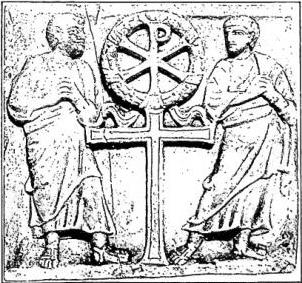
The rather rare X, which, as a superimposition of the initials I ('Ἰησοῦς') X (Χριστός), dates from the 3rd century, is called pre-Constantinian. The X, which likewise arose in the West a little later, and which owes its rapid diffusion - particularly in Rome - to Constantine and to its repeated appearance on his coins, has been called Constantinian. It is only from the 4th century that this, from a compendium scripturae of the name of Christ, becomes a true monogram, signum Christi, and a figure of the C. (St. Augustine, Tract., 118, 5: PL 34, 1950). The oldest example of it is given to us by a Roman inscription, attributed to the year 323 (G. B. De Rossi, in Bull. d'arch. crist., 1 [1863], p. 23). In another inscription, also from Rome, of 340 (G. Cotzoni, op. cit., p. 88), as if to reinforce its relation with Christ, the apocalyptic letters A and Ω are found associated with it, which from then on are encountered quite often. Also from Rome it spreads into all its variants, with or without a circle or enclosed in a wreath, as is excellently represented on the Christian sarcophagi in the scene of the resurrection, which has been called anastasis or, more precisely, Crux invicta, because the resurrection of the God-Man is the victory of the C. (cf. Wilpert, Sarcofagi, pls. 11, 4; 18, 1-5; 44, 1-3; 142, 1 and 3; 145, 1 and 7; 146, 1 and 3; 192, 6; 238, 1, 4, 7; 239, 2; 241, 1-4; 243, 1; 285, 1). In the East, the first certain case known so far is from 354 (G. Cotzoni, op. cit., p. 69).
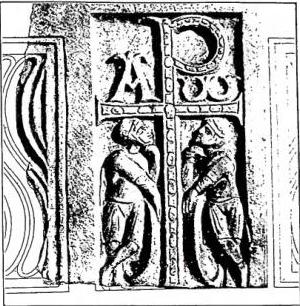
Since the allusion to the C. was too concealed there, this monogram was also represented as crossed by a horizontal line (X). From this, as is found on Constantinian coins already around 335 and in funerary inscriptions of 355, one passed to the monogrammatic C. (†), which also appears in the forms † X and X X X. In 365 (G. Cotzoni, op. cit., p. 91) there is the monogrammatic C. with the A and the Ω, in the positions A † Ω and ‡ or in other variants; and often, especially in Syria, surrounded by a circle or a crown, or else with the fish, the doves or the peacock. This monogram, almost contemporaneously with its emergence and before the Constantinian one, on coins and then on monuments, passed from the West to the East (For the monogram in the paintings of the catacombs, v. Wilpert, Pitture, pp. 117-18; pls. 154, 1; 162, 2; 207; 241; 251).
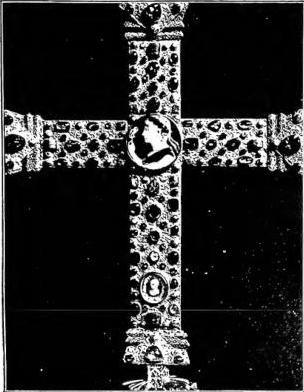
At the beginning of the 5th century the X disappears from Roman sepulchral inscriptions and the † becomes rarer. Outside Rome, on the other hand, both are still maintained for a long time on monuments and objects, and it is known that from the time of Justinian, especially in Syria, there was the custom of depicting the monogram on the exterior of houses (C. M. Kaufman, Handbuch der christlichen Archäologie, Paderborn 1922, fig. 215, p. 270). Cases of the monogrammatic cross still appear in the 8th century. Yet also from the beginning of the 5th century, these two monograms, together with the cross that later prevailed, appear in the splendor of the mosaics. Typical are the beautiful †, crowned by the manus divina, on the vault of the baptistery of Naples and the triple X of the baptistery of Albenga, surrounded by the twelve doves (Wilpert, Mosaihen, pls. 29, 88; as well as 32, 51, 91, 109). In the late Middle Ages the Constantinian monogram was replaced by the abbreviation IHS, which according to a popular etymology was interpreted as in hoc signo or, as today, Jesus hominum salvator. To it, more recently, a small cross was added above the H (IHS).
3. Jeweled cross
The open cross (+ †), commonly called capitata or immissa, is used as an ornament both before and after Christ; as a Christian sign and in the equilateral or so-called Greek form it appears in Syria and in the West.
The cross † is found for the first time in Herculaneum (v.); the four small crosses (+) traced in charcoal on one of the ossuaries found in 1945 near Jerusalem had an ephemeral success (v. L'Osservatore Romano, 1945, nos. 229-31, 255, 279).
As far as is currently known, the oldest monument with a Christian cross appears to be the inscription of Palmyra, of the year 136 (cf. H. Leclercq, in DACL, III, col. 3048; here it is erroneously assigned to 134), which offers two crosses in the manner of an X: the sign that, also in the form of +, was used in the ancient Hebrew alphabet to express the tāw. It is followed by the inscriptions, with a Greek cross, of Dura Europos and of Madula in Syria, of the years 163 and 197-98 respectively. Of later ones, besides the disputed cross on the coin of King Abgar IX (179-234), there are the crosses of three other inscriptions of Dura Europos, of 234, two of which present the well-known cryptogram or magic Sator Arepo, similar to two from Pompeii. For the period that goes from 313 to 350 only three examples of the cross have come down to us.
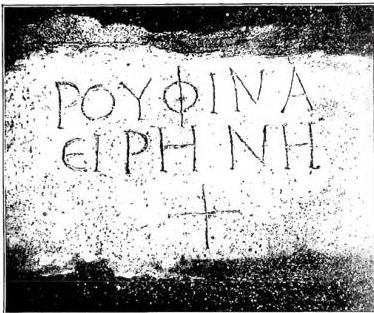
In the West, the Latin cross, besides in the aforementioned one of Herculaneum (v.); is also found veiled under the form of the tāw (T) and, perhaps, sometimes also of the anchor; then of the monograms X and †. In the cemeteries it is rather rare and of the few examples that remain from the pre-Constantinian period none is dated. However, with the Greek cross of the inscription of Rufina at St. Callixtus and the blasphemous graffito of the Palatine (v. ACCUSATIONS AGAINST THE CHRISTIANS), it seems that one can arrive, at most, at the end of the 2nd century. It is then found in the hypogeum of the Aurelii (v.) on the viale Manzoni. From 314, even among pagan symbols (for its appearance and importance of place follows the progressive predominance of Christianity in the Empire), the cross is found on the coins of the imperial mints of Tarragona, Lyon, Trier and Aquileia. From about the middle of the 4th century, that is, after the finding of the Cross in Jerusalem (326-36), they begin to ap-
(phot. Alinari)
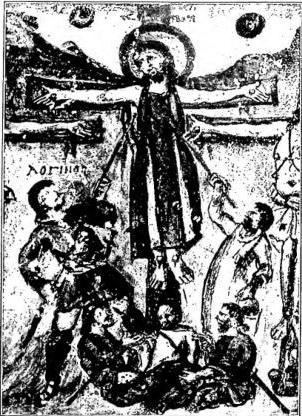
CROSS - Crucifixion. Detail of the miniature in the Syriac Evangeliary of Rabbula (a. 586) - Florence, Biblioteca Laurenziana, cod. Pl. 56.
to appear on sarcophagi, almost simultaneously, the Crux invicta (Wilpert, Sarcofagi, pls. 142, 3 and 146, 3) and the open representation of it, as incontestably results from the sarcophagus lid found in 1942 in the Vatican Grottoes, also assigned to around 340, which presents the first true image of the C. (v. L. De Bruyne, Importante coperchio di sarcofago, in Riv. d'arch. crist., 20 [1945], pp. 249-80), and moreover in the capitata or Latin form, such as the C. of Christ is believed to have been.
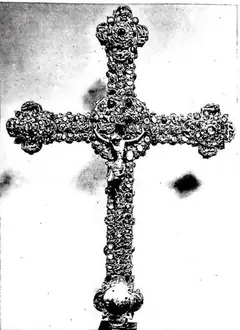
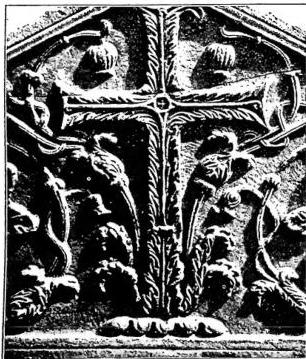
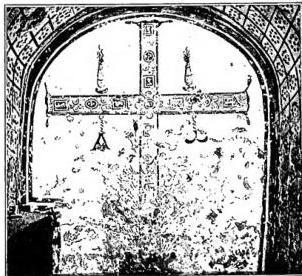
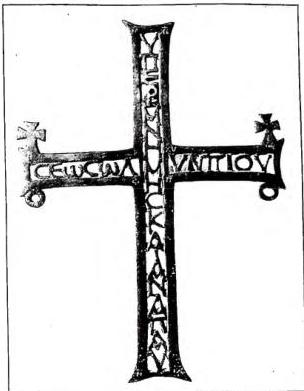
With the expansion of the cult of the relics of the C. and the erection of the related Constantinian basilicas, the number of depictions of the C. grew extraordinarily. And from the end of the 4th century, the C. — which at first is found represented as a mere sign of the Passion, then as the Crux invicta — placed in relation to the final coming of the Son of Man (Mt. 24, 30; Apoc. 1, 7), becomes its glorious and triumphant sign (often a substitute for Christ himself): and therefore depicted gemmed and in gold color, or among the symbols of the Evangelists and the Apostles, or enthroned, predominantly in apses and starry vaults. This is attested to us by the sarcophagus of Probus (around 395) and several others (Wilpert, Sarcofagi, pls. 18, 1, 4, 5; 145, 7; 238, 4, 7; 243, 1), but more than anything by the mosaics of the apse of St. Pudentiana (end of the 4th century), of the atrium of the baptistery of St. John Lateran and of the arch of St. Mary Major in Rome (432-40); of the dome of the mausoleum of Galla Placidia (2nd quarter of the 5th century), of the baptistery of the Orthodox (449-59) and of the oratory of the archiepiscopal palace (494-519) in Ravenna; the beautiful gemmed C., with the four rivers that flow at its foot, on the front of an altar at Nola, as well as the one between two saints in the cemetery of Ponziano in Rome, both from the end of the 5th century; the C. of the dome of the church of Casaranello; of the apse of St. Apollinaris in Classe in Ravenna (6th century) and of St. Stephen Rotondo in Rome (648), with the bust of Christ, the one at the intersection and the other at the top (Wilpert, Mosaiken, pls. 42-44, 1-3; 70-72; 81; 101; 108; 255, 1; 259, 1). In several other cases, not only of mosaics, paintings and sculptures, but also of the minor arts, and starting from the middle of the 4th century, examples of pectoral C. are given (of which the most memorable is the gold one found at St. Lawrence in Rome, from the end, it appears, of the 5th century), shafted and hand crosses, so frequently depicted in the Middle Ages (Wilpert, Mosaiken, pp. 47-50).
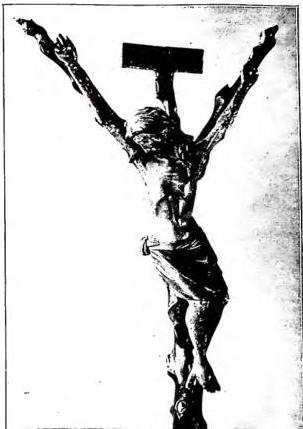
Thus it is that the C., from a sign of ignominy, is changed into a sign of glory and becomes the most common and honored Christian symbol.
Bibliography2 works
Bruno Leoni
IX. THE CROSS IN ART
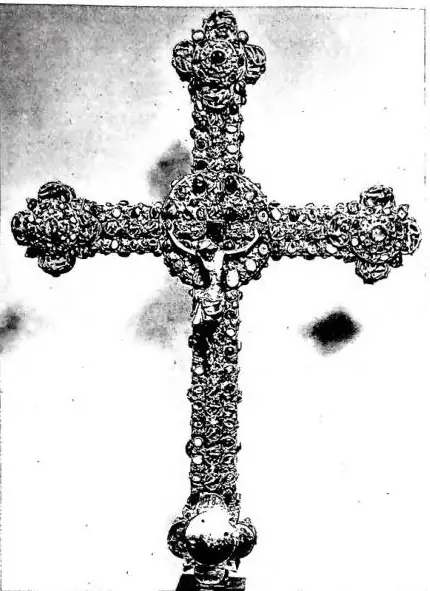
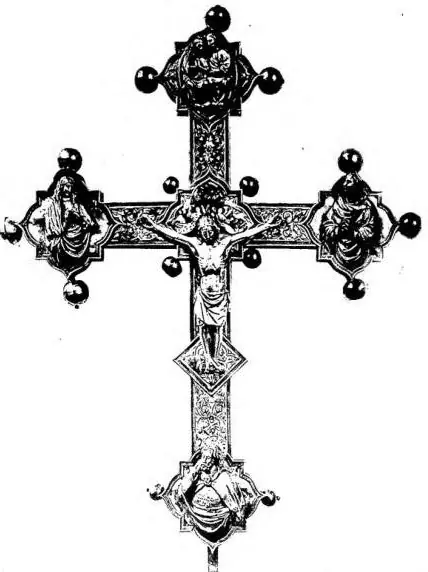
1. Barbarian C
This name is given to the C. found in barbarian tombs, mainly in Italy, but also in France and Germany. They perhaps served for personal devotion, like the pectoral ones, but instead of being hung around the neck they were applied to garments. They are of very thin gold leaf, with small holes so that they could be sewn on. They have braided ornaments, and sometimes extremely crude figures; they have equal arms, and generally measure 7 or 8 cm.; but some more notable examples are exceptions, such as the one in the museum of Innsbruck, coming from Livezzano, about 16 cm. long, and the one found in the so-called tomb of Gisulf at Cividale, adorned with garnets and lapis lazuli. They were in use in the 7th century.
2. Votive C
Precious royal gifts, generally pendants from crowns (v. corona), which were hung above the altars. Among those found in the treasure of Fuente de Guarrazar near Toledo in the last century, the most notable is that of King Recceswinth (8th century, now in the museum of Cluny). Those of the cathedral of Monza are also known, one of which is a gift of Agilulf (591-615), the other is perhaps from Berengar I (888-924). In all of them the gold surface is completely covered with gems and pearls.
3. Processional C. and altar C
In the early Middle Ages, since the priest celebrated standing behind the altar, the cross was not placed above the mensa, but stood to the left, supported by a cross-bearer, and also served as a processional cross. Among the most precious crosses of this time one may recall for the 7th century that of St. Eligius, donated by King Dagobert to the treasury of St-Denis (fragment in Paris in the Cabinet des Médailles); for the 8th century the famous cross known as that of Desiderius in the Christian Museum of Brescia; for the 9th that known as of the Angels and that of the Victory in Oviedo; for the 10th that of Aachen, known as that of Lothair, those of Essen, and that of Munich of Queen Gisela. In these crosses the arms are generally widened toward the extremities, and the gold surface, sometimes made more resplendent by filigree, is covered with gems, together with which classical cameos and engraved stones are also used.
A separate mention among the processional crosses must be made for the one known as del Campo in the old cathedral of Brescia (12th century?) in repoussé silver with figures, extremely rare for its purpose, because it served as a battle standard above the pole of the carroccio.
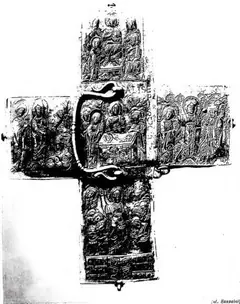
For figured crosses the iconography had been taking shape over the course of the centuries, ever since the encolpia (v.) of Monza. The most frequent type has on the recto the Crucifix, at the ends of the transverse arms the half-figures of the Virgin and of St. John, at the ends of the vertical ones mostly an angel and Golgotha, symbolized by a small mound and a skull; on the back, in the center the cruciform lamb, but more often the Virgin with the Child, and at the ends of the arms the symbols of the Evangelists. But there is no lack of crosses that depart entirely from this iconographic type, such as the cross known as that of Constantine in the Lateran basilica (12th century), in which scenes from the Old and New Testaments are represented.
After the 13th century the cross intended to be placed on the altar is supported by a base, which is sometimes complicated with symbolic ornaments or architectural motifs in the Gothic period, pictorial ones in the Baroque age, and is at times also a support for statuettes, generally of the Virgin and of St. John. But in form and in the technique of decoration, the altar cross follows the same development as the processional cross.
In the 13th century goldsmiths begin to shy away from rigid lines: the extremities of the crosses are lobed, and a second transverse bar (probably a derivation from Eastern types) is above the horizontal arm, with an effect of greater lightness; to the technique of filigree is added that of niello, and the precious stones are arranged with a more spaced-out rhythm (cross of the cathedral of Amiens and of the church of Blanchefosse in the Ardennes). At the same time the Rhenish and Limousin workshops produce crosses covered with champlevé enamels, more modest in material but rich in color (Poldi Pezzoli Museum in Milan, museum of Copenhagen, cathedral of Gerona). In the following century the most precious translucent enamels are used (processional cross of the Schlossmuseum in Berlin, altar cross of the National Museum of Florence), and large knots or rosettes make the outlines more animated. But it is in the processional crosses of the 15th century that Gothic fantasy expresses itself with the greatest exuberance. From the first half of the century are the splendid crosses of the major "schools" of Venice, in rock crystal and silver, all jagged with flowers and little figures of angels. More severe, with a prevalence of plastic elements, are the Abruzzo crosses, among which are noted those of Nicola da Guardiagrele (S. Maria Maggiore of Lanciano, 1422; cathedral of Aquila, 1434). In the Sicilian ones the sumptuousness of the ornament shows Arab-Spanish influences (cross of Mazara, similar to the Spanish one of Cervera), or Catalan ones (S. Martino delle Scale). Gothic nostalgias persist in the first half of the 16th century, but with the advance of the century there is a return to an austere simplicity of outlines, and new chromatic preciousness is obtained with new materials, such as engraved crystal (cross of Valerio Belli in the Victoria and Albert in London) or hardstone; and in the course of the 17th century also coral.
4. Reliquary crosses
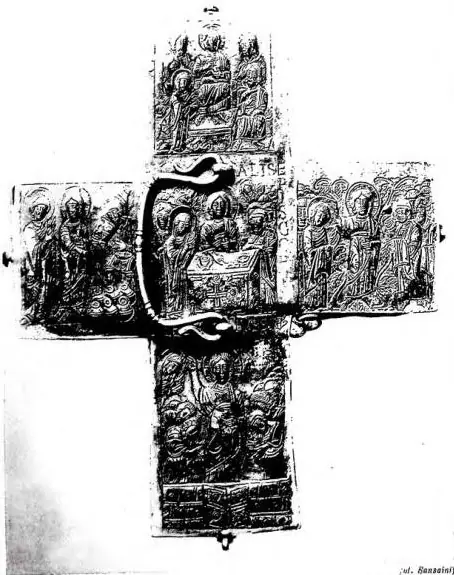
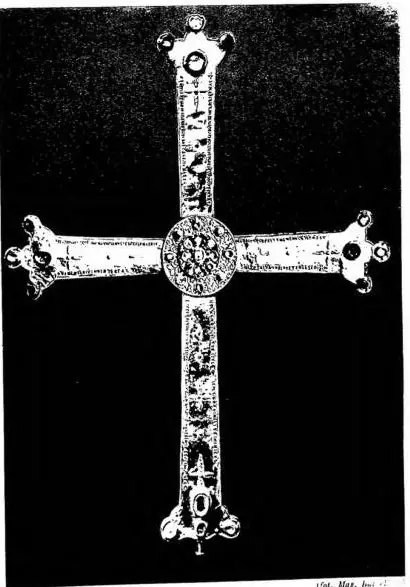
Already in the first half of the 4th century the distribution of fragments of the sacred wood had begun, and the relics were kept by the faithful in ring settings and in pectoral crosses. Those of the churches were kept in precious staurothekes, mostly in the form of a cross, sometimes processional, which do not differ from other crosses in form and ornament, but which have - mostly in the center - a compartment to contain the relic. This is concealed by a lid formed by a large precious stone in the gemmed cross of the Sancta Sanctorum (6th century?); and it was also hidden in the enameled cross with scenes of the infancy of the Redeemer, in the Vatican Museum (from the time of Paschal I). But afterward it is almost always visible through a crystal.
One of the most precious reliquary crosses of the 10th century is that of Limbourg; for the 12th one may recall that of the cathedral of Cosenza and that known as of St. Leontius in the cathedral of Naples, both with plaques of Byzantine enamels; for the 13th that of Genoa known as of the Zaccaria, coming from the spoils of Phocaea, and those of the cathedral of Atri and of S. Niccolò of Pisa, in rock crystal, perhaps of Venetian work, with miniatures on a gold ground shining like enamels. Of the same type is a 14th-century cross in S. Francesco of Assisi; instead, translucent enamels have a cross of Padua and another for various relics in the National Museum of Florence.
These reliquaries generally had a case, often itself cruciform (box of repoussé silver in the Christian Vatican Museum, of the 9th century); but sometimes in the form of a quadrangular tablet in which the staurotheke was set (reliquary of Cardinal Bessarion in Venice).
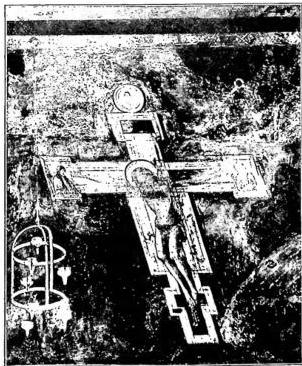
5. Painted crosses
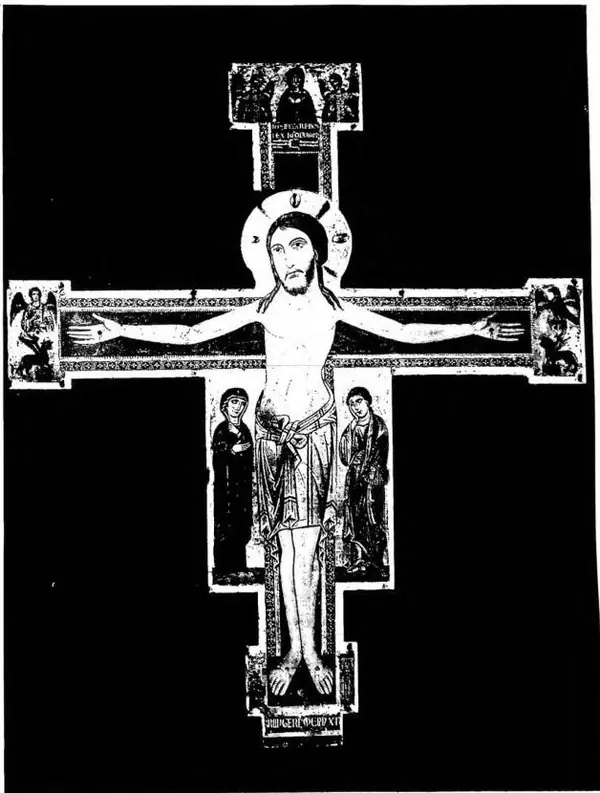
Wooden crosses, shaped, painted with the great image of the Crucifix and with lateral illustrative scenes, are an almost exclusively Italian usage, especially of Tuscany and Umbria. They appear at the beginning of the 12th century, are elaborated with new realism in the course of the 12th, simplified in the iconographic scheme in the 14th, and fall into disuse in the 15th century with the disappearance of the iconostasis (v.). They were in fact placed above the iconostasis, inclined toward the nave, as can be seen in two frescoes of the cycle of Giotto in Assisi (the Nativity at Greccio, and the miracle of the stigmata); in the same cycle the fresco with the prayer in S. Damiano indicates that the smaller crosses stood above the altars.
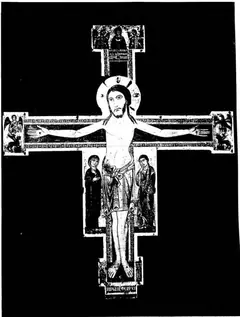
The oldest dated cross is that of the cathedral of Sarzana, painted by a Guglielmo in 1138; but then throughout the 12th and 13th centuries there are no more than nine crosses that can be securely dated. The shaping is varied, and does not follow a logical process of transformation, while the iconographic development is clear, at least for the principal figure: until the middle of the 13th century the Christus triumphans and the Christus patiens are found simultaneously, whereas afterwards the latter type predominates. As for the accessory scenes, one notes that the cymatium always bears the scene of the Ascension; in the lateral panels are represented first the evangelical symbols, figures of prophets, figures of mourners, which are then simplified into the half-figures of the Virgin and St. John; in the central panel, which until the middle of the 13th century is also figured, there are represented in the Umbrian crosses the Virgin and St. John, alone or with other figures of mourners, and in the Pisan crosses compartments with scenes of the Passion. Among the most famous painted crosses of the 13th century are cited those of the Lucchese Berlinghiero and Bonaventura Berlinghieri, those of Giunta Pisano (Assisi, S. Maria degli Angeli; Pisa, S. Ranierino, etc.), who nobly simplifies the iconography, reducing it to the principal personages of the drama, and those of Cimabue (Florence, S. Croce; Arezzo, S. Domenico). Among the 14th-century crosses those of Giotto stand foremost (Florence, S. Maria Novella; Padua, chapel of the Arena), whose human grandeur is sometimes echoed by his followers (the cross of S. Giorgio at Ruballa by Taddeo Gaddi and that of an anonymous Riminese painter in the Malatestian temple at Rimini). At the beginning of the 15th century, from the workshop of Lorenzo Monaco come crosses cut out following the contour of the Crucifix; an innovation not followed in the rare crosses of the middle of the century, which have polylobed terminal panels, as was already in use in the 14th century (the cross of Giovanni di Francesco at S. Andrea a Brozzi).
6. Boundary crosses
Of stone, generally placed on a high pedestal; they stood at the entrance to a village or at the boundary of a property or of a district. The oldest known are those of Newcastle (7th century) and of Hexham (8th century), adorned with low-relief carvings that represent the earliest documents of English sculpture. After the 12th century they are frequent in France, where many were destroyed by the Revolution; in Spain (Avila, gate of S. Vincenzo; Durango); and in Italy, where the best known are those of the streets of Bologna, now in S. Petronio.
Bibliography10 works
Emma Zocca
X. THE TREE OF THE CROSS
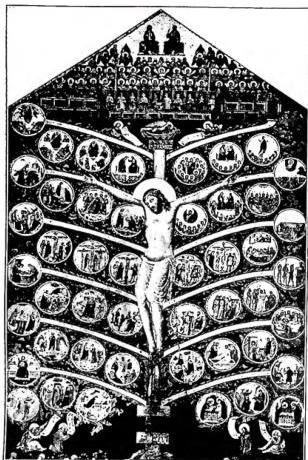
It is a symbolic representation of the Cross of Christ, imagined as a living tree, that is, furnished with branches and leaves, flowers and fruit, as in the author of the hymn Vexilla Regis: Crux fidelis.
The fundamental concept, already traceable in the early Christian era (Tertullian), was explicitly treated by St. Bonaventure in the book Lignum vitae and later taken up again by German mysticism (Master Eckhart, Tauler); among the various types of the tree of the Cross in figurative art, the vine stands out (already in the ancient East a symbol of the tree of life), the rosebush (from a vision of the mystic Suso, 1295-1366) and the oak (symbol of strength). Having already appeared in the initials of German miniatures of the 12th century, and at the same time in the Roman mosaic of the apse of St. Clement in connection with other motifs of early Christian origin, it later became in the 14th century of much wider use in the domain of painting, sculpture and graphic art, as well as in the decoration of vestments. Noteworthy, for Italian art, are the panel by Pacino di Bonaguda (1310, Florence, Accademia) and various Piottesque frescoes. To the 14th century also belongs the great figuration of the Benedictine abbey of Sesto al Réghena in Friuli (cf. Mem. Stor. Forogiul., 38 [1942], pl. 17). For German art, the wooden crucifixes at Zismar and Thorn, a chasuble at Vreden (Westphalia, 14th century) and two woodcuts in the book Der Seube (Augsburg 1482).
Bibliography2 works
XI. THE CRUCIFIXION IN ART
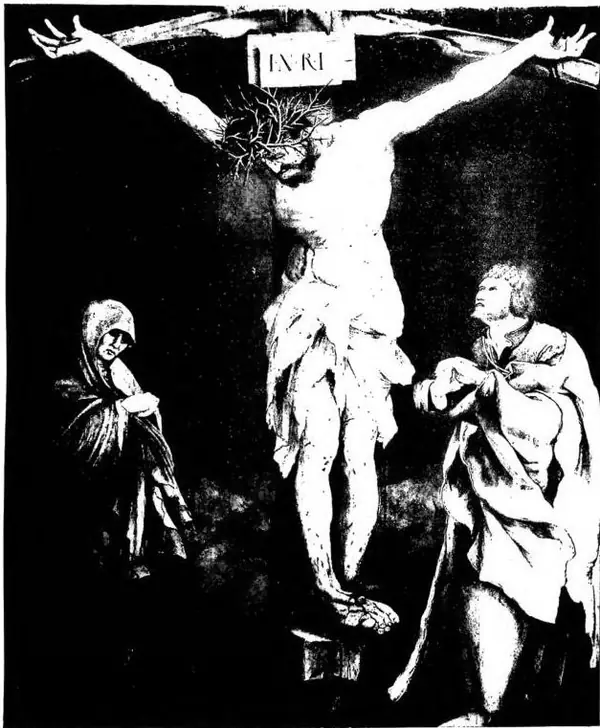
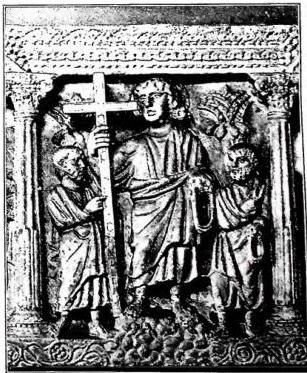
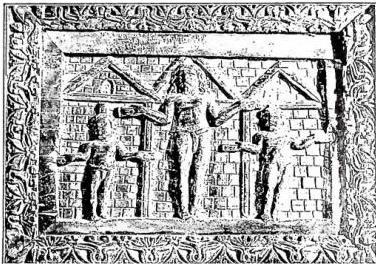
The oldest realistic representations of the scene of the crucifixion go back to the 5th century. Among these one may include the famous panel of the door of St. Sabina in Rome, although there Christ and the thieves have hands and feet pierced by nails but the crosses are not represented. Also to the 5th century must be assigned an ivory in the British Museum in London, where Christ, still alive, appears nailed to the cross, and Longinus is in the act of dealing him the blow of the lance, and nearby are also the Madonna and St. John; a little apart Judas is hanging from the tree. To the 6th century belongs a miniature of the Evangelary of the monk Rabbula, transcribed in Mesopotamia in 586 (Florence, Laurentian Library, Syr. Cod. 56), where the scene is taken up by a miniaturist who follows certain aspects of Hellenistic painting with equally realistic accents and even greater vividness and number of details. In fact here the Redeemer between the thieves, still alive, is clearly fastened to the cross with four nails, wears the colobium (v.), which is a long sleeveless tunic, and below are, besides the Virgin and St. John, three pious women, who express their intense grief; then the soldiers with the lance and the sponge and, at the foot of the cross, the others who cast lots for the garments of Christ. In the sky, on high, the sun and the moon are darkened. The scene is completed below with the other of the Resurrection.
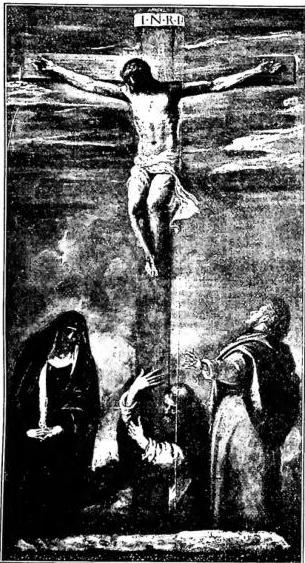
About two centuries later, in the chapel of St. Zacharias in S. Maria Antiqua in Rome, the scene is repeated in a fresco, but simplified. The great image of the crucified Redeemer, still alive and wearing the colobium, balances the composition; at his sides there are no longer the thieves, but on the left the Virgin and Longinus, on the right St. John and the soldier with the sponge. The greater schematization of the scene and the evident tendency toward the hieratic quality of the images depend on clear influences of Byzantine taste.
Meanwhile, while in the East after the iconoclastic controversy a new figuration of the Redeemer is gradually taking shape, who now appears dead on the cross, in Italy, and also in the rest of Europe until the 13th century, the concept of the living and triumphant Christ prevails. Thus also when, as in S. Urbano alla Caffarella near Rome, at the beginning of the 11th century, a popularizing painter insists on the realistic elements of the scene. This nevertheless takes on a new character, beyond the thirteenth-century figurations, whose sense of heartfelt melancholy is to be related to the Franciscan spirit, when
Cimabue in the transept of the upper basilica of Assisi paints the two great crowded crucifixions, where the pathetic accents of Byzantine art acquire irrepressible dramatic force and the drama explodes with a power hitherto unknown. Today of those paintings little more than a shadow remains, enough nevertheless to make us understand their very high value not only pictorial but also religious and human.
A few years later Giotto in Padua, in the Scrovegni chapel, also depicted in the scene of the crucifixion the great figure of the dead Christ nailed to the cross, on the left the group of the Marys and on the right that of the soldiers. The forms have become larger and more solemn, the emotions are more intense even if apparently less dramatic and sorrowful; what Giotto says seems truths awaited for centuries; Christ has just breathed his last, in the sky the angels give free vent to their grief, but on earth the Virgin, St. John and the pious women are petrified by anguish, by dismay; the soldiers, busy arguing and quarreling, are as if absent from the drama, and this detail too accentuates its expressive power.
The master's followers will repeat his scheme or complicate it, as in the crucifixion of the right transept in the lower church of St. Francis at Assisi, but they will not even touch the simple and severe sense of his narration. Nor will Pietro Lorenzetti touch it, despite the highly dramatic accents and the great crowd that throngs at the foot of the cross, in his Crucifixion, likewise in the transept of the lower church of St. Francis at Assisi, nor Barna in that of S. Gimignano, likewise crowded and dramatic for the group of the pious women near the swooning Virgin, the knights, the soldiers and the executioners, nor Andrea da Firenze in the fresco of the Spanish Chapel near S. Maria Novella in Florence.
In a similar manner, with respect to the master's prototype, had acted the sculptors who derived the scheme of their reliefs with the crucifixion from the one sculpted in relief by Nicola Pisano in the pulpit of the baptistery of Pisa and which Giovanni Pisano had taken up with more vivid accents and exasperation of forms in the pulpits of Pistoia and of the cathedral of Pisa.
Masaccio himself, at the beginnings of the Renaissance, was to leave the deep mark of his formidable personality in two crucifixions; he in fact collaborated on the one painted by Masolino around 1423 in S. Clemente in Rome, still along the lines of fourteenth-century compositions, and on the other which was part of the polyptych of the Pisan church of S. Caterina and which is now in the National Museum of Naples. Here, besides the image of the dead Christ on the cross and on the left and right of the Virgin and St. John, is that of the blond Magdalene dressed in red, who has flung herself on her knees to embrace the wood of martyrdom. And that most human impulse of hers, that desperate grief of hers contrasts, by bringing out its majestic solemnity, with the image of the Redeemer erect on the cross, his head as if sunk between his shoulder blades, and with the mute anguish of the Madonna and St. John.
In those same years Beato Angelico in S. Marco proclaimed the drama of the crucifixion with quite different intentions; against the background of a flat, livid brown horizon rise the three crosses, at whose feet are lined up, with the principal personages of the drama, saints and friars of the Order, who, enraptured and sorrowful, contemplate the dead Redeemer on the cross. It is a solemn celebration rather than the re-evocation of the drama.
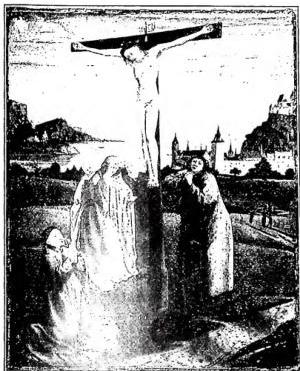
These are two different orientations that are reflected according to the modes proper to fifteenth-century art. Thus, while in one group of works the naturalistic elements are accentuated because in the scene of the crucifixion there are essentially brought out, along with the suffering of Christ, the atrocious grief of the Mother, of St. John and that of the pious women, and in contrast to them the unbridled cruelty of the executioners, according to a taste that, widely diffused in Nordic art, finds correspondences although with different accents also in Italy (Francesco di Giorgio Martini, relief of the Kaiser Friedrich Museum in Berlin), in another group there is maintained that character of calm solemnity to which reference was made above apropos of the Crucifixion of Angelico (Perugino, triptych of Leningrad, fresco in the chapter hall of S. Maria Maddalena de' Pazzi in Florence, Giambellino in his numerous crucifixions), while the scene gradually becomes depopulated and the two thieves no longer appear, nor the soldiers or the executioners.
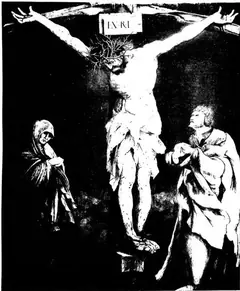
With the early sixteenth century, the resolution of the theme of the Crucifixion seems to turn, in artists who were not lagging behind, more toward the second solution than toward the first, and Michelangelo himself left some of his drawings, barely ideas, later used by his followers (Marcello Venusti, Jacopo del Duca), in which the image of the crucified Redeemer dominates, flanked only by the Virgin and by St. John. But then, in the second half of the century, the new sentiments connected with the great movement of the Catholic Reformation (v.) demanded that the theme be taken up again and expressed in all its dramatic power (Tintoretto, the great Crucifixion of the Scuola di S. Rocco in Venice in 1565), themselves preparing the way for those seventeenth-century forms characterized by a complacent naturalistic representation of the events (Lanfranco, Barberini collection in Rome). Along that path, naturally with the different accents determined by the different age and by the new pictorial and sculptural achievements, some memorable eighteenth-century representations of the drama of Golgotha must also be placed (G. B. Tiepolo in the church of Burano; G. D. Tiepolo in the Crucifixion of the Via Crucis of the church of the Frari in Venice; G. B. Goya in the Crucifixion of the Museo del Prado in Madrid).
The nineteenth-century figurations, in the great majority of cases, do not go beyond the illustrative value of the drama, while the most modern ones aspire, also by means of formal stylizations, to convey the sense of the absolute spiritual dominion of the Redeemer who died on the C.
In medieval and fifteenth-century representations of the Crucifixion, sometimes, at the foot of the C. a skull is depicted; it is meant to recall that, according to a belief widespread in the Middle Ages, the C. of Christ was planted on the tomb of Adam.
Bibliography3 works
Emilio Lavagnino
XII. THE CRUCIFIX IN ART
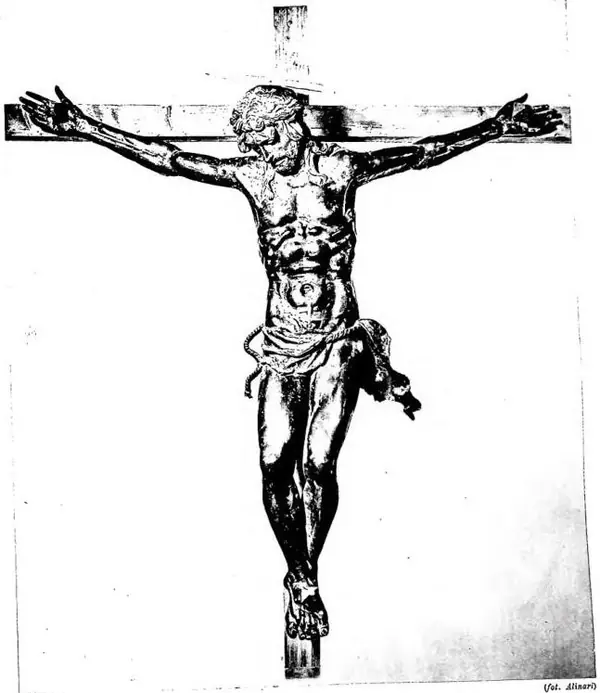
One must reach the Romanesque age to find a true diffusion in sculpture of the iconographic type of the isolated figure of Jesus on the Cross, that is, detached from the more complex scene of the crucifixion, about which see above (XI).
Among the oldest and most famous is to be placed the Crucifix known as "the Holy Face" (v.) of Lucca, of the 12th century, which gathers around itself a very vast series of sculptures in France, Spain and Germany (on the subject see the extensive work of Bréhier, cited in the bibliography). In Italy, the Crucifix of S. Gimignano and the other of S. Paragorio at Noli adhere to the type of the Holy Face, while the other works repeat a different iconography, also modeled on Byzantine models, which represents Christ already expired on the Cross, no longer clothed in the colobium but naked, with the simple perizoma (Crucifix of Archbishop Ariberto in the cathedral of Milan). Another iconographic type of the Crucifix had established itself in the West, prevailing in the northern countries: it depicted Jesus still living and with the royal attributes that magnified the divine sacrifice, as had already been seen in the Holy Face and in works akin to it. This type is found again in the bronzes and goldsmiths' works of Limoges and in the Rhenish and Burgundian Crucifixes, of which a splendid example in Italy is the one in the church of S. Anna at Pisa, derived from the contemporary sculptures of Autun, Vézelay and Moissac. It differed profoundly from the Byzantine forms through the different stylization and modeling of the body, spread throughout all Romanesque art and also reached Italy, though slightly modified by the coexistence of influences derived from the East. Thus in the Crucifixes of the cathedral of Casale and of that of Vercelli, in the other of S. Antimo which, however, of mediocre workmanship, approaches closer to the Burgundian type, in the Crucifix of Perugia and in that of Castelnuovo dell'Abate, a grandiose eclectic product of the end of the 12th century. Among the wooden crucifixes of the 12th century, mention is also made of that of S. Lorenzo Nuovo near Bolsena (1160-68) with the living Christ, as in the Crucifix in S. Pietro in Bologna, and in the other one of Ferdinand III in Innsbruck. Also very beautiful are the Crucifixes of the Turin picture gallery, the Courajod one of the Louvre, and the other one that is in Cologne in the church of St. George, in which Christ hangs from the C. already dead.
With the 13th century the new iconography spreads more and more, affirming a more human and pathetic conception of the sacrifice of Golgotha: the Crucifix is often fastened with three nails instead of four to increase realistic vividness, the torso twists, the legs bend, and the head is completely reclined on the right shoulder.
Once universally admitted into worship, the iconography of the Crucifix nevertheless ceases to be a fixed module and becomes a mere index for the artist's creation, who interprets with his personal vision the sorrowful figure of the Redeemer on the C. Thus Christ still appears alive and serene, a conqueror of every human contingency, in the Crucifix of Pratomagno (church of S. Pietro), which dates from the middle of the 13th century.
Giovanni Pisano in the Crucifix of the museum of the Opera del duomo of Siena, and Lorenzo Maitani in those of the church of S. Francesco and of the sacristy of the duomo of Orvieto, open at the beginning of the 14th century the series of admirable Crucifixes of which Italian art was at every time and in every sort of material, from wood to bronze, to marble, to ivory, to silver, the most conspicuous producer. Of particular beauty is also the great wooden Crucifix of the basilica of S. Paolo in Rome, considered by some scholars, following Vasari, to be a work of Pietro Cavallini. From it derives a notable series of Crucifixes existing in the churches of Rome.
At the beginning of the 15th century Brunelleschi, still feeling the influences of 14th-century iconography, models his wooden Crucifix for S. Maria Novella with the head bowed and the body inert, but impresses upon it a new human realism, restrained and measured, which now belongs to the stylistics of the Renaissance: and Donatello obtains equal results in the wooden Crucifix carved in antagonism with Brunelleschi and in the other one that he cast in bronze in 1447 for the high altar of the basilica of the Santo in Padua. A more placid sentiment of sorrow asserts itself with the advance of the Renaissance and is already evident in works of the first half of the century (Crucifix by Michelozzo in S. Giorgio Maggiore in Venice, by Benedetto da Majano in S. Maria Novella in Florence), beyond which the theme thins out somewhat from sculpture and finds greater place in painting, also through isolated figurations.
In the not numerous examples of the 16th century, however, this humanity of the Crucifix remains alive (marble Crucifix by Alfonso Lombardi in the church of the Servi in Bologna, Crucifix of Impruneta, attributed to Giambologna), and with the Counter-Reformation a conception takes hold that is linked to the regenerative work of the Church, which seeks to stimulate the piety and devotion of the faithful: thus the Crucifix takes on a livid and convulsed appearance that accentuates the realism and pathos of the agony. In fulfillment of the wish of Leo X, Crucifixes are then produced for the altars of churches and are spread in homes for pious use, mostly works of a customary art that models, according to the current iconography, small sculptures in ivory or in other precious material. But from the artisan production many artists stand apart, who create, even in the modest proportions of the altar ornament, works of exquisite workmanship. Thus Alessandro Algardi in the Crucifix of the chapel of the palace of the Governatorate in the Vatican, and Gian Lorenzo Bernini, who provides the clay models of a living Crucifix and of a dead Crucifix for the series of Crucifixes of the altars of St. Peter's, executed, as is established by documents, with the collaboration of his pupils, between 1657 and 1661. And mention should also be made of the school established in Palermo by Gian Francesco Pintorno (Fra' Umile da Petralia) in the same Franciscan convent, which produced a vast number of Crucifixes, mostly wooden, pervaded by a devout sentiment and inspired by a moving realism. Among the best are remembered those in the church of S. Anna at Aidono, in the Franciscan convent of Milazzo, in the churches of S. Giuseppe and of S. Antonino in Palermo, the latter completed by Fra' Innocenzo da Palermo who, having moved to Rome, spread the works of the Sicilian School throughout central Italy (his Crucifixes are in Pesaro and in the church of S. Damiano at Assisi).
Subsequently, more than the works of individual artists, one should cite the artisan productions for church furnishings and a few significant products of modest craftsmen in which the expression of religious sentiment is worth more than mere artistic interest.
Bibliography16 works
Giovanni Carandente
XIII. THE CRUCIFIX IN FOLKLORE
In popular tradition the Crucifix has aroused particular forms of veneration for certain images and has inspired numerous legends that sprang up around those very images. For the most part these are accounts of miracles worked by this or that Crucifix, with a prevalence of the motif of the sacred image struck, which sheds blood, or even water and blood, or moves, or grows pale, or cries out, while the impious offender is reduced to ashes by a thunderbolt or swallowed up by a chasm, or the limb with which he committed the sacrilege remains paralyzed.
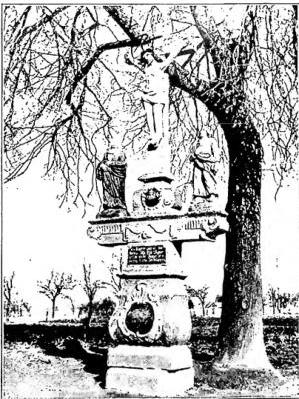
Through the ages these sacrilegious acts were attributed to the Jews, to the iconoclasts, to the Muslims, to unbelievers. Very well known is the anecdote according to which Sixtus V would have broken a Crucifix wrongly believed to be miraculous, pronouncing the phrase: "As God I adore you, as wood I break you." Purely by way of example, let us recall: the Crucifix of the Annunziata in Como, which, according to tradition, broke the chains that blocked the passage of the sacred image across a bridge during the Good Friday procession in the year 1529; the Crucifix of Belice (Caltanissetta), which is venerated on May 3 with particular forms of worship (the singing of a "story" in Sicilian dialect and a pilgrimage on foot, barefoot); and, again in Sicily, the Crucifix of Resuttana, the object of similar forms of devotion.
A curious legend also circulates about the Crucifix of the church of S. Marcello in Rome: to explain its dark color, the common people tell that the artist who carved it killed a charcoal burner who was sleeping, so as to portray with the greatest possible vividness the death throes of a dying man. - See plates LXI-LXV.
Bibliography5 works
Paolo Toschi