
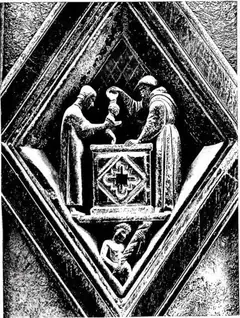
BAPTISM. - One of the seven Sacraments instituted by Jesus Christ, the first that can be received and that allows one to receive all the others: Sacramentorum ianua et fundamentum (CIC, can. 737).
I. DOCTRINE OF BAPTISM.
I. NAME AND DEFINITION
B. (from the Greek βαπτίζω, frequentative of βάπτω = I immerse) means bathing, immersion. The term "B." in Sacred Scripture is not reserved exclusively to the Sacrament instituted by Jesus Christ (cf. Mt. 3:7; Mk. 7:4, 8; Lk. 3:3), nor is it even the only word chosen to designate it (Eph. 5:26; Tit. 3:5; F. Prat, I, p. 551; Oepke, pp. 527-28, 543).
In the holy Fathers the B. of Christ is indicated and described with various names and circumlocutions. St. Gregory of Nazianzus summarizes the varied terminology, saying: "We call it gift, grace, Baptism, anointing, illumination, garment of incorruptibility, washing of regeneration, seal, and by every other most excellent name. It is called gift, because it is given to those who have given nothing beforehand; grace, because it is granted to one who is rather a debtor; Baptism, because sin is buried in the water; anointing, because it is sacred and royal... illumination, because it is splendor; garment, because it covers our ignominy; washing, because it purifies; seal, because it preserves and is a sign of dominion" (In S. Baptisma, oratio 40, 4; PG 36, 362-63; cf. St. Cyril of Jerusalem, Protocatechesis, 16; PG 33, 360-61; Pseudo-Basil, Hom. 13, 5; PG 31, 434; St. John Chrysostom, Catech. I ad illuminandos, 2; PG 49, 225-26). Among these appellations, particularly noteworthy for the theological thought they imply and the developments to which they will give occasion are those of illumination, seal, character, which are already found in the earliest Fathers (e.g., Justin, I. Apol., 61 [testimony to the spread of the term: F. Prat, I, p. 507, note 1]; Pastor Hermae, Simil. 8, 2.4; 9, 16.17 [F. X. Funk, Patres Apostolici, I, Tübingen 1901, pp. 559, 561, 609, 611]; Abercius, Epitaph, v. 9; St. Ephrem, Hymni de oleo et oliva, 4 [ed. T. J. Lamy, 4 vols., Malines 1882-1902, II, p. 805 ff.] etc. Cf. J. Coppens, pp. 313-14).
With the passing of the centuries, the meaning of the terms gradually crystallized, and although a great variety of expressions remained in use, the classic and technical term for indicating the Sacrament instituted by Jesus Christ became that of B. Subsequently, scholastic theology, rather than seeking new names and periphrases, preferred to apply itself to the systematic and profound study of the Sacrament in its various aspects. The fruit of this study was exact and precise definitions. These reduce, according to the canons of the time, to two types: those that reveal especially the "visible components" of the baptismal rite (definitio physica), and those that reveal "the specific element" that differentiates it from the other Sacraments (definitio metaphysica). Outside of strictly scholastic schemas, the authentic magisterium of the Church proposes to the faithful this definition: "B. is the Sacrament that makes us Christians, that is, followers of Jesus Christ, sons of God and members of the Church" (Catechism of Christian doctrine published by order of Pius X). Cardinal P. Gasparri, with a less concise definition, says: "B. is the Sacrament instituted by Jesus Christ, by means of which the baptized person: 1) becomes a member of the mystical body of Jesus Christ, which is the true Church; 2) obtains the remission of original sin and of all actual sins that he might have on his soul and of all the punishment due to them; 3) becomes capable of receiving the other Sacraments" (P. Gasparri, Catechismo per gli adulti, 2nd ed., Brescia 1934, p. 130).
The definitions cited agree with the terminology of the holy Fathers on one essential point: B. is a rite of great richness of content. A richness expressed by the Fathers of the Church with the multiplicity and variety of their terms, by theologians with the determination and coordination of concepts.
II. INSTITUTION
It is a truth of faith that the Sacrament of B. was instituted in his Church by Jesus Christ. Although Holy Scripture does not say so in express terms, nevertheless the equivalent terms that it employs leave not a shadow of doubt.
Jesus, in fact, says to Nicodemus: "Unless one is born of water and the Holy Spirit, he cannot enter the kingdom of God" (Jn. 3:5). Here the water is the outward and sensible rite; the intervention of the Holy Spirit indicates its sanctifying effect; their joint action opens the kingdom of heaven and produces in the soul a new life of an order superior to the natural life (cf. further on, III, n. 4). The text also teaches in universal terms the necessity of this baptismal rite; equally universal are the terms with which the command to baptize is promulgated: "All power has been given to me in heaven and on earth. Go, therefore, and instruct all nations, baptizing them in the name of the Father and of the Son and of the Holy Spirit" (Mt. 28:19); "Go into all the world and preach the Gospel to every creature. Whoever believes and is baptized will be saved; whoever does not believe will be condemned" (Mk. 16:15-16). According to these texts, Jesus therefore established in principle the necessity of B. and ordained its use in his Church.
For this reason the Apostles administered B. from the very day of Pentecost (Acts 2:41). The deacon Philip administers it to the converts of Samaria, and, along the road to Gaza, to a high official of Ethiopia (Acts 36-38). Peter, to the question of his hearers, "What must we do?", answers: "Do penance and let each of you be baptized in the name of Jesus Christ for the remission of your sins" (Acts 2:38). B. is also given to persons sent by God in a miraculous manner, for example, to the centurion Cornelius (Acts 10:47) and to Paul (Acts 9:15). Now the Apostles could not have administered B. in so universal, determinate and formal a manner, "in the name of Jesus", unless they had received from him both the command and the doctrine. This doctrine St. Paul further develops in its most recondite and mystical meanings: there is only one B., as there is only one Christ (Eph. 4:5); B. brings the imprint of the Holy Spirit (II Cor. 1:21-22); it clothes us with Christ (Gal. 3:27); it makes us mystically relive the death and resurrection of Jesus (Rom. 6:3-4); etc. (cf. further on, III). B. thus appears immediately in the teaching and practice of the Apostles as a rite accompanied by doctrine concerning its efficacy.
The dogma of the institution of B. was defined by the Council of Trent where it declares, under penalty of anathema, that all the Sacraments of the new law were instituted by Jesus Christ (Sess. VII, can. 1; Denz-U, n. 844). Against the theory of liberal theology and of modernism, which would derive Christian B. from the rites of purification in use among various peoples, and also among the Hebrews, the Church condemned in the decree Lamentabili this proposition: "It was the Christian community that introduced the necessity of B., adopting it as a necessary rite and attaching to it the obligations of the Christian profession" (Denz-U, n. 2042; cf. n. 2088).
The moment of the institution of B. is not indicated to us by Scripture; and the Fathers and theologians hold to different opinions. Some think that Jesus instituted it at the moment when he himself was baptized in the Jordan (Mt. 3:13); the water, then, would have received a purifying power (St. Ambrose, In Lc., II, 83; PL 15, 1665; St. John Chrysostom, In Mth. hom. 12, 3; PG 57, 206; St. Thomas, Sum. theol., 3ª, q. 66, a. 2; Catechismus Romanus, part 2, ch. 20, n. 19). Others, instead, choose the moment of Jesus' conversation with Nicodemus (Jn. 3:1-21); still others the moment when Jesus, before ascending to heaven, gave the Apostles the command to baptize (Mt. 28:19). Bringing the three points of view together, one may say with St. Albert the Great (In IVª Sent., dist. III, a. 3) that the B. in the Jordan determined the matter of the Sacrament, the command given to the Apostles to baptize expressed its form, the discourse with Nicodemus indicated its end; the blood and water that flowed from the side of Jesus on the cross conferred its power and efficacy (cf. also St. Bonaventure, In IVª Sent., dist. III, part 2, p. 1, a. 1).
III. MEANING AND EFFECTS
Baptism presupposes and cannot prescind from Catholic doctrine on the condition of man in the state of sin, on redemption, and on the manner in which redemption is applied to individuals.
According to Catholic doctrine, Adam was created in a state of justice and holiness, free from evil inclinations, immortal. He sinned and dragged all his descendants into ruin. Now men are born sinners (original sin), subject to the violence of the passions which they do not know how to resist (Rom. 7:14-25). They fall and rivet their chains ever more firmly. Sin holds them beneath itself as slaves (Rom. 6:17, 20; John 8:34; 2 Pet. 2:19); they are subject to the devil as subjects to their head (John 12:31; 14:30). The devil is the god (θεός) "of this world" (2 Cor. 4:4; 1 Cor. 2:6; Gal. 2:15).
The power of Satan was shattered by Jesus Christ the redeemer. But the vanquished devil has not abandoned the world. He continues to struggle (1 Pet. 5:8). His attempt will have no end except with the end of the world. Jesus Christ has his apostles, he has his "antichrists," "who are many" (1 John 2:18) and are zealous in sustaining the effort of their head who tries to supplant God, to put himself in his place, and to make himself adored (1 John 2:18-22; 2 Thess. 2:3-12. Cf. A. Charue, in L. Pirot, La Sainte Bible, XII, Paris 1946, pp. 179-85, 530-32; P. De Ambroggi, Le Epistole cattoliche, in S. Garofalo, La Sacra Bibbia, XIV, 1, Turin 1947, pp. 217-19; H. Rahner, pp. 239-73).
This is the situation in which every man finds himself: a sinner because a descendant of Adam, and, if an adult, a sinner by personal sins; salvation, purification from his faults and liberation from the dominion of Satan he can find in Jesus Christ and only in Jesus Christ (Acts 4:12). He must choose between Jesus Christ and Satan. He cannot remain neutral: either he is with Christ or against Christ (Luke 11:23). With Baptism the passage from Satan to God is marked.
1. Drawing near to the cross of Christ
The central moment of the life of Jesus Christ is the moment of his death. Then redemption was accomplished. Jesus Christ saved the world by dying for it. But St. Paul warns us that Jesus Christ did not die alone. To the Corinthians he writes: "The love of Christ spurs us on, thinking that one died for all [ὕπερ πάντων] and therefore all have died" (2 Cor. 5:14) ideally and mystically in him and with him. All have died, that is, they became sinners "in Adam" by the very act of his disobedience and become sinners "in fact" at the moment of their natural generation, because then they become in fact members of the sinful human family. In an analogous way, all are justified "ideally and by right" on Calvary, with the death of Jesus Christ, "in fact and really" at the moment when they come into contact with the death of Jesus Christ (J. Cools, p. 305; F. Prat, pp. 243-44).
Contact with the death of Christ takes place in Baptism. It is the application of the sanctifying power of the Passion to every Christian (C. Spicq, p. 384). Here are two fundamental texts of St. Paul: "Do you not know that all of us who were baptized into Christ Jesus (εἰς Χριστὸν Ἰησοῦν) were baptized into his death? We were therefore buried with him in death
(συνετάφημεν) through Baptism so that, as Christ was raised from the dead by the glorious power of the Father, we too might walk in newness of life" (Rom. 6:3-4). "In him [Christ Jesus] you were circumcised with a spiritual circumcision (not made with hands) which completely strips off the carnal body, that is, with the circumcision of Christ. Buried with him (συνταφέντες) in Baptism, with him you were also raised through faith in the power of God who raised him from the dead. And while you were dead in your sins and in the uncircumcision of your flesh, God gave you life with him (συνεζωοποίησεν) forgiving you all your sins" (Col. 2:11-13).
The content of these dense verses can be ordered into three concepts: 1) with Baptism the Christian is incorporated into Christ; 2) purified from every fault; 3) regenerated.
2. Incorporation into Christ Jesus
The doctrine set forth in the cited verses is not new in the Pauline epistolary.
To the Christians of Corinth St. Paul has already written that as in the human body there are many members and yet the body is one, «so also is Christ. For we were all baptized, whether Jews or Gentiles, whether slaves or free, in one Spirit into one body... you are the body of Christ» (1 Cor. 12:12, 13, 27; cf. J. Huby, Première Épîtr. aux Corinthiens [Verbum Salutis, 13], Paris 1946, pp. 288-89). To the Galatians he said that by being baptized into Christ one puts on Christ and every difference originating in race, civil condition, or sex falls away: «you are all one in Christ Jesus» (Gal. 3:28). Whether one interprets the preposition εἰς of Gal. 3:27, Rom. 6:3, and 1 Cor. 12:13 in an almost local sense, saying that Christ is, as it were, the element, the medium in which Baptism immerses us (F. Prat, I, pp. 552-53; J. Bover, Teologia de s. Pablo, Madrid 1946, pp. 64-65), or more simply as a relation of mystical belonging (J. Coppens, s. v. in DBs, I, col. 897), it always remains true that Baptism really unites us with Christ. This assertion is confirmed by many other expressions of St. Paul and of the New Testament in general, in which the Christian life is described as beginning and unfolding in union with Jesus (cf. Eph. 2:5-7; Col. 2:20; 3:3; 1 Pt. 3:21; Phil. 3:10, etc.). Particularly worthy of note are the expression so frequent in St. Paul, «in Christ Jesus» (cf. F. Prat, p. 478; M. R. Weijra, In Christo Iesu, in Revue Thomiste, 55 [1947], pp. 499-517; J. Bonsirven, L'Évangile de Paul, Paris 1948, pp. 241-42), and the group of words compounded with the preposition (σύν), forged and used to indicate the unfolding of the events of the Christian life in contact with the events of the life of Jesus (for example, συναποθνήσκειν = to die together [with Jesus Christ], συνθάπτεσθαι = to be buried together [with Jesus Christ], συζωοποιεῖν = to give life in [Jesus Christ], σύμμορφος = of the same form [as Jesus Christ], etc. List in F. Prat, I, p. 21; J. Bonsirven, ibid.).

The body of Christ is the Church (Eph. 1:23). Through Baptism one enters and becomes part of it. For the Church the Savior «went to his death, to sanctify her, purifying her in the bath of water [by means of the word]» (Eph. 5:26; cf. A. Médebielle, in L. Pirot, op. cit., p. 67). According to Huby, St. Paul here says that, in the divine intention, the Church as a society comes before the individual faithful. The Christian adheres to Christ and becomes an heir of God because he enters the Christian community, which cannot fail in the purpose for which it was founded. Individual Christians can fail and render the Passion of Christ fruitless; the Church, however, as a unity, cannot. (J. Huby, Mystiques Paulinienne et Johannique, Paris 1946, pp. 30-31). Baptism thus proves to be a Sacrament of profound social significance. In receiving it, relations with other Christians cease to be merely relations between man and man: they become relations between members of one and the same body. Rightly did schism, which breaks the unity of the body of Christ, always inspire horror in Christians and was cursed as heresy (cf. H. de Lubac, Catholicisme, 4th ed., Paris 1947, pp. 51-52).
In entering and becoming part of the mystical body of Christ one receives the gift of the Holy Spirit. The Holy Spirit is the Spirit of Christ, and whoever does not possess him is not a Christian (Rom. 8:9). The Holy Spirit teaches one to invoke God as Father (Rom. 8:15-17; Gal. 4:6), to judge spiritual and supernatural things (1 Cor. 2:10, 16) and, in general, to think and judge as Jesus Christ thought and judged (Phil. 2:5; F. Mura, Le Corps Mystique du Christ, 2nd ed., I, Paris 1936, pp. 198-201; J. Duperray, Il Cristo nella vita cristiana secondo s. Paolo, trans. G. Montali, Riccione 1934, p. 70; L. Cerfaux, La théologie de l'Église suivant s. Paul, 2nd ed., Paris 1948, pp. 182-99).
3. Remission of sins
With incorporation into Christ the divine plan concerning the salvation of humanity is fulfilled. God's eternal plan is to bring all to salvation through Jesus Christ. God created men so that they might be holy and immaculate before him in charity; he predestined them to become his adopted sons through Jesus Christ, in whom men find redemption and the remission of sins; he wills that all things be united in Christ so as to be brought to God in Christ (Eph. 1:4-6, 10; J. Huby, Les Épîtres de la captivité [Verbum Salutis, 8], Paris 1935, pp. 153-61). This divine plan of salvation embraces all, even the pagans, who, no less than the Jews, are destined to be co-heirs, concorporate [σύσσωμα], partakers of the goods promised to the Hebrews in Jesus Christ (Eph. 3:4-6). This is the great mystery that Paul must proclaim to the world (D. Deden, Le «Mystère» paulinien, in Ephemerides Theologicae Lovanienses, 13 [1936], pp. 20-22; C. Spicq, p. 116 ff.).
The unity in Christ that is in the divine designs becomes a reality in Baptism. It must therefore make men immaculate and holy, taking away their sins, which make union with Christ impossible and would nullify the divine design of salvation. In fact Baptism is the tomb of sin. Not merely in the sense of a legal fiction, by virtue of which God considers just what in reality is not so, or in the sense of a simple conversion of the heart that no longer wishes to return to sin, but in the sense of the true and full destruction of the sins committed. The texts of St. Paul do not say «to die to sin,» but «you have died to sin,» buried as Christ was buried in his tomb; the body of sin was crucified together with Jesus (Rom. 6:3-6). In Rom. 5:12-21 it is affirmed that the liberation from sin worked by Jesus Christ is as real as the sin that men contract in Adam; indeed, if the sin of Adam was great and efficacious, the work of Christ is still greater and more efficacious, because where the trespass abounded, grace abounded all the more (vv. 1, 6, 17, 20). Before descending into the baptismal pool one could have been fornicators, idolaters, adulterers, effeminate, thieves, drunkards, etc.: in Baptism all this falls away, one becomes clean, holy, just (1 Cor. 6:9-11). «For those who are in Christ Jesus there is now no condemnation» (Rom. 8:1). Sin is dead. Original sin and actual sin. St. Paul makes no restriction or limitation: everything that is sin in the true sense of the word is dead.
The Fathers of the Church extol the purifying power of Baptism both in frequent direct affirmations (cf. C. Pesch, n. 399) and by saying that the water of Baptism is the tomb of the earthly life and the maternal womb of the new heavenly life. (Clement of Alexandria, Stromata, IV, 25, 160; Cyril of Jerusalem, Catechesis mystagogica 3, 2-4; PG 33, 1078-80; Pseudo-Dionysius, De cael. hierarchia, II, 2, 7; PG 3, 396; Augustine, Sermo 119, 4; PL 38, 674; Pseudo-Augustine, De Symbolo ad catechumenos: PL 40, 659, etc.). Or else, taking their cue from St. Paul (I Cor. 10, 2-5, 11), they like to find a parallel between the historical fact of the Exodus of the Hebrews from Egypt with the crossing of the Red Sea, and the spiritual event of the departure from the state of sin through the pool of baptismal water. The historical fact that happened to the Hebrews is the image of what happens to the Christian in the pool of Baptism: God works for him what he worked for the Hebrews in the crossing of the Red Sea. "Whoever therefore affirms that Baptism does not totally remit sins, let him say that in the Red Sea the Egyptians did not truly die. But if he admits that the Egyptians truly died, he must also admit the full remission of sins in Baptism" (St. Gregory the Great, Epist., XI, 45; PL 77, 1162; cf. J. Daniélou, pp. 402-30). Or again they say that the cross of Christ sanctifies the water and from common water makes it sanctifying water (e.g. St. Ambrose, De Mysteriis, 4, 20; PL 16, 394; St. Augustine, Contra Iulianum, VI, 19, 62; PL 44, 861; id. De Catechizandis rudibus, 20; PL 40, 425, etc.). This same thought of the cross of Christ that sanctifies the water the ancient writers and artists express by representing or speaking of the cross planted in the middle of the Jordan to sanctify the water that generates Christians (H. Rahner, Griechische Mythen, pp. 114-17). The Roman liturgy of the consecration of the baptismal font has symbolically rendered the same concept by having the priest who blesses the font stand over the water in the form of a Greek V (the V indicates the tree of life, the cross that fecundates the waters) and by having a lighted candle immersed in the font while the antiphon is sung: "may the fullness of the Holy Spirit descend into this water," a symbol of Jesus Crucified who descends into the water and grants it the powerful light of the Spirit and of life (cf. H. Rahner, ibid.; for the concept of Jesus Christ as light, M.-J. Lagrange, Évangile selon s. Jean, Paris 1925, pp. CLXI-CLXII; F. J. Dölger, Sol Salutis, Münster in W. 1925).
The doctrine of Baptism as destroyer of sin displeased especially the reformers of the 16th century. For them concupiscence, understood as a tendency, is already sin, and consequently Baptism, which does not free us from evil inclinations, does not free us either from all that is sin.
On this subject the Church had already expressed itself directly and explicitly in the Council of Florence. The Decretum ad Armenos affirms as an effect of Baptism "the forgiveness of all original and actual guilt and also of all the punishment that is due for them. Therefore no penance is to be imposed on the baptized for sins committed, and if they die before sinning again, they go straight to paradise" (Denz-U, 696). And it had pronounced itself indirectly long before, placing among the articles of faith necessary to be believed by every Christian, that Baptism is "for the remission of sins" (Creed or Nicene-Constantinopolitan Symbol, Denz-U, 86), "of all sins, both of original sin which is contracted, and of those which are committed voluntarily" (Innocent III, profession of faith prescribed for the Waldensians [Denz-U, 424]; cf. Council of Lyon [Denz-U, 464]; constitution Benedictus Deus of Benedict XII [Denz-U, 539]).
Since this constant teaching had not been sufficient to restrain the Protestants, the Church formulated its thought anew in the Council of Trent. Can. 5 of session V establishes that all that is sin in the true and proper sense is really "taken away" by Baptism and not simply "not imputed." In those who were regenerated in Baptism there is no longer anything that is an object of hatred on God's part. They have become pure, innocent, immaculate, without guilt and beloved of God. Nothing prevents their entry into paradise. The Church knows that, even in the baptized, concupiscence remains, that is, the tendency to evil, but she teaches that it is a trial for man and brings no harm to those who do not consent to its inclinations and strive against them manfully (Denz-U, 792). It is true that in the discussions prior to the definition of this canon, some voice of sentiment not too far removed from the religious innovators had made itself heard more than once, proposing to remove, as though they were inaccurate, the words "in the regenerate God hates nothing" (nihil odit Deus), but the conciliar fathers did not yield. The official and infallible teaching of the Church sanctioned once again that with B. sin is entirely taken away (cf. Concilium Tridentinum, ed. Societas Goerresiana, V: Actorum pars altera, ed. S. Ehses, Freiburg im Br. 1911, pp. 105-256 and passim).
In B. the past is buried with Jesus Christ and dies. A new life is born. Death and life are total terms. In death every activity ceases; in B. sin dies and with it dies everything that is its work, including the obligation of punishment. A new life begins which feels the past only insofar as it gives life and unfolds its activity through a nature that was the instrument of the sin by which it was ruined and made inclined to evil.
4. Regeneration
The great text of Rom. 6:3 ff. presents B. under the twofold aspect of union with the death of Christ, which destroys sin, and of union with the resurrection of Christ, which introduces into a new life. The immersion of the rite symbolizes death and burial; the emersion, resurrection and life. For Jesus Christ, death, burial and resurrection were real. Likewise for the Christian, the death and burial of sin are real, and the resurrection to new life is real.
The new life of the baptized is not constituted by the resolve to change one's conduct. The Christian as such is the effect not of an evolution brought about in his conduct, but of a creation (II Cor. 5:17; Eph. 2:10, 13 [ἐκτίζω], Gal. 6:15), of a regeneration: "(God) saved us through the washing of regeneration and renewal of the Holy Spirit, which he poured out upon us richly through Jesus Christ our Savior, so that, justified by his grace, we might become heirs in hope of eternal life" (Tit. 3:5-7). Thus Paul, at the end of his life, sums up his teaching in a few words. St. John, alluding to the result of this regeneration which makes us children of God, will say: "See what great love the Father has given us, that we should be called children of God and indeed are" (καὶ ἐσμέν: I Io. 3:1). That we are called children of God is not a mere title or a legal fiction, it is due to our real state (cf. P. De Ambroggi, in S. Garofalo, La Sacra Bibbia, XIV, 1, Turin 1947, p. 223). The Jewish people prided itself on being the chosen people par excellence, and is in fact called by St. Paul an "adopted" people (Rom. 9:4); but in comparison with Christians it can no longer be called "son." Only in Christ are we truly adopted as sons (Gal. 4:5; F. Amiot, Epître aux Galates [Verbum Salutis, 14], Paris 1946, pp. 190-91; E. Mersch, La Théologie du Corps Mystique, II, ibid. 1946, pp. 16-49). In comparison with Christians the Jewish people is in the condition in which the son of a slave woman stood in ancient society in relation to the son of the free wife (Gal. 4:21-31; F. Amiot, op. cit., pp. 200-206; L. Cerfaux, La théologie de l'Église suivant s. Paul, 2nd ed., Paris 1948, pp. 127-29). The reason for this difference lies in the fact that the regeneration of Christians proceeds from a heavenly and divine principle, which does not limit its action to an external and legal recognition, but penetrates into the innermost being and there causes the life to spring up for which the title "child of God" is a just title. Nicodemus is amazed at having heard Jesus say that whoever is not born ἄνωθεν (again, or, from above) cannot enter the kingdom of God, and asks Jesus: how can a man be born when he is already old? can he perhaps enter his mother's womb a second time? Jesus answers him: "Truly, truly, I say to you: whoever is not born of water and the Holy Spirit cannot enter the kingdom of God" (Io. 3:5). Whether the ἄνωθεν of v. 3 means "again," as many exegetes hold, or means "from above," as many other exegetes hold (cf. J. Coppens, in DBs, I, coll. 865-66), or whether John, in writing this word, had both senses in mind, as still others hold (J. Huby, Mystique Paulinienne et Johannique, Paris 1946, p. 156), it is certain that Jesus speaks of a true rebirth. The terms used and the bearing and words of Nicodemus prove it (V. Iacono, La Παλιγγενεσία, pp. 376-80). The principle of this new life, together with the water, is a heavenly and divine principle, the Spirit (πνεῦμα; J. Coppens, ibid.). With an even stronger term, St. John in his I Letter calls Christians "born of God," having within themselves a seed of him (σπέρμα αὐτοῦ: I Io. 3:9; cf. ibid., 2:29; 3:13; 4:7 and P. De Ambroggi, op. cit., p. 227).
With this rebirth one begins to live that life which, in its fullness, is possessed by the Father, is transmitted by the Father, always in its fullness, to the Son, and by the Father and the Son to the Holy Spirit (Io. 5:26). This life, which is the dominant theme of the whole Gospel of St. John (J. B. Frey, Le concept de «vie» dans l'évangile de s. Jean, in Biblica, 1 [1920], pp. 37-58; 211-39). Jesus has the mission of bringing it to all men, and for this he came into the world (Io. 10:10). And in reality, all those who accept him and his doctrine are given life by him (Io. 1:12-13) and made "partakers of the divine nature" (II Pt. 1:4).
The intimate nature of this life that God gives us remains for us, who, living on earth, know spiritual and heavenly things only by reflection (I Cor. 13:12), a mystery. It is revealed to us in part through the more than human life and experiences of the saints, but its intimate essence and its inner value escape us. They will be fully unveiled in heaven (I Io. 3:1-4).
The process that has as its term the regeneration in the sense indicated, we owe to the heavenly Father, from whom the initiative of redemption came (F. Prat, I, p. 91 ff.; P. Bonnetain, Grâce, in DBs, III, col. 1008 ff.). St. Paul says expressly that God "saved us through the washing of regeneration and renewal of the Holy Spirit, which he poured out upon us richly through Jesus Christ our Savior" (Tit. 3:5). B. is the place of convergence of the action of the divine persons. The Father applies to individuals with B. the merits of Christ's passion, sanctifying them with the intervention of the Holy Spirit who gives life and renews the neophyte interiorly.
In the fact that B. works a rebirth, theologians have always seen the intimate reason why B. remits every sin and every punishment due for sin (cf. St. John Chrysostom, Catechesis I ad illuminandos, 3; PG 49, 226-27; Sum. Theol., 3ª, q. 69, aa. 1-2). St. Paul adds that the rebirth worked by B. is a beginning and a point of departure, not a definitive point of arrival. The Christian is a new being but is also a being who is continually renewed (II Cor. 4:16). The life received invades ever more completely the activity of man, develops and grows every day, until it reaches adulthood, until it is a "mature" man in the Christian life, as Jesus Christ was (Eph. 4:12-16; C. Spicq, loc. cit.).
5. Character
God the Father predestined Christians to be conformed to his Son (Rom. 8:29). Baptism responds to God's desire, incorporating the faithful into Christ and making them live with the supernatural life that is found in its fullness in Jesus. It is a first way of becoming "conformed" to Jesus. It is not the only one. The sources of revelation know of another.
Revelation says: a) Baptism is the sacrament that is received first in order of time. It is "the door of the spiritual life" (Decretum ad Armenos, Denz-U, 696). Without Baptism no other sacrament can be received. An unbaptized person, even if he knows Christian doctrine, believes it, and is repentant of his sins, cannot be absolved in confession; that is, not only must he not be absolved, but if he found a priest who absolved him, the absolution would be as if it had not been given. Two Christians who marry, even if they are in a state of sin of which they are not repentant, commit sacrilege, but they truly receive the sacrament of Matrimony, and they administer it. Two unbaptized persons, on the other hand, even if they have a faith more alive than that of the two Christians just mentioned, and are in the grace of God, if they marry, neither receive nor administer the sacrament of Matrimony.
These differences indicate that Baptism leaves in the soul something that remains even when sanctifying grace has already been lost.
b) Baptism is received only once. This doctrine was one of the pivots on which the defenders of the validity of the sacraments administered by heretics rested their case.
c) Together with the two preceding affirmations there is the doctrine of the sacrifice of the Mass as the sacrifice of the Church and of the priesthood of the faithful (cf. 1 Pt. 2:9; Pius XII, encyclical Mystici Corporis of 29 June 1943, in AAS, 35 [1943], pp. 232-33).
d) There are finally the numerous affirmations of the Fathers who speak of a seal (in the passive sense of an impressed image), of a distinguishing mark received in Baptism, indelible, which makes the Christian discernible from one who is not a Christian, and makes him capable of receiving the other sacraments. Some Fathers see an indication of this distinguishing mark in three texts of St. Paul (Eph. 1:13; 4:30; 1 Cor. 1:21-22) that speak of a σφραγίς (= seal) impressed by the Holy Spirit on Christians and on the Apostles (for example, St. Cyril of Jerusalem, Catechesis 17, 35; PG 33, 1010; St. Athanasius, Epist. I ad Serapionem, 23; PG 26, 583; St. Basil, Homilia in S. Baptisma; PG 31, 431; St. Ambrose, De Spiritu Sancto, I, 6, 78; PL 16, 723; St. John Chrysostom, In II Cor. homilia 4, 7; In Eph. homilia 2, 1; PG 61, 418; 62, 18). St. Basil calls it the distinguishing mark that makes known those who are of God. Whoever does not have this mark will not be spared, just as the houses marked with blood were not spared when the destroying angel passed by (Homilia in S. Baptisma 1; PG 31, 431).
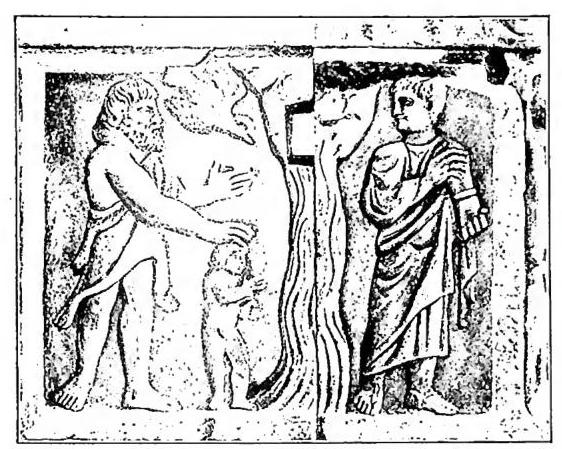
A passage of Theodotus, preserved by Clement of Alexandria, speaks of the image of Christ that is impressed on Christians as on the coin, presented to Christ by the tempting Pharisees, was impressed with the effigy of the emperor (Clement of Alexandria, Excerpta ex scriptis Theodoti, nos. 83, 86, ed. F. Sagnard [Sources Chrétiennes, 23], Paris 1948, pp. 206-209, 210, 235). St. Ephrem compares it to the imprint that a ring leaves on wax (in G. S. Assemani, Biblioth. Orient., I, 94). Others call it a sign that puts the demons to flight and indicates to the angels the souls to be received (St. Cyril of Jerusalem, Catechesis 17, 36; PG 33, 1010; St. Gregory of Nazianzus, In S. Baptisma, orat., 40, 15; PG 36, 378; St. Gregory of Nyssa, Oratio adversus eos qui Baptismum differunt; PG 46, 423). Still others insist on the notes proper to this seal, calling it holy, spiritual, salutary, impressed in the soul, in the heart, unbreakable, inamissible, which remains even in the deserters who have passed over to the camp of Satan (Tertullian, De Baptismo, 6; De resurrectione carnis, 8; De publicitia, 9; St. Cyprian, Epist., 73, 9; St. John Chrysostom, In II Cor. homil., 4, 7; PG 61, 418; etc. Cf. J. B. Franzelin, De Sacramentis, 4th ed., Rome 1888, p. 154 ff.). St. Augustine in the controversy with the Donatists often bases his arguments on the existence of an effect of B. that is produced by the Holy Spirit, is independent of and separable from the grace of justification, and cannot be lacking in any valid B. (De Baptismo, III, 16, 21; V, 24, 34; PL 43, 148-49, 193). This effect, different and separable from sacramental grace, is a distinguishing mark, a character of Christians, and all the baptized have it, even if they are heretics (Epist., 173, 3; 185, 23; PL 33, 754, 803); it is a "royal sign," a "royal" character, the "character imperatoris mei" (Serm., 8, 2; Contra ep. Parmen., 12, 29; Sermo ad plebem Caes., 2, 4; PL 46, 839; 43, 71, 691-92). The reason why even heretics, in baptizing, impress this sign of Christ, is that B. is the work more of Christ than of man. It is Christ who baptizes in his apostles. The B. administered by John the Baptist was repeated, whereas the B. administered by Judas was not repeated: the Baptist, in fact, baptized himself, whereas in Judas it was Christ who baptized (St. Augustine, In Io. tract. 5, 18; 6, 7; PL 35, 1424-28).
In the following centuries all these data were carefully examined and the doctrine of the "character" (as this particular effect of B. was called) was deepened in its various aspects. A solemn document was produced at the Council of Trent. It was defined that the three sacraments of B., Confirmation and Order impress the character on the soul, that is, a spiritual and indelible sign, and therefore cannot be repeated (Sess. VII, can. 9; Denz-U, 852). An identical declaration had already been made at the Council of Florence (1439) (Decretum ad Armenos; Denz-U, 695).
These two documents say what the character is (it is a spiritual, indelible sign, impressed on the soul), but they do not specify its function. Other documents are more explicit. Pius XII in the encyclical Mystici Corporis of 29 June 1943, and in that Mediator Dei of 20 Nov. 1947, says that the faithful at Holy Mass "offer" the divine victim together with the celebrating priest (NAS, 35 [1943] pp. 232-33; 39 [1947], pp. 532-55). Only the priest consecrates and accomplishes the unbloody immolation; "by placing, however, the divine victim on the altar, the priest presents it to God the Father as an oblation to the glory of the Most Holy Trinity and for the good of all souls. In this oblation properly so called the faithful participate in the manner allowed to them and for a twofold reason; namely, because they offer the sacrifice not only through the hands of the priest, but, in a certain way, also together with him, and with this participation the offering made by the people also refers to the liturgical cult" (encyclical Mediator Dei, ibid.; S. Tromp, Quo sensu in sacrificio Missae offerat Ecclesia, offerant fideles, in Periodica de re morali et canonica, 30 [1941], pp. 265-73). The power to participate, together with the priest, in the offering of the divine victim the faithful have from B.: "By the washing of B., in fact, Christians become, by a common title, members of the Mystical Body of Christ the priest, and, through the 'character' that is impressed on their soul, are deputed to the divine cult, thus participating, in a manner suited to their state, in the priesthood of Christ" (encyclical Mediator Dei, ibid.). If therefore we observe that in Jesus Christ we can consider his personal state and his office of priest of the New Law, it must be said: B., insofar as it gives the life of grace, makes us like Jesus considered rather according to his state: Jesus is the life, we are given life by him. On the other hand, insofar as it impresses the character, it makes us like Jesus Christ considered rather according to his office (H. Hurter, Theologiae Dogmaticae Compendium, III, Innsbruck 1903, no. 276).
In other words, Jesus Christ is the supreme head of the cult and the principal priest of Holy Mass, which is the only sacrifice of the New Law. He is also the supreme head of the Mystical Body in the order of the grace distributed by him to all the members. Through grace one is in contact with Christ, head of the order of grace; through the character one is in contact with Christ the supreme priest. Through the character that is impressed in B., one participates in his priesthood to such an extent as to be able to receive the other sacraments, administer the sacrament of Matrimony, and offer with the celebrating priest the divine victim at Holy Mass (cf. Ch. Journet, p. 69; E. Mersch, Morale et Corps Mystique, Louvain 1937, p. 145).
With the hypostatic union the human nature of Jesus Christ was assumed by the divine Word, deputed exclusively to the cult of God, excluded from every profane use, that is, from everything that does not refer to God and to his honor and cult. With B., receiving the character, the Christian is "sanctified by a certain consecration, insofar as he is deputed to the divine cult, just as inanimate things are also said to be consecrated, insofar as they are deputed to the divine cult" (Sum. Theol., 3a, q. 63, a. 6 ad II).
Grace and character, although different, are intimately united.
It is obvious that the divine cult cannot be properly exercised unless one is a friend of God, in his grace, and he who is destined to the cult, that is, to procuring honor for God, must not offer him offense and must be his friend. One therefore well understands why the Fathers say that the character is a title for obtaining the custody of the angels: the custody of the Christian is the custody of one who owes honor to God so that he may not fail in his purpose.
IV. CONSTITUENTS AND CONDITIONS
The history of the liturgy documents that Baptism was not always administered in the same way.
The interpretation of this fact is governed by two principles: 1) The Church has the power to determine the conditions and the manner to be followed in administering the Sacraments, but she has no power over their "substance" (Council of Trent, sess. XXI, cap. 2: Denz-U, n. 931). 2) The Church has always preserved the "substance" of the Sacraments intact, because the infallible assistance of the Holy Spirit preserves her from every error in matters of faith and morals. Consequently, the variations of the rite that history documents have always left the essential core of the Sacrament intact. They are, indeed, an excellent means for knowing what the "substance" of the individual Sacraments is.
1. Matter of the Sacrament
There belongs to the essential core of Baptism an ablution made with natural water (matter of the Sacrament), accompanied by words that express the action of baptizing and contain an invocation of the Most Holy Trinity (form of the Sacrament).
The New Testament knows only one Christian Baptism: that done with water. Thus the servant of Queen Candace is baptized. The narrative of Acts 8:36-37 is significant: the apostle Philip and this servant of the queen arrive where there is water "and the eunuch said: here is water, what prevents me from being baptized? Philip said: if you truly believe with all your heart, nothing prevents it. He answered: I believe that Jesus Christ is the Son of God. They had the chariot stopped and both went down into the water, Philip and the eunuch, and he baptized him." In the minds of the two, Baptism requires an ablution of water. An equal assertion is found in Acts 10:47. The apostle Peter finds a figure of Baptism in the Old Testament: it is the water that lifts up Noah's ark (1 Pt. 3:21). St. Paul indicates another figure: it is the crossing of the Red Sea and the cloud, a figure of the Holy Spirit (1 Cor. 10:2, 6; cf. J. Huby, Première Épître aux Corinthiens [Verbum Salutis, 13], Paris 1946, pp. 216-18). Jesus Christ himself speaks of the rebirth from water and the Holy Spirit (Jn. 3:5).
The fire of which John the Baptist speaks in Mt. 3:11 and Lk. 3:16 does not refer to the matter of Baptism. There, fire characterizes the action of the Holy Spirit, whose supreme efficacy it emphasizes. As fire burns and consumes, so the Holy Spirit, in whom Jesus Christ will baptize, will consume all impurities and sanctify souls. The Baptist, on the other hand, baptizes only in water for repentance. He does not purify souls; he disposes them to purification by arousing compunction and contrition (D. Buzy in L. Pirot, La Sainte Bible, IX, Paris 1946, p. 30). According to P. Van Imschoot, "to baptize in the Holy Spirit and fire" designates the judgment that will be carried out by the terrible avenger upon whom the Spirit of God rests and who will burn obstinate sinners with fire and will bring the sanctification of the elect to its ultimate perfection (cf. P. Van Imschoot, Baptême d'eau et Baptême d'Esprit Saint, in Ephemerides Theologica Lovanienses, 13 [1936], pp. 653-66). The Didache says: "baptize in the name of the Father, of the Son and of the Holy Spirit in running water. If you have no running water, baptize with other water; if you cannot with cold, [baptize] with warm; if you have neither the one nor the other [for immersion], pour water three times on the head in the name of the Father, of the Son and of the Holy Spirit" (Didache, 7; P. X. Funk, Patres Apostolici, I, Tübingen 1901, p. 16). The character of the booklet and the insistence with which it speaks presuppose an accepted and fixed usage (cf. G. Van Noort, De Sacramentis, 4th ed., Hilversum 1927, n. 175).
In the early times of the Church some heretic of Gnostic or Manichaean tendency refused to accept Baptism with water (cf. Irenaeus, Adversus haereses, I, 21, 4; PG 7, 666; St. Augustine, De haeresibus, 46; PL 42, 38). The answers given to such doctrines by Tertullian and by St. Augustine remained famous. Tertullian answers by taking his cue from the word ἰχθύς. He writes against a female supporter of the heresy of Gaius, previously called a most venomous viper, and observes that vipers, asps and basilisks love arid places, "but we, little fishes according to our ἰχθύς Jesus Christ, are born in the water. That most monstrous woman, who, even if she were not a heretic, would have no right to teach, knew very well how to kill the little fishes by drawing them out of the water" (De Baptismo, 1). St. Augustine, on the other hand, answers with the classic words: "What is Baptism? an ablution of water with the word [sacramental form]. Take away the water. It is no longer Baptism" (In Io. tr. 15, 4; PL 35, 1512). Among the official documents of the Church, particular importance attaches to the decrees of Innocent III (Denz-U, 412), Gregory IX (Denz-U, 447), Innocent IV (Denz-U, 449), of the Council of Florence in the Decretum ad Armenos (Denz-U, 696) and of the Council of Trent (Sess. VII, de Sacr. Baptismi, can. 2: Denz-U, 858).
2. Manner of baptizing
Baptism is a λουτρόν (= washing; Eph. 5:26; Tit. 3:5). The water must therefore touch the body and flow over it. In a different case there would be no ablution and not even Baptism.
The ablution can be done by immersing the one being baptized in water (Baptism by immersion), or by pouring water over him (Baptism by infusion), or again by sprinkling him with water (Baptism by aspersion).
The rite of immersion was common in antiquity (cf. Hippolytus, La Tradition apostolique, 21, ed. B. Botte [Sources Chrétiennes, 11], Paris 1946, pp. 49-51; A. Rücker, Ritus Baptismi et Missae quem descripsit Theodorus ep. Mopsuestenus in sermonibus catecheticis [Opuscula et Textus, Series liturgica, 2], Münster 1933, pp. 17-18). The Baptism of the eunuch of Queen Candace certainly took place by immersion (Acts 8:38). The Baptism of which the Didache, 7, Tertullian, De Baptismo, 4, and the Recognitiones of Pseudo-Clement, 32; PG 1, 1329, speak, that is the Baptism done in running water, in the sea, in a river, must have been by immersion. The Baptism administered in the "baptisteries" built precisely for this purpose was by immersion (cf. Leclercq, Baptistère, in DACL, I, coll. 382-90). This manner of baptizing symbolizes very well the death, burial and resurrection which St. Paul set forth earlier in Rom. 6:3 ff.
Baptism by immersion was not the only manner of baptizing even in antiquity. It is difficult to think that the approximately 1000 people baptized at the first Pentecost in Jerusalem were all baptized by immersion. It is still less probable that the Baptism conferred by Paul in prison, on the jailer of the prison of Philippi and on his whole household, was by immersion (Acts 16:33). The Didache is explicit testimony that Baptism can be administered by pouring water three times on the head (Didache, 7). The Baptism of the sick could only be by aspersion or by infusion (cf. St. Cyprian, Epist., 69, 12, ed. L. Bayard [Les Belles Lettres], II, Paris 1925, pp. 247-49), Pope Cornelius, in Eusebius, Historia eccl., VI, 43; PG 20, 621; Responsa Stephani papae: PG 89, 1027). In theory there is no difference between the validity of Baptism conferred by infusion and that conferred by aspersion. In practice, aspersion is dangerous and not used because it easily remains doubtful whether there has been a true ablution. The Latin Church now baptizes by infusion with a triple ablution. For validity, however, a single ablution is sufficient (St. Gregory the Great, Epist. I, 43: PL 77, 498). In the East, Baptism by immersion is still in use (cf. M. Jugie, Theologia dogmatica orientalium, III, Paris 1930, pp. 68-80).
3. Form of Baptism
In the Latin Church, the one who baptizes says, while pouring water on the head of the person being baptized: "I baptize you in the name of the Father and of the Son and of the Holy Spirit." In the Greek Church: "βαπτίζεται ὁ δούλος κ.τ.λ." The form evidently refers to Mt. 28:19: "All power has been given to me in heaven and on earth. Go therefore into the whole world, teach all nations, baptizing them in the name of the Father and of the Son and of the Holy Spirit." If βαπτίζειν εἰς means to consecrate, by means of Baptism, the believers to the Most Holy Trinity (F. Zorell, Lexicon graecum N. T., 2nd ed., Paris 1931, coll. 209-11; βαπτίζειν; M. Zerwick, Graecitatis biblicae cognitio quid ad S. Scripturam interpretandam conferat, Rome 1944, p. 18; see however also D. Buzy, in Pirot. op. cit., IX, pp. 386-87; J. Coppens, in DBs, I, coll. 867-68; 873-74; Oepke, p. 537) the words of Jesus would not by themselves contain the explicit command to baptize while expressly pronouncing the name of the individual divine persons. It is nevertheless obvious that the Most Holy Trinity is named in the sacred rite that is performed by authority received from God, which purifies and sanctifies souls by consecrating them to the worship of God and making them his daughters, and is efficacious solely because the Most Holy Trinity acts in it and through it. In fact Christian usage understood the words βαπτίζειν εἰς as if they imposed the precept of baptizing while explicitly invoking these three sacred names (Didaché, 7; St. Justin, I Apologia, 61, etc.).
The necessity of using these three names made many baptisms administered by heretics doubtful. Whoever did not believe that the Son or the Holy Spirit are God, or that they are distinct persons, was naturally led to change the form of Baptism and consequently to invalidate or render doubtful the Sacrament. Thus a problem was created that was often difficult for Catholic bishops, who, faced with a heretic who wished to convert, had to ascertain how he had been baptized in order to know whether they should rebaptize him or not (cf. the decisions of Damasus I [Denz-U. 82], Innocent I [Denz-U. 97], Pelagius I [Denz-U. 229], Gregory the Great [Denz-U. 249], Zachary [Denz-U. 297a]. Conciliar decisions were made at Rome in 1215, at Vienne in 1311-12, at Florence in 1439 [*Decretum ad Armenos*], at Trent in 1547 [Denz-U. nn. 430, 482, 696, 860]).
The Acts of the Apostles say a few times that Christians were "baptized in the name of Christ Jesus" (Act. 2:38 [ἐπὶ τῷ ὀνόματι]; 10:48 [ἐν τῷ ὀνόματι]; 8:16; 19:5 [εἰς τὸ ὄνομα]). Moreover, the text of a reply of Pope Nicholas I (866) is extant, in which he would admit as valid Baptism conferred in the name of Jesus Christ. A passage of St. Ambrose (De Spiritu Sancto, I, 3: PL 16, 713) and a Synod "ad ripas Danubii" of 796 are cited in the same sense (cf. C. Le Clerc, A propos de la formule de Baptême «in nomine Iesu», in Collectanea Mechlinensia, 5 [1931], pp. 313-18 and Recherches de Théologie ancienne et médiévale, 4 [1932], Bulletin, n. 1013). Many theologians believed they could conclude from this that in the times of the Apostles baptism was administered not only with the Trinitarian form, but also with the name of Christ alone. Others extended the validity of Baptism conferred with such a form also to post-apostolic times. The majority did not admit the validity of such Baptism for any time (cf. Sum. Theol., 3rd part, q. 66, a. 6; J. B. Sasse, Institutiones Theologicae de Sacramentis Ecclesiae, I, Freiburg im Br. 1897, p. 206).
At present theologians observe: a) the liturgical documents always have the Trinitarian form, and none is known that has only the form "in nomine Iesu." b) The Popes are explicit in requiring the invocation of the Most Holy Trinity. The only text that poses a difficulty — that of Nicholas I — is not of evident interpretation. c) Likewise for the holy Fathers, the meaning of the passage of St. Ambrose is disputed (cf. O. Faller, Die Taufe in Namen Jesu bei Ambrosius, in 75 Jahre Stella Matutina, 1 [1931], pp. 139-50; B. Marchetta, La materia e la forma del B. nella Chiesa di S. Ambrogio, Rome 1940, p. 141 ff.; A. d'Ales, De Baptismo et confirmatione, Paris 1927, pp. 54-58; C. Pesch, n. 338). The texts of Act. that speak of Christians baptized "in nomine Iesu" are not regarded by exegetes as demonstrative of the existence of a Baptism conferred with the form "in nomine Iesu" (J. Coppens, in DBs, I, col. 873; cf. however M. De Jonghe, pp. 647-53). K. Prümmer observes that the form of Baptism "in nomine Iesu" can only be a way of indicating Christian Baptism. One cannot think that the first Christians had to express the entire rite or report the essential form every time they intended to speak of the Baptism instituted by Jesus Christ. There had to be a short expression that would identify Christian Baptism, distinguishing it from non-Christian baptisms, especially from the baptism of John. It would be precisely the expression "Baptism in the name of Jesus." The adjective "Christian," which serves us so well, is not found in St. Paul. It was applied to the disciples of Jesus Christ in Antioch by non-Christians. According to E. Peterson, by the Roman authorities. The title would have had a political flavor like those of "Caesarians," of "Herodians" (K. Prümmer, Christiantum, pp. 161-62; Oepke, p. 537; A. Ferrua, Christianus sum, in La Civiltà Cattolica, 1933, II, pp. 552-53; E. Peterson, Christianus, in Miscellanea Glos. Mercati, I [Studi e Testi, 121], Rome 1946, pp. 355-72). It is therefore quite problematic whether the Apostles baptized saying only "in nomine Iesu." For post-apostolic times, A. d'Ales (op. cit.) does not admit that valid Baptism was conferred in the sole form "in nomine Iesu." Given the repeated and clear declarations of the Church, it is beyond all doubt that now the Trinitarian invocation is required for the validity of the Sacrament (A. De Smet, nn. 828-30).
A group of theologians of early Scholasticism had doubts about the necessity of using the words "I baptize you." They believed that the Sacrament would not be invalidated by saying only: "in the name of the Father, etc." (A. Landgraf, Die Ansicht der Frühscholastik von der Zugehörigkeit des Baptists zur Taufform, in Scholastik, 17 [1942], pp. 412-27, 531-55). The doubt ceased to exist from the 13th century. Since then theologians are in agreement on the necessity of the words that indicate the action of baptizing [I baptize you] (cf. Decretum ad Armenos: Denz-U, 696). In the 17th century, F. Farvacques wanted to maintain as probable that there was a time when Baptism conferred with these words alone was valid: "in nomine Patris et Filii et Spiritus Sancti." His opinion was rejected by Alexander VIII (Decree of the Holy Office of 7 Dec. 1690: Denz-U, 1347).
4. Minister of Baptism
The minister of Baptism is the priest, to whom baptizing belongs by office. In case of necessity a layman or a woman, indeed, even a heretic or a pagan can baptize, provided they observe the form of the Church and intend to do what the Church does (Decretum ad Armenos: Denz-U, 696). St. Thomas indicates as the reason for this so benevolent disposition of Jesus Christ the supreme necessity of Baptism. Since without Baptism no one can go to Heaven, the Lord, who wills all to be saved, has granted to all living human beings the power to baptize (Sum. Theol., 3rd part, q. 67, aa. 3-4).
In the 3rd century, Baptism conferred by heretics created particular difficulty (v. B. DEGLI ERETICI).
5. Subject of Baptism
Every person not yet baptized is a subject capable of receiving Baptism. If Jesus Christ came on earth to save every man, and Baptism is the means of realizing the divine plan of salvation, no one can be excluded from this Sacrament.
Baptism must be received freely. Whoever is forced by violence to receive it, if in his heart, despite the pressure, he does not accept, is not baptized (cf. Innocent III, epist. Maiores Ecclesiae causas of 1201; Denz-U, 411).
The adult who comes to receive B. must be repentant of his sins and must believe. Faith always appears intimately united with B., and the Church has never admitted anyone to B. except after a profession of faith (F. Prat, II, pp. 312-15; J. Bonsirven, L'Evangile de Paul, Paris 1948, pp. 189-91; J. de Ghellinck, Patristique et Moyen Age, I, ibid. 1946, p. 224). Whoever, for whatever reason, though lacking faith, should ask for B. and receive it, would be validly baptized, but his sins would not be forgiven him. They will be remitted when he repents.
A doubt may arise regarding infants, who, not having the use of reason and of freedom, do not seem capable of receiving the Sacrament that binds them to Christianity.
In fact, the capacity and the lawfulness of the B. of infants was denied for various reasons. By the Pelagians, because they did not admit original sin. Once original sin was denied, and it was affirmed that the child is born in the condition of Adam before sin, one no longer sees why he should receive B. It was an error regarding B. that depended on an error regarding original sin and Grace. It was condemned in the Council of Carthage of 418 (Denz-U, 102). In the 12th century Peter de Bruys did not accept the B. of infants because, he said, in order to be saved faith and B. are required. Infants cannot believe, precisely because they are infants, and therefore they cannot be saved either. And then it is useless to baptize them. It is better to wait until they become adults. The strongest opposition to the B. of infants occurred in the 16th century through the work of the Anabaptists. They rebaptized those who had been baptized as infants. The Anabaptists were approved neither by Calvin (Institution de la religion chrétienne, ed. J. Pannier, III, Paris 1938, p. 224 ff.) nor by the Lutherans of the Augsburg Confession (Confessio Augustana, a.9, ed. M. Bendiscioli, Como 1943, p. 60). The Church always opposed all these doctrines (Second, Fourth, Fifth Lateran Councils, Vienne, Trent: Denz-U, 367, 430, 482, 868-70; Decretum Lamentabili, prop. 43: Denz-U, 2013). It is a fundamental principle of Christianity that God wills all to be saved, and that the redemption of Christ extends to all. If the child, because he is a child, cannot be baptized, there exists a great mass of human beings who are sinners because they descend from Adam, and who are excluded from the benefit of redemption. St. Paul, on the other hand, teaches that the benefits brought by Christ to the human race are greater than the harms of original sin (Rom. 5, 12, 21).
The case of infants, when it was put forward by Peter de Bruys, had already been repeatedly considered and resolved by the Fathers of the Church (cf. Hippolytus, La Tradition apostolique, loc. cit.; Irenaeus, Adversus haer., II, 22, 4: PG 7, 784; Origen, Commentarium in Romanos, 5, 9 [Ecclesia ab apostolis traditionem suscepit etiam parvolis Baptismum dare]; PG 14, 1047; St. Augustine, Epist. 166, 23: PL 23, 731). The practice of the Church of baptizing infants was one of the main arguments of St. Augustine to prove the existence of original sin (cf. De civ. Dei, XXI, 14: 16: PL 41, 728, 730; In Io. tr. 41, 5; 80, 3: PL 34, 1068, 1840). It is true that even in antiquity there was no lack of examples of B. deferred until the ardor of the passions should quiet down (Tertullian, De Baptismo, 18; St. Augustine, Confessiones, I, 11), but this usage denied neither the possibility nor the lawfulness of the B. of infants, and it was not accepted by the Church. St. Cyprian writes to Fidus — who thought that infants should not be baptized until 8 days after birth — that those present at the Synod of Carthage of 253 were unanimous in disapproving the delay and in approving the contrary practice (Epist., 64, 2, ed. L. Bayard, II, Paris 1925, p. 214). St. Augustine cites this passage of St. Cyprian and approves it as conforming to the "most firm faith of the Church" (Epist., 166, 7: PL 33, 730-31).
The question of the delay of B. was placed under a new light by Erasmus. Erasmus admitted that infants can be baptized, but added that, when they have grown up, it is fitting to question them in order to learn whether they approve what the sponsors promised in their name, and if they do not approve, they may consider themselves exempt from the Christian law (cf. Concilium Tridentinum, ed. Soc. Goerresiana, V, Actorum pars altera, ed. S. Enies, p. 838). This point of view was rejected by the Church (Council of Trent: Denz-U, 870). It forgets that the promises of the sponsors are not the cause of the obligations of the baptized. The latter is bound by natural law to renounce the devil and to observe the law of God; he is bound to receive B. as much as he is bound to believe in Jesus Christ. And therefore the Church does him no injury by baptizing him at an age at which he cannot dispose of himself. She does him a favor, rather, because she assures him of eternal life and of the graces that are connected with B., and she imposes on him no obligation to which he is not already bound, whether immediately or mediately. Moreover, it is not accurate to say that one is obliged to keep faith only with those bonds that we ourselves have freely accepted. The ward is bound by the dispositions of his guardians; the child by the laws of his country and by the natural laws (C. Pesch, n. 450).
The Church, however, does not baptize the children of non-Christians if their parents do not consent. The B. would be valid, even if given against the will of the parents, but, since the natural law places children under the guardianship of their parents, the Church respects their right and, when they do not consent, does not baptize their children. The children of non-Christians the Church baptizes, even without the consent of the parents, when they are in danger of death. Then the child's right to eternal life prevails over the contrary will of the parents (C. Pesch, nn. 456-61).
V. NECESSITY
Jesus Christ said: "Unless one is born of water and the Holy Spirit, he cannot enter the kingdom of God" (Jn. 3:5). Baptism is the way to spiritual rebirth and is as necessary as rebirth itself. Jesus uses a universal negative proposition, ἐὰν μή τις, so that no case may remain excluded. Sending the Apostles into the world, Jesus says: "Whoever believes and is baptized will be saved; whoever does not believe will be condemned" (Mk. 16:16).
Baptism is the normal term of apostolic preaching (Acts 8:38). On the day of Pentecost, to the people who ask St. Peter: "what then must we do to be saved?", St. Peter answers: "Do penance and be baptized" (Acts 2:38). When through error the converts receive only the baptism of John, they are rebaptized with the baptism of Jesus Christ (Acts 18:25; 19:5; cf. 10:48; 16:12-15; 22:11-16). In the mind of the first Christians the necessity of baptism was so deeply rooted that the Pastor Hermae extended it even to the righteous of the Old Testament, who would have been baptized in limbo in order to be admitted into the kingdom of heaven (Simil. 9, 16: F. X. Funk, Patres apostolici, I, 2nd ed., Tübingen 1901, p. 608).
Down the centuries, the doctrine of the necessity of baptism must be joined with the doctrine on original sin. The two periods of greatest tension were in the 5th century with the Pelagian heresy, and in the 16th century with the doctrine of the reformers. In these two periods there are also the most explicit and solemn interventions of the Church (Council of Carthage of 418 and Council of Trent: Denz-U, 102, 861).
Theologians observe that the Council of Trent places the necessity of baptism "after the promulgation of the Gospel" (Sess. VI, chap. 4: Denz-U, 796). The law of baptism, before coming into force, had to be legitimately promulgated, like every other law. The solemn and official promulgation was certainly complete with Pentecost, but no document obliges us to admit that the proclamation of Jesus when sending the Apostles into the world, and the events of Pentecost, notified the law of baptism to all men to the extent necessary for it to become immediately binding.
for the individuals of the whole world, and so that the means of salvation that the peoples scattered throughout the world could have would automatically lose all efficacy. At what time the promulgation became sufficient for all is not easy to determine. The Church has explicitly fixed no date. It is commonly admitted that the promulgation sufficient for all was already completed several centuries ago. Some theologian is more benign and delays it (cf. G. Van Noort, loc. cit., n. 207; L. Lercher, Institutiones Theologiae Dogmaticae, IV, 3rd ed., Innsbruck 1934, n. 279; A. Michel, Sacraments préchrétiens, in DThC, XIV, coll. 652-53).
VI. CHILDREN AND ADULTS WHO DIED WITHOUT BAPTISM
Some theologians attempted to soften the law of Baptism in favor of of children who cannot be baptized. Recourse was had to the desire of the parents, which could replace Baptism in cases of impossibility, at least sometimes; it was proposed to consider the death of children as a kind of martyrdom of blood; it was supposed that at the moment of death they acquire cognition, know their state, and can, if they wish, make an act of perfect love and be saved. These are pious suppositions, lacking the proofs that would justify them. Revelation never alludes to them. Rather, Revelation does not seem favorable to them. If these exceptions existed, they would have to be known in some way by the Church, and the tone of Revelation and of the Church in affirming the necessity of Baptism would have to be less strong. That death, moreover, is a martyrdom is an assertion contrary to the obvious meaning of the words; that God intervenes, miraculously giving cognition to one who naturally would not have it, we have no foundation for asserting.
On children who die without Baptism v. LIMBO.
It is certain, on the other hand, that Baptism of water (Baptismus fluminis) can be supplied by Baptism of blood (Baptismus sanguinis) and by that of desire (Baptismus flaminis).
Baptism of blood is martyrdom. Martyrdom is the suffering of a mortal violence inflicted out of hatred for God or for Christian virtue, and patiently endured. Martyrdom supplies Baptism which one cannot receive because Jesus Christ has promised the salvation of the soul to whoever loses his life for him (Lk. 9:24; Mt. 10:39; Jn. 12:25). Repentance for sins is necessary, because without repentance no sin can be forgiven.
Baptism of desire is the act of perfect charity, or love of God for himself above all things, and of neighbor for the love of God. This act of charity implies the desire of Baptism. Whoever truly loves God above all things wills to do everything that God asks and wills to receive the Baptism that God requires of all. In the case where the law or the existence of Baptism is unknown, by the very fact that one wills everything that God wills, implicitly one also wills Baptism.
The act of perfect charity supplies Baptism, because Jesus Christ has said: "Whoever loves me will be loved by my Father, and I will love him and will come to him and will manifest myself to him" (Jn. 14:21 ff.). Whoever is loved by God in this way is certainly among his friends and cannot be lost. Perfect charity cannot be separated from the grace of God (cf.: Council of Trent, sess. VI, cap. 4 [Denz-U, 796], and propositions 31, 32, 33 of M. Baius [Denz-U, nn. 1031-33]).
Martyrdom and Baptism of desire do not imprint the character. By revealing to us that in the case of impossibility of receiving Baptism, an adult can be saved by the act of perfect charity, God makes us understand that the salvation or damnation of every adult is always connected with his good or evil will. The grace to love God and, in case of necessity, to make an act of perfect charity, God grants to all. Whoever does not listen to it and is damned must blame his ruin on himself alone.
VII. CHRISTIAN BAPTISM AND NON-CHRISTIAN BAPTISM
The doctrine set out above is of fundamental importance in investigating the origin of Christian Baptism.
All peoples have felt the need to "purify" themselves inwardly. To represent "purification" by a sensible religious rite, the most obvious image, suggested by human psychology itself, is that of a washing. That Christian Baptism, considered in the materiality of its rite, may have analogies with ceremonies in use among the Jews or even among the pagans, therefore has nothing strange about it. But the similarity, in so obvious a symbol, does not of itself prove dependence. One precaution is necessary in noting external resemblances: that is, one must be on guard not to project one's own mentality onto the rites and deform them by interpreting them in a false light.
Inner purification can be conceived in various, different, even opposite ways. In investigating whether Christian Baptism could derive from similar rites of other religions, it is necessary to inquire what "type" of purification it symbolizes, and what historical information we have about its origin. Christian Baptism is a sensible rite, an ablution that remits sins, puts one in communication with Christ, and brings to the baptized the divine life of which Jesus possesses the fullness.
The sin that is presupposed and destroyed by this rite is sin as conceived by one who admits a personal God, offended by the sinful act. One who does not admit a personal God, who is personally offended by sin, cannot have an idea of what Christian Baptism is and cannot invent it.
The Baptism instituted by Jesus Christ is efficacious because God works in it, not because water has the power to cleanse from sins. This is explicitly excluded. Doctrines with a Gnostic or Manichaean background, which regard matter as evil and remove it as far as possible from God, cannot have given rise to a Baptism like the Christian one, where God works by means of a material element. And if magic is the art of dominating the occult forces of nature and of life, Christian Baptism, where God is the principal agent in a rite instituted by him, has nothing magical about it (cf. E. Hocedez, Sacraments et magie, in Nouvelle Revue Théologique, 58 [1931], pp. 481-506; N. Turchi, Magia, in Enc. Ital., XXI [1934], p. 893).
In Christian Baptism a true rebirth takes place. Not in the sense that it releases the spark of divine life that lay hidden and imprisoned in man, nor in the sense of a merely moral renewal. The inner principle of divine life granted in Baptism is given to one who did not have it in any way, had no right to it, and was wholly unworthy of it. It is not the release of what lies fettered in man, it is the gift of what man does not have and would never have without the infinite liberality of God.
In the doctrine to which Baptism belongs, it is explicitly admitted that man is naturally the image of God. Baptism is not the strengthening of this natural likeness: Baptism elevates to an order of likeness and sonship that has no term of comparison except in the sonship of the second Person of the Most Holy Trinity. One who thinks only of a spark of divine life imprisoned in man, who does not have the concept of the supernatural in the sense indicated, and has no idea of the mystery of the Most Holy Trinity, cannot think of Christian Baptism and cannot understand it. Christian Baptism refers to the death of Christ. The very sources that speak to us of Baptism say that Jesus Christ is God. Doctrines that reject as repugnant the idea of a God who dies, and cannot conceive a God who suffers and dies for men, have not even been able to think of Christian Baptism. And this Baptism is not preached as the application of and contact with a mythical event, lost in the darkness of the centuries, but has a precise and very recent reference: the life of a being who disappeared from the earth less than 20 years earlier. Many of the living had known him; his enemies are full of strength and vigor. This very recent personage preached a new doctrine and a new morality: Baptism presupposes and synthesizes them. It stands or falls with them. How the Christian doctrines were regarded by the surrounding pagan world and by Judaism appears from two verses of St. Paul: we preach Christ crucified, a stumbling block to the Jews, folly to the Gentiles. (I Cor. 1:23). This stumbling block and this folly Christians make live again in themselves. It is not without significance that the whole of paganism made common front against the religion of the crucified Christ. They felt that Christianity was not "one" of them. It is also symptomatic that modern research is moving toward admitting that in the New Testament the profane vocabulary is Greek, while the religious vocabulary has nothing to do with Hellenism (cf. St. Lyonnet, Hellenisme et christianisme, in Biblica, 26 [1945], p. 116 [reviewing G. Kittel's Theologisches Wörterbuch]). The Apostles were men of their time, in everything except religion (cf. J. Lebreton, Histoire du dogme de la Trinité, I, 7th ed., Paris 1927, pp. 540-47; V. Iacono, Il Battesimo; J. Coppens, in DBs, I, coll. 887-906; K. Prüm, Christentum; M.-J. Lagrange, Les Mystères: L'Orphisme, Paris 1937; A. J. Festugière, La Révélation d'Hermès Trismégiste, I, Paris 1944; in which there is a very abundant bibliography).
VIII. CONCLUSION
In the years when the Apostles were preaching the theology of Baptism that we have set out, the cult of the emperor acclaimed as κύριος was raging in the provinces of the East and spreading in the West (A. Deissmann, Licht vom Osten, 4th ed., Tübingen 1933, pp. 299-304).
The title κύριος in itself expressed only the king's dominion over his subjects, but in the East, where royal power was regarded as a divine power, it had led to apotheoses and often indicated, even where the apotheosis was more a matter of form, an extension of dominion that Christians could not accept (cf. L. Cerfaux, Le titre de Kyrios et la dignité royale de Jésus, in Revue des sciences philosophiques et théologiques, 25 [1923], pp. 146-47). With Baptism a Christian did not renounce the authority of the State (Rom. 13, 1-5), but he made his own the words of St. Paul: «there are many who receive the title of god, both in heaven and on earth; for us there is one God, the Father, and one Lord [κύριος] Jesus Christ, who has the totality of royal power, in heaven, on earth and in the abysses» (I
Cor. 8, 6; Phil. 2, 11). He is the king of kings, the lord of lords (Apoc. 19, 16). With Baptism one becomes his (I Cor. 1, 12-13).
Becoming Christ's, one renounces the devil, and everything that belongs to the devil and enters the sphere of his action. The liturgy summed up the renunciation in the phrase: renunciation of «the pomp of the devil». The pomp of the devil was Satan's triumphal procession with everything that adorns it (cf. H. Rahner, Pompa diaboli, p. 246 ff.). The Christian renounced entering into a part of this procession and everything that is its ornament. It is a renunciation full of struggle because the devil, prince of this world, contests with God the dominion of private life and of the public manifestations of society. Baptism marked the passage from Satan's array to God's. The devil is the prince of death (Hebr. 2, 14; Rom. 6, 23). Jesus Christ is the prince and the author of life (Act. 3, 15; Hebr. 2, 10). Passing over to Jesus Christ, man «is reborn». A new life arises and develops and makes him holy. The Christian is ἄγιος [= holy] because he is united to Jesus Christ. His is a life of intimacy with God and estranged from the world to a degree and with determining features until then completely unknown (cf. A. J. Festugière, La Sainteté, Paris 1942; H. Delehaye, Sanctus, in Analecta boll., 28 [1909], pp. 145-200).
The Christian is a son of God. His life must be conformed to his state. The Christian law, new and different from current customs, springs from this fact. The New Testament never brings to Christians, as motives that spur them to virtue and to the avoidance of vice, the nobility and dignity of the undefiled life or the indignity of vice, but only the example of the heavenly Father and the example and teaching of Jesus Christ.
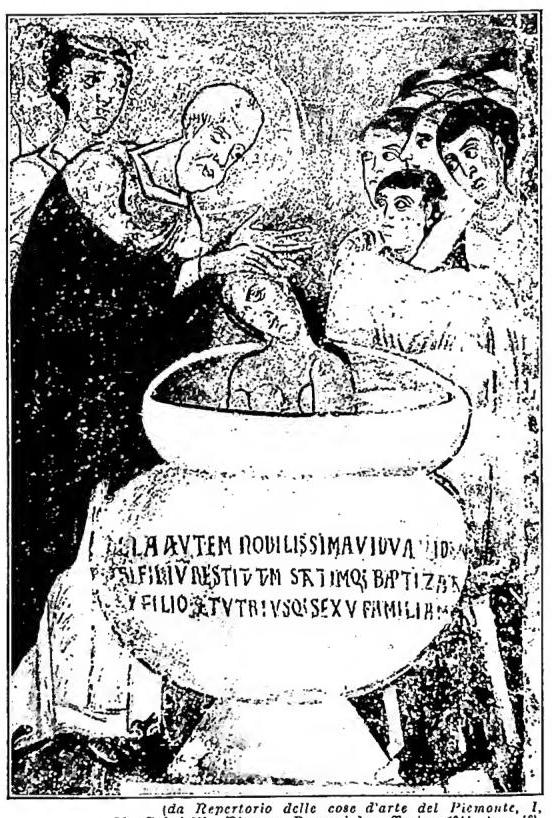
It is in the order of things that it should be so. Whoever is no longer merely a man, but is also a son of God, a brother of Jesus Christ, has his rule of conduct in his state as a son of God. The Christian law with its precepts and its counsels is precisely the expression of this higher norm. It is not a code imposed from without. It is the code that corresponds to the intimate essence of one's own being. A code vivified by the consciousness of union with Christ and of the fatherhood of God who loves, assists and helps. This code the Christian observes, led gently by the Spirit of Christ (Rom. 8:9-17).
Bibliography14 works
Paul and in the pagan milieu, in Biblica, 15 (1934), pp. 369-98; id., Il B. nella dottrina di s. Paolo, Rome 1935; K. Prüm, Der christliche Glaube und die altheidnische Welt, 2 vols., Leipzig 1935; id., Christentum als Neuheitserlebnis, Freiburg im Br. 1939; J. Cools, La présence mystique du Christ dans le Baptême, in Mémorial Lagrange, I, Paris 1940; F. Prat, La théologie de s. Paul, 2 vols., 28th ed., ibid. 1941-42; Ch. Journet, L'Église du Verbe Incarné, I, ibid. 1941; H. Rahner, Griechische Mythen in christlicher Deutung, Zurich 1945; J. Daniélou, Traversée de la Mer Rouge et Baptême aux premiers siècles, in Recherches de science religieuse, 33 (1946), pp. 402-30; C. Spicq, Les épîtres pastorales, Paris 1947.
Giuseppe Rambaldi
II. DISCIPLINE ON THE ADMINISTRATION OF BAPTISM.
I. MATTER OF BAPTISM
As has been seen, the matter of B. is water and only water, whether it be from a spring, the sea or rain, melted from snow or hail, hot or cold.
If the water is mixed with some other substance, it is valid only if the compound is commonly considered as water and properly bears this name. Oil, saliva, milk, blood, fat are not valid matter for B., and likewise neither are beer, fruit juice and any mixture which, even though it contains some water, is not commonly called such. If B. must be administered in an emergency, and it is not possible to procure true water proper, one may also make use of water of doubtful nature. In this case, however, if the baptized person remains alive, the Sacrament must be conditionally administered with true water.
In order to be valid proximate matter, the water must directly touch the body of the one being baptized and flow over it: which can be done either by immersing the candidate in the water (the form that prevailed until the 12th century), or by infusion or by aspersion.
According to the norm prescribed by the Roman Ritual, the ablution must be performed on the head of the one being baptized: once the head has been washed, the whole body is also considered washed. According to the common opinion of theologians, B. must be held valid if the water has been poured on one of the principal parts of the body, such as the chest, the neck, the shoulder blades, so that, if the water could not be poured on the head of the catechumen or in fact was not, B., where the matter is easy to do, should be repeated sub conditione. Nevertheless F. Hürth-P.-M. Abellán (De Sacramentis, Rome 1947, n. 44), say: « B. is more or less doubtful and must be conditionally repeated if the water has washed another part different from the head ». All moralists, moreover, admit that, if the water has been poured on a less principal part of the body, such as the hand, the foot, the arm, B. must be considered as probably not valid.
The Church prescribes that the baptismal water be blessed with the formula established by the Ritual. The blessing is meant to emphasize that, if the water takes away sins, it does so only because in it and through it the power of God is operative. The use of blessing the baptismal water is very ancient. B., however, would be valid even if it were administered with unblessed water.
It is to be observed here that B., in order to be valid, requires that the ablution be performed by the same person who pronounces the formula, distinct from the one who receives it, and that between the pouring of the water and the recitation of the formula there be a moral unity, at least in the sense that one has not yet finished pouring the water when one has begun to pronounce the formula.
Therefore, if someone falls or is thrown into water and pronounces the formula at the moment when he gets wet, B. is not valid, whereas it is valid if the formula is pronounced by the one who has thrown or immersed him in the water. B. is likewise not valid if one person pronounces the formula and holds the one being baptized, and another performs the ablution, or if someone, while pronouncing the formula, places himself under the water gushing from a spring.
II. NECESSITY
If Baptism is necessary in order to enter the kingdom of heaven, the obligation to receive it is grave for every man. Fulfilling this obligation is particularly urgent whenever one is in danger of death or its postponement endangers eternal salvation. Baptism is in fact not only a means to eternal life but also the Sacrament by which a man is made a member of the Church and becomes capable of the means of grace that Christ instituted, entrusting their distribution to his Church, and which man absolutely needs in order to be able to live without sin. What the limits of postponement, as such, should be in an adult man for it not to be considered a grave sin cannot be established, since to catechumens, with the consent of the Church herself, indeed even by her express order, Baptism was often deferred for a long time, which still happens today in the missions. Infants must be baptized as soon as possible.
III. EFFECTS
With regard to the effects, it should be noted that if Baptism is administered and received in full observance of all the conditions relating to the form, the matter and the intention both of the baptizer and of the one being baptized, the latter always receives the impression of the character and the Baptism is valid. If, however, even while observing all these conditions, an adult receives Baptism without the due disposition, that is, without faith, hope and attrition for the grave personal sins committed, Baptism does indeed imprint the character but, because of the obstacle, it is not productive of Grace. This
Grace, however, will be produced by it when, the obstacle having been removed (for example, by an act of attrition), the Sacrament recovers its efficacy.
IV. MINISTER
Any person who uses the prescribed matter and form and has the due intention validly administers Baptism.
This intention is to do what Christ instituted or what the Church does; that is, one must have the will to perform a rite that is not merely external (ablution and recitation of the formula), but to perform this rite in such a way that the one performing it positively wills what the Church wills, or at least wills this rite insofar as it is held sacred by Catholics. If a Protestant pastor, in administering Baptism, uses the matter and form proper to it, with the intention of doing what the true Church of Christ does, the Baptism is valid. But since the different sects follow different forms of Baptism and have a different concept of its value and meaning, a heretic who converts cannot be admitted into the Catholic Church without a prior examination of the Baptism he has received. If, this examination having been made according to the norms of the rite, the Baptism proves valid, the convert must not be rebaptized. If, on the contrary, the validity of his Baptism remains doubtful, either because it was not performed with the required matter and form or because of suspicion that the minister's intention was not upright, the Baptism must be renewed conditionally, unless it is certain that the convert either was not baptized at all or was baptized in a positively invalid manner, in which case he must be rebaptized absolutely.
The minister who licitly as well as validly administers Baptism is the one who according to the canonical laws holds the functions of minister. The ordinary minister of solemn Baptism (solemn is the Baptism in which the essential rite is carried out with all the ceremonies that accompany it) is any priest; but its conferral is reserved to the parish priest or to another priest provided with the license of the parish priest or of the local ordinary. In case of necessity the license is legitimately presumed (can. 738). If the one to be baptized is an adult, the Baptism must be celebrated, if possible, by the ordinary or by another priest delegated by him (can. 744). The parish priest, the ordinary minister of solemn Baptism, is the proper parish priest who resides in his own territory. The extraordinary minister of solemn Baptism is a deacon provided with a special license from the ordinary and from the local parish priest, a license that is granted for a just (not precisely grave) cause and that, in case of necessity, is legitimately presumed (can. 741). The minister of private Baptism in case of necessity, that is, when the life of the one to be baptized is in danger, is any person, provided that in administering Baptism he observes all the conditions required by the matter, the form and the intention. According to the norms of the Roman Ritual, the order of preference among the persons present is the following: the parish priest first of all, a priest in preference to a deacon, a deacon in preference to a layperson, a man in preference to a woman, unless either for reasons of modesty or for greater competence in the matter and consequent ability, the woman is to be preferred to the man, anyone else in preference to the father and mother of the one to be baptized (cf. also CIC, can. 742). The administration of private Baptism in case of necessity must be done, if possible, in the presence of two or at least one witness. The minister of private Baptism, where there is no danger of death, is of itself the parish priest. If the one to be baptized is a converted heretic who is baptized privately under condition on the permission of the local ordinary, or a Catholic who already in his time received solemn Baptism, but this proving doubtful, must be conditionally and secretly rebaptized, the Baptism must be conferred by the proper parish priest; however, in the second case, if, out of respect for his good reputation or his modesty, it is deemed opportune to have the Baptism conferred by another, it can be licitly administered by any priest whatsoever. It is to be borne in mind as regards the minister, that he contracts with the one baptized a spiritual relationship, which is a cause of a diriment impediment in the case of marriage (v. COGNATION, SPIRITUAL).
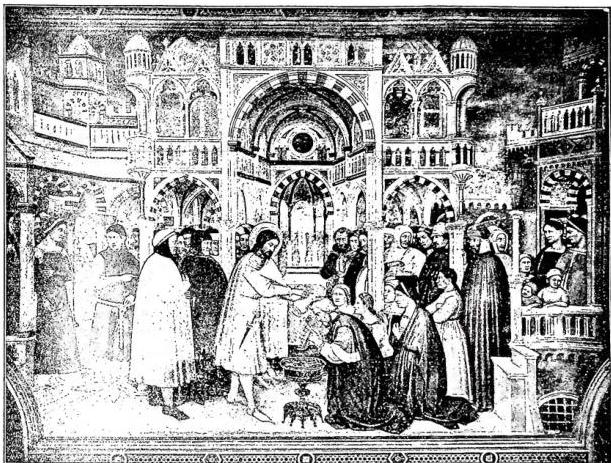
V. SUBJECT
It is every man and only man as a "wayfarer," that is, man who is still on the way and has not yet reached eternal beatitude, not yet baptized and, in the case in which he is already an adult, endowed with the due intention. Today Baptism is administered to children before the use of reason or to adults.
1. Baptism of children
Children must be baptized as soon as possible (can. 770), not only because of the danger of death, which for infants is greater than for adults, but also because of the custom universally followed in the Church, which has for a long time now had the force of law, and by which parents who delay too long the Baptism of their children incur grave sin. Many moralists consider it a mortal sin for parents who, without grave cause, postpone Baptism beyond two weeks. In many places the time limits for conferring Baptism on infants without incurring sin are established by law. Naturally, exception is made for cases in which the delay is due to a just cause.
Particular norms regulate the Baptism of premature infants and of fetuses.
The Roman Ritual prescribes not to baptize the infant who is still in the maternal womb, and this on the presupposition that it cannot materially receive the ablution. If, however, either directly or by means of some instrument, water can be made to reach the infant, it can and, if there is no probability or hope of baptizing it once born, must be baptized. If this hope exists and is well founded, Baptism must not be administered. In the case in which the infant has been licitly or illicitly baptized in the maternal womb, Baptism must be repeated conditionally, after its birth (can. 746, 1 and 5). If the mother dies before the child is born, the infant or fetus, extracted from the womb by those whose duty it is to do so (not by the priest), must be baptized absolutely if it is clearly alive, conditionally if its life is doubtful. A living mother who cannot give birth by natural means is obliged to submit to a cesarean operation, so that the infant may be baptized, provided always that this can be done under the following conditions: a) if in the actual circumstances the operation can take place without killing the mother; b) if the infant is certainly alive; c) if the infant cannot be baptized in another way. This obligation, however, must be recalled to the mother with the greatest caution, and in any case only persuasion will be used. If the infant, imperfectly born and exposed to danger of death, has put out its head, it shall be baptized absolutely, and if it survives it must not be baptized a second time conditionally. If instead of the head it has put out another member, let it be baptized conditionally on this member, and, if it lives, let it be baptized again in the due manner conditionally. All abortive fetuses, if they are alive, are to be baptized absolutely; if their life is doubtful, the Baptism will be conditional (can. 747). In order that the water may touch the fetus, the placenta in which it is wrapped must be broken. Deformed offspring (monsters, etc.) must be baptized only conditionally. "In doubt whether it is a question of one or more human beings, one shall be baptized absolutely, the others conditionally" (can. 748). "Foundling or exposed infants, where, after diligent investigation, it has not been possible to ascertain whether or not they have received Baptism, must be baptized conditionally" (can. 749). The certificate of Baptism is not sufficient proof.
The children of non-Catholics (that is, of two unbelievers or heretics or schismatics, even in the case in which the faith they abandoned was originally the Catholic one), if they are in danger of death either present or future before they reach the age of reason, can be licitly baptized, even against the will of their parents. If the danger is imminent and certain, they must be baptized by precept of charity, if this can be done without provoking the hatred of unbelievers or heretics against the Catholic religion. If the danger is only probable, they can be licitly baptized, even if death is still far off, provided that it is foreseen that it may occur before the child has reached the use of reason.
When there is no danger of death, and care is taken that the child have a Catholic education, it is licitly baptized: 1) in the case in which both parents or only one of them, whether the father or the mother, or even the grandfather or grandmother or, where these are lacking, the guardian consents to it; 2) in the case in which none of the aforesaid is alive, or the parents have been juridically deprived of every right over their offspring, or again in the case in which they are not in a position to exercise it. In other cases, where no danger of death impends, it is not licit to baptize the children of non-Catholics (can. 750).
2. Baptism of adults
An adult with respect to Baptism is one who has reached the use of reason and who can of his own will request it and be admitted to it. For an adult to be able to receive Baptism validly, it is always necessary that he have at least the explicit habitual intention of receiving it, that is, it is necessary that he have at least once explicitly willed Baptism and have not subsequently retracted his decision. For Baptism to be licit there are further required faith, hope, and attrition for personal grave sins. If the adult who has requested Baptism is in danger of death and cannot be fully instructed in the principal mysteries of the faith, Baptism can be licitly administered to him, on condition that he in some way give a sign of assenting to the truths of the Christian faith (can. 752, 2).
If the adult is not in a condition to request Baptism, it will be conferred on him in conditional form, provided that at the moment he manifests by signs and gestures the intention of receiving it, or had already manifested it in a probable manner before, when he was in possession of all his faculties. If he recovers and some doubt remains that the Baptism received was not valid for defect of intention, it shall be conditionally repeated (can. 752, 3). When there is no danger of death, the adult nisi sciens et volens probeque instructus ne baptizetur, besides which he must still be admonished to be sorry for his sins (can. 752, 1).
Those who are not masters of their own reason are, in relation to Baptism, to be equated now with infants, now with adults (can. 754).
The insane and the violently mad, who have never had the use of reason, must be baptized like infants (can. 754, 1). The insane who have had the use of reason for a brief time or have it, are to be equated with adults. Consequently: 1) if there is no danger of death, let them be baptized, provided that they wish it, in an interval of lucidity; 2) if there is danger of death, let them be baptized if before losing the use of reason they manifested the desire to receive Baptism. The lethargic or the frenzied, that is, those who transiently and not habitually are deprived of reason, where there is no danger of death, are to be baptized in the waking state and if they have the will for it; in danger of death they are to be treated like the insane (can. 754, 2, 3, 4).
VI. CEREMONIES
The ceremonies of the solemn Baptism of infants are, in brief, the following:
The infant is brought to the door of the church by the godparents, and there the minister comes to meet him. When the godparents, in the name of the infant, have asked the Church for faith, the priest breathes on the infant's face and exorcises him from the evil spirit, then marks his breast and forehead three times with the sign of the cross, imposes his hands upon him and puts salt in his mouth. After this the priest places his violet stole upon the infant and leads him into the church, and here with saliva he touches the ears and nostrils of the catechumen. The godparents, in the name of the infant, renounce three times Satan with his pomps and his works, and the infant is anointed on the breast and between the shoulders with the oil of catechumens. Then, through the godparents, he professes his faith and asks for Baptism. The priest, having then changed the violet stole for a white one, pours the baptismal water three times on the head (better on the forehead) of the infant and at the same time says the sacramental formula. After this he anoints the head of the baptized with chrism, places a white veil upon him, hands him a lighted candle and dismisses him in peace. The Baptism of adults is carried out with ceremonies that are substantially the same, but contain something more.
Baptism must normally be conferred in solemn form, according to the rite of the parents, if this is identical for both; otherwise, according to the rite of the father (canons 755, 756). The local ordinary may, for a grave cause, permit the ceremonies prescribed for the Baptism of infants to be followed in the Baptism of adults.
The obligation to observe the ceremonies described in solemn Baptism is under grave sin in a grave matter. The following are considered principal and grave ceremonies: the use of baptismal water, of saliva and of salt, the insufflation, the anointing, and the assistance of the godparents. As regards the use of saliva, it has recently been established (decree of the S. C. R., 14 Jan. 1944) that this ceremony may be omitted whenever there is a reasonable cause of hygienic protection or when there is danger of contracting or transmitting a disease. The water to be used in solemn Baptism is the water destined for this special purpose and blessed on Holy Saturday or on the vigil of Pentecost, or on another occasion with its own and shorter rite. The ceremonies cannot in themselves be separated from the essential rite, that is, from the application of the matter and the form, but must be performed together with it and performed all and in a complete manner.
When, in case of necessity, Baptism is conferred in private form either by a layman or by a cleric who is not a deacon, it is celebrated only as regards the part relating to the essential rite, omitting the ceremonies that accompany it. If, on the other hand, it is administered by a cleric who is at least a deacon, the ceremonies are to be observed. In either case, if the infant survives, the omitted ceremonies must be completed. When Baptism is repeated conditionally, or in the case in which it must be repeated absolutely, because the one previously conferred proves certainly invalid, the ceremonies omitted in the previous Baptism must be supplied in the second; those that have already been performed may, but need not, be repeated. In the private Baptism of an adult heretic, converted and repeated conditionally, all the ceremonies may be omitted.
VII. NAME
It is a prescription of the Church that a Christian name be imposed on the one being baptized. If the parents do not wish this and insist on imposing a strange or pagan name, the parish priest must add the name of some saint and transcribe it together with the profane name in the register of the baptized.
VIII. GODPARENTS
It is the custom that the one being baptized be assisted by godparents. The godparents, or "sponsores" or "offerentes" or "suscetptores" or "fideiussores", are the persons who assist the infant in solemn Baptism to make the profession of faith in his name. It is proper to them "to have (the baptized) as a spiritual child entrusted to them in perpetuity and diligently to see to it that in all things relating to the establishment of the Christian life he shows himself throughout his life to be what with solemn ceremony he promised to be" (can. 760). The obligation that they assume in this is grave, insofar as the primary care belongs to the parents and to those who take their place; this holds also for Baptism that is repeated under condition, if the godparent is the same one who assisted the baptized in the previous Baptism. He also takes part in the completion of the ceremonies alone. In private Baptism the godparent shall be used, provided this can be done easily. As to number, the godparent must be "only one, even if of a sex different from the baptized, or at most a godfather and a godmother will be permitted" (can. 764). The godparent who is certainly such (whether he assisted the baptized in the single Baptism conferred in absolute and valid form, or in several Baptisms repeated under condition) contracts with the baptized a bond of spiritual relationship (v. COGNAZIONE SPIRITUALE) which constitutes a diriment impediment in the case of marriage between the baptized and the godparent.
In order for there to be a legitimate godparent, these conditions must be present, among others: 1) to be baptized and to have reached the use of reason; 2) to have the will to submit to this task; 3) not to belong to a non-Catholic sect; 4) not to be either father or mother or spouse of the baptized; 5) to be designated either by the baptized or by his parents or, in their absence, by the minister; 6) physically to hold or touch or immediately lift or receive from the baptismal font or from the hands of the baptizer the baptized, either personally or through a proxy. Furthermore, to be able to serve as godparent, it is necessary: 1) to have completed the 14th year of age, unless the minister for a just cause disposes otherwise; 2) not to be, by notorious crime, excommunicated or deprived of legal right; 3) to know at least the rudiments of the faith; 4) not to be a novice or professed, even if not a religious, in any religion, not to have taken sacred orders, except in the case in which there is urgent necessity and with the express license of the local superior for religious, and of the proper ordinary for those ordained (can. 766).
IX. TIME AND PLACE
Baptism of necessity may be conferred, where the necessity is urgent, at any time. The solemn Baptism of infants must be conferred as soon as possible and on any day. That of adults will be conferred suitably on the vigil of Easter or of Pentecost and preferably in cathedral churches (cann. 770-72).
The proper place for private Baptism of necessity is any place; for solemn Baptism, a church or a public oratory.
Parish churches must have a baptistery or baptismal font, which, either by requirement of law or on the permission and order of the local ordinary, may also be found in any other church. The proper church for Baptism is one's own parish church, or another which within one's own parish possesses a baptismal font, or again a church or public oratory of one's own parish. That Baptism be administered in the home is granted in particular cases, but always in a decent place and with baptismal water. Such a concession is ordinarily made in favor of: 1) the children or grandchildren of sovereigns and of the supreme heads of State and of those who have the right to succeed them, provided it is requested; 2) all those to whom the local ordinary, according to his considered judgment and in good conscience and for a reasonable cause, deems it right to grant it. After the Baptism, the parish priest is obliged to transcribe without delay and with all care in the parish book "the names of the baptized, making mention therein of the minister, the parents, the sponsors, the place and the day of conferral" (can. 777, 1).
Bibliography
Michele Fàbregas
III. LITURGY OF BAPTISM
Until the 2nd century, Christian initiation took place through three essential rites: Baptism, Confirmation, first Communion. The increasingly prevalent custom of giving Baptism to children separated the three rites, though not however equally and in complete form everywhere. Baptism, being a rebirth, implied three fundamental rites: renunciation of Satan, profession of faith, triple ablution. Around them, owing to circumstances of time and place, secondary ceremonies arose whose understanding proves clearer if they are studied in their liturgical stem, of East and West. Even the historical examination of these, on account of the variants within the ambit of one and the same rite, is so vast as to impose a restriction to the principal ones, preserved in the living liturgies.
I. EASTERN LITURGIES
1. Byzantine rite
It is living among the peoples once subject to the influence of Constantinople: Russians, Bulgarians, Romanians, Georgians, Melkites, Greeks properly so called, including those united with Rome. The principal sources for the study of the rites are those of the liturgies of St. John Chrysostom and St. Basil, to which must be added the writings of the Fathers and of St. Gregory of Nazianzus. The ritual, in its broad outlines, goes back to the 4th century; divided at the outset into four groups of ceremonies, separated by intervening periods of time; perhaps already before the 8th century it formed a compact whole in which, nevertheless, several parts can be distinguished: 1) The catechumen was received with a threefold insufflation on the face; his forehead, mouth, and breast were signed; a prayer with the imposition of hands closed the ceremony intended to drive the evil spirit away from the individual. 2) A threefold exorcism (simple, however, if followed immediately by Baptism) with threefold insufflation and sign of the cross. 3) Renunciation of the devil, adherence to Christ and to the Most Holy Trinity, recitation of the creed. 4) Exorcism and blessing of the water and of the holy oil used to anoint the catechumen on the forehead, breast, back, ears, hands, and feet, so that as an athlete he might resist the attacks of the enemy he is going to meet. Then came the threefold immersion in water, accompanied by the Trinitarian formula. Today the Russians still immerse the child's whole body, covering with the hand his mouth, nose, and eyes; then they place a cross around his neck, which must never again be removed, and clothe him in a white tunic. As in ancient times, Confirmation follows, and, if Baptism has been conferred, as is recommended, before the Mass, the priest also gives him Communion with a few drops of the Most Holy Blood.
2. The ancient Syriac rite did not differ substantially from the Byzantine, having, however, formulas of its own. Today it presents some variants: the blessing is removed from the water once the rite is finished; the forehead of the person being baptized is anointed three times and, seated in the font, water is poured three times over his head.
3. The Armenian rite likewise links back to the Byzantine. The renunciation of the devil and the profession of faith follow immediately upon the exorcism of the catechumen. The most ancient manuscripts, like the modern ritual, indicate a double ablution: water is poured three times over the head of the neophyte and three times the whole body is immersed in the pool. It is probable, however, that the immersions are merely ceremonial because only the threefold ablution is accompanied by the sacramental formula.
4. Alexandrian rite
The canons of Hippolytus and the Egyptian apostolic canons are the most ancient sources for the baptismal ordo of the Coptic and Ethiopian rites, which, in its broad outlines, must already have been complete in the 3rd-4th centuries. According to the ancient sources, the ceremonies began on Holy Saturday in the evening. The bishop summoned the catechumens for the solemn exorcism with the imposition of hands, followed by insufflation and the anointing of the members: breast, forehead, ears, nose.
After the entire night vigil was completed, at cockcrow, the elect were admitted to Baptism after having stripped off their garments. They first pronounced the renunciation of Satan and received an anointing with exorcised oil, blessed by the bishop together with the eucharistic oil (chrism). Then, descending into the water, each answered a threefold interrogation concerning the faith and was immersed three times in the water, until the one baptizing him imposed his hand on his head. Before putting their garments back on, the neophytes were anointed with the eucharistic oil. After the prayer, a brief interlude between the rites, Confirmation was followed by the Mass. The present-day ritual is somewhat lengthened and begins with a prayer for the purification of the mother. The blessing of the water by means of a threefold infusion of oil, the breathing upon it and the division in the form of a cross, the prayers and again the breathing and the infusion of chrism, take place immediately before the immersion. The threefold declaration of faith is no longer made, and the formula: "I baptize you in the name of the Father. Amen. I baptize you in the name of the Son. Amen. I baptize you in the name of the Holy Spirit. Amen," although curious, does not imply any declaration of tritheism.
II. WESTERN LITURGIES
The Western Church has only two rites: Roman and Ambrosian, which also differ in the administration of Baptism. The Church of Toledo, while preserving the Mozarabic rite, follows the Roman rite in the ritual and the pontifical; therefore Baptism is conferred there as in the rest of the West.
1. Roman rite
We have very few documents that can give us information about the ceremonial followed in the first centuries at Rome. Justin (2nd century), in fact, does not offer much data; nevertheless the recent thesis that ascribes the Egyptian apostolic canons to the Roman Hippolytus offers clear information, already reported as proper to the Alexandrian Church. On this point and in this age the agreement between Rome and Egypt would have been complete. We also have St. Leo the Great and Pope Gelasius (end of the 5th century), to whom is attributed the drafting of the formulary that bears his name, but which must rather be held to have contributed to the fixing of that text which testifies to us the Roman liturgical use of the 6th century. Even more precious is the letter of the deacon John to Senarius (PL 59, 401 ff.). To these documents of the early age must be joined the abundant and precious information of the Africans Tertullian and St. Cyprian, generally concordant and mutually complementary. At Rome too the rites consisted of a remote and a proximate preparation and of Baptism itself. The first two parts gave rise to the catechumen (v.), which essentially consisted in an instruction. When, through the prevalence of infant Baptism, instruction was delegated to the school, only some relic of it remained in the ordo, which instead was enriched with prayers, signings, exorcisms which, having gone from three to seven, and performed on as many days, were subsequently gathered into a single rite coupled with Baptism. The ritual that resulted stands as an appendix in the Sacramentaries from the 9th century onward and must be considered as the fruit of the replies that Charlemagne obtained from the various bishops of the empire concerning the ceremonies of Baptism. Today it is preserved for the Baptism of adults, a simplified ritual having been drawn up for that of children, of a much more recent age.
Three elements of the baptismal rite deserve particular emphasis: a) The name of the elect begins the baptismal formula. The present ritual twice prescribes asking the name of the one to be baptized: at the beginning, a reminder of the ancient enrollment among the catechumens, and before the final renunciation of Satan. This last time is required by the Gregorian Sacramentary probably because of the now prevalent custom of imposing a new name on one who is about to be reborn to a new life. In the earliest times there was no prescription on the matter, because a pagan name did not entail a corresponding religious profession (Tertullian): proof of this is the list of bishops present at the Council of Nicaea (325). Nevertheless in the 3rd century one notes the tendency to highlight the Christian character of certain names (St. Cyprian in Epist. 67) and in the following century it happens more often that names drawn principally from the Old Testament are assumed. The Fathers indeed (St. Ambrose, St. John Chrysostom) combat the indifferentism of some Christians in giving their children names that mean nothing. Until then, in fact, the persecutions had advised against imposing names that openly manifested the Christian condition; but, with peace, it was repeatedly advised to assume the names of the martyrs, because, even if these names were originally pagan, they had become, through martyrdom, Christian. Other names derived from the feasts on which Baptism was received (Epiphanius, Paschal, Natalis), from the virtues most loved (Fidentius, Sperantius, Pius), from animals that represent virtues (Leo, Ursula, Columba), from the angels and the saints of the Old Testament. The name of Jesus is found imposed only among the Syrians, though in a compound form (Ebediesus); instead the related appellatives are in wider use (Salvator, Emmanuel, Renatus, Theodorus). In the 14th century the conviction had entered that the new name brought the new life, and this conviction was so deeply rooted as to rebaptize anyone who had not assumed one: a most grave error condemned by the Council of Benevento (1374). Today the Church exhorts the faithful to give their children a Christian name, preferably that of a saint, chosen thus as protector of the new creature. b) Many Fathers (Cyprian, Ambrose, Augustine, Basil, Gregory of Nazianzus) consider the blessing of the baptismal water necessary. Although the Didache speaks of running water, it must ordinarily be blessed because, according to patristic doctrine, the divine power is thus united with it in a permanent way. Today this blessing with exorcisms, infusion of salt and chrism, is performed on only the two days that were once reserved for solemn Baptism: Holy Saturday and the vigil of Pentecost. c) In antiquity the normal way of baptizing was the immersion of the whole body in the water, three times pronouncing the name of one of the divine Persons. This way, already attested by Tertullian, is called by St. Basil of apostolic origin, and the multiplicity of documents confirms it. Also much practiced was the custom of entering the basin and receiving three times the pouring of water on the head, as is found represented in ancient monuments. Aspersion was practiced for the dying. Immersion required nudity. This may surprise moderns but did not surprise the ancients, especially Mediterraneans, accustomed to frequent baths taken in public. The Christian documents themselves exhorted to a distinction of sexes but did not forbid promiscuity when there was only a single public bath. Quite early, however, the inconvenience was noticed, principally for the Baptism of women, and provision was made in some places (for example
Arles, Milan) with two baptisteries and with the institution of deaconesses who, however, no document says replaced the bishop or the priests in the act of baptizing. Various reasons concurred in abolishing nudity and consequently the use of immersion: the barbarian invasions and the resulting coarseness of customs, the almost absolute prevalence of Baptism of newly born children, and finally the most intense Christian love for purity, which strongly developed modesty. Today the Latin Church practices infusion without excluding immersion, which has been preserved, in a form limited to the head alone, in the Ambrosian rite for the Baptism of children.
2. Ambrosian rite
Despite some diligent studies, a history of the Milanese baptismal Ordo is not yet available. Precious sources are two writings of St. Ambrose: De mysteriis and De Sacramentis. The manuscripts (which begin with the 11th century) are not always concordant. The present ritual, in its substance, was drawn up at the end of the 16th century and, while agreeing greatly with the manuscript tradition, does not give us the fusion of the primitive rites as clearly as the Roman liturgy. Once the candidate is presented, he immediately performs the renunciation of Satan followed by the effeta ("be opened"), by the insufflation and by the anointing with the oil of the catechumens. An exorcism prepares the imposition of the cross on the forehead, which is followed by that of salt. After the invitation to enter the church and Ps. 41, the catechumen recites the Creed and the Pater, makes a profession of Trinitarian faith and is baptized. Immediately afterward the litanies of the Saints are sung, followed by the chrismation, by the imposition of the white garment and of the burning lamp. A prayer closes the rite.
Taking into account the Ambrosian testimonies, certain points of the ancient Ordo deserve particular emphasis: a) The renunciation of the devil takes the form of two responses to two questions, whereas in Rome there are three questions, and in Gaul only one. b) Each immersion is preceded by a profession of faith in each of the three Divine Persons. c) After the chrismation "the feet of the baptized are washed so that the inherited stains may be removed from him, while his own sins are wiped away by Baptism" (De mysteriis, 6). St. Ambrose himself notes that this ceremony was not practiced in the Roman church (De Sacramentis, III, ch. 1), while we know that it was practiced in Gaul.
BIRL.: H. J. Denzinger, Ritus Orientalium Captorum, Syriorum, Armenorum in administrandis Sacramentis, 2 voll., Würzburg 1863-64; L. Corblet, Histoire dogmatique, liturgique et archéologique du sacrement du Baptême, Parigi 1881-82; M. Magistretti, Monumenta veteris liturgiae ambrosianae, II, Milano 1897, pp. 143-47; III, ivi 1905, pp. 466-71; F. Wiegand, Erzbischof Odilbert von Mailand über die Taufe, Lipsia 1899; G. Morin, La disputation du rite baptismal de l'église de Milan au IVe siècle d'après un passage corrigé du De Mysteriis de s. Ambroise, in Revue bénédictine, 16 (1899), pp. 414-18; L. E. Lebourgeois, Le Baptême romain au IVe siècle, Aix 1902; F. J. Dölger, Der Exorcismus im altchristlichen Taufritual, Paderborn 1909; P. de Puniet, Aperitio aurium, Aubes baptismales. Baptême. Bénédiction de l'eau (baptismale), in DACL, rispettivamente I, coll. 2523-37; ibid., coll. 3118-3140; II, coll. 251-346; ibid., coll. 685-713; H. Leclercq, Immersions. Noms propres. Nudité baptismale. Onction, ibid., rispettivamente VII, coll. 305-11; XII, coll. 1481-1553; ibid., coll. 1801-1805; ibid., coll. 2116-30; L. Duchesne, Les origines du culte chrétien, Parigi 1925, pp. 309-60; F. Cabrol, Le livre de la prière antique, Tours 1929, pp. 376-87; I. Schuster, Liber Sacramentorum, I, Torino 1929, pp. 10-25; O. Faller, Das Teufelsanspeien im Mailänder Taufritual, in Jahrbuch für Liturgiewissenschaft, 1929, pp. 128-32; B. Neunheuser, De benedictione aquae baptismalis, in Ephemerides liturgicae, 44 (1930), pp. 194-207, 258-81, 269-312, 455-92; A. Villien, Les Sacrements, histoire et liturgie,
Parigi 1931, pp. 9-81; P. Borella, Sabato in albis depositis, in Ambrosius, 2 (1933), pp. 78-80; id., Il Crimon, la cenere ed il cilicio negli antichi scrutini battesimali ambrosiani, ibid., pp. 59-77; A. Paredi, Formulari battesimali ambrosiani, in La scuola cattolica, 1 (1935), pp. 4-14; P. Galtier, Imposition des mains et bénédictions au Baptême, in Recherches de science religieuse, 6 (1937), pp. 464-66; D. Van Den Eynden, Notes sur les rites baptismaux dans les églises d'occident, in Antonianum, 3 (1939), pp. 257-276; C. Callewaert, Sacris erudiri, Bruges 1940 (comprende, fra gli altri, stuur su varie questioni battesimali); A. Paredi, La liturgia di s. Ambrogio, Milano 1940; Ph. Oppenheim, Ins liturgiae baptismalis. De fontibus et historia ritus baptismalis. Commentationes ad ritum Baptismi, Torino 1943; B. Marchetta, La materia e la forma del B. nella Chiesa di s. Ambrogio, Roma 1945; I. M. Hanssens, La concélération du catéchumène dans l'acte de son Baptême, in Gregorianum, 27 (1946), pp. 417-43; A. Raes, Introductio in liturgiam orientalem, Roma 1947.
Enrico Cattaneo
III. BAPTISM IN THE MISSIONS
The baptismal rite, when missionary activity resumed in the 15th century, immediately became the subject of disputes from the point of view of its adaptation to certain usages and customs of the new peoples to be evangelized.
In this regard it must immediately be recalled that the baptismal rites were born in the European West and were established in specific historical periods in harmony with the habits and mentality of the European peoples. When they are practiced among other peoples of a very different civilization and of habits very far removed from ours, it is easy for them to provoke admiration and sometimes mockery and scandal.
Against this situation the zeal of missionaries can react with some effect only where Catholics, by number and by social position, exercise a certain influence over the rest of the population. But in the missions among pagans, there where Christianity makes its first conquests, the missionary's action upon the mentality of the great pagan mass is nil or nearly so.
As an example, let us recall certain prejudices which even in our own days are found in some regions of India. The repugnance that Indians have for the use of saliva is not due solely to reasons of hygiene and of decency, but to the more than thousand-year-old custom of those peoples, who regard it as a legal contamination. Regarding the ceremony of salt, it is pointed out that swallowing any food or drink touched by a person of another caste is likewise severely prohibited by caste laws. Moreover, putting food into a woman's mouth is considered a confidential and amorous gesture, which only the husband may permit himself, and in secret. Among some aboriginal tribes, e.g. the Santals, the essential ceremony of marriage consists in this: the bridegroom dips his thumb in a little red powder and marks with it the forehead of the girl, who thus becomes his legal wife. One can imagine the embarrassment of the missionary who administers Baptism in the open air and often in the presence of pagans, when he must perform the anointing on the forehead of women.
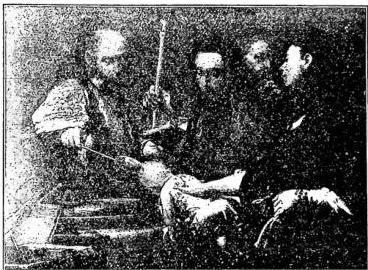
It should be noted that generally the neophytes gradually adapt to the rites of the Church. The same ceremonies that arouse objections when used in Baptism are then peacefully accepted by the same persons when they receive other Sacraments and Sacramentals. Thus one who has accepted, blushing, the baptismal salt from the hands of the priest, later hastens to receive Holy Communion from the same hands; one who has received the sacred anointings with evident embarrassment in Baptism, receives them with frankness in Confirmation, and so on for other ceremonies. All these reasons and others suggested by the customs of the peoples to be evangelized prompted the missionaries to ask the Holy See for modifications to the baptismal rite.
In this regard one of the first documents is given by the constitution of Paul III Afrituto divini consilii, dated 1 June 1537 for the East Indies, in which, besides prescriptions ordered to abbreviate the rite, it was established that the anointing with chrism and the oil of catechumens be performed for women on the part «quam ratio pudicitiae demonstrabit» (Collectanea S. C. de Prop. Fide, I, Rome 1907, n. 114, pp. 30-31).
By decree of 12 Sept. 1645 the Holy Office replied negatively to the request made by some missionaries of China to abstain in the sacrament of Baptism «ab imponendo mulieribus oleum sanctum catechumenorum, sputum in suribus et sal in ore» (op. cit., n. 114, pp. 31-32). The same Holy Office, however, with a document of 23 March 1656, after re-examining the question, gave a completely contrary reply, permitting that «ex gravi necessitate proportionata» in China some Sacramentals could be omitted in the Baptism of women and that Extreme Unction could also be omitted (op. cit., n. 126, p. 38). The two decrees mentioned above must have aroused great discussions among the missionaries, because with another decree of 13 Nov. 1669 the Holy Office, without abolishing the decree of 1656, recalled that of 1645 to observance (op. cit., n. 189, p. 64). The Synod of Tonkin celebrated on 14 Feb. 1670 also dealt with the question, following the current intent on defending the use of the Sacramentals in Baptism (R. De Martinis, Jus Pontificium de Prop. Fide, I, Rome 1888, p. 431).
Some missionaries had asked to follow the usage of the primitive Church in performing the various ceremonies of the baptismal rite on the catechumens in four successive stages. The reply was negative (Collectanea, loc. cit., n. 301, p. 97). The missionaries complained, in fact, that they often could not calm the minds of the catechumens, especially among primitive peoples and the uneducated persons of pagan nations, because these, during the notable period of time that elapsed from their renunciation of paganism until they received Baptism, felt deprived of God's protection against the presumed vengeances of the evil spirit to which they had renounced.
Unfortunately the question concerning the omission of some baptismal ceremonies was treated as a corollary of that concerning the Chinese and Malabar rites (v.) and followed its fate. Consequently, to the repeated requests of the missionaries in the matter the reply was almost always given with the words: «servetur ab omnibus Rituale Romanum» (Arch. di Prop. Fide, Acta C. P. Indiarum or. et Sinarum, a. 1723-28, t. IV, f. 270 and 272).
The constitution of Benedict XIV Ex quo singulari of 11 July 1742 (Collectanea, loc. cit., n. 339, pp. 130-41)
does not speak of the baptismal rites; instead the constitution Omnium sollicitudinum of 2 Sept. 1744 treats of them extensively, in which is reported the decree that de Tournon promulgated in a rigorist sense (Collectanea, loc. cit., p. 155) and which with historical naivety says that the baptismal rites were «ex Apostolica traditione Catholica Ecclesia recepti». The decrees of Clement XII issued on 24 Aug. 1754 and 13 May 1739 confirm that of de Tournon but at the same time grant to the missionaries «Regnorum Madurensis, Maysurensis et Carnatensis» the faculty «ad decennium» to omit saliva in Baptism and to use insufflations secretly in particular cases and for grave and proportionate necessity (Collectanea, loc. cit., p. 166). Once the decade had passed, the missionaries asked for the extension of the faculty received from Clement XII. The supreme pontiff at that time was Benedict XIV, who granted the renewal of the indult on very restrictive conditions and declared that he would not renew it for a third decade. Meanwhile all the missionaries had to strive to remove from the minds of the peoples every false notion concerning the baptismal rites (Collectanea, loc. cit., pp. 169-70; cf. ibid., n. 345, p. 151; Arch. di Prop. Fide, Lettere della S. C., a. 1774, vol. 224, f. 54 v; Esame del Sinodo Sutchucense celebrato nel 1803 e approvato nel 1822, ff. 13-16 v). In the examination of the Synod of Sutchuen the question was much discussed among the consultors, who were not all of the same opinion, and there one reads a long annotation of Msgr. Lambertini, later Pope Benedict XIV, reported by one of the consultors. The words «secluso gravis necessitate casu» that are read in chap. 2, which speaks of Baptism, were introduced precisely for this reason.
Also the use of the ritual for children in the Baptism of adults was permitted with many restrictions. In fact the first concessions were temporary and with the clause that the exact observance of the Roman Ritual had to be slowly introduced. Such a faculty was requested both to abbreviate the rite and to avoid embarrassments for adult converts (cf. Arch. di Prop. Fide, Acta S. C. de Prop. Fide, a. 1830, vol. 193, f. 388-388 v; ff. 396-98; Collectio Lacensis, III, Fribourg in Br. 1875, coll. 34-35 and 151-52; Arch. di Prop. Fide, Acta S. C. de Prop. Fide, a. 1852, vol. 214, ff. 226-74; Collectanea S. C. de Prop. Fide, loc. cit., n. 1057, p. 572 and n. 1054, p. 569; Arch. di Prop. Fide, Acta S. C. de Prop. Fide, a. 1853, vol. 215, part 1ª, ff. 5v, 13v, 43v, 46, 261-78; Collectio Lacensis, III, coll. 929, 807, 461-462, 384; Archivio di Prop., Acta S. C. de Prop. Fide, a. 1855, vol. 219, ff. 341, 343-48, 375).
The numerous concessions given in this regard induced the Holy Father to order that the faculty in question be added among the extraordinary faculties of the ancient «Formola P» (a form of concessions designated by this letter), customarily given to the English episcopate «ad biennium». In number 12 that sets it out, there is no mention of the clause of gradually conforming to the Ritual. The same faculty was extended «ad quinquennium» also to the bishops of Holland and to the ordinaries of China and adjacent kingdoms with Formula 6. After the provision of can. 775, § 2 such a faculty concerns all the territories of the Church. In a note the CIC indicates some other documents.
There was also a request to make use of the vernacular language in the interrogations, and recently the Holy See has granted that in the missions of Indonesia, China, Japan, Indochina, India and Africa the Ritual translated into the vernacular be used, as was already permitted to Germany (v. RITUALE ROMANO NELLE MISSIONI).
Regarding the ceremony of saliva, the recent provision permitting it to be omitted "quotiescumque rationabilis adest causa munditici tuendae aut periculum morbi contrahendi vel propagandi" finds its best reception in mission territories (AAS, 36 [1944], pp. 27-29).
A. Maus (Selon quel cérémonial convient-il de baptiser un groupe d'adultes en pays de missions?, in Nouvelle Revue Théologie, 66 [1939], pp. 693-700), bearing in mind all the rubrics of the Ritual, sought to simplify the baptismal rite for adults. The simplified rite, which is already in use in some missions of the Congo, shortens the lengthy ceremonies and proves very convenient in hot regions.
It has been obtained as follows: 1) omission of the psalms and prayers of numbers 1 to 4, because the rubric says: "si temporis ratio ferat"; omission of two or even all three of the interrogations concerning the name: nos. 5 and 37, and of all the apostrophes: nos. 5, 6, 9, 10, 15, 29, 35, 38 and 50; 2) all the prayers "singulariter singulis" and a fortiori the others are said in the plural, and each is recited only once for all the catechumens before the gesture that accompanies it; 3) all the gestures: signs of the cross on the forehead, the breast, the body, etc., insufflations, inhalations, imposition of the hand on the head, anointings, the rites of salt, of saliva, of the white garment, of the candle, are repeated over each one, in silence, after the corresponding prayer, said in the plural for all; 4) the infusion of water and the sacramental words, preceded by the name and the interrogation of the name, are repeated for each one.
The method is very simple, and to facilitate its use it is advisable to prepare the text of the ceremonial in this simplified with the prayers in the plural. It may be freely used whenever the number of catechumens exceeds ten.
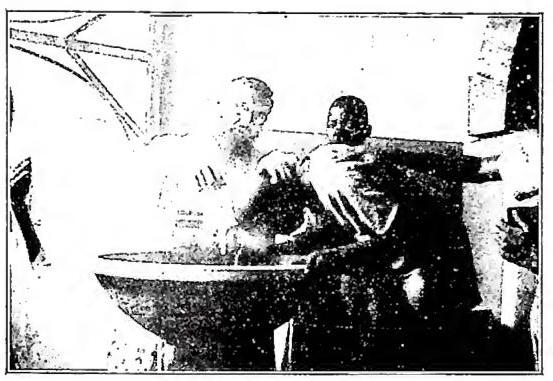
Another question concerns the missions, namely that of the B. of children born to unbelieving parents. Very many are the decrees and instructions issued on the matter by the Supreme Pontiffs, by Propaganda and by the Holy Office, and which can. 750 § 1 almost summarizes. Among the various documents relating to the question, particular importance attaches to the instruction of Propaganda dated 17 April 1777 (P. Gasparri, Codicis Iuris Canonici Fontes, VII, Rome 1935, n. 4575, pp. 107-15; Collectanea, loc. cit., n. 522, pp. 319-23). In it it is established: «non licere nisi in articulo seu moraliter certo imminentis mortis periculo infantes infidelium filios, invitis seu insciis parentibus, baptizare». With this reply the practice followed by the ven. Giovanni Martino Moyé, of the seminary of the Foreign Missions of Paris, a missionary in China, was clarified. During the famine which in the two years 1777-79 reaped a very great number of victims in the apostolic vicariate of Su-cthuen, the ven. Moyé, with the help of pious women, baptized a great number of children of pagan parents, and after the end of the famine he continued his practice, inspired by very broad criteria in the matter and which was the subject of discussions on the part of other missionaries.
On the subject, in 1779 Monsignor F. Pottier, apostolic vicar, and in 1780 Moyé himself wrote to Rome to obtain a definitive decision in the matter. In the meantime Propaganda had issued on 17 April 1777 the «Instructio super dubiis nonnullis propositis quoad baptismum pro diversis cum personarum tum periculi circumstantiis», which resolved the question in a sense contrary to the practice followed by the ven. Moyé and which reached the hands of Monsignor Pottier in the first months of 1782. The ven. Moyé submitted to it fully.
Bibliography3 works
Saverio Paventi
IV. ASCETICS OF BAPTISM.
The inexhaustible riches of the truths contained in the doctrine of B. and in the symbols, with which the ceremonies of the rite are laden, have induced the Fathers and ascetical writers from the very beginning to study profoundly the contribution they can make to the spiritual formation of souls, and Christian piety to institute practices that keep them alive in the memory.
I. LIVING ONE'S OWN BAPTISM
It means first of all becoming conscious of it. The child, when he receives the Sacrament, does not know what he is receiving; but as he grows in years he must strive to understand ever more intimately the gift bestowed upon him. B. deposits the divine life in the soul; but this is only like a seed; it is up to the Christian to make it grow until it reaches, in the expression of St. Paul, "the stature of the perfect man, the fullness of the age of Christ" (Eph. 4:13). To live one's own B. therefore means to develop the richness contained in the seed, to make Jesus Christ grow within oneself. This, which at bottom is the vocation to holiness, is nothing but the development of baptismal grace.
The imperatives that derive from it and constitute the application of the principle "to live one's own B." can be reduced to four: 1) to avoid sin. "Receive this white garment and bring it back without stain to the tribunal of Our Lord Jesus Christ," says the priest in the baptismal rite, laying a white linen cloth on the baptized. And St. Paul: "Do you not know that we have been baptized in Jesus Christ... so that we may walk in newness of life?" (Rom. 6:4). 2) to acquire a filial spirit toward God. "You have received the Holy Spirit, a spirit of adoption, in which we cry: Father, Father" (Rom. 8:15). 3) to acquire the spirit of sacrifice. Even while receiving the divine life, the Christian retains within himself the possibility of rebelling against right reason; he carries on his lips, with the possibility of one day giving it, the kiss of Judas; it is therefore necessary to be strong, to struggle and to conquer, and this entails sacrifices. 4) to acquire the spirit of the apostolate. Once incorporation in Christ is posited, all the baptized are united to help one another, and each one must cooperate for the spiritual good of others.
II. DEVOTION TO BAPTISM
Various practices were introduced by the Church and by Christian piety to keep the memory alive and thus recall to us the spirit and the promises made in the act of receiving the Sacrament: 1) to solemnize the date, not only of birth, but of Baptism. The first recalls one's appearance in the human family; the second one's appearance, far more important, in the divine family. 2) To renew one's baptismal vows. This can be done privately and also by taking part in the ceremony held at the beginning of each year, or on the occasion of solemn communions, or of the administration of Confirmation. To renounce Satan, that is, to react against the seduction of perverse ideas, spread about in profusion, is a necessity of every day. Therefore the ratifying of the pact pronounced in our name by the godfather or the godmother is an action that is incumbent upon the Christian who understands what he is and what he does.
Bibliography6 works
Celestino Testore
V. ICONOGRAPHY AND FOLKLORE OF BAPTISM.
I. ICONOGRAPHY
The scene commonly called that of the Baptism was among the very earliest New Testament scenes to enter paleochristian art, both in sculpture and in the catacomb frescoes. Later it would pass quite naturally into the decoration of baptisteries and of liturgical furnishings. Conceived according to a rather simple scheme, it was nevertheless subject to variants and evolutions. A description that takes these into account must include among the substantial elements of the composition, common to all monuments: the baptized person, usually nude; the baptizer, whose clothing varies between the exomis tunic or an animal skin and the tunic with the pallium; an indication of the baptismal bath by means of the very nudity of the baptized person and of the water represented as a horizontal mass, as sprays scattered around the neophyte or, in sculpture, as a vertical cascade, which from the 5th century becomes the historical Jordan; and finally an allusion to the intervention of the Holy Spirit, figured in the dove which, from the 4th century, can send forth a ray of light from its beak, and also in the imposition of the hand, which is found everywhere except in those monuments in which the Baptist helps Christ to rise from the waters of the Jordan. The cups for infusion that are found in a few ancient monuments are due to recent restorations. The criteria once accepted for distinguishing the Baptism of Christ from that of the simple neophyte do not stand up to comparison with all the monuments; one can say only that in certain cases the former serves as the prototype of the latter. The ancient figurations serve little or not at all to illustrate the different rites of immersion, infusion or aspersion, because the purpose of art was not to represent realistically a liturgical ceremony, but to compose together the elements most suited to recall to the minds of the faithful the rite of Christian initiation, that is, Baptism "in water and in the Holy Spirit."
Bibliography2 works
Luciano De Bruyne
Iconography of the Baptism of Jesus. — The theme of the Baptism of Jesus continued throughout the Middle Ages, and underwent no essential variants in the West, while in the East it took on a more anecdotal and narrative character: the 10th-century frescoes of Toqale Kilissé in Cappadocia influenced, through miniatures, especially the Romanesque miniatures (for example, the conical form of the waves of the Jordan).
In the Romanesque period the theme underwent some modifications also because it came to be used in ways and on occasions different from the previous ones, as, for example, for the decoration of capitals, tympana, etc. The miniaturists, on the other hand, were faithful to the iconographic tradition (Sacramentaries of Autun and of Drogo, Hortus deliciarum) while often handing down to us a bearded and blessing Christ. The number of angels standing by becomes variable: in France one or two, in Italy even three (baptistery of Parma) or four (S. Maria d'Arezzo). Sometimes the Baptist, clothed in skins and girded with a rope, baptizes Christ with a cruet.
Subsequently the subject had iconographic variants depending above all on the growing predominance of the artist's individuality and on the picturesque taste that sought indistinct occasions to manifest itself: thus while Giotto (Padua, Scrovegni Chapel) expressed in the Baptism of Christ his human religiosity, Masolino adhered rather to tradition (Castiglione d'Olona) while showing himself curious about iconographic novelties; Verrocchio composed the scene before a luminous landscape amid bursts of light, while Piero della Francesca impressed upon it his absolute geometric and spatial rigor.
The setting of the scene, moreover, became complicated with plants, flowers, and little scenes, as demonstrated, for example, by Perugino, the Bellini and especially Tiepolo.
Bibliography4 works
Fabia Borroni
II. FOLKLORE
Popular tradition preserves, around the ceremony of Baptism, a series of original customs which, almost as a complement to the rite, help to accentuate and color the festive and solemn character of the event and to give prominence to the entry of a newborn into the Christian community.
As long as the child is not baptized, in many regions, especially of central-southern and insular Italy, he is called "Turk," or "little Turk," or even "pagan," and when, after the sacred rite, the godmother returns the child to the woman who has given birth, she pronounces the sacramental phrase: "You gave me a pagan, and I return him to you a Christian." In the same sense the Greeks call him ἄρστος, serpent, and if it is a girl ἄρστος, serpentine, in the notion that the unbaptized child is not only a man at the mercy of the devil, but rather himself a devil.
Hence the tendency, in places where popular tradition is more alive, to hasten as much as possible the date of Baptism. The baptismal outfit for the newborn generally consists of a long little dress and a white cap. It is understood that, in this regard too, the variations are many, owing to climate, environment, social condition, individual taste, etc. What predominates, in any case, is the notion of innocence (white) and of the need to indicate the distinction of sex, so that at first glance even a stranger may immediately recognize whether it is a boy or a girl.
Extraordinary importance had, in popular tradition, the institution of the godfather and godmother, or of the compare and comare of Baptism. Now the custom is, somewhat everywhere, losing vigor, but, until not many years ago, in very many villages the godfather was truly a "compare," assuming in the family into which he held the newborn at Baptism a place of very close spiritual kinship, and almost superior to a blood kinship. The number of godfathers is in certain regions doubled with another couple chosen from the children of friendly families: in France these minor godfathers are called "parrains babillauds." To the two godparents is due by custom the first news of the labor pains and of the birth that has taken place. In many places it falls to the godfather to give the name to the newborn. Even in the giving of the name the people usually follow the rules of an ancient tradition; they "redo" first the paternal grandparents, then the maternal ones, then the uncles, that is, the brothers of the father and of the mother, provided that internal vicissitudes of the family, premature deaths, etc., do not lead to imposing the name of other relatives or friends. This is one of the typical expressions of the sense of tradition and of family cohesion among the people.
In church the newborn is held in the arms of the godfather (or of the godmother): at the moment when Baptism is conferred, the father withdraws and places himself a few steps below the compare (the mother never takes part in the Baptism and has herself found in bed, even if the ceremony is postponed to a long time after the birth). The exit from the church gives rise to manifestations of merriment, the firing of rifles and the throwing, on the part of the godparents, of confetti or even hazelnuts, beans or wheat and even money, all as a sign and good omen of prosperity and abundance. The throwing, with a gesture of sprinkling, gives rise to scuffles among the children. On the return the procession follows the same order as on the way there, except that the priest is given the place of honor, where he takes part in the feast in the house of the newborn.
At home, then, it is the moment of good wishes and festive expressions, some according to ritual formulas. Of the return of the baptized child to the mother, on the part of the comare, we have spoken above. The family offers a refreshment more or less rich according to its own condition. Characteristic is the offering of confetti, almonds, walnuts, sugar-plums, hard-boiled eggs, as well as wine or rosolio and coffee.
All this complex of customs or beliefs serves to give to the ceremony of Baptism, in the simple soul of the people, a tone of moving poetry and of intimate festivity. - See Pl. LXV.
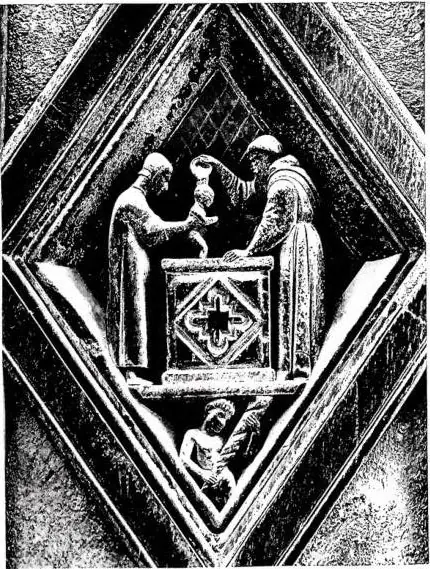
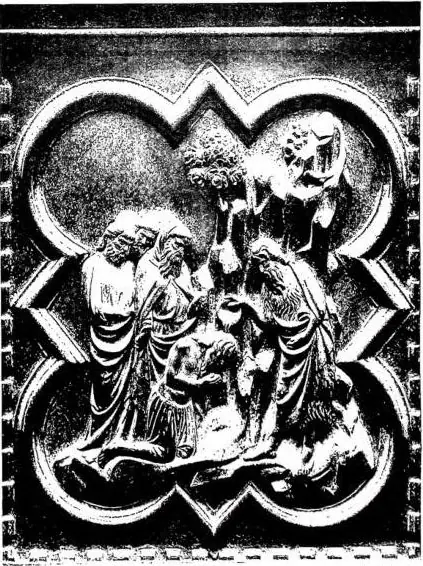
Bibliography5 works
Paolo Toschi