

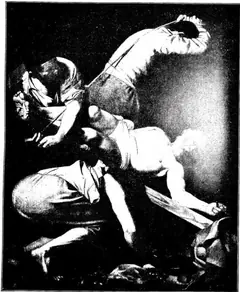
PETER, Apostle, Saint. - First of the Apostles, appointed by Jesus as head of his Church.
I. LIFE
His name occurs in the New Testament in four forms: Σιμεών (Simeon, from Sim'ōn, a Semitic form: Acts 15:14; 2 Pt. 1:1), Σιμιών (Simon, the more common form, a Hellenized abbreviation of the preceding), Κηφᾶς (Latin Cephas, a transcription of the Aramaic Kēphá', which means "rock"), Πέτρος (Latin Petrus, a translation of the preceding Aramaic nickname, given to Simon by Jesus [Jn. 1:42]). His father was called John ('Ιωάν[ν]ης: Jn. 1:42; 21:15-17) or Jonah. In Mt. 16:17 Simon is called the son of Jonah (Βαριωνά; v. BAR JONAH), but it may be that the name Jonah, attributed to P.'s father (by the Vulgate also in Jn. 1:42), is an abbreviation of Ioannes (perhaps due to an oversight of the Greek translator of Mt. 16:17: U. Holzmeister [v. bibl.], p. 6).
P. was born at Bethsaida (v.) near the lake of Gennesaret, where he practiced fishing with his brother Andrew (v.), who was also called to the apostolate, and with the sons of Zebedee (v.), James the Greater (v.) and John (v.), who later also became apostles.
From the fact that P. had at Capernaum his mother-in-law, healed by Jesus (Mt. 8:14; Mk. 1:30 ff.; Lk. 4:38), it follows that P. was married; the name of his wife is not known with certainty, called Joanna by the Easterners and Perpetua by the Westerners; nor is it known whether the wife was still alive at the time of P.'s vocation. Some exegetes have wished to identify P.'s wife with the "sister wife" whom Cephas led with him on his apostolic journeys (1 Cor. 9:5), but this is far from proven. It was probably a Christian woman (a domestic or a deaconess) who followed P. and the other missionaries listed there, on the basis of the tradition that attributes to P. a daughter Petronilla (v.).
P. and John are called "unlettered and ignorant" by the members of the Sanhedrin (Acts 4:13): a sign that they had not attended the learned rabbinic schools. They had, however, followed the instructions of John the Baptist (v.). This is certain for the sons of Zebedee and for Andrew: probable for Simon-P. The vocation of P. to the apostolate came about by degrees. When he was presented by his brother Andrew to Jesus with the words: "We have found the Messiah," he received the nickname of Cephas (Jn. 1:42). He was present at the miracle of Cana (ibid. 2:2-11), and then settled with Jesus at Capernaum (ibid. 2:12). He was definitively called to the apostolate after the first miraculous catch of fish (Lk. 5:11; Mk. 1:18; Mt. 4:22), thus becoming a "fisher of men."
Bibliography8 works
Pietro De Ambroggi
II. ST. PETER IN ROME
Pope Clement in his Letter to the Corinthians, written between 18 September 96 and 25 January 98 (A. Casamassa, I Padri Apostolici, Rome 1938, p. 49), having recalled the martyrdom of the holy founders Peter and Paul, attests that to these men of holy life was added a multitude of the elect who amid so many torments constituted among us a magnificent example (I ad Cor.: PG 1, 217-21). Ignatius of Antioch, martyred in Rome under Trajan, writing on his journey to the faithful of the City, entreats them because he cannot give them orders, as Peter and Paul (Ad Rom., IV, 3). Bishop Dionysius of Corinth, addressing between 165-70 the bishop of Rome, Soter, testifies explicitly that Rome and Corinth had as founders of their respective Churches the same apostles Peter and Paul (Ad Rom., in Eusebius, Hist. eccl., II, 25, 8). The same testimony is given a few years later by St. Irenaeus, bishop of Lyon (Contra haeres., III, 3, 3) and later by Tertullian (Adversus Marcionem, IV, 5, 2: CSEL, 47, 430). He moreover calls "blessed" the Church of Rome for which the Apostles poured out their blood, where Peter conformed to the Passion of the Lord (De praescr., 36, 2). Commodianus attests that Nero "Petrum et Paulum prius punivit in urbe" (Carmen Apologet., 828: CSEL, 15, 169). Peter of Alexandria and Athanasius indicate Rome as the place of martyrdom of the two princes of the Apostles (Epist. canon., 9, 9: PG 18, 484; Apol. de fuga sua: PG 25, 668); the same is affirmed twice by Gregory of Nyssa (In s. Stephanum, 2: PG 46, 729; Epist., 17: PG 46, 1061). St. John Chrysostom repeats several times that St. Peter died in Rome (Contra Iudaeos et Gentiles, 9: PG 48, 825; In s. Ignatium, 4: PG 50, 593; In Psalm., 48, 6: PG 55, 232; In Rom., 32, 2 ff.: PG 60, 678). Whatever interpretation one may wish to give to some expression in the context of the poem placed by Damasus (366-84) "in catacumbas", it is undisputed that he claims Peter and Paul as Roman citizens by their martyrdom: "Roma suos potius meruit defendere cives" (A. Ferrua, Epigramm. Damasiana, Vatican City 1942, pp. 139-44). While the year of St. Peter's coming to Rome cannot be fixed with certainty, there is instead a series of undoubted testimonies that he suffered martyrdom in Rome and had his tomb in Rome. If several times attempts have been made to deny St. Peter's coming to Rome, beginning with the heretics of the 13th century, just as many times it has been confirmed also by learned Protestants, such as A. Harnack and above all H. Lietzmann (Petrus und Paulus in Rom, 2nd ed., Berlin-Leipzig 1927; id., Gesch. der alten Kirche, I, ibid. 1932, p. 20) and especially Petrus römische Martyrer, in Sitzungsbericht der Preuss. Akad. der Wissenschaft, Philolog. Hist. Klasse, 29 [1936], pp. 1-21) in which he refutes Daunenbauer (1932) and K. Heuss (1936).
III. MARTYRDOM
1. The year
The sources and the interpreters do not agree regarding the year of the martyrdom of P. In fact, in the so-called Liberian Catalogue one reads that the apostle P. "passus est autem cum Paulo die III Kal(endas) Iulias, consulibus suprascriptis", that is, on 29 June of the year in which Nero and Vetus were consuls, that is, in 55. This year for the death of the Apostle was held by Th. Mommsen (Über den Chronographen des Jahres 354, in Abhandlungen der Königl. der Sächsisch. Gesellsch. der Wissenschaftl., 1 [1850], pp. 634-37) and later, then, by H. Kellner (Jesus von Nazareth und seine Apostel, Ratisbon 1908, pp. 216-43). The death of P. is assigned to the year 57 in the "Fasti Vindobonenses priores" and in the "Consularia Ravennatia", while the "Consularia Constantinopolitana" place the martyrdom in the year 58 (ed. Th. Mommsen, in MGH, Auct. antiquis., IX, pp. 283, 194, 220). Not a few authors place the death of St. P. in the year 64, making it coincide with that of the fire of Rome, which occurred in the month of July. Such is the opinion, among the Protestants, of C. Erbes (Die Todsstage der Aposteln Petrus und Paulus, Berlin 1899, pp. 1-138); A. Harnack (Chronologie, I, Leipzig 1897, p. 242); T. Zahn (Grundriss der Gesch. des apostol. Zeitalters, 2nd ed., ibid. 1927, p. 68); and, among the Catholics, of L. Duchesne (Hist. ancienne de l'Eglise, I, Paris 1906, p. 64); P. Franchi de' Cavalieri (in N. Bull. di arch. crist., 13 [1907], p. 113); M. Lagrange (Evang. selon et Luc, Paris 1921, p. XXXI). On the other hand, other authors prefer the following year, 65. In fact, the text of Tacitus' Annals interposes a certain time between the fire and the persecution, which came about when "non ope humana, non largitionibus principis aut deum placamentis decedebat infamia, quin iussum incendium crederetur. Ergo abolendo rumori Nero subdidit reos" (XV, 44). Such was already the opinion of D. Papebroch (Acta SS. Iunii [Paris 1867], § 2, 17-25, pp. 367 B-369 B) and in more recent times of O. Marucchi (La crocifissione di s. P. in Vatic., in N. Bull. arch. crist., 11 [1905], pp. 137-53; A. Profumo (Le fonti ed i tempi dell'incendio
Neronian, Rome 1906, pp. 306-15, 320-27). St. Epiphanius placed the death of St. P. and of St. Paul in the twelfth year of the Empire of Nero (Hom., 27, 6, 6: PG 41, 373 B); this opinion was followed by L. Tillemont (I, p. 179). But in the Armenian version of the Chronicle of Eusebius (v.), in the Chronicon Gallicum (ed. Th. Mommsen, in MGH, Auct. antiquis., IX, p. 639) and in Agapius (PO 7, 478) the martyrdom of P. is indicated in the thirteenth year of the Empire of Nero, which runs from 3 Oct. 66 to 12 Oct. 67, unless this year is to be counted from the second time that Nero obtained the tribunician power, that is, from 10 Dec. 54. Clement of Rome places the martyrdom of St. Paul (I Cor. 5, 7) ἐπὶ τῶν ἡγουμένων, that is, in 67, when Nero, having set out for Greece, left the government of Rome to Sabinus, Tigellinus and Helius Cesarinus (Dio Cassius, 63, 12, 19); but the term "hegumenoi" can also mean ordinary judges, and the contemporaneity of the martyrdom of Paul with that of P. is not certain. St. Jerome places the year of the death of St. P. in the last year of Nero (P. "...Romae... cathedram sacerdotalem tenuit ad ultimum annum Neronis, id est decimum quartum" [De viris illustr., 1: PL 23, 638]) and repeats the same date for St. Paul (De viris illustr., 5: PL 23, 647) as well as in the version of the Chronicle of Eusebius (ed. R. Helm, in CB, XXIV, Leipzig 1913, p. 185). Jerome moreover wrote that the apostle P. was martyred two years after the death of Seneca, which occurred in 65, and therefore in 67, a date that was chosen by C. Baronio (Annales, I, nn. 1-4).
2. Manner
The first Christian writer who attests the crucifixion of P. is Tertullian, both by referring to the prediction made by Jesus Christ himself (Io. 21, 18-19) concerning the martyrdom of the Apostle (Scorpiace, 15: CSEL, 20, p. 178), and by declaring that P. by his martyrdom conformed to the Passion of the Lord (De praescr., 36, 2). Lactantius distinguishes the manner of martyrdom inflicted by Nero on the two Apostles and indicates that P. was crucified (De mortibus persecutorum, II, 6: CSEL, 27, p. 175); as Eusebius also does (Hist. eccl., II, 25, 5). Peter, bishop and martyr of Alexandria (300-11), recalls that P., first of the Apostles, was several times in prison and finally crucified in Rome. St. John Chrysostom likewise repeatedly affirms that he was crucified (In Gen., 66: PG 54, 657; In II Tim., 5, 2: PG 62, 626; In Pent. et initium Act., 8: PG 51, 109), while Jerome indicates that P. was so with his head downward, at his own request, feeling himself unworthy to be martyred in the same manner as his Lord (De viris illustr., 1: PL 23, 639). This manner of martyrdom was in fact in use at the time of Nero, because the contemporary philosopher
Seneca affirms that he had seen crosses of various makes, to which certain slaves were suspended with their heads downward (Consol. ad Marc., 20). Origen writes that St. P. was crucified with his head downward, at his own express request to the executioner (Euseb., Hist. eccl., III, 1, 2). Moreover six Christian sarcophagi (four Roman and two from the Galilees), all of the 4th cent., offer the scene of the apostle P. led to martyrdom by a soldier preceded by the executioner who carries the instrument of martyrdom: the cross (Wilpert, Sarcofagi, pp. 168-69; figs. 99 and 100; pls. 121, 4; 146, 1; 145, 1; 16, 1-2).
3. Place
As for the place of the martyrdom, it is indicated in the Martyrium Petri of pseudo-Linus "ad locum qui vocatur Naumachiae, iuxta obeliscum Neronis, in montem" (in R. A. Lipsius, Acta Apostol., apocr., Leipzig 1891, pp. 11-22). In the later account of pseudo-Marcellus it is Nero himself who orders that P. and Paul be put to death "in the naumachia". The Lib. Pont. indicates the place of the martyrdom as near that of the tomb, which it places "in templum Apollonis iuxta locum ubi crucifixus est, iuxta palatium Neronianum in Vaticanum, in territurium Triumphale Via Aurelia", thus in the biography of St. P. (I, p. 52); the topographical indication is repeated for the translation of his relics from the place "in catacumbas", which is attributed to Pope Cornelius, who would have deposited them "iuxta locum ubi crucifixus est, inter corpora sanctorum episcoporum, in templum Apollinis in monte Aureum, in Vaticanum, palatii Neroniani, III Kal. Iul." (I, p. 150).
IV. TOMB
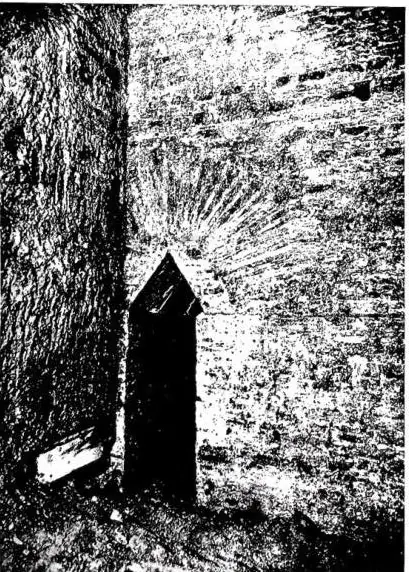
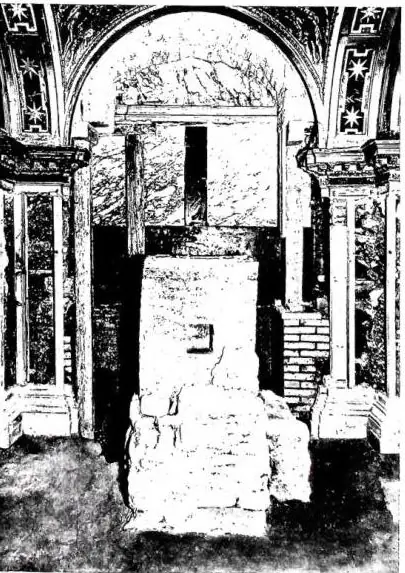
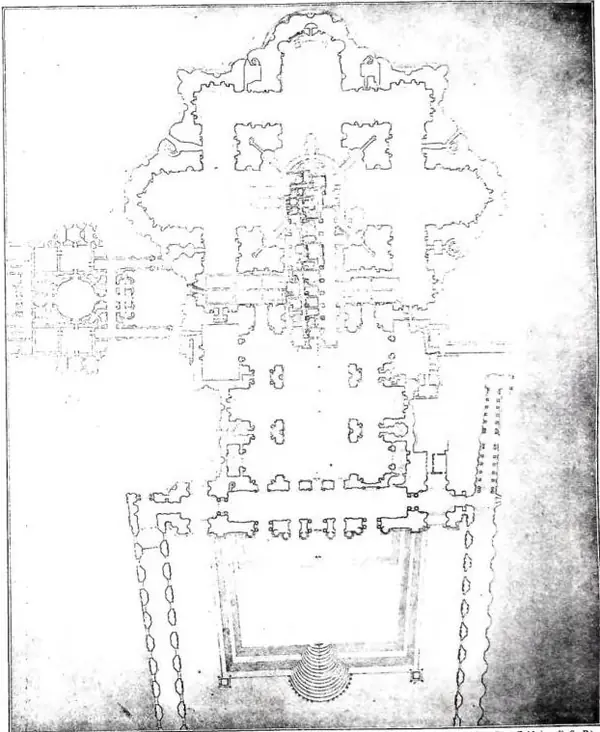
The oldest testimony concerning the place of the Apostle's burial is the well-known passage of the "vir ecclesiasticus Gajus" who, in his polemical writing against Proclus, head of the sect of the catadrygi (Montanists), wrote "If you go to the Vatican or on the road to Ostia, I can show you the trophies (τράπευα) of the founders of this church," in Eusebius, Hist. eccl., II, 25. Jerome writes that P. was buried in Rome on the Vatican, near the Via Trionfale, where he is venerated by the whole world (De vir. ill., 1: PL 23, 639). The place is indicated in the 2nd redaction of the Lib. Pont. in the biography of P. as follows: "P. sepultus est via Aurelia, in templum Apollinis, iuxta locum ubi crucifixus est, iuxta palatium Neronianum, in Vaticanum, iuxta territurium Triumphalem III Kal. Iul." (I, 118). In the biography of Cornelius the Pope he would have reported it "de Catacumbas iuxta locum ubi crucifixus est, inter corpora sanctorum episcoporum, in templum Apollinis, in monte Aureum in Vaticanum, palatii Neroniani III Kal. Iul." (ibid., p. 150). According to the biography of Sylvester, Constantine built the basilica of St. Peter "in templum Apollinis, cuius loculum cum corpus sancti Petri ita recondit" (I, p. 176). That the Constantinian Basilica arose "in templum Apollinis" is affirmed, as has been seen, three times in the Lib. Pont. But in the recent excavations, throughout the whole area of the confessio no vestiges other than tombs have been found; nothing that would authorize searching there for the aforementioned "templum Apollinis." Quite summary and contradictory were the reports published on the nature of the tomb of St. P. Previously it may be said that the excavations and archaeological discoveries had always been occasional, and only as much was known as had been transmitted by Pietro Mallio, by Maffeo Vegio, and by the finds of 1594 and 1626, within the area of the Confessio. G. Settele, entrusted together with E. Sarti with the Appendix to F. L. Dionisi's work on the Vatican Grottoes, published in 1846, carried out some research in the niche of the pallia. It emerges from his diary that he brought back into view the gate of Innocent III, removed the metal slab of Innocent X, recognizing that it "rested upon a wall that has a square hole, beneath which is a void, as Borgia describes it in the Vaticana Confessio (p. LXIX). But when a light was lowered, it was seen that at a depth of five palms there were cements and among these a rib bone and a piece of wood" (R. Cugnoni, Giuseppe Settele e il suo diario, Rome 1888). On the basis of the Vita Silvestri in the Lib. Pont. archaeologists believed that the Apostle's tomb was subterranean, and G. Wilpert even attempted a reconstruction of it, although Duchesne had warned not to consider reliable the data provided by the 6th-century biographer (Lib. Pont., I, p. 194, n. 61; L. Duchesne, Notes sur la topographie de Rome au moyen âge, Vaticana, XII, in Mélanges d'arch. et d'hist., 35 [1915], p. 67).
Now for the first time in the annals of history, from 1939 to 1949, through the personal initiative of the Supreme Pontiff Pius XII, explorations could be carried out within the area of the Confessio of the Vatican Basilica, thus crowning his personal aspiration, formulated even before his elevation to the Chair of St. Peter.
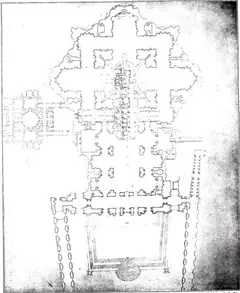
In 1939, when provision had to be made for the tomb of Pius XI in the Vatican Grottoes, Pope Pius XII himself wished that the floor level of those grottoes be lowered and that a more worthy arrangement be given to the tombs of his predecessors existing there. Then the explorations in the Confessio were begun. The course of the excavations was always conditioned by the structural requirements of the Basilica, especially in the two most delicate parts, such as the area of the piers of the dome, the foundations of the medieval Confessio and of Clement VIII, of the high altar of the same Pope and of the Berninian baldachin. The report of the excavations carried out was published by B. M. Apollonji-Ghetti, A. Ferrua S. J., E. Josi, E. Kirschbaum S. J., Esplorazioni sotto la Confessione di S. Pietro in Vaticano eseguite negli anni 1940-49, with a numismatic appendix by C. Serafini (2 vols., Vatican City 1951). If one descends today into the Confessio, where the statue of Pius VI in prayer stands (executed by Canova), one has before one the gleaming polychrome marble decoration of Paul V, right beneath the papal altar. In the center stands a rich gate of gilded bronze; behind this there is another gate above, also of gilded bronze, on which is engraved a metrical inscription of Innocent III (1198-1216). Behind this grille is fixed an oak panel, about 2.35 m long and 36.5 cm high, on which are applied two small columns and a fragment of a turreted tower in Limoges enamel. The original decoration can be reconstructed, as Stohlman has done, by means of the examples of antependia offered to the cathedrals of Orense and of S. Domingo de Silos, all the more so since the statuettes that belonged to it are today in the Sacred Museum of the Vatican Library.
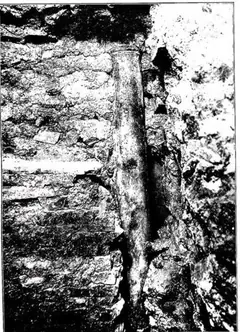
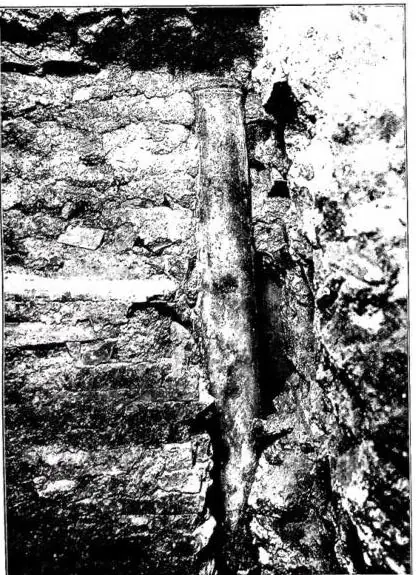
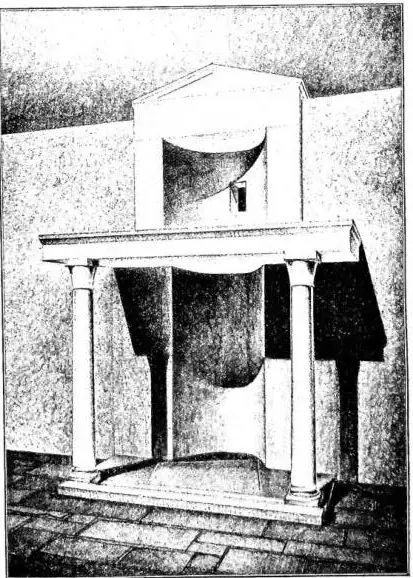
In the center stood Jesus Christ enthroned between the symbols of the four Evangelists and the twelve Apostles, distributed in two groups of six, beneath the arches of the walls of the turreted city of Jerusalem; in other words, it is the same representation that about eight centuries earlier the emperor Valentinian III had placed there in the time of Sixtus III (432-40). On the level of the niche is situated a silver casket offered by Benedict XIV to contain the sacred pallia that are blessed by the pope each year, on the evening of the vigil of St. P. At the bottom opens an irregular apsidal niche with, on the right and left, in mosaic, the apostles P. and Paul, from the time of Urban VIII, but restored under Pius IX. At the bottom of the apse stands out the mosaic with the image of Christ, bearded, with long hair, with a cruciform nimbus; with his right hand he makes the oratorical gesture, in his left he holds the open book on whose pages one reads: "Ego sum via, veritas et vita, qui credit in me vivet." The mosaic, however, has undergone many and not always happy restorations that greatly altered the original and it is therefore difficult to date; it was attributed to Leo III, but it seems later. Below the casket of the pallia there is a floor decorated with marbles and a bronze slab placed by Innocent X (1644-55). In 1892 Fr. H. Grisar opened the small door existing on the right of that slab and found a square opening of 22 × 17 cm. that leads to a small well which seemed to Grisar to be lined with bronze, whereas it is of marble; it descends to a depth of more than 35 cm., where the same Grisar ascertained the existence of a slab of white marble with a square opening that leads into a small space with irregular masonry. Such is the description given with great diligence by Grisar (Le tombe apostoliche, in Studi e documenti di storia e diritto, 13 [1892], p. 321 ff.; Analecta Romana, Rome 1899, p. 274 ff. and pl. VIII). The remains of the Apostle were deposited near the very place of martyrdom in the sloping area of the Vatican hill, in a simple grave in the bare earth, covered by a few roof tiles, precisely one of those sepulchres that the historian Tacitus describes as « humili sepultura » (Hist., I, 49). It is known from the four Gospels that the body of the Redeemer had been requested by Joseph of Arimathea from that same Roman authority that had issued the sentence of crucifixion and that Pilate « dedit corpus ». Indeed Roman law established that « corpora damnatorum quibuslibet petentibus ad sepulturam danda sunt ». Moreover this « ius sepulchri » was later granted to all the other Roman martyrs, even to Sixtus II and his four deacon co-martyrs « incontinenter animadversi », because they were surprised on 6 Aug. of the year 258 on the very area of the cemetery of Callistus. For the body of the disciple P. it happened as for the divine Master. His burial took place in an area of the Vatican hill where other tombs seem already to have been, such as tomb γ, even deeper, consisting of a terracotta sarcophagus protected by a wall containing a clay pipe for libations, emerging from the surface of the ground, as has been found in other tombs of Rome and elsewhere. Another grave further east, θ, contained another corpse likewise deposited in the bare earth; it was covered by roof tiles, one of which bore the factory mark of a certain « Stat. Marcius Demetrius » (CIL, XV, 1273 a) which E. Dressel dated to the time of Vespasian (69-79); but stamps of the same workshop were also found in the ships of Nemi from the time of Caligula (G. Gatti, in G. Ucelli, Le navi di Nemi, Rome 1938, p. 337 ff.). And it must be emphasized that both γ and θ have the same east-west orientation, slanting toward the southwest, in the same way that the tomb of the Apostle was arranged. To the southeast of this field P., after 123 and not beyond the middle of the 2nd century, the mausoleum of the Matucci, O, was erected, as attests the « titulus » still in place on the façade, in front of which is an « ambitus » delimited by a wall in opus reticulatum that leads to a staircase built at the western end of the mausoleum itself, with which it is contemporary. After the Matucci mausoleum and to the west of it the mausoleum S was erected, later largely damaged in 1626 by the foundations of the southeast pillar of the support of the baldachin of G. Lorenzo Bernini, surmounting the high altar of Clement VIII. Uphill, delimited by walls, was field Q, entirely occupied by open-air inhumation tombs, covered by a mosaic floor in basalt tesserae; access to that area was from the south, by means of a « clivus » and a staircase; below the « clivus » at a depth of 2.30 m. a drain was run, which channeled the rainwater descending from the hill; its bottom consists of bricks produced in series; four of them bear the factory mark « Aurelii Caesaria et Faustinae Augustae », offering a dating between 147-161, a dating that is common to the large protection wall recognized for a height of at least 2.50 m., for a length of 7 m. from north to south, about 0.50 m. thick, faced with opus testaceum and red plaster and therefore distinguished by the designation of « red wall ». All this was carried out when the steep south-north « clivus » was arranged by means of a staircase made to access field Q and the solarium of mausoleum R¹ which had meanwhile been built. The workman who built the red wall passed over the western part of the tomb of the Apostle, which had already received a small protection wall m¹, plastered on the inside, which suggests another m²; but then a rough irregular niche N¹ was made in the same wall, 21 cm. deep, 72 cm. wide and about 1.40 m. high; above it there was a broken marble slab, already used for a mausoleum, because it contained the inscription of an « Aelius Isidorus ». Above, in the body of the red wall, a second niche N² was made, 0.72 m. wide, lined with small slabs of gray marble and covered by a travertine slab supported by two Corinthian columns of white marble 1.40 m. high; their bases, which show the socket for a gate also to the east, rested on a travertine threshold belonging to a rebated square. The south column was found still in place, the base and a stump of the shaft of the north one were moved later. Above, a third niche N² opens, 1.12 m. wide, 0.92 m. high. But this embellishment of the tomb attests that it was already then frequented and venerated by the Christian community of Rome; indeed Eusebius declares that « myriads » of visitors flocked there from every part of the Roman Empire (Theophania Syriaca, IV, 7: ed. H. Gressmann, in CB, XI, 2, Leipzig 1904) and it is even confirmed by Julian the Apostate (Cyril of Alexandria, Contra Iulianum: PG 76, 1004 ff.). The exploration has brought to light precisely what, from the 2nd century onward, was pointed out, venerated and recognized as the trophy of Peter. The space beneath niche N², glimpsed by Settele and by Grisar, was found occupied by fragments of walls and human bones of an elderly person; among the earth a gold leaf was collected on which is represented in the center a gemmed cross between two eyes, of 7th-century workmanship, evidently an ex-voto for a healing obtained. The earth also yielded a precious documentation of offerings from unknown pilgrims of every age and every country who left their obol at the tomb (v. below). Meanwhile other sepulchres, always solely by inhumation, had been made all around; tomb γ is also very ancient, while tomb ζ is not much later; on the other hand sepulchre i may have come together with the red wall, while those κ and λ are later; post-Constantinian, then, are α, β, δ, ε.
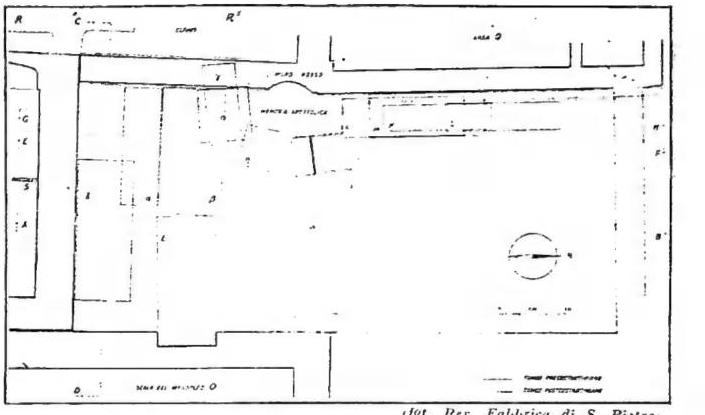
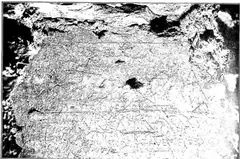
Other reinforcement works were later necessary on the north side, where the red wall presents a crack and therefore the monument had the north column moved and received a reinforcement wall about 50 cm. thick, and about 90 long, covered on the north by a layer of decorated plaster that immediately received the testimonies of visitors, who scratched their names there one upon others. "Simplici vivite in ♣ Nicasi vibas in ♣; Victor cum suis Gaudentia vibatis in ♣, etc. Paulina vivas, Prima vivas; in ♣ Venerosa Vea, Verus, Bonifatia, Venerosa, Vea", etc. But at a certain point an opening was nevertheless made in this graffitied wall in order to place inside the wall itself a small box made of marble slabs, probably intended to contain relics. The whole was sealed with a coat of lime that was superimposed over the graffiti. This undoubtedly happened before the Constantinian works that definitively concealed the wall itself. After the publication of the report on the excavations, on the red wall, behind the box, Fr. A. Ferrua identified a graffito in Greek letters invoking IIETP(E) and gave notice of it in Cte. Catt., 1952, I, pp. 15-29, fig. 3. No site was less suited than this one of the Vatican for building a five-nave basilica on terrain sloping from south to north and from east to west; occupied in the valley by a public burial ground, not of simple freedmen, "de Caesaris domo", but also by many mausoleums of freedmen of notable Roman families, such as the Marcii, the Matucei, the Popilii, the Tullii, the Valerii (where Christian graffiti and inscriptions were discovered and are now being studied), etc. Constantine's architects contented themselves with including in a marble facing the trophy pointed out by Gaius. They in fact surrounded the monument on the north, west and south with slabs of pavonazzetto placed on bases also of pavonazzetto, found "in situ" to the north and south, while on the eastern side the niche remained visible. In the center of the transept there was thus a small building, which, again according to the Lib. Pont., would have been adorned with porphyry columns and with other vitineous columns coming from Greece. Furthermore, in front of the tomb Constantine would have placed a gold crown forming a lamp with 50 dolphins, weighing 35 pounds. In 1908 Gnirs published a precious ivory casket found near the confessio of the church of Samagher (Istria: v. plate 99 of vol. VI). The decoration of the rear face represents the presbytery of a basilica with an architrave supported by six vitineous columns and in the middle a tabernacle or small building surmounted by a crown. The typical vitineous columns immediately led Gnirs himself and then M. Cerrati, G. Wilpert and P. Toesca to think that the presbytery of the Vatican basilica with the monument of the Apostle had been reproduced. Constantine's architects were forced to create an enormous platform against the hill that rose to the north and west. The Roman necropolis (v. VATICANO) was buried beneath this platform; the two steep slopes east-west and south-north were eliminated, not only by demolishing whatever could be an obstacle to the foundations of the new building, but also whatever of the upper parts of the mausoleums themselves was above the chosen level, that is, about 1.30 m from the tomb of the Apostle. All the voids were filled with rubble material, a veritable "congestio terrarum", after having placed inside numerous sarcophagi that had been filled with bones from the smaller tombs found on the slopes of the hill; the same rubble material was contained by means of masonry walls.
The floor of the Constantinian presbytery is composed of thick marble slabs; the remains of its enclosures to the north and south survive, and there the bedding plane of two of the six vitineous columns. Further damage was done to the subsoil by the establishment of a veritable Christian cemetery beneath the floor of the Constantinian Basilica, with "formae" and sarcophagi, as were found in the basilica "Apostolorum in catacumbas", sarcophagi frequent especially in the area of the apse and the presbytery. Gregory of Tours reports what he had learned from his deacon Agisifus, who had visited the Apostolic Sanctuary in 589-90. He indicates the "sepulchrum sub altari collocatum" and of no easy access "valde rarum habetur". To approach it, the gates surrounding it had to be opened "reseratis cancellis, quibus ille ambitur" and then one reached above the tomb itself "accedit super sepulchrum"; then a small window had to be opened "et sic fenestella parvula patefacta" and one could put one's head in and implore the graces one needed "immissio introrsum capite, quae necessitas promit efflagitat" (De gloria martyrum, 27: PL 71, 728). There were therefore two closures that protected the tomb: an outer gate and a "fenestella parvula" that could be opened. It is to these two closures that the imperial envoys refer in their petition to Pope Hormisdas. They, between 514 and 523, had come to Rome sent by the emperor Justinian, asking the Pope to have, as relics, objects that had been near the tombs of St. P. and St. Paul, if it had been possible "usque ad secundam cataractam"; by "cataracta" it has hitherto been thought one must understand a vertical shaft near the tomb into which the objects would be lowered. Gregory of Tours also reports that many pilgrims had gold keys made identical to those that locked the gates of the Apostle's tomb and substituted them in order to carry them away blessed as a remedy against illnesses. The custom of these gold keys is confirmed by a letter of Gregory the Great in which he writes of sending to John, former consul, patrician and quaestor, one of the keys that served to lock the gates of the tomb of St. P.; he calls it "sacratissima" because it contains filings from the apostle's chains; it seems that such keys were also worn around the neck out of devotion.
The mosaic decoration of the niche of the pallia that has come down to us with repeated and not always happy restorations, as has been said, is certainly not earlier than Leo IV (847-55). Many are the works carried out by Leo IV "post depredationem Saracenorum" in the Vatican Basilica. The biographer recalls three "imagines argenteas totasque exauratas" placed "in corpus beati Petri" (Lib. pont., II, p. 111); shortly afterwards, however, he describes the Pope's anguish "cum cotidie beatissimi apostolorum principis Petri sacratissimum altare cerneret violatum"; he then covered with gold and silver "non tantum confessionem sacram, verum etiam frontem sepedicti altaris" (ibid., p. 113); shortly afterwards there is mention of an altar "quod supra sanctissimum beati Petri apostoli corpus consistit" (ibid., p. 133). The Lib. Pont. indicates that by the Saracens the basilicas of St. P. and St. Paul "funditus depredatione sunt" (II, p. 106). The Annales Bertiniani declare that the Saracens carried off "cum ipso altari, quod tumbae memorati Apost. principis superpositum fuerat, omnibus ornamentis atque thesauris". Evident traces of the depredations were found beneath the hatch of Innocent X, where a triple lead covering was found broken, violently twisted at its edges, just as a very thin silver sheet suffered the same fate, the only metal remains found on the tomb itself.
The altar of the raised presbytery was dilapidated in the 12th century and Callixtus II enclosed it in his own, which he consecrated on 25 March 1123; upon it in 1594 the present high altar of Clement VIII was erected. Of the many tombs found, the humble burial of the Apostle is the only one that presents the undoubted evidence of later embellishment and uninterrupted veneration from the time of the presbytery of Gaius, that is, from the close of the 2nd century. The 1,900 coins, the gold ex-voto, the triple lead covering, the thin silver sheet constitute the evident proofs of its veneration, which always remained localized where the sumptuous Constantinian facing arose, where the altars were superimposed one upon another; that of the raised presbytery, of Callixtus II, of Clement VIII, remaining always through the centuries the center of veneration and worship.
Indeed, from the Liber Diurnus it appears that the indiculum written by each newly elected Lombard bishop was addressed to the same apostle P. and deposited on the body of the Apostle "supra sacratissimum corpus tuum beate Petre"; the new pope himself, on the day of his election, addressed to the Apostle his "promissio fidei," which was presented together with the oath at the Confession of the Apostle, while on the day of his consecration the "cautio" addressed to the Church of Rome was offered at the Confession and kept "in venerabile corpus tuum beate Petre apostole" (formula 76: ed. Th. v. Sickel, Vienna 1889, pp. 80-81). The biographer of Adrian I attests that Charlemagne, on 6 April 774, deposited the text of his donation, signed by him and his dignitaries, first on the altar of the Apostle, then in the Confession "intus super corpus beati Petri...
pro firmissima cautela et aeterna nominis sui ac regni Francorum memoria" (Lib. pont., I, p. 498).

L. von Pastor has emphasized the firmness of Julius II in opposing the plan of D. Bramante, who wished to move the tomb of the Apostle. The Pope decreed "nihil ex vetere templi situ inverti, nihil e primi pontificis tumulo attractari se passurum dicit... se sacra prophanis religionem splendori, pietatem ornamentis esse praepositurum" (Aegidius Viterbensis, Historia viginti saeculorum, cod. C. 8-19, f. 245 of the Bibl. Angelica, in L. von Pastor, Storia dei Papi, 2nd ed., III, Rome 1942, pp. 899-900 and Document no. 135, pp. 1121-22). Even today the pallia for archbishops are kept on the most venerable tomb, where they are blessed: every year by the successor of P. on the evening of 28 June, the vigil of the Apostle's birthday. The explorations personally conceived and promoted by the reigning Pontiff have fully confirmed the centuries-old tradition that has uninterruptedly venerated the tomb of the Prince of the Apostles beneath the altar.
Coins. - The coins collected in the recent excavations, identified and classified by the late C. Serafini, are divided into: Roman imperial coins from Augustus to the emperor John (423-25); Byzantine coins from Arcadius to Justinian-Atalaric (527-34); papal coins from Stephen V (VI) (885-91) to Paul V (1605-21); Italian coins of Milan, from Louis II (855-75) to G. Galeazzo Visconti (1395-1402); of Pavia, from Lothair (840-55) to Frederick II of Swabia (1220-50); of Cremona (13th century); of Venice, from Henry IV or V of Franconia (1056-1125) to Giovanni Dandolo (1280-1289); of Verona, from Otto I of Saxony (962-73) to Frederick III (1218-50); of Bologna, from the 12th century to 1605; of Parma, from the time of Frederick II (1220-50); of archbishops of Ravenna of the 13th-14th centuries; of Rimini (1250-1385); of the Republic of Florence, ed. 1315; of the Commune of Arezzo (13th-14th centuries); of Lucca, from a gold tremissis of Charlemagne (reproduced under that entry) to the Republic of the 14th century; of the Commune of Pisa (15th century); of the Republic of Siena, from the 11th to the 16th century; of the Republic of Ancona (13th-15th centuries); of the Commune of Ascoli (13th-14th centuries); of Urbino, from Guidobaldo II (1558-74) to Francesco Maria II (1574-1624); of Perugia (15th century); of Castro (1545-47); of Naples, from Charles of Anjou (1285-1309) to Louis and Joanna (1352-1362); of Aquila (Joanna II, 1414-35); of the Latin East, that is, of Chiarenza (1318-33) and of Lepanto (1366-11).
The foreign coins are: 190 from France, from the reign of Louis the Pious (814-40) to Charles VII (1422-61); of the Duchy of Dreux (11th century); of the dukes of Normandy of the 11th century; of Brittany, from Conan II (1057-66) to Charles of Blois (1341-64); of Anjou, from Count Geoffrey II (1040-60) to Fulk IV or V (1060-1129); of Count Herbert I of Maine (1015-36); of the abbey of St. Martin of Tours (11th-12th centuries); of the counts of Chartres (11th-12th centuries); of the viscounts of Bourges (11th century); of the lords of Chateaureux (1012-1187); of the counts of Nevers (10th-11th centuries); of the bishops of Le Puy (11th-13th centuries) and of Clermont (11th century); of the viscounts of Limoges (10th-12th centuries); of the abbey of St. Martial of Limoges (11th-12th centuries); of the counts of Poitou (11th-12th centuries); of the counts of Angoulême (11th-12th centuries); of the counts of Bordeaux (984-1010); of the counts of Toulouse (1060-88); of the counts of Carcassonne (10th century); of the counts of Melgueil; of the archbishops of Lyon, of Vienne and of Besançon; of the bishop of Valence; of the duchy of Burgundy; of the counts of Auxerre and of Champagne, of Sens and of Provins; of the bishops of Meaux, Laon, Metz, Strasbourg, Verdun.
From Flanders there are coins of Antwerp, of Liège, of the Netherlands, of Maastricht, of the bishops of Utrecht and of Groningen, of Vilvorde; from Germany, of Aachen, of Duisburg, of the archbishops of Cologne and of Mainz, of the bishops of Osnabrück, Trier, Bamberg, Constance; of Regensburg, of Deventer, of Magdeburg. From Switzerland: of the bishops of Basel, of Geneva, of the cities of Fribourg and of Zurich. From Germany, Switzerland and Austria there are in all 323 coins. England is represented by 25 coins ranging from the Anglo-Saxon ones of the 7th century to that of Edward III the Confessor (1327-77); one from Ireland of the 10th century; one from Lund of the 11th century and 3 other Scandinavian ones of the same age; three from Hungary of the 12th century; one from Croatia of the 12th century,
(phot. Res. Fabbrica di S. P.)
PETER, APOSTLE, saint. - The niche of the Pallia; above, the gate of Innocent III; at the back, mosaic of the Savior (9th century); at the sides, Sts. P. and Paul, in mosaic commissioned by Urban VIII; below, the casket of Benedict XIV for the Sacred Pallia and the slab with the cross of Innocent X, located above the tomb.
one from Bohemia of the 14th century; one from Livonia of the 15th century; one from Slavonia of the 13th century; 5 from Spain of the 11th and 12th centuries; one from Portugal of the 12th century; altogether 812 Roman coins, 102 papal, 526 Italian and 460 foreign have been identified, for a total of 1900 coins.
Enrico Josi
V. LETTERS OF ST. PETER
Two epistolary writings belonging to the group of the 7 "catholic letters" (v.) of the New Testament. The first was always recognized as canonical (protocanonical); the second was the object of doubts in some Churches (deuterocanonical).
1. The first epistle of Peter
a) Subject. - The author, who presents himself as "Peter an apostle of Jesus Christ," wishes an abundance of grace and peace "to the elect sojourners (that is, to the Christians who tend toward the heavenly homeland) living in the diaspora (scattered among the Gentiles) of Pontus, Galatia, Cappadocia, Asia and Bithynia" (1:1-2).
In the body of the letter he exhorts to a holy life for three principal reasons: 1) for the great benefits granted by God (1:3-2:10); 2) to edify and convert the Gentiles (2:11-14:4); 3) for the divine judgment that overhangs all (4:5-5:11).
b) Genuineness and canonicity. - They were always admitted among Catholics. In the prologue the author presents himself as Peter the apostle. From the context it results that the writer was an immediate disciple of Christ, a witness of the Savior's sufferings (5:1; 2:21-24). He distinguishes himself from those who believe in Christ without having seen him (1:8); he calls "my son" that Mark (v.) who, from the Acts of the Apostles (12:13) and from tradition, is presented as the spiritual son and "interpreter" of Peter. The author of the epistle shows the characteristics that the Gospels attribute to Peter: simplicity, united with a certain roughness, enthusiasm, fervent love, humility (5:5-6), sorrow for sins and great trust in divine mercy (1:3; 2:22-25; 5:10, 15).
The testimonies of the first three centuries are summarized by Eusebius of Caesarea, who lists this letter among the ὁμολογοῦμενα (Hist. eccl., 3, 25: PG 20, 268).
Already before the Council of Nicaea (325) the First Epistle of Peter is explicitly accepted by Irenaeus, Tertullian, Clement of Alexandria, Origen, Cyprian. Implicit citations are noted in the Letter of the Churches of Lyons and Vienne, in the Acts of the Scillitan martyrs and in the writings of Clement of Rome, Polycarp, Justin, Hermas, as well as of the Basilidian and Valentinian heretics. It is debated whether the Muratorian Canon, which cites an Apocalypse of Peter, alludes (lines 71-73) to the First Epistle of Peter or to an apocryphon. Only the Syriac Churches were somewhat slow to accept the Catholic Epistles. Nevertheless St. Ephrem cites the First Epistle of Peter, and in the Peshitta version (ca. 400) are found James, the First Epistle of Peter, and the First Epistle of John. The opposition against the Petrine origin of the letter arose only in the 18th century with the doubts of J. S. Semler, and with the denials of the modern rationalists H. von Soden, H. Gunkel, R. Knopf, A. Loisy, H. Windisch, F. Hauck. There is no lack, however, even in the non-Catholic camp, of scholars who defend its authenticity. Among these are noted B. Weiss, F. Sieffert, C. H. van Rhijn, K. Burger, J. C. K. v. Hofmann, E. Kühl, J. Monnier, Ch. Bigg, G. Wohlemberg (for the details cf. U. Holzmeister, cited in the bibl., p. 148 ff.). The objections that are based on the similarity of style with the epistles of Paul are explained by taking into account the intervention of the secretary-editor Silvanus, already a disciple of Paul. There are then no explicit allusions to persecutions of Domitian or of Trajan. The allusions to the trials to which the readers are subjected are sufficiently explained by thinking of the time of Nero. The circumstances of the composition of the epistle offer sufficient arguments to answer the difficulties of the opponents.
The author says that he wrote by means of Silvanus (5:12), or Silas (Acts 15:22, 32): this is not a simple amanuensis, but a secretary-editor, who clothed the thoughts of Peter with his style. Thus are explained certain Pauline resonances and certain differences between this letter and the Second Epistle of Peter, due to another secretary-editor.
c) Purpose. - From the cited epilogue (5:12) it results that Peter wrote to exhort the Christians and to confirm them in the faith. The dogmatic teaching too is in function of the exhortation. Thus is explained the lack of a strict logical order in the parts. The faithful were undergoing trials of every kind (1:6-7), calumnies (2:12-15), threats, interrogations (3:9-17), insults (4:4); they were as it were in a conflagration of trials (4:12-16). For this reason they needed to be exhorted and comforted. It does not seem, however, that the persecution of Nero (v.) had already begun, on account of the fire that broke out in July of 64, but its threat was looming on the horizon. From this and from other indications one can conclude that the letter was written in the spring of 64. In the epilogue (5:13) the author sends the greetings of the Church that is "elected with you in Babylon" (v.). With this symbolic name Peter indicates Rome, not the city of the Euphrates destroyed centuries earlier and not even the homonymous small Roman military garrison in Egypt. The historians of the life of Peter are by now in agreement on this point. In the years 63-64 Paul, freed from imprisonment, must have been absent from Rome; thus is explained the lack of Paul's greetings to those Churches of Asia Minor evangelized in part by him.
d) The recipients. - They are the Christians of Pontus, of Galatia, of Cappadocia, of (proconsular) Asia and of Bithynia (1:1). They must have been converted from paganism: Peter thinks that their women "were not daughters of Abraham" (3:6). To all he says: "Enough of having satisfied the desires of the Gentiles" (4:3). Since there are found some admonitions for slaves, without the corresponding ones for masters, one can suppose that Peter addresses himself especially to the lower social classes. Writing to those populations of Asia Minor evangelized by Paul and by others, Peter exercises his primatial authority.
e) Doctrine. - The First Epistle of Peter contains the principal truths of the Apostles' Creed. It expressly recognizes the divinity of Christ, calling him Lord (1:3; 2:13; 3:15), preexistent (1:20), illuminator of the prophets (1:11). It insists particularly on the salvific work of God and of the Messiah who redeemed men with his precious blood (1:18-19). On this subject v. P. De Ambroggi, Epistole cattoliche, 2nd ed., Turin 1949, pp. 93-98.
2. The second epistle of Peter
a) Subject. - The author, who presents himself as "Simeon-Peter, servant and apostle of Jesus Christ," wishes the readers (not determined) an abundance of grace and peace (1:1-2).
There follow the paternal recommendations, which can be summarized in three groups, corresponding to the number of the chapters: a) persevere in the faith: the divine power of God has filled men with gifts, with participation in the divine nature. Let them practice the virtues, they will assure their salvation. Peter is about to die: let them gather his supreme admonitions; the teaching on the parousia is confirmed by the divine voice and by the inspired prophetic word (1:3-21). b) Be on guard against false teachers. These deny the Master who has redeemed men. They will be punished like the rebellious angels, like the unbelievers at the time of Noah, like Sodom and Gomorrah. They are impious, shameless (2:1-22). c) Remember the teaching of the prophets and of the Apostles on the parousia. It is not true that everything remains as at the beginning. A thousand years for the Lord are as a day. Let them prepare themselves fittingly, as the beloved brother Paul has written (3:1-16). There follows a final admonition and a doxology (3:17-18).
b) Genuineness and canonicity. - The prologue and the internal criteria present the First Epistle of Peter as the work of "Simeon-Peter, servant and apostle of Jesus Christ." The author shows himself animated by a sincere, ardent zeal for the purity of the faith and of morals. If the adversaries had suspected in this letter a fiction, even if only literary (pseudepigraphy), they would have seized the occasion to devalue it. The writer attests that he was with Jesus on the "Holy Mount" of the Transfiguration (1:16-18). A hypothetical forger would have taken care to accord this account better with the analogous one of the Gospels. Only an Apostle could call Paul "our beloved brother" (3:15).
The author says explicitly: "This is now the second letter that I am writing to you" (3:1). There is no reason to suppose that he is alluding to a letter other than 1 Peter. The sentiments expressed in this second letter correspond well to the character of Peter, as it emerges from the Gospels and from 1 Peter. With the latter, moreover, there are notable agreements of thought and wording.
Both give the number of those saved with Noah (1 Pet. 3:20; 2 Pet. 2:5), speak of the flood as a type (1 Pet. 3:20; 2 Pet. 2:5), bring the prophets close to the announcers of the Gospel (1 Pet. 1:12; 2 Pet. 1:16, 21; 3:2), and consider Christianity as the fulfillment of ancient prophecies (1 Pet. 1:10-12; 2 Pet. 1:19-21). Many verbal concordances between the two epistles are pointed out by the Anglican J. B. Mayor himself (v. bibl.), p. LIX. On this subject see also U. Holzmeister, Vocabularium secundae epistulae s. Petri, erroresque quidam de eo divulgati, in Biblica, 30 (1949), pp. 339-55.
The external criteria favorable to the genuineness and canonicity of this deuterocanonical epistle are relatively numerous. The first explicit testimonies go back to Origen (In Lev., 4, 4: PG 12, 437; In Ios., 7, 1: PG 12, 857). Firmilian of Caesarea also admits two epistles of Peter (Ad Cyp., 75, 6: PL 3, 1159). The doubts recalled by Eusebius, who lists the second among the disputed works (ἀντιλεγόμενα), but accepted by the majority (Hist. eccl., III, 25: PG 20, 269), and by St. Jerome (De vir. ill., 1: PL 23, 638) are founded on the "dissonance of style" between the two epistles. For his part, St. Jerome held 2 Peter to be genuine and explained its differences by supposing that Peter made use of another "interpreter," one might say a "secretary-editor" (Ad Hedibium ep., 120, 11: PL 22, 1002). From the 4th century onward one may say that there is morally unanimous agreement in accepting 2 Peter as genuine and canonical; only in the Churches [of the East] was there some delay.
The objections that the rationalists and some Catholics (among them J. Chaine) adduce against the genuineness of 2 Peter can be resolved either by citing and giving weight to the answer already given by St. Jerome (a different editor), or by observing that the alleged indications of a late date are not decisive. Among these indications they cite the expression "your apostles" (3:2), in order to conclude: therefore the author was not an apostle. One may answer: the author, who in the prologue declares himself an apostle, by the expression "your apostles" alludes to those who brought the Gospel directly to the recipients. There are no decisive reasons for supposing a pseudepigraphy in this letter, which bears clear marks of sincerity. It is true that from 3:4 it follows that "the fathers" had been dead for some time, but it is not necessary to go down to the decade following the death of Peter (70-80), as J. Chaine thinks, in order to explain that expression. The persecution of Nero, which broke out between 1 and 2 Peter, with the consequent psychological reactions in the faithful who were awaiting the imminent punishment of the tyrant, sufficiently explain that and other disappointed expressions of the deniers of the parousia, who in the meantime had multiplied. From the fact that 1 Peter speaks of "all the epistles" of Paul (3:16) it does not follow that the one who wrote knew the complete canon and that he belongs to the 2nd century. The author does not clearly indicate the recipients of this letter, but from the fact that he himself calls it "second" one may suppose that they are the same [communities] of Asia Minor to which the first had been addressed. They had been converted from paganism (2:18-20); they were in danger of losing the faith through the intervention of false teachers given over to vices (described especially in ch. 2). Peter, who had received from Christ the revelation of the nearness of his death (we are therefore around the year 67), orders a collaborator to write this his testament in order to put the faithful on their guard, to instruct them and exhort them to resist the heretics courageously. Probably 2 Peter too was written from Rome.
Many similarities are noted between 2 Peter and the letter of Jude (v.), not only in subject matter but in the order of the sections. One may say that the brief letter of Jude (setting aside the disputed citations of the apocryphal books of Enoch and the Assumption of Moses, proper to Jude) is contained integrally in this writing of Peter, especially in chs. 2 and 3. The majority of scholars hold that Peter, seeing the false teachers, already combated by Jude in the Jewish-Christian Churches, penetrating into the Gentile-Christian communities of Asia Minor, drew from that letter the arguments and the strongest expressions to refute them. The author of 2 Peter lets it be understood that he has made use of the writings of others (he praises the epistles of Paul). Taking into account the dependence on the letter of Jude and the collaboration of another secretary-editor, certain dissonances with 1 Peter are easily explained.
3. Doctrine
Against the false teachers, St. Peter intends to demonstrate that the parousia is certain, as are also the sanctions that will accompany it. This is the central point of the teaching of 2 Peter. The other truths are taught or presupposed as a framework for this. The coming of the judge is certain: the Apostles, witnesses of the Transfiguration, affirm it (1:16-18); it is foretold by the prophets (1:19-21); it is willed by the justice of God, who punishes sinners and saves the just. The examples adduced in ch. 2 prove this thesis. The Lord does not delay the fulfillment of his promise: he exercises patience because he does not want anyone to perish: his day will come like a thief (3:9-10).
Bibliography4 works
Pietro De Ambroggi
(from W. Pirot, Sarodagi, loc. 17)
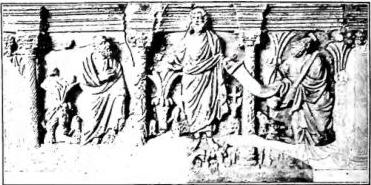
PIETRO, APOSTOLO, santo - Dominus legem dat, Detail of a sarcophagus (4th cent.) - Rome, church of St. Sebastian.
VI. LITURGY
1. Veneration
John Chrysostom points out "him who, clothed in purple, approaches like a pilgrim the tombs of P. and Paul and devoutly kisses them. Having laid aside the splendor of his garments, he clothes himself in humility and fervently prays the holy Apostles to be his intercessors before the Lord. The Emperor prays at the tombs of a tentmaker and a fisherman" (PG 61, 582). The same idea is repeated twice by St. Augustine, who indicates that the Emperor, on arriving at Rome, does not go up at once to the palace of the Palatine, but hastens to the tomb of the Fisherman (PL 33, 1028, 1830). Around 393 Rufinus, praetorian prefect, erected near Chalcedon a basilica in honor of the holy apostles P. and Paul, placing in it "brandea" brought from Rome (Callinicus, Vita Hypatii, Leipzig 1895, p. 18). From the frontiers of the Roman world, Theodoret, bishop of Cyrrhus in Syria, near the Euphrates, thus wrote to Pope Leo the Great in 449: "Rome possesses the bodies of P. and Paul, our common fathers, our lords in the faith; their tombs enlighten the souls of the faithful. This blessed pair, inspired by God, arose from the East and penetrated everywhere with its rays: but in the West it found death, and from the West it enlightens the world. They have given your chair an incomparable glory, and constitute its most precious treasure" (PG 83, 1314). Veneration for the apostles P. and Paul spread throughout the Christian world, and "brandea" were collected and carried to the most distant regions to honor the Princes of the Apostles in the sacred buildings that arose in their honor. Bishop Achilleus (v.), in the first twenty years of the 5th century, built at Spoleto, on the Via Flaminia, a basilica in honor of the Prince of the Apostles, because in P. the Church is founded for all peoples. P. stands as an arbiter on earth, "ianitor in superis" (G. B. De Rossi, in Bull. arch. crist., 1871, p. 117). In the basilica of St. Stephen in Ravenna, Bishop Maximian in 550 placed merita (brandea) apostolorum Petri et Pauli. On the hill sacred to the pagan divinities, Clovis, at the urging of Genevieve, caused to rise in Paris the great Basilica with the precious columns of Oloron marble, which he dedicated to the apostles P. and Paul, where St. Genevieve would later be buried. Gregory of Tours in his Historia Francorum recalls a basilica of St. P. at Clermont and one of the two Apostles at Tours. In Spain, at ancient Hilipula Halos, today Loja, were found the remains of a Christian basilica and a cippus with the inscription of the building to the holy P. and Paul (E. Hübner, Inscriptiones latinae Hispaniae christianae, suppl., Berlin 1900, pp. 59-60, no. 374). The Benedictine B. Biscop, from 653 onward, made his pilgrimage five times from England to the apostolic tombs; in 674 he founded in Northumberland a monastery at Wearmouth in honor of the Prince of the Apostles and another at Jarrow in 682 dedicated to St. Paul. In the atrium of the Vatican Basilica was buried Cedwalla, king of Wessex, baptized by Pope Sergius I on Holy Saturday of 689, and who died on the following Low Sunday (G. B. De Rossi, Inscr. Chr., II, 1, p. 288). King Coenred of Mercia and Prince Offa of Essex, having come to Rome at the time of Pope Constantine (708-15; Lib. pont., I, p. 391), exchanged the royal purple for the Benedictine habit in order to remain in one of the four monasteries that ensured the laus perennis in the Vatican Basilica. His successor, King Ine, likewise died in 730 in Rome "ad limina apostolorum." In Africa at El Kef (the Roman Sicca Veneria), on the keystone of the apse of the Byzantine basilica of Dar-el-Kouss is carved DMNS for "dominus," and below is a wreath enclosing a Greek cross with a letter in each of the four arms forming P(e)TR(u)S, that is, DOMNUS PETRUS (P. Monceaux, Enquête sur l'épigraphie chrétienne de l'Afrique, in Mémoires de l'Académie des Inscr. et belles lettres, 12, 1 [1907], p. 42 ff., no. 247); a second keystone belonging to the narthex has carved on a disc an equilateral cross with SCS (Sanctus) P(e)TR(u)S (ibid., p. 45 ff.). At Henchir-Chigarnia, ancient Uppenna, in a large floor mosaic of a Byzantine basilica, with a gemmed cross between two sheep, is read a long inscription that begins: "Hec sunt nomina martirum Petrus Paulus" (ibid., pp. 26-29, no. 238). Southwest of Tebessa, at Henchir-Magroun, on an arched block of a tabernacle, above two large monograms, is the inscription: "Memoria domni Petri et Pauli" (CIL, VIII, 10693). At Henchir-Taghfaght, not far from Khenchela, was found a stone on which was carved the inscription: "Hic est domus Dei, hic memoriae Apostolorum..." evidently the apostles P. and Paul (CIL, VIII, 17714). On a marble slab found near Guelma (ancient Calama), now in the Louvre museum, is written: "Hic reliquiae beati Petri Apost(o)l(i)..."; this slab closed a marble reliquary (ibid., pp. 64-65, no. 262). Among the ruins of a church at Ain Zirara between Constantine and Tebessa, from which the well-known silver capsella was extracted (G. B. De Rossi, La capsella argentea africana, Rome 1889), were collected fragments of a limestone stone with a long inscription: "Hic exaudito sanctorum Petri Pauli apostolorum," etc. (CIL, VIII, 17746). At 15 km north of Ain Beida, on a stone perhaps from a pulvinus, is carved the epigraph "Hic memori(e)e sancto(rum) Pauli Petri" (ibid., 18656). At Kherbet Oum-el-Ahdam southwest of Setif, in the ruins of a church was found a stone mensa with the inscription dated to the year 320 of the Mauretanian era, that is, 359 A.D., containing a series of relics, among which those of the apostles P. and Paul (CIL, VIII, 20600). A limestone stone belonging to a tabernacle situated in a chapel of Oppidum novum, today Duperré, contained a "memoria sanctorum Petri et Pauli" (CIL, VIII, 21496), today at St-Cyprien des Attafs. At Castellum Tingitanum, today Orléansville, on a marble slab with the date of the Mauretanian era of the year 367, that is, 406 A.D., is indicated the sepulchral inscription of the son of a military tribune buried in an oratory near the altar containing relics of the apostles P. and Paul (CIL, VIII, 9715). Also at Orléansville, in a chapel were found two fragments of brick bearing a carved epigraph containing the mention of a "memoria apostolorum Petri et Pauli" (CIL, VIII, 9714); another broken tile likewise recalls a memoria of the martyrs P. and Paul (CIL, VIII, 9716). All these fragments are now in the museum of Algiers. At Bir Hadad, near Ain Melloul, that is, south of Setif, a limestone reliquary was closed with a lid on which was carved an epigraph indicating the memories deposited, among which those of Paul and of P. (CIL, VIII, 20490). At Tipasa in Mauretania a basilica dedicated to the apostles P. and Paul has recently come to light again.
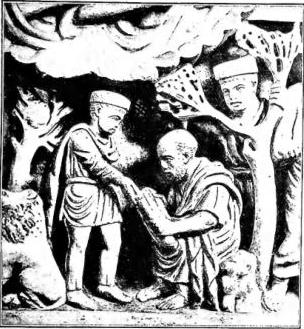
(de Wilpert, Sarcofagi, pl. 153, 1)
2. The dates of veneration
June 29. In the Liberian catalogue we read that P. "passus autem cum Paulo die III Kal. iulias consulibus ss. (Nerone et Veto, 55) imperante Nerone" (MGH, Anct. antiquiss., IX, 1, p. 73); the same date occurs in the Depositio martyrum, followed by the indication "Petri in catacumbas, Pauli Ostense, Tusco et Basso consulibus" (a. 258). There is therefore a single date of commemoration in the 4th century for both Apostles. All the manuscripts of the Hieronymian Martyrology, both the complete ones and the abridged ones, record under June 29 the feast of the apostles P. and Paul, which in the hymn attributed to St. Ambrose is said to be celebrated at Rome "trinis viis", that is, on the Appian, the Aurelian and the Ostian ways. Paulinus of Nola calls his annual pilgrimage to Rome for the feast of the apostles P. and Paul on June 29 a "solemnis consuetudo" (PL 61, 235, 247, 382, 392). In the Lib. pont. the date of the "III Kal. iulias" appears as the day of burial in the biography of the Apostle (Lib. pont., I, p. 118) and as the date of the reposition of his relics from the Appian Way by Pope Cornelius (ibid., p. 150). The Bern codex of the Hieronymian Martyrology gives "Romae Via Aurelia, natale sanctorum Apostolorum Petri et Pauli : Petri in Vaticano, Pauli vero in Via Ostienai, utrumque in catacumbas, passi sub Nerone, Basso et Tusco consulibus"; the names of the two consuls of 258 added at the end are evidently taken from the Depositio martyrum. H. Quentin tried to prove that the consular date did not refer to the Apostles (Tusco et Basso cons., in Rendiconti della Pont. accad. rom. di archeol., 5 [1929], pp. 145-47); he was refuted by H. Delehaye (Tusco et Basso cons., in Mélanges Paul Thomas, Bruges 1930, pp. 201-207). But why such a liturgical station "in catacumbas"? The excavations carried out there in 1892 and from 1915 onward have shown that in that place the Christians gathered from the middle of the 3rd century to perform the rite of the refrigerium, as is attested by hundreds of graffiti in Greek and Latin invoking the two Apostles. Archaeologists have divided into three groups: the first recognizes in "in catacumbas" a place where the two Apostles would have stayed for some time during their lives (R. Gamurrini, G. Wilpert, R. Lanciani); a second group thinks that it is a question of a temporary dwelling of their bodies either immediately after the martyrdom or in 258 (L. Duchesne, H. Lietzmann, A. Profumo); the third, instead, that the date of June 29, 258 "in catacumbas" is nothing other than that of the liturgical institution of a feast in honor of the two Apostles (H. Delehaye, P. Franchi de' Cavalieri). Let it be permitted to point out that the place "in catacumbas" is that of a public Roman burial ground in use even before Vespasian, one of whose slaves was buried there in one of the columbaria; that the part downstream of this burial was covered with earth, after the mausoleum of Clodius Hermes had passed into the ownership of Christians, the graffito ITXØYC (v. Enc. Catt., IX, col 1270) had been made in the adjacent mausoleum, and faithful whom H. Lietzmann called "cryptochristians" had been buried nearby; that on the raised ground a triclia was built where from 258 to the beginning of the 4th century the rite of the refrigerium, an eminently sepulchral rite, was celebrated in honor of the two Apostles.
Recently E. Griffe wished to see in the memoria "in catacumbas" a "sepulchrum honorarium" in honor of the two Apostles, which would have preceded the sumptuous basilicas of the 4th century of the Vatican and of the Ostian Way (La légende du transfert des corps de saint Pierre et de saint Paul ad catacumbas, in Bulletin de littér. ecclés. publié par l'Institut catholique de Toulouse, 1951, pp. 193-200), but the basilica of St. Paul became sumptuous later than the Vatican one, since "Theodosius coepit, perfecit Honorius aulam". N.-M. Denis-Boulet wished to see a relationship between the two dates of the Chronographer, December 25 and June 29, and to imagine that the Vatican Basilica had been consecrated on December 25, 335 and 336 (A propos des fouilles de St-Pierre. Questions historiques et liturgiques, in Recherches de sciences religieuses, 34 [1947], pp. 385-406). An untenable hypothesis, because the excavations ordered by Pope Pius XII have brought to light the magnitude of the works carried out by the Constantinian architects to reach the construction of the grandiose five-naved basilica, with a complex of works that require a certain lapse of time for the building to be completed, as has been pointed out, for example, by W. Seston (Les récentes fouilles de St-Pierre de Rome et la date de la construction de la Basilique constantinienne, in Revue de l'hist. des relig., 130 [1945], pp. 186-88, and Hypothèse sur la date de la Basilique constantinienne de St-Pierre de Rome, in Cahiers archéolog., 2 [1947], pp. 153-59). Better, E. Kirschbaum has connected the commemoration of P. alone "in catacumbas", from the Chronographer of the years 336-54, with the construction of the basilica of St. Peter in the Vatican, certainly not yet completed (Petri in catacumbas, in Miscellanea liturgica in honorem L. Cuniberti Mohlberg, Rome 1948, pp. 221-29). That the date of the "III Kalendas iulias" was regarded in the 4th century as a date of deposition is demonstrated by the following inscription discovered in the cemetery "inter duas lauros": "III Kalendas iulias deposo Donni Petri" (R. Kanzler, Relazione ufficiale degli scavi eseguiti dalla Commissione di Archeologia sacra nelle catacombe romane [1911-1912]. Scavi nel cimitero di SS. Marcellino e Pietro sulla via Labicena, in N. Bull. arch. crist., 20 [1914], p. 76, n. 46). Therefore June 29 has been celebrated by the Christian community of Rome since 258 as the date of deposition of the two Apostles. In the East too, both the "Consularia Constantinopolitana" and the "Consularia Ravennatia" and Pseudo-Chrysostom (in SS. Petrum et Paulum: PG 59, 496) mark under June 29 the date of the martyrdom of the two Apostles. Only the Syriac Martyrology, dated between 411-12, indicates "on the 20th day of the first Kanun, that is, on December 28, in the city of Rome, Paul the apostle and Simon Cephas the chief of the Apostles of our Lord" (H. Lietzmann, Die Drei älteste Martyrologien, Bonn 1912, p. 9).
On August 1 in Rome the feast of the dedication of the Basilica rebuilt by Sixtus III in honor of the apostles P. and Paul was first celebrated; later on that day popular devotion became centered on the chain of St. P. and his miraculous liberation from prison in Jerusalem, as the Gregorian Sacramentary indicates (Sacramentarium Gregorianum, ed. H. Lietzmann, Münster in W. 1924, p. 83, n. 136). For the chains of St. P., v. CATENE DI S. P. For the East v.: J. H. Hanssens, La liturgie romane-boyantine de St-Pierre, in Orientalia Christiana periodica, 4 (1938), pp. 234-58; 5 (1939), pp. 103-50. Note that in the East the solemnity of the chain of St. P. was celebrated on January 16; in the emerologium of Constantinople it is said: "adoration of the venerable chain of the holy and praiseworthy apostle P."; in a text of the Syriac rite: "adoration of the chain that fell from the feet of the prince of the Apostles"; in the Maronite calendar: "Commemoration of P. the apostle when he was freed from prison" (Nilles, Calendarium manuale utriusque Ecclesiae orientalis et occidentalis, I, 2nd ed., Innsbruck 1896, p. 71 ff., 468, 487).
For the feast of February 18 and 22 v. CATTEDRA DI S. P. For the feast of January 25 v. CONVERSIONE DI S. PAOLO.
VII. ICONOGRAPHY
1. Archaeology
As in the Gospels P. is mentioned 195 times, John 29 times and the other Apostles a total of 130 times, so in the icono-
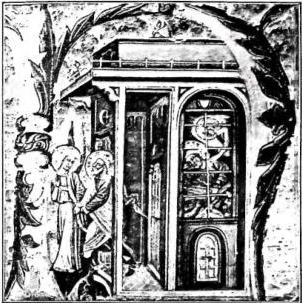
(from Catalogue d'une collection de manuscrits à miniatures des IX-XIᵉ siècles, Amsterdam DD, fax. 68) PIETRO. APOSTOLO, santo - St. P. in prison and his liberation. Miniature of the Bolognese school (14th century) - Amsterdam, Private Collection.
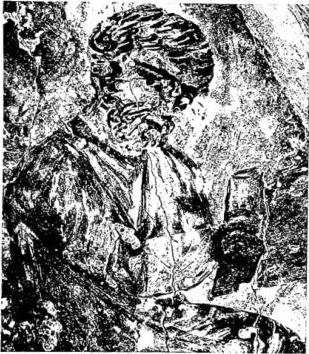
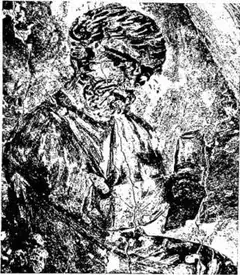
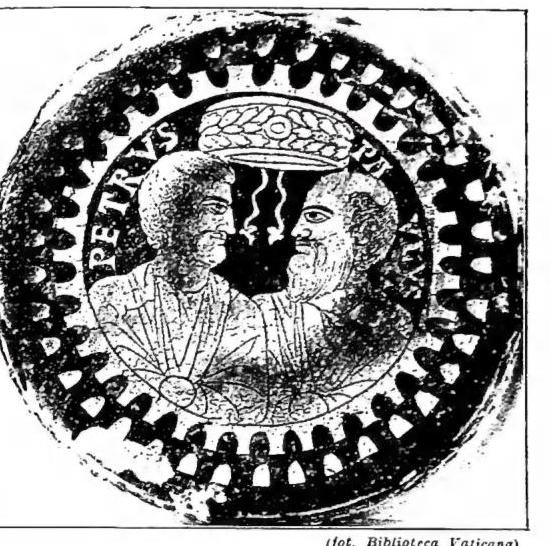
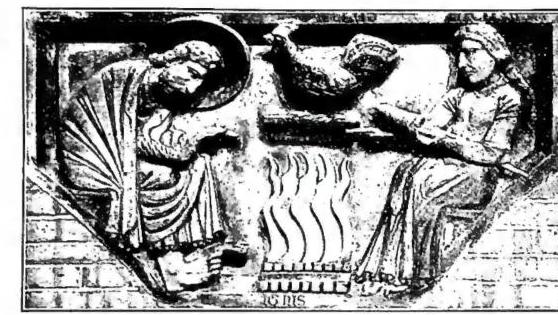
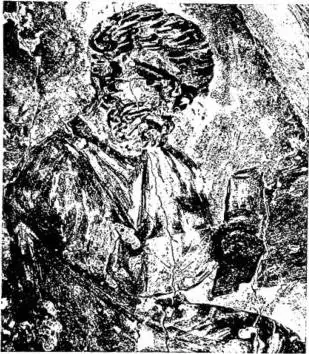
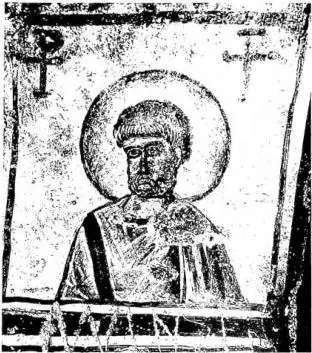
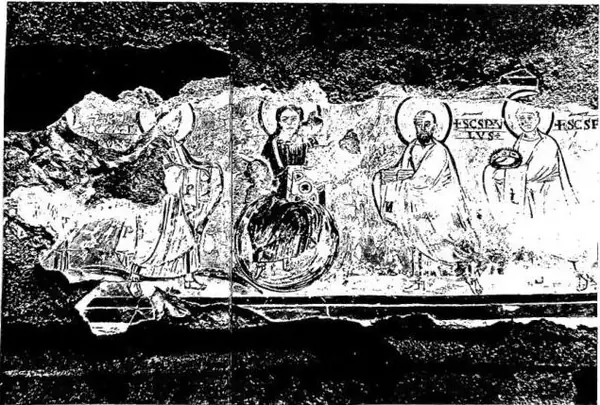
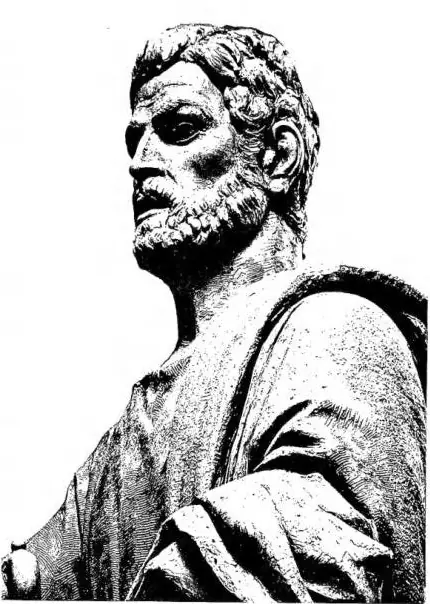
ancient Christian iconography P. is the most represented and surpasses all the others in the number of scenes. G. Wilpert has established that of the scene of the baptism of Cornelius alone there exist over 120 representations: sixty of the capture, about seventy of the announcement of his denial. Of the miracle of the spring with the indication of P., besides the Podgoritza cup (v.) there are also gilded glasses on which the miracle of the spring is represented with the inscription PETRUS (R. Garrucci, Storia dell'arte crist., III, Prato 1876, pl. 179,9) to indicate, as St. Augustine says, that Moses "figura fuit Petri" (Serm., 251, 4). P. is shown with a thick, dense and curly beard and hair, the beard short, as in the cemetery "inter duas lauros" (Wilpert, Pitture, pls. 93-94) or in Domitilla (id., ibid., pl. 193, 2); the Apostle appears beardless in only one painting of the denial (Wilpert, Pitture, pl. 242, 1). But the most characteristic type, that of a sailor with a high forehead, expressive eyes, and a beard framing his face, is in the fresco in the hypogeum of the Aurelii (v.) on the Viale Manzoni (Wilpert, Le pitture dell'ipogeo di Aurelio Felicesimo presso il Viale Manzoni in Roma, in Memorie della Pont. accad. rom. di archeol., 3rd series, 1 [1924], pl. 6, 1). P. is the apostle to whom the Lord hands over his law as the Moses of the New Testament. The scene, represented only once in cemetery painting (Wilpert, Mosaiken, p. 269 and pl. 132), is instead frequent on sarcophagi, where P. receives it while also supporting the cross, the instrument of the martyrdom that will make him equal to the Lord (Wilpert, Sarcofagi, p. 113 ff.). And it is the scene that in baptisteries is preferred for initiation into the lex Christi. To P. the Lord entrusts the keys of the heavenly kingdom (Mt. 16, 19) and through P. to his Church, as Tertullian will say (Scorpiace, 10); he is the "ianitor aeternus" (Dracontius, Carmen de Deo, v. 222: PL 60, 857). On sarcophagi the scene is represented no fewer than sixteen times in Rome and in Gaul; in painting in the cemetery of Commodilla (Wilpert, Mosaiken, pls. 148-49). To P. the Lord washes the feet (v. LAVANDA). St. P. saved from the waves is represented for the first time on the walls of the house transformed into a church at Dura Europos (v.); in Rome in a fragment found in the eastern trichora in St. Callixtus (G. Wilpert, La cripta dei Papi e la cappella di S. Cecilia nel cimitero di Callisto, Rome 1910, p. 96 and pl. 6, 1). The scene is engraved on a gem published by Girolamo Aleandro (R. Garrucci, Storia dell'arte cristiana, VI, Prato 1881, p. 118 and pl. 418, 13). The scene appeared in the basilical cycle in a basilica of Spain, because it is attested by the descriptive verses of Prudentius in his Dittochaeon (PL. 60, 105) and in the basilica of St. Martin of Tours (E. Le Blant, Inscriptions chrétiennes de la Gaule, I, Paris 1886, p. 235); at Ravenna in a mutilated inscription in the baptistery of Neon (R. Garrucci, Storia dell'arte cristiana, IV, Prato 1876, pl. 37); at Naples in mosaic in the baptistery (Wilpert, Mosaiken, pl. 30 ff.). At Gaza in a painting mentioned by Choricius (ca. the year 550) in the church of St. Sergius. The same episode was painted at the beginning of the 9th century in St. Sabas (G. Wilpert, Le pitture dell'oratorio di S. Silvia, in Mélanges d'archéologie et d'histoire, 26 [1906], pp. 224 ff.). The scene of the raising of Tabitha appears on a whole sarcophagus from St. Maximin (Provence) and on another fragmentary one. G. Wilpert has identified the representation of the episode of the punishment of Ananias and Sapphira in a fragment of the museum of Avignon (Sarcofagi, pl. 145, 3) and in another from St. Callixtus (ibid., 145, 2), basing himself on the scene carved on the ivory casket of Brescia (v.); a scene that in the Middle Ages was painted at the Lateran. In a basilica of Spain (perhaps Saragossa, in which the biblical cycle was illustrated by verses of Prudentius) the episode of P. freeing the possessed was also represented (Dittochaeon, 36), just as it was depicted at SS. John and Paul in Rome (G. B. De Rossi, Inscriptions Christianae, II, 1, Rome 1888, p. 150). Eusebius attests that the images of Paul and of P. were preserved on painted panels (Hist. eccl., VII, 18, 4). Very many are the monuments that represent them together, P. with his type, Paul bald with a full beard long and pointed, of a brown color; although St. Augustine casts doubt on the existence of a portrait of Paul (De Trinitate, 8, 5: PL. 42, 912). The two Apostles together appear with their individual types in Roman cemetery frescoes (Wilpert, Pitture, pls. 153 ff.; 117, 1; 179; 182; 248; 251 f. and 254). The episode of P. and Paul led to martyrdom is a subject found on Roman sarcophagi such as the most famous one of Junius Bassus (v.) discovered right in the confessio of St. P. and in the Lateran one 164. They appear together on sarcophagi, in the only cemetery fresco (ad decimum) and in mosaics in all the representations of the handing over of the law; they appear again in all the scenes of the traditio clavium; together acclaiming again in the triumphal arch of St. Mary Major near the divine throne. But they appear together at Naples several times in St. Januarius of the Poor, where they present the same individual characteristics as at Rome; P. appears also alone in St. Gaudiosus in the tomb of Pascentius (H. Achelis, Die Katakombe von Neapel, Leipzig 1936, pl. 39). Together they are found in a fresco in the cemetery of Albano (O. Marucchi, Le catacombe di Albano, in N. Bull. di arch. crist., 8 [1902], p. 89 ff., pl. 5); together they return acclaiming the "Signum Christi" in Pannonia at Cinque Chiese (G. B. De Rossi, Bull. arch. crist., 1874, pls. 7-8); on sepulchral slabs such as that of "Asellus" in the Lateran Museum, where their busts are scratched according to the well-known iconographic type, marked by their names PETRVS PAVLVS; together they are found again in a precious series of cemetery glasses (R. Garrucci, Vetri cimiteriali in oro, Rome 1854, passim); on terracotta lamps such as one from Akhmim, in which they are haloed and distinguished, P. with the keys, Paul with the sword (R. Förrer, Die altchristliche Alterthümer aus dem Gräberfelde von Akhmim Panopolis, Strasbourg 1893, p. 6, pl. 5, no. 2); on diptychs such as that of the "Sancta Sanctorum", now in the Sacred Museum of the Vatican Library (H. Grisar, Die römische Kapelle der Sancta Sanctorum und ihre Schatz, Freiburg im Br. 1908, pp. 118-20 and pls. 4-5, nos. 5-6); in icons such as the Vatican one (W. F. Volbach, Die Ikone der Apostelfürsten in St. Peter zu Rom, in Orientalia Christiana Periodica, 7 [1951], pp. 480-97).
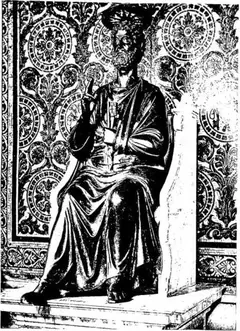
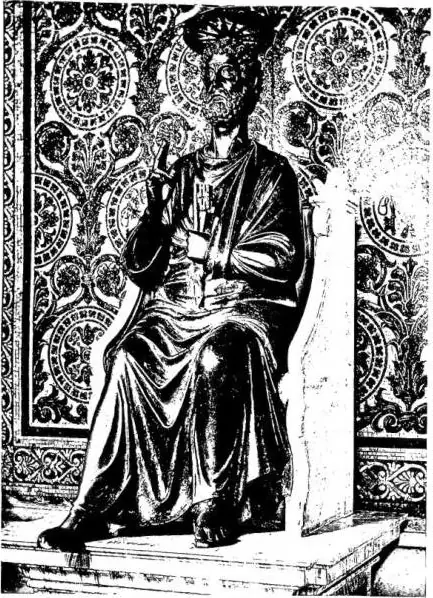
A glass cup perhaps of the 4th century found at Carthage offers two fishermen whom the inscription indicates to be the "Apostoli Petrus et Johannes", in which P. does not have his usual iconographic type (G. Picard, Vase gravé de Carthage, in Fasti archaeologici, 4 [1949], p. 530, no. 5031). Two are the statues of the Apostle that were in the ancient Basilica; the first is the famous one in bronze. H. Wickhoff considered the statue to be of the 13th century (Zeitschrift für bild. Kunst, 1890, p. 108 ff.). H. Grisar proposed dating the statue at the end of the 5th century (Della statua di bronzo di s. P. apostolo nella Basilica Vatic., in Civ. Catt., 1898, II, pp. 459 ff.; id., in Analecta romana, Rome 1899, pp. 627-57). A. Venturi first dated it to the 4th-5th century (Venturi, I, p. 414) and then attributed it to Arnolfo di Cambio (ibid., IV, p. 113 ff.). For P. Toesca it belongs to the 13th century (Storia dell'Arte it., I, Turin 1927, pp. 287 and 1110). C. Cecchelli followed Grisar's dating, but for G. B. De Jerphanion the question of the date still remains open (Bulletin d'arch. chrét. et byzant., in Orientalia Christiana periodica, 4 [1938], p. 538). In the atrium of the old Basilica there was a seated marble statue of the Apostle, which is nothing other than an adaptation of the statue of a Roman rhetorician whose head was changed in about the 13th century and whose right forearm and left hand, grasping the keys, were changed in the 16th. It is now in the S. Grotte.
Bibliography2 works
Enrico Josi
2. Art
In the Romanesque age the representation of the cycles of the Apostle's life and martyrdom also underwent a broad development. Unfortunately the most important of them have not come down to us: such as the frescoes, the work of Cavallini, of the old Vatican Basilica; or they are much damaged, like those of the choir of the upper church of Assisi, the work of Cimabue. A repetition of the lost cycle of St. Peter in the Vatican is found in the organic decoration of S. Piero a Grado, near Pisa, ascribed to the painter Deodato Orlandi, who died at Lucca in 1337. Isolated events of the Saint's life were also depicted in panels, as in the Stefaneschi polyptych of the Vatican Museums, by Giotto and pupils, and in a panel of the Pinacoteca of Siena, in a Byzantine style, with the representation of the Apostle's imprisonment and crucifixion. Mention must also be made of stained-glass windows, especially French ones, at Bourges (13th century), at Chartres, Lyon, Sens, Poitiers, Troyes, Tours. The Renaissance masterpiece of the representation of the deeds of St. Peter is in the Brancacci chapel at the Carmine in Florence, where Masolino, Masaccio and Filippino Lippi followed step by step, availing themselves also of the apocryphal Gospels, the wondrous story of the Saint.
Innumerable devotional images dedicated to St. Peter alone or to sacred conversations in which he takes part follow one another throughout the Renaissance, the Baroque age and modern times, down to the present day. Very many altars represent him in individual compartments, like the panels by Francesco del Cossa at Brera. It suffices to note that while in Italy the character of the Saint as he appears in paintings even very close to our own time remains quite similar to that of the original images, in Germany and generally in northern Europe there is a preference for representing the Saint in his pontifical vestments rather than in the aspect of an Apostle, as also in many paintings representing the death of Mary, where he likewise appears.
The vastness of the iconographic theme, developed especially in Rome, in the basilicas dedicated to the Saint, in sculptures, altars, sacred furnishings, sometimes of high artistic value, allows only of briefly indicating some particular iconographic themes, which were moreover extremely popular. St. Peter in the boat, the symbolic guide of the Church, already appears in a bronze of the Archaeological Museum of Florence (about the 4th century) and has its greatest apotheosis in the celebrated, and unfortunately disfigured, mosaic by Giotto for the Jubilee of 1300. The handing over of the keys to St. Peter was described by Perugino in a fresco of the Sistine Chapel and in a tapestry by Raphael, who in the Stanze also described his liberation from prison. St. Peter as guardian of Paradise already appears in an historiated capital of the 11th century in the Museo civico of Turin, in which the Apostle introduces a devotee with his companion into the heavenly Kingdom, indicated symbolically by the key. Similarly in a Gothic reliquary from S. Galgano, in the Museo dell'Opera del duomo of Siena, at the end of the 1200s.
On the other hand, throughout the Middle Ages and subsequently, the cock, which recalls his denial, and the keys, symbol of his power, are the iconographic characteristics of the Apostle, whose image recurs continually in all the representations of the events narrated by the Gospel.
Bibliography
Eugenio Battisti
VIII. APOCRYPHA
1. Apocalypse of P
An apocryphon cited as authoritative by St. Clement of Alexandria (in Eusebius, Hist. eccl., 6, 14: PG 20, 549), by St. Methodius (Symposion, 9, 1: PG 18, 180) and, perhaps, by the Muratorian Fragment (line 71 ff.), where, however, some, with Th. Zahn, see a citation of I Pt. From Sozomen we learn that the Apocalypse of P. was still read in the 5th century in the churches of Palestine on the day of Parasceve (Sozomen, Hist. eccl., VII, 19: PG 67, 1477), but it had already been excluded from the canon by Eusebius (Hist. eccl., III, 2: XXV, 4: PG 20, 217, 269) and by St. Jerome (De viris inlustr., 1: PL 23, 609).
According to E. Amann the Apocalypse of P. was written in Egypt in the first half of the 2nd century A.D. It would allude there to the persecution of Bar Kokhba against the Christians. The text that was believed lost was rediscovered in part in Greek in 1886 at Akhmim by U. Bouriant (edited in Mémoires publiées par les membres de la Mission archéologique franç. du Caire, 9 [1892], pp. 91-147) and supplemented by another papyrus fragment from the Bodleian (edited by F. Nau, Rev. de l'Orient chrét., 15 [1910], p. 441 ff.). There is also a complete Ethiopic reworking edited by S. Grébaut (Littérature éthiopienne pseudo-clémentine, in Rev. de l'Orient chrét., 12 [1907], pp. 139-51, 285-93, 280-92; 13 [1908], pp. 166-80, 314-20). Jesus, to the question of the Apostles that precedes the eschatological discourse (Mt. 24, 3), responds by showing the glory of the righteous and the terrible torments of the damned. The eschatological ideas seem to derive from Jewish sources. The author also had in mind the texts of II Pt. 1, 16-18; 3, 6-17. Among the Gnostic writings recently discovered in Egypt an Apocalypse of P. is also noted. Cf. Biblica, 31 [1950], p. 71.
Bibliography
2. Acts of P
A legendary apocryphon that has come down to us in various recensions.
According to L. Vouaux and E. Amann it would have been composed in Greek, not in Rome (as C. Erbes thinks) but in Asia Minor around 200 by an orthodox author. H. Höpfl and B. Gut think of a Gnostic author, because in it the Eucharist is celebrated with bread and water (chap. 2 of the Acts of Vercelli). But in the Coptic fragment only bread is mentioned; Eusebius (Hist. eccl., III, 3: PG 20, 217) excludes them from the canon. The central theme of the Acts of P. are the struggles sustained by St. P. against Simon Magus first in Palestine, then in Rome. Of the first part, with the Palestinian events, only a Coptic fragment remains and one episode (of Eubula) preserved in chap. 17 of the Latin version, known under the name of Acts of Vercelli. The last twelve chapters (30-41), also called the Martyrdom of P., were also preserved in the original Greek text. Here the famous episode of the Quo vadis? is also narrated (v. below). Jesus, appearing to P. who was fleeing from Rome, asks him: "Where are you going?". P. returns and is crucified upside down. There is also a Latin paraphrase, which claims to have been written by Pope Linus (Pseudo-Linus) and other reworkings called Pseudo-Hegesippus and Pseudo-Hippolytus. Partial Coptic, Slavonic, Syriac, Armenian, Arabic and Ethiopic versions are extant. The Acts of P. certainly depend on the Acts of Paul (v.) and on the Acts of John (v.). It is debated whether they also depend on the Preaching of P. (v.). The events of P. are joined to those of other apostles in the Acts of P. and Paul (v. below) and in the Acts of P. and Andrew, edited by C. Tischendorf in Apocal. apocr. (Leipzig 1866), pp. 161-67. Among the Coptic Gnostic papyri recently discovered in Egypt there are also some Acts of P. (cf. B. Altaner, Theol. rev., 46 [1950], pp. 41-42).
Bibliography2 works
3. Acts of P. and Paul
An apocryphon born from the revised fusion of the Acts of P. (v. above) and the Acts of Paul (v.).
These writings, of Asiatic origin, spoke of the two Apostles independently, taking no account of the Roman tradition, attested also by the decree of Gelasius (v.), according to which P. and Paul suffered on the same day, whatever the heretics may say. The compiler of the Acts of P. and Paul eliminated certain theologically less acceptable expressions (not properly Gnostic, as H. Höpfl and B. Gut think [v. bibl.], n. 308) of the Acts of P., and endeavored to show that a perfect accord reigned between the two Apostles, who together would have confronted Simon Magus, together would have been condemned by Nero, and on the same day would have suffered martyrdom: P. crucified, Paul beheaded. The last chapters speak of the burial of P. "under the terebinth, near the Naumachia, on the Vatican," and of a vain attempt made by the Orientals to carry off from Rome the relics of the two Apostles, which, recovered, would have been deposited provisionally in the catacombs, awaiting being later placed in their respective monuments: P. in the Vatican, Paul on the Via Ostiense. The various strata of the reworkings can be ranged from the 3rd to the 6th century.
Bibliography3 works
4. Preaching of P
An apocryphon written originally in Greek (Κηρυγιὰ Πέτρου). It was used by Clement of Alexandria and by Heracleon the Valentinian (cf. Origen, In Io., XIII, 17: PG 14, 424). It is relegated among the apocrypha by Eusebius (Hist. eccl., III, 3, 2: PG 20, 217) and by St. Jerome (De viris inlustr., 1: PL 23, 609).
From the fragments preserved by Clement of Alexandria it appears that the work must have contained a kind of programmatic discourse of P., which summarized his entire preaching. It seems that the author took his cue from II Pt. 1, 15, where the Apostle writes: "I will endeavor that you may be able to remember [my admonitions] after my departure." Among the admonitions reported by the Preaching of P. there must have been this: there is only one God, who must be honored, not as the pagans do, nor as the Jews do. Christians constitute a kind of tertium genus. They must remain faithful to the new covenant already foretold by the prophets. The work was written in the first decades of the 2nd century, in the opinion of E. Dobschütz in Egypt, in the opinion of A. Hilgenfeld in Greece. It is debated whether the work is to be identified with the Didascalia of P. of which St. John Damascene speaks (PG 95, 1157 B., 1461 D), and to which (Doctrina Petri) Origen seems to allude (De principiis: PG 2, 119 O). Among the Coptic Gnostic papyri recently discovered in Egypt there is also a Prayer of P. the Apostle; cf. Biblica, 31 (1959), p. 71 (Elenchus bibl.*).
Bibliography9 works
Pietro De Ambroggi
5. Gospel of P
An apocryphon, the first notice of which is found in a letter of Serapion, bishop of Antioch, toward the end of the 2nd century, to the faithful of Rhossos in Cilicia (Eusebius, Hist. eccl., VI, 12, 2 ff.; PG 20, 545). He condemns the reading of it.
The Gospel of P. is also mentioned by Origen (In Mt., 10, 17; PG 13, 876); rejected by Eusebius himself (op. cit., 3, 3 and 25; PG 20, 217 and 269); discussed among the apocrypha by St. Jerome (De vir. ill., I; PL 23, 639) and by Theodoret (Haer. fabul. comp., II, 2; PG 83, 389). Apart from the name, nothing was known of it until in the winter of 1886-87 the Mission archéologique française discovered in the tomb of a Christian monk at Ahmim, together with others, an old parchment, attributed to the 8th-9th century and containing part of the Gospel of P. It is a writing with traces of docetism (vv. 10, 19, 39-44), mutilated at the beginning and at the end, containing the narrative of the Passion, Death and Resurrection of Christ. It is a free reworking of the Gospel account, with a markedly anti-Jewish stamp; all the guilt for the condemnation and crucifixion of the Savior falls upon Herod and the Jews, while Pilate appears as a spectator favorable to the condemned man. The composition, in popular Greek, took place, in all likelihood, around the middle of the 2nd century (130-60).
Bibliography4 works
Fedele Pasquero
IX. LEGENDS
Legends also arose concerning the founders of the Roman Church, which are reported in the apocryphal Acts and in the topographical localizations in various parts of the city, all relating to various episodes of their life in Rome.
1. The legend of the Mamertine prison
In an itinerary of Rome from the end of the 8th century A.D., a "Fountain of St. P." is indicated immediately after the Porta Aurelia (today's Porta S. Pancrazio), where his prison is said to have been. Since there is no ancient notice of a prison of St. P. on the Janiculum (v. below), Marucchi and Duchesne held that this indication was out of place and referred to the prison near the Roman Forum on the slopes of the Capitoline, of which Titus Livy speaks, attributing its foundation to King Ancus Marcius. King Servius Tullius is said to have added to it the lower chamber, where there was a spring of water, tullus, from which in reality its name Tullianum derives. On the outside the prison was restored in the time of Tiberius (14-37 A.D.), as is shown by the names of the two suffect consuls carved on the blocks of travertine: Caius Vibius Rufinus and M. Coccius Nerva. After the 5th century A.D. this prison was erroneously given the name "Mamerinum" or "Privata Mamertini," as is found in the legendary acts of many Roman martyrs, for example, of the popes Stephen (154-56) and Sixtus II (258), of Caledopius, Abbundius and Abbundantius, Chrysanthus and Daria, and especially of Processus and Martinian. Of these last two the legend made the two jailers of P. and Paul in this same prison near the Roman Forum; for there it is said that, seeing the prodigies worked by P. and Paul in the Mamertine prison, the two jailers Processus and Martinian asked to be baptized together with all the prisoners. P. then is said to have made the sign of the Cross over the Tarpeian Mount, the waters gushed forth from it, and Processus and Martinian, having been baptized, asked P. and Paul to leave the prison freely. But in that place the water spring was very ancient; near it in the Middle Ages an altar was built. People even sought to identify the column to which P. and Paul were said to have been bound and a mark left on the wall by the head of St. P. In reality, although the legend of the martyrs Processus and Martinian belongs to the advanced 6th century, it was still unknown to Pope Gregory the Great, who belongs to the end of the century (590-604) and presents the two martyrs as two foreigners, without any allusion to their function as jailers of the Apostles.
2. The title "de Fasciola." — In the acts of Processus and Martinian (Acta SS. Iulii, II, p. 304) it is related that St. P., fleeing from prison, is said to have lost on the "Via Nova" a bandage which he had placed on his foot around the wounds produced by the chains; this bandage was picked up and kept by a matron who had her dwelling nearby; when this was transformed into a titulus, it is said to have received the appellation "de Fasciola," later of Sts. Nereus and Achilleus. Apart from the fact that the document is much later than the Apostle, the "Via Nova" was built by Caracalla at the time of the Antonine baths. The oratory that stood on the Via Ostiensis, called of the "separation," was [erected] in the Middle Ages, on the basis of a legend that on the Via Ostiensis the two apostles P. and Paul separated before being led to martyrdom. The origin of the legend may derive from the episode, contained in the apocrypha, of St. Paul's farewell to the matron Plautilla (F. Martinelli, Roma ex etonica sacra, Rome 1653, pp. 101, 301; G. B. De Rossi, in Bull. arch. crist., 1877, p. 137). The oratory, modernized later, was then removed for the widening of the road.
3. The oratory of the "Quo vadis." — In the acts of Processus and Martinian there is also the legend of St. P.'s flight from Rome and the appearance to him, on the Via Appia, of the Redeemer, who to the Apostle's question: "Domine, quo vadis?" is said to have answered: "Romam redeo ut iterum crucificar." Origen, citing a passage of the Acta Pauli, adds that the Redeemer asserted that he would be crucified again; which was believed to refer to P. (In Iohannem, 20, 12; PG 14, 600; also in St. Ambrose, Contra Auxentium, 13; PL 16, 1053). In the aforementioned legendary acts of Processus and Martinian there is still no indication of the existence of an oratory on the site of the apparition. At the end of the 8th century the itinerary known as that of Einsiedeln places on the Via Appia, beyond the gate and beyond the stream of the Almone, an oratory of St. Mary, which only in the 11th century bears the addition "where the Lord appeared." The author of the Mirabilia, in the 12th century, indicates without more ado the oratory where the Lord appeared to P.: "Domine, quo vadis?". In other documents, however, the original name of St. Mary remains, with the addition "of the plants." Indeed in the church a stone is preserved with the imprints of two feet, which is a copy of an original existing there until 1620 and then transported to S. Sebastiano. The legend has seen in these imprints the miraculous appearance of Jesus to P.; in reality they were brought there, whereas originally they were nothing but a votive monument in some pagan sanctuary to signify the road traveled by a pilgrim and his desire to perpetuate his presence in the sanctuary itself. In the 16th century Cardinal Reginald Pole, seeing that the oratory was falling into ruin, built another round one, a little farther on along the Via Appia, at the point where it meets the vicolo della Caffarella. At the end of the same century a learned Roman, Pompeo Ugonio, described the ancient paintings existing there, among which the scene of Pentecost.
The church was rebuilt in 1620 and in 1637 Cardinal Francesco Barberini added to it the present facade. Perhaps the localization of the legend of the "Quo vadis?" on the Via Appia is due to the fact that this queen of Roman roads, which led from Rome to Brindisi, was traveled by those who came from the East or went there.
4. The alleged dwelling of St. P. in the house of Pudens
Also dependent solely on apocryphal documents is the legend that P. dwelt in the house of a senator "Pudens"
on the "vicus Patricius" (today, Via Urbana), where the church of S. Pudeniana is; just as the legend that in the altar of the Gaetani chapel the wood of the table is preserved on which the Apostle is said to have celebrated Mass has no historical value. The explorations carried out in the church show that it was built at the end of the 4th century in the time of Pope Siricius (385-98), on the site where there existed a bath building which the legend calls that of Novatus. The baths had been erected above an earlier building, in which bricks were found with the factory mark of a Servilius Pudens and the dates of the years 128 and 129. A part of this underground area was accessible in the 9th century, because there is a painting with St. Paul between Sts. Praxedes and Pudentiana, whom the legend indicates as daughters of the senator Pudens (v.).
5. The alleged dwelling and baptistery of P. on the Aventine
An attempt has been made to identify the present church of St. Prisca with the site of the house of Aquila and Prisca, mentioned in the letters of St. Paul. The legendary acts of St. Prisca, perhaps of the 8th century, make her a martyr from the time of Claudius II Gothicus (468-70), buried first on the Via Ostiensis and then, by Pope Eutychian, on the Aventine in the house of Aquila and Prisca, the friends of St. Paul, where P. would have preached and baptized. On a capital out of place, in the underground chamber of the church, the inscription in Latin was engraved in 13th-century characters: "Baptism of St. P." Now it is absurd to imagine that the Apostle could have baptized inside the hollow of a capital much later than his time, in a place where no authentic document authorizes the identification of the presence of P., and precisely where recent excavations have shown it to be the atrium of a mithraeum, already existing in 203, in the underground chamber of a Roman building. Certainly the title (or parish) is already known in the 5th century; but it was not where the present church is, built above the aforementioned mithraeum. Probably the ancient Christian building should rather be sought in the vicinity, where in 1776 the remains of an ancient oratory appeared, with sacred paintings.
6. The legend of P. and Simon Magus
In the Acts of the Apostles we read that when the deacon Philip arrived in Samaria, he found that this city had already been seduced by Simon Magus, who, having come to know Philip, had himself baptized by him and then went to P. and John with the intention of buying from them the power to confer the Holy Spirit. P. rebuked him and Simon seemed repentant (Acts 8:9-24). The alleged encounter of P. with Simon Magus at the beginning of the reign of Claudius, therefore around the year 12, is reported only by the Actus Petri and by the Acts of P. and Paul. Eusebius writes in his history that the preaching of P. put an end to the success of Simon Magus. A later recension, known under the name of "Pseudo-Marcellus," places the ascension of Simon on the Campus Martius, where the wooden tower is set up, from which Simon will take flight. There Nero is present, with P. and Paul. On the "Via Sacra," Simon falls headlong and dies, breaking into four parts. Subsequently, on the same street, two small hollows were shown in the stones, regarded as the traces left by the two Apostles in prayer. In the 8th century Pope Paul I (757-767) had an oratory built on the place called "in silice," where Simon Magus fell, near the temple of Romulus. In the 13th century this memorial was transferred to the nearby church of St. Maria Nova, built by Leo IV after the earthquake that had buried the church of St. Maria Antiqua in the Roman Forum under its ruins. In this church too an ancient fragment of basalt from the Via Sacra is shown, with hollows, which legend attributes to the imprints of the knees of St. P. (P. Lugano, Le memorie leggendarie di Simon Mago e della sua volata, in Nuovo Bull. di arch. crist., 6 [1900], p. 29 ff.; F. Savio, S. Giustino martire e l'apoteosi di Simon Mago in Roma, in Civ. Catt., 1910, IV, pp. 532-48; 673-88). G. Wilpert examined a sarcophagus found on the Tiburtina near Portonaccio, in whose central panel is represented a philosopher who clasps a volume with his left hand, while with his right he makes the oratorical gesture, turning to the standing woman before him (Wilpert, Sarcofagi, 252, 3); he interpreted this scene as that of Simon Magus and Helena his companion, basing himself on a passage of Irenaeus (Adv. Haer., I, 23: PG 7, 673; see also Justin, Apol., I, 26); but such a scene is nothing other than a representation of teaching. The same author even held that the encounter of St. P. with the dog of Simon Magus, which would have been loosed from the chain that held it bound (Actus Petricum Simone, 9), would have been represented on three sarcophagus lids, the first from Mantua, the second from Verona, the third from Nîmes (Wilpert, Sarcofagi, pls. 30 and 150, 2; E. Le-Blant, Les Sarcophages chrétiens de la Gaule, Paris 1886, p. 114). In the Vatican Museum there is a base with the inscription dedicated to Semoni Sano Sancto Deo Fidio, which recalls the one that Justin claims to have seen on the Tiber Island with the inscription Semoni Sancto Deo Fidio. The base preserved in the Vatican supports the statue of a naked, beardless youth which Wilpert holds to have nothing to do with Simon Magus because Irenaeus attests that the latter was represented under the figure of Jupiter and his companion Helena under that of Minerva (Adv. Haer., I, 23: PG 7, 571); the same Irenaeus adds that the followers of Simon Magus were called "Simonians" (C. L. Visconti, Di un simulacro di Semo Sancus, in Studi e documenti di storia e diritto, 1881, pp. 105-30; G. Wilpert, La statua di Simon Mago sull'isola Tiberina, in Riv. di arch. crist., 15 [1938], pp. 334-339; id., La fede nella chiesa nascente, Vatican City 1938, pp. 301-304).
7. St. P. in Vinculis or ad Vincula. — Basilica situated in the third Augustan region a short distance from the "Porticus Tellurensis" and from the "Baths of Titus and Trajan." The metrical inscription placed on the inside of the entrance wall of the Basilica attested that Sixtus III (432-40) had had the church rebuilt ("cede prius nomen, novitati cede vetustas") in honor of the apostles P. and Paul (G. B. De Rossi, Inscr. christ., II, 1, Rome 1888, pp. 110 and 134). The inscription was copied in the 6th century in a basilica of Tebessa (G. B. De Rossi, in Bull. arch. crist., 1878, p. 19). In the biography of Symmachus (498-514) a "Dignissimus presbyter a vinculis sancti Petri" is mentioned (Lib. Pont., I, p. 261). In the three apses there were three distichs; in one there is mention of the vow of Theodosius II, Eudocia and Eudoxia; in another that "inlassas olim servant haec tecta catenae vincula sacrata Petri ferrum pretiosus auro" (G. B. De Rossi, Inscr. christ., pp. 110, n. 66; 134 nn. 1 and 2). Bishop Achilles of Spoleto also asserts that in the basilica erected by him in the first half of the 5th century on the Via Flaminia in honor of the apostle P. there are preserved "hic quoque vincula Petri" (G. B. De Rossi, loc. cit., p. 113). In the Suggestio legatorum to Pope Hormisdas, in 519, relics are requested "de catenis sanctorum Apostolorum." A Severus "presbyter a vinculis Sancti Petri" is mentioned in his votive inscription of the years 533-52 (Lib. Pont., I, p. 284, n. 1). In 544 Arator recited his "De actibus Apostolorum in ecclesia sancti Petri quae vocatur ad vincula" (PL 68, 55). In the appendix to the Liber de locis, of the mid-7th century, we read "basilica quae appellatur vincula Petri, ubi habetur catena qua Petrus ligatus est." In the biography of Adrian I we find: "titulus Apostolorum, quae appellatur Eudossiae ad vincula," and "titulus Eudoxiae, videlicet beati Petri ad vincula" (Lib. Pont., I, p. 508 and 512). The dedication of the Basilica (on August 1 in the Martyr. Hieronymianum) "Romae dedicatio ecclesiae a b. Petro constructae et aedificatae," is read in the Bernense and with a slight variant in the Wissemburgense, while in the Epternacense there is simply "Romae statio ad S. Petrum ad vincula" and "ad vincula Eudoxiae apostoli Petri osculanti populi catena." H. Grisar holds that the location of the oratory, later transformed into a basilica, was inspired by the proximity of the buildings of the urban prefecture where justice was administered (H. Grisar, Dell'insigne tradizione romana intorno alle catene di s. P. nella Basilica eudossiana, in Civ. Catt., 1898, III, pp. 205-21; J. P. Kirsch, Die römischen Titelkirchen im Altertum, Paderborn 1918, pp. 45-52).
8. The legend of the crucifixion on the Janiculum
Likewise entirely legendary is the tradition of the martyrdom of P. on the Janiculum. Only in the 15th century do we find that Maffeo Vegio (1406-57) defends the opinion, which arose perhaps a short time earlier, that the crucifixion of St. P. took place on the Gianicolo (De rebus antiquis memorab. basil. S. Petri, in Acta SS. Iunii, VI, 2, p. 70), in the place where the Bramantesque tempietto later arose near S. Pietro in Montorio. His thesis was combated by S. Borgia (Vaticana Confessio, Rome 1776), and by F. L. Dionisi (Cryptarum Vatican. monum. illustr., Rome 1838, p. 192 ff.). The opinion that Peter was crucified on the Janiculum was taken up again by G. B. Lugari (Le lieu du crucifixement de si Pierre, Tours 1898, and Il Gianicolo, luogo della crocifissione di s. P., Rome 1900), but was shown to be untenable by H. Grisar (Le antiche testimonianze sul luogo della crocifissione di s. P., in Civ. Catt., 1905, pp. 719-25) and by O. Marucchi (Il luogo della crocifissione di s. P. nel Vaticano, in N. Bull. arch. crist., 11 [1905], pp. 135-79). In a catalogue of the churches of Rome from the time of Gregory X (1272-76) a church dedicated to St. Peter appears on the Janiculum; in a later catalogue, the so-called Turin catalogue, the church is indicated as served by monks of the Order of Pietro de Morrone (Celestine V). In a compilation written by a Vatican canon between 1410 and 1415, the martyrdom of St. Peter is localized near Castel S. Angelo. As has been seen, the first to have the idea that St. Peter had been crucified on the Janiculum, near the said church, was the scholar Maffeo Vegio (1406-1457). In 1472 Sixtus IV granted the church and the convent, which had been abandoned, to the Franciscans under the patronage of the Sovereigns of Spain. The Franciscans spread the legend, and the Sovereigns of Spain, Isabella and Ferdinand, had the famous round tempietto built by Bramante. But scholars from the 16th century onward have demonstrated the entire groundlessness of this legend of the Apostle's crucifixion on the Janiculum, unknown to all the ancient sources.
9. Legend that Peter baptized in the cemeteries
V. MAJUS COEMETERIUM; PRISCILLA.
See plates XCIV-XCVII and plates A-D.
Enrico Josi