
POPE. - From the Greek πάππας, πάπας (= father), an honorific title now reserved in the Catholic Church to the Supreme Pontiff.
I. ORIGIN OF THE NAME
Until almost the 9th century, but especially in the 3rd-5th centuries, the title of p. was given to bishops as an expression of affectionate veneration, as is also evident from the adjectives my, your, our, which often accompanied it ("non tu es papa noster?" exclaim Perpetua and Saturus to Bishop Optatus of Carthage: Passio ss. Perpetuae et Felicitatis, 13; "τοῦ μακαρίου πάπα ἡμῶν Ἡρανῶν" writes Dionysius of Alexandria [d. c. 254]: Eusebius, Hist. eccl., VII, VII, 4; "Cypriano papas" the Roman deacons address a letter: Ep., 30, ed. G. Hartel, CSEL, III, 2, Vienna 1871, p. 557). This title was sometimes given even to simple priests, as, for example, in Egypt in the 4th century (cf. P. Batiffol, L'Eglise naissante et le catholicisme, Paris 1927, p. 353, n. 2); moreover it is well known that in the East the priest is still called papas. In Egypt, however, the πάπας par excellence was always the patriarch of Alexandria.
The title of p. for the bishop of Rome, beyond the "benedictus papa" of Tertullian's De pudicitia (XIII, 7), which must probably refer to Callistus, is given directly for the first time in the inscription of the deacon Severus (296-304) found in St. Callistus, in which one reads "iussu p(a)p(se) sui Marcellini" (reproduced at v. LUMINARE). With the end of the 4th century the word p., for the bishop of Rome, begins to be something more than a simple expression of affectionate veneration: it tends to become a specific title of his; significant in this regard is the address placed by St. Ambrose on the letter of the Synod of 390 "Domino dilectissimo fratri Syricio papae" (Ep., 42: PL 16, 1124). The Synod of Toledo of 400 with the word p. designates sic et simpliciter the bishop of Rome (Mansi, III, 1006-1007) and St. Vincent of Lérins, recalling various bishops, gives this title only to the pontiffs Celestine I and Sixtus III (cf. Commonitorium 32-33: PL 50, 683-84). The Roman Synod of 499 also uses the word p. in an absolute sense (ed. Th. Mommsen, in MGH, Auct. antiquissimi, XII, p. 403). However, in the course of the 5th century, the need was still felt to accompany the word p. with a determinative, such as papa Urbis aeternae or Urbis Romae (letters of Honorius: Collectio Avellana, Epp., 27, 28, 37; ed. O. Guenther, CSEL, XXXV, Vienna 1895, pp. 73, 85), papa urbicus (Paulinus of Nola, Ep., 5, 14; CSEL, XXX, Vienna 1893, p. 33), etc. With the 6th century, the term p. also enters the formulary of the Chancery of Constantinople and becomes, save for ever rarer exceptions, the distinctive title of the bishop of Rome. Also in the Liber Pontificalis the word episcopus, used in the preceding biographies, yields with the biography of Agapitus I
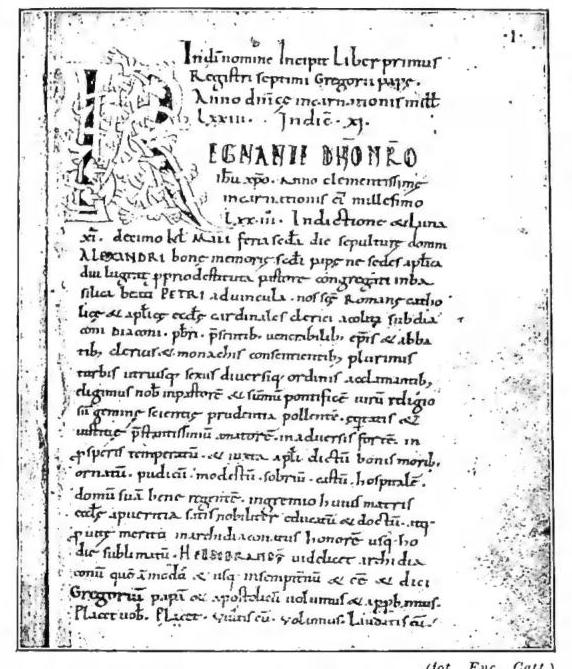
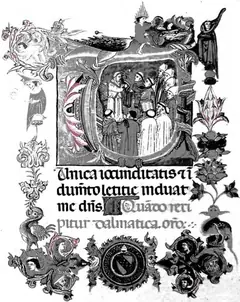
(535-36) it gives way to that of p. As for the 11th proposition of the Dictatus papae of Gregory VII (1075): "quod hoc unicum est nomen in mundo" (v. reproduction at plate LXXXII of vol. VI), it introduces no innovation regarding the meaning of the word p., but codifies a custom already several centuries old. The name papatus does not appear to be older than Leo of Ostia (12th century).
II. ELECTION OF THE POPE
The election of the bishop of Rome in the first centuries of Christian life did not differ from that of other episcopal sees. If some norms for ecclesiastical elections can be derived from chapter 44 of St. Clement of Rome's First Epistle to the Corinthians, one must nevertheless turn to the epistolary of St. Cyprian to have direct information about the election of a pope; St. Cyprian in letters 45-52, especially in 55 (ed. G. Hartel, CSEL, III, 2, Vienna 1871, pp. 599-650), deals with the election of St. Cornelius, which took place in particularly turbulent circumstances because of the conflicts stirred up by Novatian, in March 251: the clergy and the people took part in the election of Cornelius, who had passed through all the grades of the hierarchy, and the bishops present conferred the episcopate upon him. Already from that time the newly elected bishop of Rome would inform the bishop of Carthage of his elevation to the Roman see.
With the 4th century, in conformity with the practice that became established after the Council of Nicaea for the choice of bishops, the election of the pope became a matter chiefly of the clergy, to which the people and the aristocracy gave their assent. The candidate had to have passed through all the grades of the hierarchy and was generally the archdeacon, the most prominent figure in the Roman ecclesiastical administration. Normally the election took place three days after the death of the predecessor (a rule that had many exceptions, especially in the Middle Ages; the longest vacancy was the one that preceded the election of Gregory X, 1271) and the consecration took place on the following Sunday, but from Justinian I until Constantine IV Pogonatus (685: cf. Lib. Pont., I, p. 363) the elect had to ask the Emperor (cf. formula 58 of the Liber diurnus, ed. Th. Sickel, Vienna 1889, p. 47) for the iussio or the praeceptio for the ordination and pay a suitable fee to the imperial Chancery (cf. Lib. Pont., I, p. 354), and the Exarch of Ravenna for his approval (cf. formula 60: ibid., ed. cit., p. 49 ff.). The last pope who asked for confirmation from the Exarch was Gregory III (731). In cases of urgency the consecration could also take place "absque iussione principis", as happened for Pelagius (Lib. Pont., I, p. 309). The consecration of the bishop of Rome already in the 4th century was the privilege of the bishop of Ostia, as St. Augustine attests (cf. Breviculum collationis cum Donatistis, III, 16: PL 43, 641; cf. also Lib. Pont., I, p. 202), with the assistance of the bishops of Albano and of Porto (cf. formula 57 of the Liber diurnus, ed. cit., p. 46). As soon as he was elected and consecrated, the new pope would send to the patriarchs and to the bishops of the principal sees, a custom already attested by St. Cyprian for Carthage, a synodal letter to announce his elevation to the throne of St. Peter.
The election of the popes has always borne a religious and political character of particular importance; it should not be surprising, therefore, if since antiquity it was often marred by violent human passions and base political interests. The civil power believed it its duty more than once to intervene, and not always for the good of the Apostolic See, to safeguard public order or to impose its own candidates: the emperor Constantius sent Liberius into exile and patronized the election of the antipope Felix; at the death of Simplicius (483), the praetorian prefect, Caecina Basilius, in the name of Odoacer, presided over an assembly of senators and members of the clergy and had approved the regulation to prevent the future pope from alienating the goods of the Church; Theodoric intervened in the double election of Symmachus and Laurentius and gave his approval for the ordinatio of Felix IV (the first intervention of this kind: Lib. Pont., I, pp. 106, 280, n. 5); Belisarius deposed Silverius and had Vigilius elected; Duke Toto of Nepi had the antipope Constantine raised to the see of Peter (767); the Carolingians intervened with their legates; Otto I had John XII deposed and Leo VIII elected; the German emperors tyrannized pontifical elections, causing more than one antipope to be created in the 11th and 12th centuries; the sovereigns of Spain, France and Austria interfered in the choice of the popes from the 16th century until the Conclave of Pius X with the underhanded weapon of the "exclusive," that is, with the veto (v.).
To remedy the grave abuses that periodically occurred in the election of the popes, the pontiffs themselves took or invoked measures to regulate its proper conduct: Boniface I in 420 begged the emperor Honorius to take precautions to prevent in the election of his successor the disturbances that had occurred in his own; Honorius accepted the invitation, but had the prudence not to promulgate a law on the matter and assured the pope that the government would recognize only a morally unanimous election (Collectio Avellana, Ep. 37, ed. cit., p. 83). The Roman Synod of 499 forbade treating of the succession of the pope during his lifetime "et inconsulto," threatening grave penalties against violators; it then declared that, should opinions be divided (studia diversa) in the choice of the successor, "vincat sententia plurimorum" (ed. Th. Mommsen, in MGH, Auct. antiquissimi, XII, pp. 403-404; cf. also the constitutum of Boniface III: Lib. Pont., I, p. 316). The experiment of Felix IV, in 530, of choosing his successor disturbed the Roman Church at his death with the election of Dioscorus by the majority and of Boniface II chosen by the dying pope and confirmed only by a minority. The attempt for the good of the Holy See had no sequel since Boniface II, who had likewise chosen his successor, was forced to burn the chirograph of nomination before the tomb of St. Peter (Lib. Pont., I, p. 281). The Roman Synod of 769 barred access to the supreme pontificate to all those who were not cardinal priests or deacons and reserved the election to "cunctis sacerdotibus atque proceribus Ecclesiae et cuncto clero" (ed. A. Werminghoff, in MGH, Concilia, II, p. 86; Lib. Pont., I, pp. 468, 480-81), but the Constitutio Romana of 824 tacitly restored to the aristocracy and the people their part in the election of the popes. However, to avoid abuses, the consecration of the elect had to take place in the presence of the "missi" or legates of the Emperor. The Roman Synod of 898 reaffirmed the necessity of the presence of these imperial legates and restricted to the bishops (cardinals) and the clergy of Rome the act of election of the pope, which was nevertheless to take place in the presence of the Senate and the people (can. 10: Mansi,
XVIII, p. 225). To curb the grave abuses that occurred at every election, Nicholas II (1059) reserved the negotiations for the election to the cardinal bishops, who were then immediately to associate with themselves the other "clerici cardinales"; the rest of the clergy and the people were in turn convoked to assent to the election that had taken place. The candidate had to belong to the clergy of the Church of Rome, and only in case of necessity could recourse be had to a person outside it. Nicholas II also provided for the case in which the election, out of necessity, had to be held outside Rome (cf. the edition of the decree, in the genuine text and in the version interpolated by Guibert or his followers, edited by J. B. Lo Grasso, Ecclesia et Status. Fontes selecti, Rome 1939, pp. 100-107).
The decree by which Nicholas II reserved the election of the pope to the college of cardinals opened a new period in the history of this institution, which slowly evolved until it reached the present precise and severe ordering fixed in the Code of Canon Law and recently integrated by the constitution Vacantis Apostolicae Sedis of Pius XII of 8 Dec. 1945. The principal stages of this new period are: 1) the decree of the Third Lateran Council (March 1179: Mansi, XXII, 217-18) contained in the constitution of Alexander III, Licet de vitanda (6. X. I. 6; G. J. Ebers [cited in bibl.], p. 66), which required for the validity of the election a majority of two thirds of the votes, and this in order to close the way to possible schisms; 2) canon 2 of the Second Council of Lyon (1274: Mansi, XXIV, pp. 81-85), reproduced in the constitution Ubi periculum of Gregory X (July 1274: G. J. Ebers, p. 67), which fixed the norms for the conclave, which were then modified and integrated several times; 3) the constitution Si summus rerum of Julius II of 14 Jan. 1505, published at Bologna in Oct. 1510 and again sanctioned by the Fifth Lateran Council in the fifth session of 16 Feb. 1513 (Bullarium Romanum, ed. Taurinensis, V, pp. 536-37: Pastor, III, p. 701), to prevent the simoniacal scandals that had occurred in the election of Alexander VI; 4) the constitution Aeterni Patris Filius of Gregory XV of 15 Nov. 1621 (ibid., XII, pp. 619-26), containing new norms for the election of the pope in order to remedy the grave abuses of previous elections and to curb the interference, by then become intolerable, of governments, in particular of Spain, which had exercised the exclusive since the time of Charles V. The hoped-for goal was not attained; on the contrary, if up to that point the ambassadors had succeeded in their aim through intrigues, from then on they would succeed by officially imposing the exclusive (cf. Pastor, XIII, pp. 85-93), which only Pius X would have the courage to forbid with the constitution Commissum nobis, of 20 Jan. 1904, published in March of 1909 (Pii X P. M. Acta, III, Rome 1908 [1909], pp. 289-292 ff.); 5) the constitution Sede vacante of Pius X (25 Dec. 1904), integrated by the motu proprio of Pius XI, Cum proxime (1 March 1922), and by the aforementioned constitution of Pius XII (v. CONCLAVE).
To form an idea of how the election took place within the conclave from the 14th century onward, see the Ordo Romanus XIV, probably composed by Gaetano Stefaneschi, d. 1341 (ed. J. Mabillon, Museum Italicum, II, Paris 1689, p. 246 ff.); the Ordo Romanus XV, composed by Pietro Amelio, d. 1389 (ed. cit., II, p. 532); the description given of it in 1488 by the papal master of ceremonies Agostino Patrizi Piccolomini (cf. C. Marcello, Rituum ecclesiasticorum sive sacrarum caeremoniorum SS. Romanae Eccl. libri III, Venice 1516, cc. I-VIII); the constitution of Gregory XV, Decet Romanum pontificem, of 12 March 1621 (ed. G. J. Ebers, pp. 104-11), and the constitution of Clement XII, Apostolatus officium, of 5 Oct. 1732 (Bullarium Romanum, ed. Taurinensis, XXIII, p. 443 ff.; G. J. Ebers, pp. 111-16). For the ordinatio, the inthronizatio, the possessio and the coronatio, see the texts collected by Ebers, pp. 169-214; cf. E. Eichmann, Weihe u. Krönung des Papstes im Mittelalter, Munich 1951.
III. NAMES OF THE POPE
After the Prince of the Apostles, whose name Christ changed from Simon to Peter (John 1:42), the first of his successors to have changed his name is John II, who was previously called Mercurius. Other examples of this kind occur in the 10th century: Octavian of the Counts of Tusculum became John XII (955); the antipope Franco, Boniface VII (974); Peter Canepanova, bishop of Pavia, John XIV (983); Bruno of the dukes of Carinthia, Gregory V (996). From Sylvester II (999) onward popes and antipopes changed their baptismal name at the moment of election, with the exception of Adrian VI (Adrian Florensz) and Marcellus II (Marcellus Cervini); at first this happened at the will of the electors (cf., for example, Leo of Ostia, Chronicon Casinense, II, 86 [election of Victor, 1055 and of the antipope Benedict X, 1058]: MGH, Scriptores, VII, pp. 686, 695; Lib. Pont., II, p. 357; the Ordo Romanus XII of Cencio Savelli [c. 1192] still assigns the task of imposing the new name on the elect to the « prior diaconorum »: ed. P. Fabre-L. Duchesne, Le Liber censuum, I, Paris 1889-1910, p. 311), then by the personal choice of the elect, following a request of the « prior diaconorum » as the Ordo Romanus XIII already attests (1275: ed. J. Mabillon, Museum Italicum, II, Paris 1689, p. 221; G. J. Ebers, p. 186).
IV. PAPAL CHRONOTAXIS
The first attempts to hand down the succession of the popes go back to the second half of the 2nd century and are due to two writers: Hegesippus
(Int. Emil)
(between 155 and 166) and Irenaeus (177-78), who came to Rome to draw directly from the local sources the data they needed. The work of the former has survived only in fragments (cf. Eusebius, Hist. eccl., IV, 22, 3), while that of the latter is preserved in its entirety (cf. ibid., V, 6, see also 24, 28; Adversus haereses, III, 3). Irenaeus's list of the p., though without chronological data, is the most authoritative document available on the subject and is the one adopted in our chronotaxis down to Eleutherius. Sporadic references to successions of p. are found here and there in the Fathers and ecclesiastical writers, but this is not the place to dwell on them, since chroniclers, historians and anonymous compilers of catalogues of p. (v.) soon took care to fix, often by more or less empirical methods, the chronological data of the p., whether by relating them to the emperors and consuls or by indicating the number of years, months and days of individual pontificates. The catalogues of the p. were the object of careful critical examination by Duchesne (Lib. Pont., I, pp. 1-xxv, and the entry LIBER PONTIFICALIS, III, Fonti); the best known among them is the one called the Liberian Catalogue, which constitutes one of the sources of the Liber Pontificalis. The catalogues of the p. were often inserted in canonical collections, especially those coming from Italy and Gaul (cf., for example, cod. lat. 12097 of the Bibliothèque nationale in Paris, from the 2nd half of the 6th century; the oldest example of the kind), and served to date the papal decretals collected therein.
With few exceptions, these catalogues, which became very numerous in the early Middle Ages and in modern times, have no critical value, and the same must be said of countless medieval chronicles. Among the papal chronotaxes that exercised the greatest influence on historical chronology down to our own day, mention should be made of those that can be derived: 1) from the Chronicon and the Historia ecclesiastica of Eusebius of Caesarea (v.), which do not always agree on the number of years of the pontificate; 2) from the Liber Pontificalis (v.) and its continuations, which for the ancient part contains the errors of its sources; 3) from the Chronicon pontificum et imperatorum of Martin of Troppau, O. P. (d. 1278), whose third edition goes as far as Nicholas III (ed. L. Weiland, in MGH, Scriptores, XXII, pp. 327-473); 4) from the Liber de vita Christi ac omnium pontificum of Platina (critical ed. G. Gaida in RIS, III, I, Bologna 1913-32; the editio princeps, Venice 1479; noteworthy is the edition edited by O. Panvinio, Louvain 1572; various editions in Italian); 5) from O. Panvinio, Epitome pontificum Romanorum a s. Petro usque ad Paulum III. Gestorum electionisque singulorum et Conclusium compendiaria narratio (Rome 1557; the Venetian edition of the same year was published without the author's consent); 6) from the Annales of Baronio (Rome 1588; 22nd ed. Paris 1864-82, and the countless abridged editions and various translations): Baronio's chronotaxis, which ends with 1198, was accepted by almost all historians down to the last century; 7) from A. Ciacconio (Chacón), Vitae et gesta summorum pontificum a Christo Domino usque ad Clementem VIII (Rome 1601; frequently published, reworked by Oldoini, ibid. 1672); 8) from the Conatus chronologico-historicus ad universam seriem Romanorum pontificum of Daniel Papebroch (Propylaeum ad Acta SS. Maii, Antwerp 1688), the first truly critical essay: the author apologizes for having to contradict Baronio; 9) from the Mémoires of Tillemont (Paris 1693-1712, Venice 1732), which end at the beginning of the 6th century; 10) from the Chronologia Romanorum pontificum in pariete australi basilicae S. Pauli viae Ostiensis depicta saec. V seu aetate s. Leonis PP. Magni cum additione reliquorum summorum pontificum nostra ad haec usque tempora perducta... of G. Marangoni (Rome 1751), a chronotaxis that reproduces the errors of the source it describes; 11) from the Regesta pontificum of Jaffé down to 1198 and of Potthast down to 1304: at the beginning of each pontificate, the editors have placed an accurate chronological notice necessary for fixing the dates of the letters (the list of the p. from Adrian I with the dates of their election, consecration and coronation, drawn up by H. Grotefend, Taschenbuch der Zeitrechnung des deutschen Mittelalters u. der Neuzeit, 6th ed., Hannover 1928, pp. 117-24, has an identical purpose); 12) from the most recent histories of the Church of Hergenröther-Kirsch, of Duchesne (cf. the critical chronological tables down to Pius II published in Lib. Pont., I, pp. cclx-xii; II, pp. lxxv-xiii), of Funk, of Fliche-Martin, etc.; and those of the papacy: Pastor, Seppelt, Caspar, etc.; 13) from the Hierarchia catholica of Eubel, from 1198 onward.
Fr. Ehrle, librarian of the Vaticana, published in the Gerarchia cattolica of 1904 and 1905 a papal chronotaxis according to the Liber Pontificalis and its sources, edited by Duchesne, in order to offer ecclesiastics a safe and easy-to-consult guide. Ehrle's labor was not welcomed by most, and was no longer reproduced because of intemperate polemics stirred up by persons of scant historical culture, who preferred that the series of the p. of St. Paul with all its errors continue to be followed. The series of the p. according to the medallions of St. Paul was in fact reproduced from 1806 in the Notizie del Cracas, from 1862 in the Annuario pontificio, from 1871 in the Gerarchia cattolica and again from 1913 to 1946 in the Annuario pontificio. In 1947 the direction of the Annuario pontificio replaced the old and anachronistic chronotaxis of St. Paul with a truly critical one, due to the Prefect of the Vatican Secret Archive, Msgr. A. Mercati, who has duly updated Ehrle's series of the p.
The papal chronotaxis Duchesne-Ehrle-Mercati, being by far the best, has been deemed worth reproducing with some retouching, especially in the part concerning the antipopes (v.). It should be noted that the dates assigned from Linus to Pius I are only approximate; more certain, but not precise to the unit, are those from Anicetus to Callistus. The authentic antipopes have their name printed in italics; dates preceded by an asterisk mean that the beginning of the pontificate was not legitimate; names in italics preceded by an asterisk indicate doubtful antipopes; in roman type, the antipopes improperly so called or the p. who are not such, like Stephen II. When at the beginning of the pontificate there are two dates, the first refers to the electio, the second to the ordinatio or consecratio (if any) and to the coronatio; in the case where three dates are indicated, the third refers to the coronatio when it is distinct from the consecratio.
The year of the pontificate was computed from the coronatio. Before that date the condition of the elect was emphasized in papal documents both in the datatio and in the intitulatio (for example, «Benedictus presbiter et in Dei nomine electus Sanctae Sedi apostolicae» [Benedict II]: cf. C. Silva Tarouca, Nuovi studi sulle antiche lettere dei p., I, Rome 1932, p. 55). The formula electus is also prescribed by the pontifical ceremonial Patrizi Piccolomini (cf. C. Marcello, op. cit., c. VIII: «Innocentius electus servus servorum Dei» [Innocent VIII]).
PAPAL CHRONOTAXIS.
ST. PETER, of Bethsaida in Galilee, Prince of the Apostles, died a martyr in Rome between 64 and 67.
ST. LINUS, of Tuscia, 67-76 [67-79].
ST. ANACLETUS or CLETUS, Roman, 76-88 [79-91].
ST. CLEMENT, Roman, 88-97 [92-101].
ST. EVARISTUS, Greek, 97-105 [101-105].
ST. ALEXANDER I, Roman, 105-115 [109-110].
ST. SIXTUS I, Roman, 115-125.
ST. TELESPHORUS, Greek, 125-136.
ST. HYGINUS, Greek, 136-140 [138-142].
ST. PIUS I, of Aquileia, 140-155.
ST. ANICETUS, Syrian, 155-166.
ST. SOTER, of Campania, 166-175.
ST. ELEUTHERIUS, of Nicopolis in Epirus, 175-189.
ST. VICTOR I, African, 189-199.
ST. ZEPHYRINUS, Roman, 199-217.
ST. CALLISTUS I, Roman, 217 - 14 Oct. 222.
ST. HIPPOLYTUS, Roman, 217-235.
ST. URBAN I, Roman, 222-230.
ST. PONTIAN, Roman, July 21, 230 - Sept. 28, 235.
ST. ANTERUS, Greek, Nov. 21, 235 - Jan. 3, 236.
ST. FABIAN, Roman, Jan. 10, 236 - Jan. 20, 250.
ST. CORNELIUS, Roman, ... March 251 - ... June 253.
Novatian, Roman, 251, d. ca. 258.
ST. LUCIUS I, Roman, June 25, 253 - March 5, 254.
ST. STEPHEN I, Roman, May 12, 254 - Aug. 2, 257.
ST. SIXTUS II, Greek, Aug. 30, 257 - Aug. 8, 258.
ST. DIONYSIUS, of unknown birthplace, July 22, 259 - Dec. 26, 268.
ST. FELIX I, Roman, Jan. 5, 269 - Dec. 30, 274.
ST. EUTYCHIAN, of Luni, Jan. 4, 275 - Dec. 8, 283.
ST. CAIUS, Dalmatian, Dec. 17, 283 - Apr. 22, 296.
ST. MARCELLINUS, Roman, June 30, 296 - Oct. 25, 304.
ST. MARCELLUS I, Roman, May 27 (or June 26), 308 - Jan. 16, 309.
ST. EUSEBIUS, Greek, Apr. 18, 309 (or 310) - Aug. 17, 309 (or 310). *Heraclius, 309 or 310.
ST. MILTIADES, African, July 2, 311 - Jan. 11, 314.
ST. SILVESTER I, Roman, Jan. 31, 314 - Dec. 31, 335.
ST. MARK, Roman, Jan. 18, 336 - Oct. 7, 336.
ST. JULIUS I, Roman, Feb. 6, 337 - Apr. 12, 352.
LIBERIUS, Roman, May 17, 352 - Sept. 24, 366.
Felix II, Roman, ...355-Nov. 22, 365.
ST. DAMASUS I, Roman, Oct. 1, 366 - Dec. 11, 384.
Ursinus, Roman deacon, 366-367, d. after 381.
ST. SIRICIUS, Roman, Dec. 15 or 22 or 29, 384 - Nov. 26, 399.
ST. ANASTASIUS I, Roman, Nov. 27, 399 - Dec. 19, 401.
ST. INNOCENT I, of Albano, Dec. 22, 401 - March 12, 417.
ST. ZOSIMUS, Greek, March 18, 417 - Dec. 26, 418.
ST. BONIFACE I, Roman, Dec. 28, 29, 418 - Sept. 4, 422.
Eulalius, Roman archdeacon, Dec. 27, 29, 418 - March 29, 419.
ST. CELESTINE I, of Campania, Sept. 10, 422 - July 27, 432.
ST. SIXTUS III, Roman, July 31, 432 - Aug. 19, 440.
ST. LEO I, the Great, of Tuscia, Sept. 29, 440 - Nov. 10, 461.
ST. HILARY, Sardinian, Nov. 19, 461 - Feb. 29, 468.
ST. SIMPLICIUS, of Tivoli, March 3, 468 - March 10, 483.
ST. FELIX III (II), Roman, March 13, 483 - March 1, 492.
ST. GELASIUS I, African, March 1, 492 - Nov. 21, 496.
ANASTASIUS II, Roman, Nov. 24, 496 - Nov. 19, 498.
ST. SYMMACHUS, Sardinian, Nov. 22, 498 - July 19, 514.
Lawrence, Roman archpriest, 498, 501-507.
ST. HORMISDAS, of Frosinone, July 20, 514 - Aug. 6, 523.
ST. JOHN I, of Tuscia, martyr, Aug. 13, 523 - May 18, 526.
ST. FELIX IV (III), of Samnium, Sept. 12, 526 - Sept. 22, 530.
[DIOSCORUS, of Alexandria, Sept. 22, 530 - Oct. 14, 530].
BONIFACE II, Roman, *Sept. 22, 530 - Oct. 17, 532.
JOHN II, Roman, Jan. 2, 533 - May 8, 535.
ST. AGAPITUS I, Roman, May 13, 535 - Apr. 22, 536.
ST. SILVERIUS, of Campania, martyr, June 1 (or 8), 536 - Nov. 11, 537.
VIGILIUS, Roman, *March 29, 537 - June 7, 555.
PELAGIUS I, Roman, Apr. 16, 556 - March 4, 561.
JOHN III, Roman, July 17, 561 - July 13, 574.
BENEDICT I, Roman, June 2, 575 - July 30, 579.
PELAGIUS II, Roman, Nov. 26, 579 - Feb. 7, 590.
ST. GREGORY I, the Great, Roman, Sept. 3, 590 - March 12, 604.
SABINIAN, of Blera (Tuscia), Sept. 13, 604 - Feb. 22, 606.
BONIFACE III, Roman, Feb. 19, 607 - Nov. 12, 607.
ST. BONIFACE IV, Marsian, Aug. 25, 608 - May 8, 615.
ST. ADEODATUS I, Roman, Dec. 19, 615 - Nov. 8, 618.
BONIFACE V, of Naples, Dec. 23, 619 - Oct. 25, 625.
HONORIUS I, of Campania, Oct. 27, 625 - Oct. 12, 638.
SEVERINUS, Roman, May 28, 640 - Aug. 2, 640.
JOHN IV, Dalmatian, Dec. 24, 640 - Oct. 12, 642.
THEODORE I, Greek, Nov. 24, 642 - May 14, 649.
ST. MARTIN I, of Todi, martyr, ... July 649 - Sept. 16, 655.
ST. EUGENE I, Roman, *Aug. 10, 654 - June 2, 657.
ST. VITALIAN, of Segni, July 30, 657 - Jan. 27, 672.
ADEODATUS II, Roman, Apr. 11, 672 - June 17, 676.
DONUS, Roman, Nov. 2, 676 - Apr. 11, 678.
ST. AGATHO, Sicilian, June 27, 678 - Jan. 10, 681.
ST. LEO II, Sicilian, Aug. 17, 682 - July 3, 683.
ST. BENEDICT II, Roman, June 26, 684 - May 8, 685.
JOHN V, Syrian, July 23, 685 - Aug. 2, 686.
Peter and Theodore, Roman archpriest and priest, Aug. 2 -
Oct. 21, 686.
CONON, of unknown birthplace, Oct. 21, 686 - Sept. 21, 687.
Theodore, who had become archpriest, Sept. 21 - Dec. 15, 687.
Paschal, Roman archdeacon, Sept. 21, 687 - 692.
ST. SERGIUS I, Syrian, Dec. 15, 687 - Sept. 8, 701.
JOHN VI, Greek, Oct. 30, 701 - Jan. 11, 705.
JOHN VII, Greek, March 1, 705 - Oct. 18, 707.
SISINNIUS, Syrian, Jan. 15, 708 - Feb. 4, 708.
CONSTANTINE, Syrian, March 25, 708 - Apr. 9, 715.
ST. GREGORY II, Roman, May 19, 715 - Feb. 11, 731.
ST. GREGORY III, Syrian, Feb. 11, March 18, 731 - Nov. 29, 741.
ST. ZACHARY, Greek, Dec. 10, 741 - March 15, 752.
Stephen II, Roman, elected and d. between March 16-25, 752.
STEPHEN II (III), Roman, March 26, 752 - Apr. 26, 757.
Theophylact, Roman archdeacon, late Apr.-May 757.
ST. PAUL I, Roman, late Apr., May 29, 757 - June 28, 767.
Constantine, of Nepi, June 28, July 5, 767 - Aug. 1, 768.
Philip, July 31, 768.
STEPHEN III (IV), Sicilian, Aug. 1, 7, 768 - Jan. 24, 772.
ADRIAN I, Roman, Feb. 1, 6, 772 - Dec. 25, 795.
ST. LEO III, Roman, Dec. 26, 27, 795 - June 12, 816.
STEPHEN IV (V), Roman, June 22, 816 - Jan. 24, 817.
ST. PASCHAL I, Roman, Jan. 25, 817 - Feb. 11, 824.
[...], Roman priest, Feb. 824 (Zinzino?).
EUGENE II, Roman, ... Feb.-May 824 - Aug. 827.
VALENTINE, Roman, ... Aug. 827 - ... Sept. 827.
GREGORY IV, Roman, ... 827 - ... Jan. 844.
John, Roman archdeacon ... Jan. 844.
SERGIUS II, Roman, ... Jan. 844 - Jan. 27, 847.
ST. LEO IV, Roman, ... Jan., Apr. 10, 847 - July 17, 855.
ST. LEO IV, Roman, ... Jan., 10 Apr. 847 - 17 July 855.
Anastasius, the Librarian, Roman priest, Aug. ... Sept. 855.
ST. NICHOLAS I, the Great, Roman, Apr. 24, 858 - Nov. 13, 867.
ADRIAN II, Roman, Dec. 14, 867 - Dec. 14, 872.
JOHN VIII, Roman, Dec. 14, 872 - Dec. 16, 882.
MARINUS I, of Gallese, Dec. 16, 882 - May 15, 884.
ST. ADRIAN III, Roman, May 17, 884 - ... Sept. 885.
STEPHEN V (VI), Roman, ... Sept. 885 - Sept. 14, 891.
FORMOSUS, bishop of Porto, Sept. 19, 891 - Apr. 4, 896.
BONIFACE VI, Roman, ... Apr. 896 - ... Apr. 896.
STEPHEN VI (VII), Roman, ... May 896 - ... Aug. 897.
ROMANUS, of Gallese, ... Aug. 897 - ... Nov. 897.
THEODORE II, Roman, ... Dec. 897 - ... Dec. 897.
JOHN IX, of Tivoli, ... Jan. 898 - ... Jan. 900.
BENEDICT IV, Roman, ... Jan.-Feb. 900 - ... July 903.
LEO V, of Ardea, ... July 903 - ... Jan. 904.
Christopher, Roman, ... Sept. 903 - ... Jan. 904.
SERGIUS III, Roman, ... Jan. 898, *Jan. 29, 904 - Apr. 14, 911.
ANASTASIUS III, Roman, ... Apr. 911 - ... June 913.
LANDO, of Sabina, ... July 913 - ... Feb. 914.
JOHN X, of Tossignano (Imola), ... March 914 - ...
May 928.
LEO VI, Roman, ... May 928 - ... Dec. 928.
STEPHEN VII (VIII), Roman, ... Dec. 928 - ... Feb. 931.
JOHN XI, Roman, ... Feb.-March 931 - ... Dec. 935.
LEO VII, Roman, Jan. 3, 936 - July 13, 939.
STEPHEN VIII (IX), Roman, July 14, 939 - ... Oct. 942.
MARINUS II, Roman, Oct. 30, 942 - ... May 946.
AGAPITUS II, Roman, May 10, 946 - ... Dec. 955.
JOHN XII, Octavian, of the counts of Tusculum, Dec. 16,
955 - May 14, 964.
Leo VIII, Roman, Dec. 4-6, 963 - March 1, 965.
BENEDICT V, Roman, May 22, 964 - July 4, 965 or 966.
JOHN XIII, Roman, Oct. 1, 965 - Sept. 6, 972.
BENEDICT VI, Roman, Jan. 19, 973 - ... June 974.
Boniface VII, Roman, Francone, ... June - ... July 974; then Aug. 984 - ... July 985.
BENEDICT VII, Roman, ... Oct. 974 - July 10, 983.
JOHN XIV, of Pavia, Peter, ... Dec. 983 - Aug. 20, 984.
JOHN XV, Roman, ... Aug. 985 - ... March 996.
GREGORY V, Saxon, Bruno of the dukes of Carinthia,
May 3, 996 - Feb. 18, 999.
John XVI, of Rossano; John Philagathus, ... Apr. 997 - ... Feb. 998.
SILVESTER II, of Auvergne, Gerbert, Apr. 2, 999 - May 12, 1003.
JOHN XVII, Roman, Sicco, ... June 1003 - ... Dec. 1003.
JOHN XVIII, Roman, Fasano, ... Jan. 1004 - ... July 1009.
SERGIUS IV, Roman, Peter, July 31, 1009 - May 12, 1012.
BENEDICT VIII, Theophylact of the counts of Tusculum, May 18, 1012 - Apr. 9, 1024.
Gregory, 1012.
GIOVANNI XIX, Roman of the counts of Tusculum, ... April-May 1024 - ... 1032.
BENEDICT IX, Theophylact of the counts of Tusculum, ... 1032 - 1 May 1045 (resignation).
Silvester III, Roman, Giovanni, 20 Jan. 1045 - 10 March 1045.
GREGORY VI, Roman, Giovanni Graziano, *5 May 1045 - 20 Dec. 1046.
CLEMENT II, of Saxony, Suitger of the lords of Morsleben and Hornburg, *24, 25 Dec. 1046 - 9 Oct. 1047.
*Benedict IX (reappears after the resignation), 8 Nov. 1047 - 17 July 1048.
DAMASUS II, of Bavaria, Poppo, 17 July 1048 - 9 Aug. 1048.
St. LEO IX, Lorrainer, Bruno of the counts of Egisheim-Dagsburg, 12 Feb. 1049 - 19 Apr. 1054.
VICTOR II, German, Gebhard of the counts of Dollnstein-Hirschberg, 16 Apr. 1055 - 28 July 1057.
STEPHEN IX (X), Lorrainer, Frederick of the dukes of Lorraine, 3 Aug. 1057 - 29 March 1058.
Benedict X, Roman, Giovanni, 5 Apr. 1058 - 24 Jan. 1059 (deposed).
NICHOLAS II, of Burgundy, Gerard, 24 Jan. 1059 - 27 July 1061.
ALEXANDER II, Anselm of Baggio (Milan), 1 Oct. 1061 - 21 Apr. 1073.
Honorius II, of Verona, Cadalus, 28 Oct. 1061 - ... 1072.
St. GREGORY VII, of Tuscia, Hildebrand, 22 Apr., 30 June 1073 - 25 May 1085.
Clement III, of Parma, Wibert, 25 June 1080. 24 March 1084 - 8 Sept. 1100.
Bl. VICTOR III, of Benevento, Dauferius (Desiderius), 24 May 1086 - 16 Sept. 1087.
Bl. URBAN II, French, Odo of Lagery, 12 March 1088 - 29 July 1099.
PASCHAL II, of Pieda in Romagna, Raniero, 13, 14 Aug. 1099 - 21 Jan. 1118.
Theodoric, bishop of S. Rufina ... 1100, d. in 1102. Albert, bishop of Sabina, ... 1102.
Silvester IV, Roman, Maginulf, 18 Nov. 1105 - 12 Apr. 1111.
GELASIUS II, of Gaeta, Giovanni Caetani, 24 Jan., 10 March 1118 - 28 Jan. 1119.
Gregory VIII, French, Maurice called Burdinus, 8 March 1118 - Apr. 1121, d. ca. 1136.
CALLISTUS II, Guy of Burgundy, 2, 9 Feb. 1119 - 13 Dec. 1124.
[CELESTINE II, Roman, Theobald Buccapeus, 15-16 Dec. 1124; abdicated at once].
HONORIUS II, of Fiagnano (Imola), Lambert, 15, 21 Dec. 1124 - 13 Feb. 1130.
INNOCENT II, Roman, Gregory Papareschi, 14, 23 Feb. 1130 - 24 Sept. 1143.
Anacletus II, Roman, Pietro Petri Leonis, 14, 23 Feb. 1130 - 25 Jan. 1138.
Victor IV, Gregory, 15 March 1138 - 29 May 1138.
CELESTINE II, of Città di Castello, Guido, 26 Sept., 3 Oct. 1143 - 8 March 1144.
LUCIUS II, Bolognese, Gerard Caccianemici, 12 March 1144 - 15 Feb. 1145.
Bl. EUGENE III, of Pisa, Bernard, perhaps of the Paganelli of Montemagno, 15, 18 Feb. 1145 - 8 July 1153.
ANASTASIUS IV, Roman, Conrad, 12 July 1153 - 3 Dec. 1154.
ADRIAN IV, English, Nicholas Breakspear, 4, 5 Dec. 1154 - 1 Sept. 1159.
ALEXANDER III, of Siena, Roland Bandinelli, 7, 20 Sept. 1159 - 30 Aug. 1181.
Victor IV (V), Octavian of Montecelio (Tivoli), 7 Sept., 4 Oct. 1159 - 20 Apr. 1164.
Paschal III, Guido of Crema, 22, 26 Apr. 1164 - 20 Sept. 1168.
Callistus III, Giovanni, abbot of Strumi (Arezzo), ... Sept. 1168 - 29 Aug. 1178.
Innocent III, of Sezze, Lando, 29 Sept. 1179 - ... Jan. 1180.
LUCIUS III, Lucchese, Ubaldo Allucingoli, 1, 6 Sept. 1181 - 25 Sept. 1185.
URBAN III, Milanese, Uberto Crivelli, 25 Nov., 1 Dec. 1185 - 20 Oct. 1187.
GREGORY VIII, of Benevento, Alberto de Morra, 21, 25 Oct. 1187 - 17 Dec. 1187.
CLEMENT III, Roman, Paolo Scolari, 19, 20 Dec. 1187 - March 1191.
CELESTINE III, Roman, Giacinto Bobone, 30 March, 14 Apr. 1191 - 8 Jan. 1198.
INNOCENT III, of Anagni, Lothair of the counts of Segni, 8 Jan., 22 Feb. 1198 - 16 July 1216.
HONORIUS III, Roman, Cencio Savelli, 13, 24 July 1216 - 18 March 1227.
GREGORY IX, of Anagni, Ugolino of the counts of Segni, 19, 21 March 1227 - 22 Aug. 1241.
CELESTINE IV, Milanese, Goffredo Castiglioni, 25, 28 Oct. 1241 - 10 Nov. 1241.
INNOCENT IV, Genoese, Sinibaldo Fieschi, 25, 28 June 1243 - 7 Dec. 1254.
ALEXANDER IV, of Anagni, Rinaldo of the counts of Segni, 12, 20 Dec. 1254 - 25 May 1261.
URBAN IV, of Troyes, Jacques Pantaléon, 29 Aug., 4 Sept. 1261 - 2 Oct. 1264.
CLEMENT IV, French, Guy Fulcodi, 5, 15 Feb. 1265 - 29 Nov. 1268.
Bl. GREGORY X, of Piacenza, Tedaldo Visconti, 1 Sept. 1271, 27 March 1272 - 10 Jan. 1276.
Bl. INNOCENT V, of Savoy, Peter of Tarentaise, 21 Jan., 22 Feb. 1276 - 22 June 1276.
ADRIAN V, Genoese, Ottobono Fieschi, 11 July 1276 - 18 Aug. 1276.
JOHN XXI, Portuguese, Peter Iuliani or Peter the Spaniard, 8, 20 Sept. 1276 - 20 May 1277.
NICHOLAS III, Roman, Giovanni Gaetano Orsini, 25 Nov. 26 Dec. 1277 - 22 Aug. 1280.
MARTIN IV, French, Simon de Brion, 22 Feb., 23 March 1281 - 28 March 1285.
HONORIUS IV, Roman, Giacomo Savelli, 2 Apr., 20 May 1285 - 3 Apr. 1287.
NICHOLAS IV, of Ascoli, Jerome Masci, 22 Feb. 1288 - 4 Apr. 1292.
St. CELESTINE V, of Isernia, Peter of Murrone, 5 July, 29 Aug. 1294 - 13 Dec. 1294, d. 19 May 1296.
BONIFACE VIII, of Anagni, Benedetto Caetani, 24 Dec. 1294, 23 Jan. 1295 - 11 Oct. 1303.
Bl. BENEDICT XI, of Treviso, Niccolò Boccasini, 22, 27 Oct. 1303 - 7 July 1304.
CLEMENT V, French, Bertrand de Got, 5 June, 14 Nov. 1305 - 20 Apr. 1314 (1st Avignon pope).
JOHN XXII, of Cahors, Jacques Duèse, 7 Aug., 5 Sept. 1316 - 4 Dec. 1334.
Nicholas V, of Corvaro (Rieti), Pietro Rainallucci 12, 22 May 1328 - 25 Aug. 1330, d. 16 Oct. 1333.
BENEDICT XII, French, Jacques Fournier, 20 Dec. 1334, 8 Jan. 1335 - 25 Apr. 1342.
CLEMENT VI, French, Pierre Roger, 7, 19 May 1342 - 6 Dec. 1352.
INNOCENT VI, French, Étienne Aubert, 18, 30 Dec. 1352 - 12 Sept. 1362.
Bl. URBAN V, French, Guillaume de Grimoard, 28 Sept., 6 Nov. 1362 - 19 Dec. 1370.
GREGORY XI, French, Pierre Roger de Beaufort, 30 Dec. 1370, 5 Jan. 1371 - 26 March 1378 (returns to Rome).
URBAN VI, of Naples, Bartolomeo Prignano, 8, 18 Apr. 1378 - 15 Oct. 1389.
BONIFACE IX, of Naples, Pietro Tomacelli, 2, 9 Nov. 1389 - 1 Oct. 1404.
INNOCENT VII, of Sulmona, Cosimo Migliorati, 17 Oct., 11 Nov. 1404 - 6 Nov. 1406.
GREGORY XII, Venetian, Angelo Correr, 30 Nov., 19 Dec. 1406 - 4 July 1415 (resignation), d. 18 Oct. 1417.
Avignon obedience
Clement VII, Robert of the counts of Geneva, 20 Sept., 31 Oct. 1378 - 16 Sept. 1394.
Benedict XIII, Aragonese, Pedro de Luna, 28 Sept., 11 Oct. 1394 - 23 May 1423.
Clement VIII, of Valencia, Gil Sánchez Muñoz, 10 June 1423 - 26 July 1429.
Benedict XIV, of Rodez, Bernard Garnier, 12 Nov. 1425-30.
Pisan obedience
Alexander V, of the island of Crete, Peter Philarges, 26 June, 7 July 1409 - 3 May 1410.
John XXIII, of Naples, Baldassarre Cossa, 17, 25 May 1410 - 29 May 1415 (deposed).
MARTIN V, Roman, Oddone Colonna, 11, 21 Nov. 1417 - 20 Feb. 1431.
EUGENE IV, Venetian, Gabriele Condulmer, 3, 11 March 1431 - 23 Feb. 1447.
Felix V, of Savoy, Amadeus Duke of Savoy, 5 Nov. 1439, 24 July 1440 - 7 Apr. 1449.
NICHOLAS V, of Sarzana, Tommaso Parentucelli, 6, 19 March 1447 - 24 March 1455.
CALLISTUS III, of Játiva (Valencia), Alfonso de Borja, 8, 20 Apr. 1455 - 6 Aug. 1458.
PIUS II, of Siena, Enea Silvio Piccolomini, 19 Aug., 3 Sept. 1458 - 15 Aug. 1464.
PAUL II, Venetian, Pietro Barbo, 30 Aug., 16 Sept. 1464 - 26 July 1471.
SIXTUS IV, of Savona, Francesco della Rovere, 9, 25 Aug. 1471 - 12 Aug. 1484.
INNOCENT VIII, Genoese, G. B. Cibo, 29 Aug., 12 Sept. 1484 - 25 July 1492.
ALEXANDER VI, of Játiva (Valencia), Rodrigo de Borja, 11, 26 Aug. 1492 - 18 Aug. 1503.
PIUS III, of Siena, Francesco Todeschini-Piccolomini, 22 Sept., 1, 8 Oct. 1503 - 18 Oct. 1503.
JULIUS II, of Savona, Giuliano della Rovere, 31 Oct., 26 Nov. 1503 - 21 Feb. 1513.
LEO X, Florentine, Giovanni de' Medici, 9, 17, 19 March 1513 - 1 Dec. 1521.
ADRIAN VI, of Utrecht, Adrian Florensz, 9 Jan., 31 Aug. 1522 - 14 Sept. 1523.
CLEMENT VII, Florentine, Giulio de' Medici, 19, 26 Nov. 1523 - 25 Sept. 1534.
PAUL III, Roman, Alessandro Farnese, 13 Oct., 3 Nov. 1534 - 10 Nov. 1549.
JULIUS III, Roman, Giovanni Maria Ciocchi del Monte, 7, 22 Feb. 1550 - 23 March 1555.
MARCELLUS II, of Montepulciano, Marcello Cervini, 9, 10 Apr. 1555 - 1 May 1555.
PAUL IV, of Naples, Gian Pietro Carafa, 23, 26 May 1555 - 18 Aug. 1559.
PIUS IV, Milanese, Giovan Angelo de' Medici, 25 Dec. 1559, 6 Jan. 1560 - 9 Dec. 1565.
St. PIUS V, of Bosco (Alessandria), Antonio (Michele) Ghilieri, 7, 17 Jan. 1566 - 1 May 1572.
GREGORY XIII, Bolognese, Ugo Boncompagni, 13, 25 May 1572 - 10 Apr. 1585.
SIXTUS V, of Grottammare (Ripatransone), Felice Peretti, 24 Apr., 1 May 1585 - 27 Aug. 1590.
URBAN VII, Roman, Giov. Batt. Castagna, 15 Sept. 1590 - 27 Sept. 1590.
GREGORY XIV, of Cremona, Niccolò Sfondrati, 5, 8 Dec. 1590 - 16 Oct. 1591.
INNOCENT IX, Bolognese, Giov. Antonio Facchinetti, 29 Oct., 3 Nov. 1591 - 30 Dec. 1591.
CLEMENT VIII, Florentine, Ippolito Aldobrandini, 30 Jan., 9 Feb. 1592 - 3 March 1605.
LEO XI, Florentine, Alessandro de' Medici, 1, 10 Apr. 1605 - 27 Apr. 1605.
PAUL V, Roman, Camillo Borghese, 16, 29 May 1605 - 28 Jan. 1621.
GREGORY XV, Bolognese, Alessandro Ludovisi, 9, 14 Feb. 1621 - 8 July 1623.
URBAN VIII, Florentine, Maffeo Barberini, 6 Aug., 29 Sept. 1623 - 29 July 1644.
INNOCENT X, Roman, Giov. Batt. Pamphili, 15 Sept., 4 Oct. 1644 - 7 Jan. 1655.
ALEXANDER VII, of Siena, Fabio Chigi, 7, 18 Apr. 1655 - 22 May 1667.
CLEMENT IX, of Pistoia, Giulio Rospigliosi, 20, 26 June 1667 - 9 Dec. 1669.
CLEMENT X, Roman, Emilio Altieri, 29 Apr., 11 May 1670 - 22 July 1676.
INNOCENT XI, of Como, Benedetto Odescalchi, 21 Sept., 4 Oct. 1676 - 12 Aug. 1689.
ALEXANDER VIII, Venetian, Pietro Ottoboni, 6, 16 Oct. 1689 - 1 Feb. 1691.
INNOCENT XII, of Naples, Antonio Pignatelli, 12, 15 July 1691 - 27 Sept. 1700.
CLEMENT XI, of Urbino, Giov. Francesco Albani, 23, 30 Nov., 8 Dec. 1700 - 19 March 1721.
INNOCENT XIII, Roman, Michelangiolo dei Conti, 8, 18 May 1721 - 7 March 1724.
BENEDICT XIII, Roman, Pietro Francesco (Vincenzo Maria) Orsini, 29 May, 4 June 1724 - 21 Feb. 1730.
CLEMENT XII, Florentine, Lorenzo Corsini, 12, 16 July 1730 - 6 Feb. 1740.
BENEDICT XIV, Bolognese, Prospero Lambertini, 17, 22 Aug. 1740 - 3 May 1758.
CLEMENT XIII, Venetian, Carlo Rezzonico, 6, 16 July 1758 - 2 Feb. 1769.
CLEMENT XIV, of S. Arcangelo (Rimini), G. Vincenzo Antonio (Lorenzo) Ganganelli, 19, 28 May, 4 June 1769 - 22 Sept. 1774.
PIUS VI, of Cesena, Giov. Angelo Braschi, 15, 22 Feb. 1775 - 29 Aug. 1799.
PIUS VII, of Cesena, Barnaba (Gregorio) Chiaramonti, 14, 21 March 1800 - 20 Aug. 1823.
LEO XII, of Genga (Fabriano), Annibale della Genga, 28 Sept., 5 Oct. 1823 - 10 Feb. 1829.
PIUS VIII, of Cingoli, Francesco Saverio Castiglioni, 31 March, 5 Apr. 1829 - 30 Nov. 1830.
GREGORY XVI, of Belluno, Bartolomeo Alberto (Mauro) Cappellari, 2, 6 Feb. 1831 - 1 June 1846.
PIUS IX, of Senigallia, Giovanni Maria Mastai Ferretti, 16, 21 June 1846 - 7 Feb. 1878.
LEO XIII, of Carpineto (Anagni), Gioacchino Pecci, 20 Feb., 3 March 1878 - 20 July 1903.
Bl. PIUS X, of Riese (Treviso), Giuseppe Sarto, 4, 9 Aug. 1903 - 20 Aug. 1914.
BENEDICT XV, Genoese, Giacomo della Chiesa, 8, 6 Sept. 1914 - 22 Jan. 1922.
PIUS XI, of Desio (Milan), Achille Ratti, 6, 12 Feb. 1922 - 10 Feb. 1939.
PIUS XII, Roman, Eugenio Pacelli, 2, 12 March 1939.
V. THE NUMBER OF THE POPES
However much care is taken in sifting the sources, the list of the popes remains uncertain in more than one case down to the election of Martin V (1417); from this pope down to the reigning Pontiff the series presents no further doubt. The principal doubtful cases are constituted: 1) by the pairs: Cletus-Anacletus, probably a single person, although the splitting in two goes back to the 4th century and perhaps already to the 3rd, and Marcellinus-Marcellus, but the hypothesis that would make of them a single person has not met with the assent of the critics; 2) by the doubtful or improperly so-called antipopes (v. ANTIPAPA); 3) by the election that remained without effect, because it was not followed by the ordinatio or episcopal consecration of the elect, which, according to the juridical norms current before St. Gregory VII, was the condition sine qua non for the elect to be regularly considered a pope: it is the case of Stephen II, elected between 16 and 23 March 752, who died two days later without the ordinatio, who historically and juridically is not a pope: 4) by certain papal elections at the end of the 9th century that aroused the most lively polemics and that culminated in the abominable "Synod of the Cadaver"; the origin of these contestations is to be sought in the election of Marinus, bishop of Caere (882), the first case of a bishop who becomes pope, and above all in that of Formosus (891), bishop of Porto; the anticanonical character of these two elections was noted by contemporaries, but the dissent broke out violently with the succession of Theodore II (d. in Dec. 897) and the formation of the Formosan and anti-Formosan parties: there were then two elections: John IX (Jan. 898), who had himself consecrated at once, and Sergius III, bishop of Caere, who had to leave Rome, until in 904, having overthrown the antipope Christopher, he succeeded in having himself enthroned on 29 Jan. Sergius never considered John IX and his successors as legitimate, and much less Formosus. In the face of these facts the historian remains perplexed, even while accepting the papal series as it results from the various sources; 5) by the deposition of John XII by Otto I at the Roman Synod of 4 Dec. 963: the Church was certainly freed from an unworthy pontiff, but this happened in contempt of the canonical rules and more for political than for moral motives. Leo VIII, made to be elected by Otto, should therefore be placed among the antipopes, and the true successor of John XII should be Benedict V, elected at the death of John XII (964); the ancient catalogues, on the other hand, maintain the contrary; 6) by the insertion into the catalogues of non-existent popes, as in 972 or 974 Donus II (Domnus or Bonus) and John XX, created as a consequence of the splitting in two of John XV; moreover John XVI is an antipope; 7) by the very intricate successions of Benedict IX (1014), Stephen IX (1057) and Honorius II (1124); 8) by the situation created as a consequence of the existence of three "obediences" at the beginning of the 15th century, which then came to an end with the Council of Constance, which for the good of the Church proceeded more by authority than according to the traditional norms. Depending therefore on the solutions that can be given to certain of these intricate problems, the number of the popes increases or decreases. According to our chronotaxis the true popes would be 258, including Diacorus and Celestine II Buccapeus, to be considered authentic popes. The true antipopes would be 36, with Vigilius, who was afterwards legitimized. The doubtful antipopes would be 2, besides the unclear beginnings of the pontificates of Boniface II, Eugene I, Sergius III, Gregory VI and Clement II; those improperly so called would be 9. As regards the country of origin (for the first centuries the Liber Pontificalis remains an uncontrollable source), the popes can be distributed as follows: Romans 100; Italians 106; foreigners 50; of unspecified country 2. As regards cult, 77 popes are venerated as saints; 8 as blesseds; one antipope, Hippolytus, as a holy martyr.
VI. PORTRAITS OF THE POPES
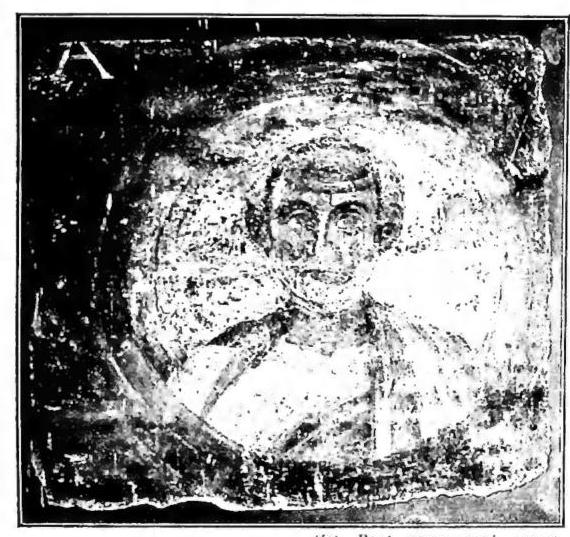
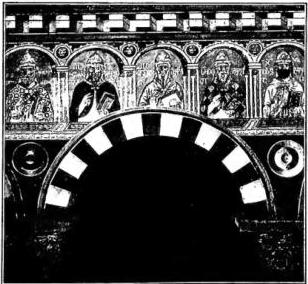
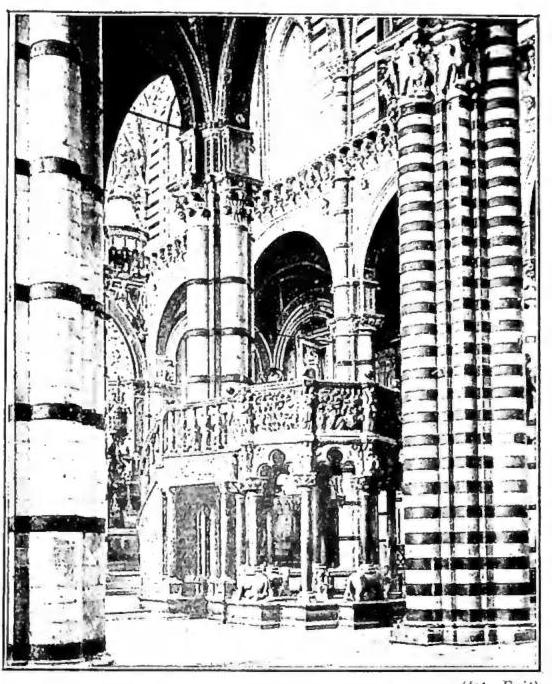
For the ancient and medieval popes there are, rather than true likenesses reproducing their personal features, iconographic types that are repeated with few variations. For the modern and contemporary era, on the other hand, portraits from life abound. Among the collections of portraits of popes, the following must be mentioned: 1) the one frescoed in the basilica of St. Paul in the time of Leo the Great, continued at the end of the 9th century by Pope Formosus, by Nicholas III at the end of the 13th century, by Benedict XIV around 1750, completely redone in mosaic after the fire of 1823; 2) those frescoed in St. Peter's and in the Lateran, now destroyed; 3) that of S. Piero a Grado (near Pisa), which now ends with John XVII, attributed to Deodato Orlandi (1300-12); 4) that painted on canvas, of the Palazzo Altieri at Oriolo, from the time of Clement X, still kept up to date; 5) that of Marino in the Casa Colonna, now the Palazzo comunale (under the pontificate of Gregory XVI). In the 15th century the cathedral of Siena was provided with a complete series of busts of the popes. Another series of 40 oval medallions with the portraits of the first saintly popes runs along the marble revetments of the inner pillars of the minor naves of St. Peter's in the Vatican (bas-reliefs by pupils of Bernini; Innocent X, 1644-55).
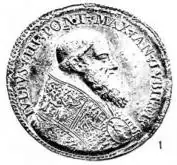
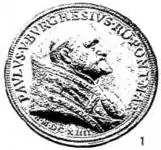
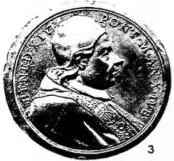
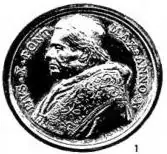
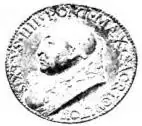
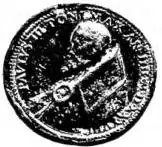
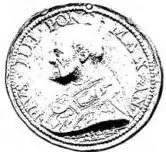
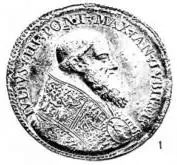
In our plates LVIII-LXII the complete series of portraits of the popes is given, reproduced on medals struck during the individual pontificates, from Nicholas V to Pius XII.
VII. COATS OF ARMS OF THE POPES
There exist many ancient and recent collections of the coats of arms of the popes, but a critical one in the full sense of the word is still lacking. Our series of coats of arms, drawn heraldically, begins with Innocent III; for Urban IV (1261-64) and the popes of Avignon (1309-76) recourse has been had to an excellent anonymous article in the Revue de l'art chrétien, 51 (1908), pp. 254-65, 409-411; for the antipope Clement VII to Galbreath; for the other antipopes and popes down to our own day, to the coats of arms existing on monuments that are almost all Roman, checked one by one by Dr. Witold Wehr. It should be noted that it is often difficult to establish exactly the metals or the enamels employed, since in most cases these are sculptures; likewise certain figures remain uncertain, because they were drawn or carved in various ways by contemporaries, even in models of truly authentic coats of arms.
VIII. BURIAL OF THE POPES
Under the respective entries will be found the indication of the place of burial of the individual popes; here it suffices to recall that the Liber Pontificalis gives as the place of burial for the popes of the 1st and 2nd centuries St. Peter's in the Vatican; now, on the occasion of the excavations carried out to identify the tomb of the Prince of the Apostles, no elements capable of confirming this report have come to light in the area explored. In the 3rd century the popes were buried in the cemetery of St. Callixtus; in the 4th and 5th centuries in various cemeteries: Callixtus, Priscilla, Balbina, Calepodius, etc., and in the basilicas of St. Lawrence and St. Paul. Leo the Great was again buried in the Vatican, in the basilica of St. Peter, which then became the preferred place of burial of most of the popes.
On the primacy of the pope: V. PRIMATO DI S. PIETRO E DEL ROMANO PONTEFICE.
Bibliography16 works
Ottob. lat. 2976, written towards the end of 1644: F. Pasini-Frassoni, Essai d'armorial des pages d'après les manuscrits du Vatican et les monuments publics, Rome 1906; extract from the Rivista del Collegio araldico, 3 (1905), pp. 706-13; 4 (1906), pp. 17-24, 81-96; H. G. Stroehl, Album Pontificale, München Gladbach 1909; R. Granozio, Stemmi e p., Rome 1936; D. L. Galbreath, A treatise in eccl. Heraldry, I. Papal Heraldry, Cambridge 1930; C. Erdmann, Das Wappen u. die Fahne der römischen Kirche (Quellen u. Forschungen aus ital. Archiv. u. Biblioth., 22), 1930, pp. 227-255. - VIII. - F. Gregorovius, Die Grabenhändler der Papate, Lipnia 1881 (Italian trans., 2nd ed. revised and enlarged by C. Huelsen, Rome 1931); H. K. Mann, Tombs and portraits of the Pages of the Middle ages, London (1929); B. M. Apolloni Ghetti-A. Ferrua-E. Josi-E. Kirschbaum, Esplorazioni sotto la Confessione di S. Pietro in Vaticano, Vatican City 1951, p. 27.
A. Pietro Frutaz
IX. ACTS OF THE POPES
The imposing mass of pontifical documents, if it represents a historical source of the first order in relation to the recipients, is also a faithful testimony of the pastoral zeal of the popes and a principal element for the reconstruction of their itineraries, in the periods in which the pontifical court, owing to particular preferences of the reigning popes or to external causes, passed from one seat to another (the principle of the supreme government of the Church being firmly bound to the Chair of Rome). Such documents are found scattered in very numerous archives, of which they almost always represent the most precious "pieces"; the series of registers (v.), which begins to be systematic only with the pontificate of Innocent III, is instead kept in the Vatican Secret Archive. Once printing was introduced, the value of these acts did not escape notice, and there were very many initiatives to collect them into different corpora of varying size and value, which are generally comprised under the name of "Bullaria," even if the documents included therein do not all fall within the category of "bulls."
Apart from an incunabulum (Nuremberg 1481 [?]) and numerous sixteenth-century editions (the most important being that of Cardinal Antonio Carafà, Epistolae decretales Summorum Pontificum, 3 vols., Rome 1591, inspired by Sixtus V and interrupted with respect to the original plan; it contains the bulls from Clement I to Gregory VII), the most important collections were made in the 17th and 18th centuries. The series is opened by the Bullarium magnum Cherubinorum which, begun by Laerzio Cherubini at the end of the 16th century (922 acts from Leo the Great to Sixtus V, 3 vols., Rome 1586; 2nd ed. ibid. 1617; he himself edited the edition of the constitutions of Sixtus V, Rome 1586 and 1588), received a broader arrangement at the hands of his son, the Benedictine Angelo Maria Cherubini. He published, as the 3rd ed. of his father's collection, a Bullarium Romanum novissimum a b. Leone Magno usque ad S. D. N. Urbanum VIII (4 vols., Rome 1634-44), later extending it (4th ed.) down to Innocent X (Lyons 1655: 2 of the 4 vols. of this ed. are on the Index "donec expurgentur" because of the intrusion of a false bull and the alteration of another). In 1659 an Appendix appeared at Viterbo; then the Fathers Angiolo di Lantusca and Giovanni Paolo di Roma edited a new ed. of it (5th, but indicated as 6th because the Appendix was also included in the count), issued in 6 vols. at Rome between 1669 and 1672, in which the material reaches down to Clement X (reprints at Lyons in 1673 and 1697). Finally the 6th ed., much ampler but no longer accurate, came out at Geneva (the title page, however, indicates Luxembourg) beginning in 1727 (vols. I-VIII; in 1730 vols. IX-X. From 1741 there were various supplements that brought the vols. to 19 [the last is from 1758], reaching the pontificate of Benedict XIV: the acts of this pontiff, however, are merely copied from the Roman ed. of Mainardi [v. below]). A brother of Angelo Maria, Flavio Cherubini, further edited a Compendium bullarii a patre editi, Rome 1623 (other eds. at Lyons, 1624 and 1638).
Another important collection, though of more modest proportions, is that of P. Constant (in collaboration with S. Mopinot), Epistolae Romanorum Pontificum et eae quae ad eos scriptae sunt, a s. Clemente I usque ad Innocentium III, which remained interrupted at vol. I (Paris 1721); the material stops at the year 440. Schönemann edited a 2nd ed. of it (Göttingen 1796), which presents some omissions and some additions. The work of Constant is usually considered to have a 3rd ed. in that of A. Thiel, Epistolae Romanorum pontificum genuinae et quae ad eos scriptae sunt a s. Hilario usque ad Pelagium II, likewise interrupted (at St. Hormisdas; vol. I, Brunsberg 1868).
Very vast, and certainly the most famous, is the Bullarium magnum seu novissima et accuratissima bibliotheca apostolicarum constitutionum, of C. Cocquelines, in 14 vols. and 28 parts (Rome 1739-62: the first 6 vols. [parts I-XX], with the title Bullarium, privilegiorum ac diplomatum Romanorum pontificum amplissima collectio, are in substance a much enlarged reissue of the work of Cherubini; the last 5 were published after the death of Cocquelines, without his name); the acts reach the pontificate of Benedict XIV. The collection interferes in various ways with another, of very intricate history: the Bullarium magnum of G. Mainardi, generally reckoned at 18 vols. (Luxembourg and Rome 1733-58), which would comprise documents from Leo the Great to Benedict XIV. In reality only 12 vols. are by Mainardi: he originally conceived the idea of making a supplement to the last Roman ed. (1669-72) of the Bullarium of Cherubini: he therefore reprinted in his vol. I (which he called VII) the acts of Clement X; he then continued down to the beginnings of the pontificate of Benedict XIV with another 7 vols. (1734-44); finally he added the 4 vols. of the Bullarium of Benedict XIV (1754-58), while entrusting the reissue of the volumes of Cherubini to Cocquelines. The work of Mainardi was abridged by L. Guerra, Pontificiarum constitutionum... epitome (4 vols., Venice 1772), and continued down to the first 4 years of the pontificate of Gregory XVI by A. Barberi, A. Spetta, R. Secreti, Bullarii Romani continuatio, 9 vols. in 19 parts, Rome 1835-57.
Wide resonance was also had by the Bullarium, diplomatum et privilegiorum s. Romanorum pontificum Taurinensis editio, published by Tomasetti under the care of Cardinal F. Gaude, archbishop of Turin, in 22 vols. (Turin 1857-72), plus 2 of Appendix (ibid. 1867); then continued at Naples, under the patronage of Cardinal Sant'elice (5 vols., 1867-85).
The multiplication of acts and the discoveries of others that had remained buried in the archives, however, made an overall edition increasingly problematic: instead, on the one hand particular bullaria became established (of individual pontiffs, of the Sacred Congregations, of religious and knightly Orders, of episcopal sees, etc.); on the other, the publication of regesta conducted with rigorous scientific method, but limited to the period comprised between the origins and the beginnings of the 14th century (v. REGESTO).
Alessandro Pratesi
X. PAPAL MEDALS
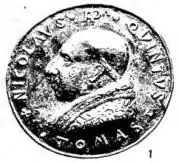
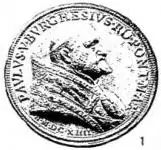
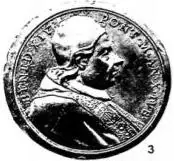
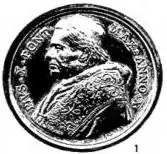
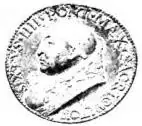
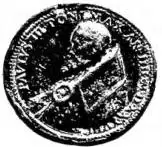
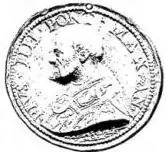
They constitute a very rich body of coin-like products from approximately the middle of the 15th century to the present day. Produced almost annually in one or more varied examples by all the pontiffs, alongside papal coinage, the pieces, contemporary with the individual titleholders, illustrate their history in their respective merits in every field, while they reflect and repeat the technique and art of the era to which they belong; therefore initially they are cast, and the figurations conceived and produced according to the canons of the technique of Renaissance medallic art, only recently inaugurated in Italy; then, from approximately the middle of the 16th century, they are struck and conform ever more closely to the monetary art of the subsequent epochs, the pieces being engraved and struck at the mint of Rome.
This being premised, numerous groups of pieces that have been improperly inserted into it over the course of the centuries, and that have formed part of it almost down to the present day, must be rejected from the true papal series. First of all, a congeries of cast pieces depicting almost all the pontiffs, from St. Peter to Martin V, and which one still wishes to distinguish into two groups, differentiated by certain extrinsic, technical and typological characteristics; but the types are without exception of minimal artistic, iconographic and historical value. The author of these falsifications has long been recognized as the Milanese G. B. Pozzi, of the late 16th century, who would have worked from imagination, creating conventional portraits, which differ for the same personages represented in the double series (cf. Gregory VII, Innocent IV, Clement IV, Adrian V, Innocent VII, Gregory XII); they are pieces that it would not be possible to attribute to the same personage without the explanatory legend. Similarly for the reverses, the design is crude and unadorned, devoid of any content personal or familial or historical, but they are emblematic types contained within the narrow sphere of papal religious symbolism, of the most generic meaning: less banal types are found for St. Marcellus, for Paschal I, for John XXI, etc.
Another rich group of pieces, struck, displays the characteristics of 16th-century art and depicts the popes at least from Martin V to Pius IV or Pius V; it may be inferred that the specimens of the popes John XXIII, Boniface IX, Gregory XII, Innocent VII, etc., also belong to it. For this struck series the name of Paladino is put forward, a well-known engraver and medalist of the second half of the 16th century. The portraits are more carefully executed in their realism, even though their fidelity to the actual appearance of the figure depicted is disputed; the technique of the period appears more refined, the reverses present the family coats of arms of the individual pontiffs and a few other more complex types that commemorate the assumption of the throne, the ceremonies of the Holy Years, some canonization. These types are repeated identically for the various popes that make up this series. It is claimed that they are "restoration" pieces, that is, repetitions of pre-existing and vanished specimens; but these in reality never existed.
(Int. Enc. Catt.)
The authentic papal series begins with the middle of the 15th century and even for the 16th century it is not rich in pieces. Moreover, these products do not bear the most celebrated signatures, even though they reveal the work of engravers and medalists such as Guazzalotti, Lysippus, Vittore Camelio, Fioravanti, Caradosso, Cellini, Leone Leoni and Federico Parmense, to mention only the best known.
It has also been rightly recognized that in Rome there was lacking a true school of medalists, identifiable by a style; and that the artists who worked there, from Nicholas V and throughout the 16th century, immigrated from various Italian cities and from their schools, and finally that their production is far better represented by non-Roman medals: even for Cellini one can assert that the characteristics of his precious art stand out much more evidently and appreciably in every other product of his chisel than on the coins and medals of Rome. But one must also bear in mind that in Rome their production took on an individual physiognomy from the environment, because of the artists' dependence on and relations with the papal court, and therefore because of the obligations inherent in their official production, restricted to the subjects commissioned from them and by them obligatorily treated and repeated for subsequent issues.
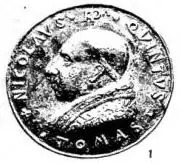
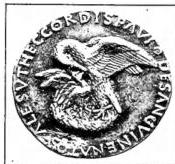
The medals of the true and proper papal series, that is, contemporary with the popes whose name and portrait they present, begin with a few cast pieces of Nicholas V, Callixtus III, and Pius II. The medal of Nicholas is posthumous and, signed by Guazzalotti of Prato, presents the Pontiff seated in the boat inscribed ECLESIA; the design and the in technique are coarse, but from the whole there breathes simplicity and naturalness. To the same artist are attributed the anonymous piece of Callistus III, with a magnificent portrait, with the papal coat of arms; the two specimens of Pius II, anonymous and cast, one (NUDUS EGRESSUS SIC REDIBO), with the coat of arms, the other with the well-known reverse copied from the medal of Vittorino da Feltre, by Pisanello, with the pelican feeding its young with its blood (ALES UT HEC CORDIS PAVI DE SANGUINE NATOS).
(Int. Enc. Catt.)
More numerous are the pieces of Paul II, all cast and for the most part anonymous; with their types they commemorate the building activity of the pope, already begun as cardinal (cf. the pieces: HAS AEDES CONDIDIT... HANC ARCEM CONDIDIT, for the Palazzo S. Marco, etc.). Other anonymous pieces are attributed to Cristoforo di Geremia and depict the house of the physician Gottifredo, the tribune of St. Peter's, etc. To the same are attributed the beautiful oval medals dedicated PAULI VENETO PAPE II ITALICE PACIS FUNDATORI, with a magnificent portrait. A single piece (LETITIA SCOLASTICA) bears the signature of Aristide Fioravanti of Bologna (A. BO.).
In the series of Paul II a special place belongs to the great medal of the Consistory of 1466, 78 mm. in diameter, and by an unknown author (the names of Andrea Niccolò da Viterbo,
Pier Matteo Orfini and also of the Bolognese Fioravanti are put forward). The piece displays types in very low relief, but with a sharp design in the details of the two scenes. These depict, the one, the Consistory presided over by the pope on his throne, surrounded by his court [SACRUM PUBLICUM CONCISTORIUM PAULUS VENETUS P(A)P(A) II]; the other, in the upper field, Christ seated in glory at the center of an oval surmounted by countless angels, with nimbed saints at the sides, and in the lower field, at the sides of an altar surmounted by the Crucifix and flanked by the Virgin and by St. John, a scene of the Last Judgment. An infinity of seated and standing figures fill the two scenes in a symmetrical arrangement which, through the variety of the attitudes, engenders neither monotony nor tedium. Two gold specimens worth 20 ducats were known, and cast bronze specimens, reproductions of the gold, are rather common.
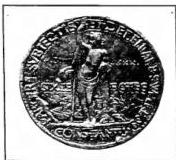
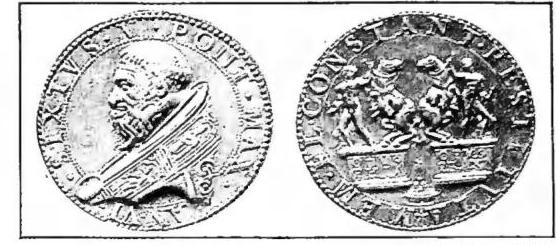
A certain number of anonymous pieces of Sixtus IV are attributed to Guazzalotti and to Lysippus; a single piece is signed by Vittor Camelio. To the former are attributed the medal for the liberation of Otranto from the Turks through the work of Alfonso, duke of Calabria, commander of the pontifical army (PARCERE SUBIECTIS ET DEBELLARE SUPERBOS SIXTE POTES-CONSTANTIA-MCCCLXXXI), where the figure of Constantia repeats that of the medal of Dotti of Padua attributed to Geremia; and the specimen with the reverse known from the medal of Geremia himself for Constantine. To Lysippus are attributed two anonymous medals, the one with the Ponte Sisto (CUBA, RERUM PUBLICARUM) and the one with the coronation of the Pontiff. Vittor Camelio signed a single cast medal with the depiction of the papal audience [OP(US) VICTORIS CAMELI VE(NETI) at the exergue of the reverse], which truly has something of the characteristic force of the 15th century.
Three cast medals of Innocent VIII are contemporary with him. They are anonymous: two with the reverse IUSTITIA-PAX-COPIA, and the three personifications; the third with INNOCENTIA MEA INGRESSUS SUM, and the papal coat of arms; they are attributed to Pollaiolo, or to Francia or even to Niccolò Fiorentino.
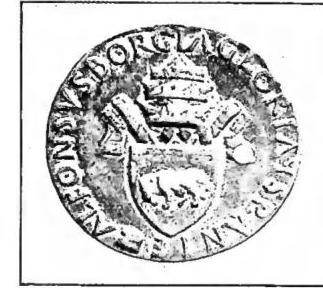
The four known medals of Alexander VI are attributed on stylistic grounds to the Milanese Caradosso; they are cast,
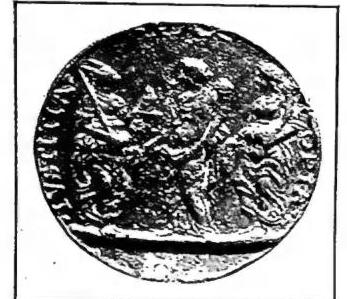
TIAM CUM FORTUNA CONIUNCT(AM).
To Caradosso are also attributed certain medals of Julius II, all anonymous. First, the cast piece of 1506 (INSTAURACIO TEMPLI PETRI - VATICANUS MONS) with the facade of the Vatican Basilica according to Bramante's design; then the piece with the landscape, the shepherd and the flock (PEDO SERVATAS OVES AD REQUIEM AGO). To Francia is instead attributed the specimen CONTRA STIMULUM NE CALCITRES with the fall from horseback of St. Paul, a lively scene of great effect. Signed by V. Camelio (V. C.) is the piece of 1506 (PASCITE QUI IN VORIS EST GREGEM DEI) with the scene of Peter giving the keys to the Pontiff kneeling at the feet of Christ; another cast piece of 1506 is by G. C. Romano (IUSTITIAE PACIS FIDEIQUE RECUPERATOR). To this artist are still attributed other pieces, among which the specimen with Civitavecchia; a second specimen with a castle with three towers [IURI REDD(ENDO)], perhaps the project of the Palace of Justice on Via Giulia; a third with TUTELA and the shepherd with his flock; and a fourth (VATICANUS MONS - VIA IULIA ADIT) with a complex view of the Palace and the terraces of the Vatican.
For Leo X no signed medals are known, and of the few specimens bearing his name the attribution to contemporary engravers is highly uncertain.
From this moment the technique of striking proper to coinage is adopted for the medal as well: hence a diminution of artistic value and an ever closer adherence between the two products of the same Roman mint.
The medals of Cellini for Clement VII are two: the signed one (CLAUDUNTUS BELLI PORTAE) which commemorates the peace between the Pontiff and the Emperor, and the other anonymous one (UT BIBAT POPULUS) with Moses making water gush from the rock, for the construction of the well of Orvieto. For the other medals of Clement VII the names still put forward are those of Giovanni Bernardi da Castel Bolognese and of Francesco Ortensi, of Girolamo Dal Prato; to the first is attributed the magnificent specimen EGO SUM IOSEPH FRATER VESTER, which others prefer to consider from the hand of Cellini; to the second the cast one of good craftsmanship (POST MULTA PLURIMA RESTANT) with Christ bound to the column, a type alluding to the sufferings endured by the Pontiff because of the sack of Rome.
To Leone Leoni are attributed certain medals of Paul III with knights fleeing under a rain of stones (DOMINUS CUSTODIT TE - DOMINUS PROTECTIO TUA) alluding to the flight of the corsair Barbarossa; and SECURITAS TEMPORUM (with the signature LEO) with three horses at pasture; finally Rome seated beside the she-wolf and the Tiber. Alessandro Cesati, called il Grechetto, signed only one medal of Paul III (OMNES REGES SERVIENT EI) with Alexander kneeling before the high priest, a type already of pompous conception, which betrays the exaggerated style and forms of the late 16th century. To him are attributed six or seven other medals, but only by tradition or on debatable testimony: among others the specimen with the facade of St. Peter's, the one of classical inspiration SECURITAS P(OPULI) R(OMANI), and the other, of melodramatic effect but original inspiration, with Ganymede watering the Farnese lily beside the imperial eagle. To Fe-
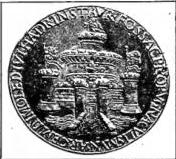
the first with the scene of the coronation (CORONAT); the second, in two variants, with Castel Sant'Angelo and the bridge of the same name (ARCEM IN MOLE DIVI HADR(IANI) INSTAUR(AVIT) FOSS(IS) AC PROPUGNACULIS MONS(VIT), and MOLEM HADRIANI VALLIS FOSSIS PROPUGNACULIS CORRIDORISQUE CINXIT); the last with the Borgia bull crowned by an angel: OR SAPIEN-
To Federico Bonzagna Parmense are attributed the pieces ALMA ROMA, HARUM AEDIUM FUNDATOR, with the Palazzo Farnese, and IN VIRTUTE TUA SERVATI SUMUS with the unicorn; finally the view of Parma, etc. By him are signed certain medals of Julius III, and his production then continues under Paul IV, Pius IV and Gregory XIII. The art is by now decadent and somewhat careless: the inspiration of the few new types of Julius III is deficient, while the repetitions of the types of the preceding series are ever more numerous.
By Cavino, the celebrated forger of the period, is signed the medal ANGLIA RESURGENS - UT NUNN NOVISSIMO DIE, on the occasion of the marriage of Mary Tudor to Philip II in 1554; several pieces of the Holy Year are signed by Cesati together with the specimen KPATOUMAI. But the greater number are anonymous and not attributable.
A medal of Marcellus II, who reigned 23 days, is signed by G. B. De Rossi, Milanese, who replaced Cesati at the mint of Rome and engraved numerous pieces of Paul IV, Pius V and Gregory XIII. Of Paul IV he signed the piece with Calvary and the one with HAERESI RESTITUTA for the institution of the tribunal of the Inquisition; other specimens of the same pope (DOMUS MEA DOMUS ORATIONIS and BEATI QUI CUSTODIUNT VIAS MEAS) are by the Parmense.
The numerous medals of Pius IV are signed, besides by De Rossi and the Parmense, by the new artists Marco Argo, a pupil of Cesati, and Simone Pallante. Of the latter is the specimen PIETATI PONTIFICIE of classical inspiration; of Marco Argo the pieces TUI SECTATOR, with a bishop on horseback pursuing and whipping the fleeing enemy, a transparent allusion to Cardinal Ippolito d'Este, legate in France to fight the Huguenots; finally the piece with the Pontiff leaving the Porta Flaminia with his Court. Noteworthy by the Parmense are the pieces TU AUTEM IDEM IPSE ES and VIRGO TUA GLORIA PARTUS.
A rich group of pieces by Federico Parmense, a few specimens by G. A. Rossi together with some anonymous specimens constitute the group of Pius V, among which noteworthy by the Parmense is DEXTERA TUA DOMINE PERCUSSIT INIMICUM, which recalls the battle of Lepanto.
The numerous medals of Gregory XIII, besides by the two preceding artists, were signed by Domenico Poggini, G. Melone, L. Fragni, Niccolò De Bonis, Lodovico Leoni, Domenico Argentario and Bernardino Passero (and also by an F. C. and an R. C. not better identified). Argentario and Passero worked together ca. 1582 on the 5 large medals executed for the 10th year of his reign, which were to be placed in the foundations of the College of the Jesuits. Of the Parmense the best pieces are UGONOTTORUM STRAGES and IN FLUCTIBUS EMERGENS - RESTAURAVIT with the bridge over the Tiber. Of D. Poggini IN NOM(INE) JESU SURGE ET AMBULA, with the healing of the paralytic. Of L. Fragni Parmense SUPER HANC PETRAM with the facade of the Vatican Basilica according to Michelangelo's project and VIATORUM SALUTI - PELIA, with the bridge over the Paglia near Acquapendente; of Niccolò De Bonis the medal commemorating the institution of the German College willed by Julius III and completed by Gregory XIII.
Numerous are the pieces in the name of Sixtus V signed by the aforementioned engravers of the period. By now the papal medallic series is uniform in technique and in the systems that are repeated and reworked in the heavy style of the period, but it no longer presents much interest, except for the new types of an architectural character.
The few medals of Urban VII, who reigned only 12 days, are posthumous. Of Innocent IX, who reigned two months, there are no coins but some medals sign-
(phot. Enc. Catt.)
POPE - Reverse of the medal of Alexander VI with Castel Sant'Angelo and the bridge (for the obverse v. plate LIX. 7). Attributed to Caradosso - Vatican Medal Collection.
struck by Niccolò and Emilio De Bonis, who also worked on the dies of Gregory XIV. Anonymous are the pieces in memory of Leo XI, who reigned only 27 days (1605).
The numerous pieces of Clement VIII are signed by the two De Bonis, by Gaspare Cambio, Giorgio Rancetti and by Fr. Mochi. Those of Paul V, by Rancetti, by Moro and by Sanquirico; and those of Urban VIII and of Innocent X by Moroni, by Mola, by Korman of Augsburg, and other lesser artists.
The medals of Alexander VII are, with few exceptions, signed by Moroni and present in the greatest number architectural types and works of art of the period, in perspective figurations of great effect. Those of Clement IX and of Clement X are by the Hamerani, by Lucenti, by Travani; for Innocent X Guglielmata is added and for Alexander VIII G. Ortolani and Ferdinando di S. Urbano; with Innocent XII and then with Clement XI again the Hamerani, Paolo Borner, A. Pilaia; Ermenegildo Hamerani signs the obverse of the piece of Clement XI FACTUS EST PRINCIPATUS SUPER HUMERUM EIUS with Jesus fallen under the weight of the Cross, and also the fine portrait of the Pontiff himself in three-quarter view to the left. From the age of Benedict XIII to the end of the century the medals are signed by the Hamerani, by Cropanese; from Pius VII onward are found the signatures of Mercandetti, Brandt, Pasinati, Passamonti, Cerbara, Caputi, Girometti; finally for Pius IX those of Cerbara, of Girometti and also of the two Bianchi.
The number of papal medals produced from the beginning of the 16th century (Julius II) onward is enormous, but not precisely determinable; the sources prove incomplete and insufficient. Bonanni described a good number of them, but stops at Innocent XIV (1700); Mazio limits himself to describing the dies collected and existing in his time at the mint of Rome (and everyone knows how and when that collection was made), and includes in it also the Paladinian dies existing there; Martinori triples the number, but inserts in it, besides the Paladinian inventions, also a good number of hybrid pieces, spurious ones, die rejects, repetitions, and finally numerous devotional medals of no official character. The question of the number remains unresolved, and one can calculate only approximately at some thousands of pieces.
The first and greatest interest of this series is the iconographic one: it is a complete gallery of portraits of all the popes who succeeded one another over more than four and a half centuries: portraits to which the engravers devoted the greatest care: right beneath the portrait the numerous artists of all times placed their signature. The iconographic value is all the greater owing to the fact that on papal coins the portrait, having appeared initially with Julius II, already with him and then after him is found exclusively on the major denominations of gold and silver, emissions that become rare and even extremely rare with Innocent XI, because scarce in pieces; moreover some popes never placed their portrait on the coin, such as Paul IV, Gregory XV, Alexander VII, Clement IX, Benedict XIII and Clement XIV. Only with Leo XII does the portrait reappear more frequently, and Pius IX adorns with it the greatest number of his numerous emissions.
In the second place one must consider the typological interest that makes of this series a precious historical-religious documentation, especially for the representations of the reverse.
The typological development, like the artistic one, of the medal runs alongside and is analogous to that of the coins, but the larger diameter of the medal allows a broader development of the types which, moreover, are never repeated identically on the two series, but appear on the medals as variants of an analogous theme proposed to the artist by the same authority, and which illustrates the same concepts and the same events. Only a few groups will be treated here, which will make it possible to draw some observations of notable importance in relation to the working systems in the mint of Rome: that is, the systematic repetition of the same types often even with the identical dies, without prejudice to the so-called author's right; one should note further that on the reverse the signature of the engraving artist is never found; these are the religious types and the sacred and profane personifications.
The type of Christ handing the keys to St. Peter (CLAVES REGNI CELORUM), appears already with Julius III, returns with Marcellus II up to Gregory XIII; it is a coin type recurring in the 15th and 16th centuries from Julius II onward (cf. ACCIPE CLAVES REGNI CELORUM). One of the last editions is that of Clement X TU ES PETRUS ET SUPER HANC PETRAM AEDIFICABO ECCLESIAM MEAM, with a figuration in the emphatic style of the period. Christ driving the merchants from the Temple (DOMUS MEA DOMUS ORATIONIS) appears in the same period, with Paul IV, and persists until Sixtus V.
The nimbed bust of Christ (BEATI QUI CUSTODIUNT VIAS MEAS), appears with Paul III and returns with his successors at least until Gregory XV. It is always the same type, severe, hieratic, with long hair falling over the shoulders, which reappears with Alexander VII. It runs alongside an analogous coin type from Julius III to Sixtus V at least. Noteworthy is the half-figure frontal of the eternal Father with cruciferous globe of the specimen of Julius XII, with the legend EGO SUM VIA VERITAS ET VITA more proper to the known medals with the effigy of the Savior, attributed to De Rossi and to Leone Leoni (cf. also the analogous pieces with EGO SUM LUX MUNDI). Another edition of the bust, rejuvenated and beautified, is found with Urban VIII (1623-1644): DOMINE QUIS SIMILIS TIBI.
Jesus washing the feet of the Apostle (TU DOMINUS ET MAGISTER - EXEMPLUM DEDI VOBIS), is found from Leo X, one or more times for each pontiff, up to Pius IX included, who presents numerous specimens of it. With Alexander VII the above-mentioned formula is replaced by FORMAM SERVI ACCIPIENS; but then the old wording returns, which with Gregory XVI changes to EGO DOMINUS ET MAGISTER. The type too undergoes variants from Alexander VII onward, since no longer only one disciple takes part in it, but five, six, and even ten, giving movement to the scene that previously unfolded calmly between Christ and a single assistant.
The type of Christ preaching to the crowds (NE DETERIUS VOBIS CONTINGAT), seems to have been introduced by Paul IV, and lasts throughout the 16th century. Christ disputing in the Temple with the Doctors (TU AUTEM IDEM IPSE ES) is proper to Paul III and to Pius IV; it must be considered a variant of the testoni of Paul III.
The type of the Apostles in the ship in the storm that re-
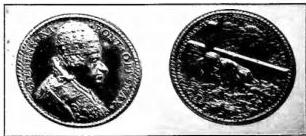
run to the sleeping Jesus so that he may help them (SALVA NOS DOMINE) is found with Clement VIII and Urban VIII, from the same die. A variant of this type, Jesus sitting at the stern of the boat and the Apostles beseeching him to calm the troubled waters (IMPERA DOMINE ET FAC TRANQUILLITATEM), appears with Pius V and returns with Paul V. St. Peter half-submerged in the troubled waters of the sea, saved by Jesus walking on the water (SALVA NOS DOMINE), a magnificent die of Innocent XI, derives from the far more complex type of the three gold multiples of Paul II, Sixtus IV, and Alexander VI and from the silver of Clement VII: QUARE DIRITASTI.
A variant in the legend on the pieces of Gregory XIII that imitate the aforementioned type of Pius V reads DOMINE ADIUNA NOS. The miraculous catch (IN FLUCTIBUS EMERGENS) is repeated from Paul IV throughout the 16th century and the pieces derive from a single die.
The type of St. Peter casting the net (IN VERBO TUO) is found with Clement VIII and Urban VIII, a variant of the coin type of the ducat from Sixtus IV onward. GREGEM NE DESERAS, a shepherd imploring from Heaven the salvation of his flock, is a die of Gregory IV repeated by Clement VIII. Jesus fallen under the weight of the Cross (FACTUS EST PRINCIPATUS SUPER HUMERUM EUS) appears with Clement XI, and is repeated, from the same die, by Clement XIV and by Pius VI.
The figuration of the Mother of God recurs in several variants of the coin type and is often repeated from the same dies: VIRGO TUA GLORIA PARTUS, from Julius II down to Gregory XIII; CAUSA NOSTRAE LAETITIAE of Gregory XV. VIRGO POTENS ORA PRO NORIS of Clement XI and SUB TUUM PRAESIDIUM of Innocent XII of 1699 are two variants from the painting by Maratta. More complex compositions are that of Alexander VIII (VICTRICEM MANUM TUAM LAUDEMUS) for the victory of the Venetians over the Turks in 1690 and AUXILIUM CHRISTIANORUM with the Madonna of the Rosary by Clement XI. Finally the two types of the Immaculate Conception of Clement X, CUM ME LAUDARENT SIMUL ASTRA MATUTINA, from the testone of the same.
The reverse BEKTERA DOMINI FACIAT VIRTUTEM 1591, with the P. handing over the banner for war, appears identical, and from a single die, for Sixtus V, Urban VII, Gregory XIV and Innocent IX. It is meant to allude to the expedition into France of the nephew of the p. Gregory against the Huguenots; if so, here we have a manifest multiple example of hybrid pieces, yet present in all collections.
Also for the Holy Years that followed one another from 1500 onward, very numerous medals were struck reproducing the Holy Door open and closed, and the various functions pertaining to them; all the types are repeated with few variants in each period and for all the ceremonies, as in the coins.
The same may be said for the sacred and profane allegorical personifications, the latter of purely classical inspiration, preceding the former: the Annona pontificia of Paul III, which is repeated throughout the 16th century and often from the same dies; Roma resurgens of Paul IV; the Poe of Pius IV, the Hilaritas pontificia, a type of Paladino for Paul II and his immediate successors, which returns with Sixtus V; the Securitas from Paul III onward and the Liberalitas of Leo X and Clement XIII, which are two analogous types.
From 1600 onward there appear those personifications of religious concepts that are known from the monumental statuary art of the period: Religio, Fides, and Ecclesia; Charitas, Iustitia, Clementia, Providentia, Fortitudo, etc. In this sector it is possible, on a detailed examination, to find identities of dies for various pontiffs; it will suffice to recall that the group IUSTITIA ET CLEMENTIA COMPLEXAE SUNT of Urban VII and of Innocent X derive from the same die.
How many hybrid and posthumous pairings can and must be recognized in this rich papal series and for each period, it will never be possible to say nor even to ascertain; the pieces have acquired a right of existence because they are present in all collections and in the manuals and catalogues; it will suffice to think of the Paladino phenomenon, whose production, only recently recognized as posthumous, is found inserted everywhere and for which a justification has been attempted down to our own days under the name of "restorations."
In one sector only has the phenomenon of the repeated use of dies in the most diverse periods not occurred and could not occur, namely that of architectural types. These types bear witness for each p. to specific merits in the field of sacred and profane constructions, of which each p. was justly proud, so that no confusion and abusive repetition of dies was possible.
Particularly illustrated are: with Julius II, the Vatican Basilica with the dome and the two bell towers according to Bramante's design [TEMPLI PETRI INSTAURACIO - VATICANUS MONIS], the Basilica of Loreto, the port and fortress of Civitavecchia, etc.; with Paul III, the Palazzo Farnese, a view of Frascati with the Villa Rufina; a magnificent bird's-eye view of Rome, etc.; with Julius III: the Vatican Basilica according to Sangallo's design, Villa Giulia, etc.; with Pius IV: Castel S. Angelo and the church of S. Caterina; with Pius V: the church of S. Croce in Bosco; with Gregory XIII: the design of the Vatican Basilica according to Michelangelo and the Gregorian Chapel of the same Basilica, the bridge over the Pelia at Acquapendente, the Capitoline Palace with the tower, the Madonna dei Monti and the Collegio Germanico, etc.; with Sixtus V: the columns of Trajan and Antoninus with the statues of Sts. Peter and Paul, the colossi of the Quirinal, the four obelisks (CRUCI FELICIUS CONSECRATA), etc.; with Clement VIII: the city of Ferrara (FERRARIA RECUPERATA), the bridge and the waterfall of the Velino (VELLINO EMISSO MDC), etc.; with Paul V: the Borghese Chapel of S. Maria Maggiore, S. Carlo al Corso, the column of the temple of Peace erected in front of the Liberian Basilica surmounted by the statue of the Madonna (PRO IUI NOMINIS GLORIA), the Palazzo del Quirinale and the door of the Pauline Chapel, that of the Vatican beneath the clock, the bridge over the Liri near Ceprano, the artificial port of Fano, etc.; with Urban VIII: the Confession of the Vatican, Castel S. Angelo, the port of Civitavecchia, the churches of S. Bibbiana, of S. Caio near the baths of Diocletian, the Lateran Baptistery, the granaries of Termini and the bastion of the Quirinal, the walls of Rome, the Porta Gianicolense, the pontifical palace of Castel Gandolfo, the ironworks of Monte Leone, etc.; with Innocent X: the interior of the Lateran Basilica and of S. Pietro, the Palazzo del Museo Capitolino, Piazza Navona with the fountains and the obelisk and the related church of S. Agnese, etc.; with Alexander VII: the churches of S. Maria della Pace, of S. Maria in Campitelli, of S. Maria in Via Lata, of S. Andrea della Valle, the Chair of St. Peter in the Vatican, the Scala Regia, the courtyard of the Roman Archiginnasio, the Palazzo del Quirinale for the pontifical family, the Porta del Popolo from the outside and from the inside, the Hospital of S. Spirito, Ponte S. Angelo with Bernini's statues, etc.; with Clement X: the Palazzo Altieri, the port of Civitavecchia, the tribune of the Liberian Basilica, etc.; with Clement XI: the basilica of the XII Apostles and the family chapel of the Albani family, the church and porticoes of the basilica of S. Clemente, the granaries of Termini, the church and baths of Nocera, the port and aqueduct of Civitavecchia, the Institute of Bologna, etc.; with Clement XII: the arch of Constantine [OB MEMOR(IAM) CHRISTIAN(AE) SECURIT(ATIS) REST(AURATAE)], the great medals with S. John in the Lateran with the portico and the Corsini chapel, the Trevi Fountain (PONTE AQUAE VIRGINIS ORNATO), the Palazzo della Consulta, etc.; with Benedict XIV: S. Maria Maggiore, the tomb of Maria Sobieski in the Vatican, the apse of the Leonine triclinium, in front of the Lateran Basilica, the interior of the Pantheon, the city walls (SECURITAS PUBLICA - MOENIA URBIS RESTAURATA); with Clement XIII: the granaries of Termini, the two black marble centaurs from Hadrian's Villa on the Capitoline (CURA PRINCIPIS AUCTO MUSEO CAPITOLINO CELBERRIMIS ADRIANAE VILLAE ORNAMENTIS), Civitavecchia (CENTUMCELLIS AMPLIATA CIVITAS MDCCLXIV), etc.; with Clement XIV: the basilica of the Sts. XII Apostles and the Clementine Museum with the Barberini candelabra; with Pius VI: the Vatican Sacristy, the Pio conservatory beneath S. Pietro in Montorio, S. Lorenzo alle Grotte, Civitavecchia and its ovens, the children's hospice in Foligno, the hospital at Città di Castello, the prisons and the Academy of Treia, the Conservatory of Fabriano, etc.; with Pius VII: the Vatican Basilica, Piazza del Popolo, Ponte Molle, the group of the Laocoön and the new wing of the Vatican Museum; with Leo XII: the Ostian Basilica after the fire, the baptismal font of S. Maria Maggiore, etc.; with Gregory XVI: the temple of Antoninus and Faustina, the Vatican Egyptian Museum, Porta Maggiore and the monument of Claudius, the bridge and canal of Terracina, the hospital of S. Giacomo in Augusta, the Ponte Gallore, the fortress of Ancona; and on the great monumental medals the entry and exit of the Aniene from the tunnels near Tivoli, etc.; with Pius IX: the interior perspective of the Lateran Basilica, the Via Appia with S. Sebastiano, the Lateran Museum, Porta Pia seen from the inside and from the outside, Porta S. Pancrazio, S. Paolo rebuilt, the basilica of S. Lorenzo, the Piazza del Quirinale, the Piana Gallery in the pontifical palace, the bridge that joins Albano to Ariccia, the temple of the B. Virgin called of S. Luca in Bologna, S. Lorenzo al Verano, etc.
Some temples and monuments recur more than once because of the successive restorations, embellishments and additions they underwent, such as S. Pietro, S. Paolo and S. Giovanni in Laterano; along with the Roman monuments there also frequently recur temples and monuments and various constructions of individual cities, large and small, of the Papal State, demonstrating that pontifical care extended to all, for all needs. Even after 1870 the minting of the annual medals was continued down to the present day, bearing on the obverse the bust of the Pontiff and on the reverse the depiction of the most salient event of the year. - See plates LVIII-LXV.
Bibliography13 works
Secondina Lorenza Cesano