
MARY, most holy - Mother of Jesus Christ, Son of God made man.
M. in Masoretic Hebrew is Mirjām; Aramaic form: Marjām (Syriac and Targumim); Μαξιάν, in the Septuagint and in the Gospels for the Most Holy Virgin; the apocopated form Μαξιάν occurs in the Gospels and in Flavius Josephus (Bell. Iud., VI, 3,4), who however ordinarily uses Μαξιάν, and Μαξιάν.
The etymology is uncertain; many explanations have been given. O. Bardenhewer reviewed about 60 of them. Of these the majority ignore the rules on the formation of Hebrew words, and are founded on simple assonances. Thus "she who illuminates the sea" (= mē'ir jām); "star of the sea" (St. Bernard); "bitter sea", mar jām (but it should have jām mar). Mirjām is not a compound name. Modern scholars revive the ancient sense "Lady" (cf. St. Jerome, Onomastica sacra) according to the use that the people made of it at the time of Jesus, bringing it close to the Aramaic māre "lord" (M.-J. Lagrange, A. Valensin-J. Huby, F. Prat, L. Marchal, G. Dorado). It has its equivalent in the Italian "Madonna", in the French "Notre Dame" and in German "Unsere Frau". The primitive Semitic meaning of the name M. now seems sufficiently established by a text from Rās Šamrah, where a noun mrjm (prob. marjam[s]) is found, derived from the root rnm: "sublime", "august" (cf. the name Mibbhār of analogous meaning in I Par. 11, 38).
I. MARY IN SACRED SCRIPTURE.
I. THE FIGURE OF MARY IN THE OLD TESTAMENT
The ancient Christian writers and the liturgical literature make very wide use of the Old Testament to illustrate the privileges and virtues of M., treating texts, figures and events "with a certain freedom" (cf. the apostolic constitution Munificentissimus Deus of Pius XII, 1 Nov. 1950) with regard to literal-historical exegesis and with a view to a rigorous theological proof.
It must be recalled especially that, from the 2nd century onward, the Virgin M. is presented by the holy Fathers as the "new Eve" (apostolic constitution cited). Marian literature appeals to many other figures, for example: the burning bush (Ex. 3, 2), which burning without being consumed represents M. who conceived and gave birth to the Son without detriment to her virginity; the ark of the covenant, of incorruptible wood like the body of M.; the fleece of Gideon (Judg. 6, 37-38), which receives the dew from heaven as M. received her Son from heaven; the bride of the Song of Songs (v.); the enclosed garden (Cant. 6, 12) and the sealed fountain (ibid., 4, 12), figures of the virginity of M. The texts on Wisdom (Prov. 8, 22-31; Eccli. 34, 5-31) and psalm 44 (Hebr. 45) notably nourish the liturgy, not to mention the Marian suggestions and applications offered by the noble figures of women such as Sarah, Deborah, Judith, Esther. These motifs, flourishing upon the texts from the richness of theological thought and spirituality, take nothing away from the precise value of the true and proper messianic prophecies concerning the Mother of the Savior.
The first and also the most discussed is that contained in the Protoevangelium (v.), where "the enmity" placed between God and "the woman" (Gen. 3, 15), between the offspring of the woman and that of the Serpent-Satan, is evidently a moral enmity (victory over sin) and, since it must be resolved with the defeat of the serpent, supposes qualities and powers that Eve, overwhelmed when she was in possession of the greatest gifts of God, all the less could personally demonstrate after the fault and its disastrous consequences.
From these mysterious remotenesses there emerges clearly on the messianic horizon, in the time of Isaiah (734 B.C.), the figure of the Virgin-Mother of the Emmanuel (Is. 7, 14; v. EMANUELE), and the prophecy is explicitly cited by Mt. 1, 22 in direct relation to M. To assure king Ahaz (v.) of God's help, the prophet proposes to him a "sign" which the king hypocritically rejected. The refused miracle will nonetheless be granted: "Behold, the Virgin conceives and bears a son and gives him the name Emmanuel." The attempts made to see in the Virgin an ordinary woman, anonymous, symbolic or identifiable among Isaiah's contemporaries, take no account of the solemnity of the oracle (introduced by a "Behold"), of the mystery that envelops it, of the dramatic character of the hour and of the context. The Virgin is specified by the article, which does not require that the subject be known to the hearers: the Virgin is determined in herself and in the prophet's vision, even while eluding a precise identification on the part of the listeners. The usage of the Hebrew Bible (Gen. 24, 43; Ex. 2, 8; Cant. 1, 2 and 6, 7; Ps. 68 [67], 26; Prov. 30, 18-19) gives the noun 'almāh the sense of a young unmarried woman, who must be supposed intact, as the Septuagint understood, before any interested polemic with Christians, translating it ἡ πάρθενος. If the Virgin was to become a mother according to the laws of nature, "all her greatness would consist in being the mother of the Messiah; consequently, why designate her according to the previous state of virginity, to which no one gives a thought and which has no importance?" (A. Condamin, La livre d'Isaïe, Paris 1905, p. 69). Ahaz had believed he must provide by human means for the stability of the throne of Judah; but the "house of David" (Is. 7, 13) must not doubt the divine assistance, because it will have to give the world the Messiah, who, moreover, will be born of a Virgin, without the cooperation of man (cf. S. Garofalo, L'Emanuele, in Il Regno, Assisi 1942, pp. 43-46).
The prophet Micah, a contemporary of Isaiah, will also speak of "she who is to give birth" to the "ruler in Israel" who will be born in the humble village of Bethlehem (Mic. 5, 1-2; Vulg. 5, 2-3). The very difficult text of Jer. 31, 22, in the translation of St. Jerome: "Creavit Dominus novum super terram: femina circumdabit virum", would refer to the virginal conception of the Savior: an interpretation common from the Middle Ages onward and upheld also by modern exegetes (Knabenbauer, Trochon, Fillion, etc.) - by another route G. Closen upholds the messianic sense (in Verbum Domini, 16 [1936], pp. 295-304) - but the most recent Catholic commentators (Condamin, Tobac, Nötscher, Clamar, Ceuppens, Dennefeld) hold that a traditional interpretation, in the theological sense, of the text is lacking, since philologically and contextually it would assume another meaning and value.
II. THE LIFE OF MARY IN THE WRITINGS OF THE NEW TESTAMENT
1. During the infancy of Jesus
The biographical data and the texts for a direct understanding of the life and personality of M. are found in the four Gospels, and above all in Matthew and Luke, the richest in information about the early years of Jesus. The relative scarcity of these data and texts in the inspired narrators of the life of Jesus finds its explanation not in a lesser interest or in the secondary consideration in which they held the Mother of the Son of God, but in the needs of the apostolic catechesis gathered in their booklets. The testimony (cf. Acts 1:8, 22; 2:32-3:15; 5:32; 10:36-43) of the Twelve insisted on the sayings and deeds of the public life of Jesus in order to draw from them the fundamental teachings and to highlight their polemical allusions and the concrete demonstration of the Master's divine nature and powers, while the accounts of the Passion and Resurrection tended to offer the extensive proofs of the two events that reveal the meaning of the whole life of Christ. A greater attention to the messianic content and to the prophetic references of the life of Jesus led Matthew to gather certain episodes of the infancy of Christ, which are completed by the accounts of Luke, who took upon himself the task of an orderly and diligent historian of the life of Jesus from its very beginning (Luke 1:1-4).
The circumstances of these events obviously assigned to M. a place of the first rank, but from the Gospel accounts there clearly emerges the importance that their authors, sparing of words, attribute to the presence and the participation of the Virgin. The two observations of Luke (2:19, 51), concerning the attention and meditation of M. during these events, make it clear that the historian draws from her (v. INFANCY OF JESUS).
The properly biographical data of the Gospels on M. are limited to the indications of her name (Luke 1:27), of her condition as a Virgin, spouse of Joseph (v.), an artisan of the house of King David; of her habitual dwelling at Nazareth, a village of Galilee (Luke 1:26-27; Matt. 13:55); of the modest resources of the little family (Luke 2:24). There is explicit mention of the kinship of M. (Elizabeth: Luke 1:36 and the "brothers" of Jesus [v. BROTHERS OF JESUS]), and implicit mention of her descent from the family of David. The apposition "of the house of David" in Luke 1:27 according to grammar must be referred to Joseph, but the words of the Angel and of M. herself (ibid. 1:32, 69) about Jesus "son of David" raised up "in the house of David," since M. alone has a part in the generation of Jesus "according to the flesh" (Rom. 1:3), were already understood by the ancients (Tertullian, De carne Christi, 22: PL 2, 373, 378, 391, 521, 834, and especially St. Augustine, Contra Faust., 23, 3-4, 8-9: PL 42, 468, 470 ff.) in the sense that M. also belonged to that royal stock, although the requirement of Davidic descent, essential for the messianic qualification of Jesus, is assured by the genealogy of Joseph, who, before the law, transmitted to Jesus his civil status.
Nothing is said of the parents of M. (v. ANNA and JOACHIM), of the place of birth (v. NATIVITY OF M.), of the events preceding the marriage (v. PRESENTATION). From the very beginning M. is as it were isolated in the Gospel and absorbed by her mission as Mother of Jesus. If her parents wished, in the imposition of the name, to express, according to ancient custom, their own wishes and hopes for the newborn, the etymology could help to highlight these sentiments; but perhaps the name M. was simply chosen in memory of the sister of Moses (v. MARY), the prophetess dear to the devotion of the Israelites.
With the episode of the Annunciation (v.), M. enters fully into the Gospel. The combined accounts of Luke 1:26-38 and Matt. 1:18-25 allow us to conclude that the heavenly message was communicated to her in the time, ordinarily a year, that elapsed between the marriage, which for the Hebrews had the juridical effects of Christian Matrimony (Philo, De leg., especially 3, 12, 72), and the effective cohabitation of the spouses (Matt. 1:18; 20:24).
Recently an ancient exegesis has been brought back into favor, according to which, at the time of the Annunciation, M. and Joseph had already begun their life in common; but philology and Jewish customs so far give greater credit to the first interpretation. The Angel greets M. with solemn words, which acknowledge in her a stable fullness of Grace (κεχαριτωμένη) already preceding the encounter (v. IMMACULATE CONCEPTION) and indicate that the Lord is about to entrust to her an arduous mission, committing himself to sustain her with the necessary graces (cf. the value of the greeting "the Lord is with you" in the biblical tradition). The profound "troubling" of M. demonstrates that she has understood the solemnity of the Angel's words and reflects (διελογίζετο) on what, precisely, he intends to refer to (Luke 1:29). Gabriel speaks to her with clear biblical resonances (cf. Isa. 7:14) of the birth of Jesus Messiah and Son of the Most High, and M. replies with a question from which the Angel's behavior excludes any trace of doubt. The Virgin reveals her vow or purpose (v. VIRGINITY OF M.) not to have conjugal relations with Joseph (the "knowledge of man" is a very well-known biblical euphemism: Gen. 19:8; Num. 31:17; Judt. 11:39) and asks, practically, for further explanations about the circumstances that accompany the prodigy in which she believes; those circumstances that must suggest to her, among other things, the way to behave with Joseph. Gabriel refers everything to the power and holiness of the Most High (Luke 1:35) and M., who will remember his words (ibid. 49), considers that she must keep silent even with her spouse (Matt. 1:18-22). The absolute abandonment to the will of the Lord (Luke 1:38), which M. as a "handmaid" (Gr. δούλη) has no reason to discuss or oppose, gives, together with the troubling provoked by her humility, the prudence manifested in the resolute questioning of the Angel and the purity revealed by her purpose, an initial and already complete picture of the depth of the interior life of M., to whose spiritual richness conferred on her by God the heavenly messenger had already paid homage.
From Nazareth, the scene of the preceding events, following the news given her by the Angel of the miraculous conception of John the Baptist by Elizabeth, M. sets out, probably not in the company of Joseph, but with a caravan of relatives or friends, near one of the three great solemnities that are celebrated with a journey to Jerusalem, toward the hill country of Judah to offer solicitously (Luke 1:39) her services to the elderly relative. M. greets Elizabeth first (ibid. 1:40), but at her voice the Baptist leaps mysteriously in his mother's womb, who, in turn, "filled with the Holy Spirit" (ibid. 1:41), blesses M. and the Son conceived by her, greeting her as Mother of the Lord, protesting her humility before her and praising the faith of "She who has believed because what has been told her will be fulfilled" (ibid. 1:45 according to the Gr.).
Before this soul open to the mysteries of God, in the exquisitely feminine intimacy of such delicate confidences, M. no longer restrains her joy, which bursts forth in the canticle Magnificat (v.): a lyrical impulse in which the spontaneity of improvisation reveals a soul assiduously nourished by the ancient faith and the ancient literature of her people. But in it there is already a foretelling of the new times: the exaltation of humility and poverty (ibid., 1, 48, 51-53) preludes the beatitudes of the Sermon on the Mount (Mt. 5, 1-12; Lk. 6, 20-23), which will inaugurate the enduring economy of God's mercy, ancient and new (Lk. 1, 55). M. exalts the dignity conferred upon her by the Lord (ibid. 1, 48), but refers every glory to him (ibid. 1, 47, 49), reserving for herself a conscious humility (ibid. 1, 48).
After a stay of three months in Judea, M. returned to Nazareth. Luke (ibid. 1, 56), by placing M.'s departure before the birth of the Precursor, seems to suggest that M. was absent at that event, but the evangelist is accustomed to conclude his narratives with glimpses into a long perspective (cf. v. 80; 3, 19 ff.). The ancient Western interpreters held that M. had remained until after the birth.
At Nazareth the brief and intense tragedy of Joseph's perplexity breaks out, as he is confronted with M.'s motherhood, the cause of which he did not know (Mt. 1, 18-24). M. has kept silent and keeps silent, mindful of Gabriel's assurances, and it is again an angel who dispels the heavy shadow from the heart of the spouse. The solemnity of the cohabitation (v. 24) concludes the drama in joy.
An edict of Augustus ordering the census of Palestine obliges Joseph to go to Bethlehem of Judea, the city of origin of the house (v. QUIRINUS), and where it seems that the descendants of David possessed property in joint ownership (Mišnāh, Taʿănīth, 4, 5). M. is with him either because, with the birth imminent, the spouses did not intend to separate, or, more probably, because women too were personally required to make the declaration demanded by the census, and M. also belonged to the stock of David.
The account of Jesus' birth places M. in significant prominence (Lk. 2, 16). Among the particulars of the event, the Evangelist notes that M. personally gave the newborn his first care, from which the Fathers deduced that the birth had taken place without weakness and pain (v. VIRGINITY OF M.). Luke's reserve is most delicate in comparison with the coarse and exceedingly tasteless narratives of the apocrypha (cf. G. Bonaccorsi, Vangeli apocrifi, I, Florence 1948, p. 303). When the shepherds, warned by an angel, went to the grotto, to the people's amazement (Lk. 2, 18) Luke opposes the demeanor of M., who "kept (a lasting imperfect) these things in herself and pondered them in her heart" (ibid. 2, 19). M. compared (Gk. συνβάλλουσα) the revelations and the events, deepening in joy and humility the meditation of the mysteries of the Incarnation and of the birth of the Son. Eight days after the birth came the circumcision of Jesus (ibid. 2, 21), with the imposition of the name already revealed to M. (ibid. 1, 31).
Forty days after Jesus' birth, M. presents herself at the Temple for the rite of purification (Lev. 12, 2-8) and of the redemption of Jesus in obedience to the law on firstborns (Ex. 13, 2.11-16). Although the miraculous nature of her childbirth exempted M. from the common obligations, she, reluctant to reveal prematurely the mysteries accomplished in her, in the difficulty of otherwise justifying a clamorous abstention and out of religious attachment to the laws given by God to her people, scrupulously performs the rite, and, availing herself of the dispensation granted to the poor, substitutes, in the prescribed sacrifice, a turtledove or a pigeon for the lamb (Lk. 2, 24). In the Temple, the pious Simeon (v.), enlightened by the Holy Spirit, identifies the messianic nature and destiny of the little Jesus, to the "amazement" of M. and Joseph at the extraordinary revelation (ibid. 2, 33). Particular attention the man of God showed to M.
(ibid. 2, 34-35), announcing to her an intimate participation in Jesus' destiny of contradiction: a "broad sword" (ἐγώσις) will pierce her soul; the Mother will be afflicted in the deepest seat of her affections (ὑνῆλ) in witnessing the oppositions and persecutions, culminating in the unjust condemnation and the cruel death inflicted on Jesus.
In the episode of the visit of the Magi (v.), whose chronology is not easy to determine, M. alone is in prominence (Mt. 2, 11). Having fled to Egypt to escape Herod's persecution, the three from Bethlehem finally return to their homeland, withdrawing into Galilee, to Nazareth (ibid. 2, 19-23; Lk. 2, 39).
The long parenthesis of Jesus' adolescence is interrupted by the episode of the loss and finding in the Temple of the twelve-year-old Boy, who had accompanied his parents to Jerusalem on the occasion of a Passover (Lk. 2, 41-51). In this sorrowful circumstance,
M.'s anxiety, her grief, the sorrowful lament addressed to the Son (ibid. 2, 48), manifest the delicacy and depth of her maternal love. To the astonishment (ibid.) at having found him in discussion with the doctors were joined the mysterious words then spoken by Jesus and which M. and Joseph "did not understand" (ibid. 2, 50). Only later will M. understand to what extent her Son must be free from human ties in order to fulfill the will of his Father (cf. Mt. 12, 46-50).
M. awaits the day of separation for about 20 years, during which the full submission of Jesus and his life, which revealed nothing extraordinary in the eyes of men (cf. ibid. 13, 55-57; Mk. 6, 2-3), offer her matter for meditation, for faith and for sweet memories (Lk. 1, 51).
2. M. during the public ministry of Jesus
For this period the Gospel texts are few, but the presence and action of M. at the wedding of Cana (v.), on the occasion of the first miracle worked by Jesus (Jn. 2, 1-11), have a decisive significance. She participates with solicitous care in the joyful banquet and notices the unexpected lack of wine; the simple words addressed to the Son: "They have no wine," judging from Jesus' answer, implied the urging to intervene with supernatural powers. Jesus addresses the Mother with an appellation of respect ("woman," cf. Arab. sitt - lady; v. E. Zolli, Christus, Rome 1946, pp. 125-32), underlining the gravity of M.'s request. From Jesus' voice and demeanor, M. must have understood that he was disposed to accede, despite everything, to her request, and she gave orders to the servants to abide by Jesus' directions, which, in fact, he carried out the miracle, not thereby anticipating "his hour" but granting the Mother an exception more significant than an anticipation. The fact reveals M.'s faith in the Son's powers and his respect for the Mother, whose delicate and resolute intercession he accepts. John notes that M., after the episode of Cana, accompanies Jesus to Capernaum (Jn. 2, 12), where they stayed a few days.
The Gospels do not say that M. usually followed Jesus on his apostolic wanderings, although the presence and assistance of other pious women (Lk. 8, 2-3) may obviously allow the Mother's presence and assistance to be implied as well, she who, at least once in Galilee, sought the Son, besieged by the crowd (Mt. 12, 46-49; Mk. 3, 31-35; Lk. 8, 19-21).
Someone announced to Jesus the presence of his Mother and relatives, and the answer came that his mother and relative was whoever did the will of the Father. It is indisputable that M. had already given a perfect example of doing the will of the Father (Lk. 1:38) and that therefore her natural bonds were strengthened by other spiritual and intimate ones. On another occasion Jesus responds to a moving eulogy by a woman for the fortunate Mother who had carried in her womb and nourished such a Son, and even then Jesus shows in what direction one must orient oneself to identify the exact measure of M.'s greatness: her adherence to the word of God and her dedication in putting it into practice (Lk. 11:27-28); to the free privilege of M.'s motherhood corresponded her capacity and will for love, obedience and sacrifice. The words of the anonymous listener of Jesus seem to note, in Luke, the first fulfillment of M.'s prophecy: "all generations will call me blessed" (Lk. 1:48). M. reappears during the Passion of Jesus, sorrowful beneath the Cross of her Son, who addresses one of his last words to her, entrusting her to his beloved disciple John (Jn. 19:25-27). The solemnity and gravity of the hour, the messianic context of the tragedy, have rightly led to the thought that Jesus' words: "Woman, behold your son (John)" are the sign and pledge of a broader spiritual motherhood (v. MATERNITÀ SPIRITUALE DI M.).
3. M. after the death of Jesus
About M.'s life with John (Jn 19:27) and the subsequent events the texts are silent. Luke, the historian of the first days of the Church, mentions M. at the head of the disciples gathered in prayer, awaiting the Holy Spirit, after the Ascension of Jesus (Acts 1:14): the words do not note an occasional presence, but present M. at the center of the life of the Church, the natural source and witness of the history of her Son, the natural president of the charitable and eucharistic assemblies (cf. ibid. 2:42, 46).
In a manner consistent with their essentiality and brevity, the inspired sources thus provide sufficient material of sayings, facts and notations to bring fully to light the Mother of God, filled with privileges and gifts, whom all of Sacred Scripture "presents to us... closely united to her divine Son and always sharing in his lot" (Pius XII, Munificentissimus Deus of 1 November 1950).
Bibliography20 works
Salvatore Garofalo
III. THE APOCALYPSE OF THE VIRGIN MARY
An apocryphal book connected with the Apocalypse or Vision of Paul (v.); like the latter, it admits a mitigation of the pains of Hell.
Two recensions of it are known. One, in Greek, was edited by Rh. James: Ἀποκάλυψις τῆς ἁγίας θεοτόνου περὶ τῶν κελάσιων ("Apocalypse of the Holy Mother of God concerning the pains"), in Apocrypha anecdota (Texts and studies, 4), Cambridge 1893: there is an Armenian text of it, edited by the Mechitarists
(Ankanon girkh Nor Ketakar anatz, I, Venice 1898, pp. 388-450).
While the Virgin is at prayer on the Mount of Olives, the archangel St. Michael shows her the pains of hell. The damned Christians beg her to intercede in their favor, and other saints of the Old and New Testament also intercede. After her Assumption the Virgin obtains from her Son that the damned Christians may have rest on the feasts of Pentecost so as to be able to glorify the Most Holy Trinity. This recension goes back to the 9th century.
Another Apocalypse or Vision of the Virgin M., in Ethiopic, recounts that while she was praying on Golgotha, at the sixth hour of the sixth day she was caught up to the third heaven; she saw the judgment of souls unfold, and contemplated the kingdoms of the afterlife. She obtained a mitigation of the pains, especially for monks and ecclesiastics, from the vespers of the sixth day until the matins of the second day. This recension was written after the 7th century. Edited by J. Chaine: Apocalypsis B. Mariae Virginis, Apochrypha de B. Maria Virgine, III, Visio seu Apocalypsis, in Corpus Scriptorum Christianorum Orientalium, Script. Aeth., 1st series, VII, Rome 1909.
Bibliography2 works
Pietro De Ambrogei
II. MARIOLOGY.
By this term is usually designated that part of theology which has as its object the Most Holy M. As an integral part of theological science, it shares in its scientific character. In recent times, following not a few studies both positive and speculative conducted with a rigorously scientific method, mariology has received a development that confers on it a certain autonomy.
I. ORIGIN
The first seeds of Mariology are found in Sacred Scripture, in the Old and New Testaments, in the passages referred to above, and in the various writings of the Fathers of the Church.
Among the latter, in the ante-Nicene era the concept of Mary as the new Eve, the repairer of the first mother's fault, predominates (cf. E. Neubert, Marie dans l'Eglise antenicienne, Paris 1908). It suffices to cite St. Ignatius Martyr, St. Justin Martyr, St. Irenaeus (cf. J. Garçon, La Mariologie de st Irenée, Lyon 1932), "the first theologian of Mary," St. Hippolytus of Rome, Origen (cf. C. Vagaggini, M. nelle opere di Origene, Rome 1942).
After the Council of Nicaea (year 325), many contributed to the development of Mariology: St. Ephrem (cf. M. Ginnetti, Un precursore di Efeso: s. Efrem e la sua mariologia, Milan 1931), the great singer of Mary; St. Epiphanius, author of the first monograph on the Madonna; St. John Chrysostom; St. Ambrose (cf. M. Pagnamenta, La mariologia di s. Ambrogio, Milan 1931); the "father of Western Mariology," St. Jerome (cf. M. Niessen, Die Mariologie des hl. Hieronymus, Münster 1913) and St. Augustine (F. Friedrich, Die Mariologie des hl. Augustinus, Cologne 1907), who was the first to frame the problem of the Immaculate Conception and gave a timid solution to it.
II. THE DEVELOPMENT
The true development of Mariology, based on biblical and traditional data of the ancient Fathers, begins in the East with the definition of the dogma of the Divine Maternity, proclaimed against Nestorius at the Council of Ephesus in 431. While the earlier Fathers insisted on the concept of Mary as the new Eve, the post-Ephesine Fathers, in their homilies, insist principally on the Divine Maternity, the tessera of the faith and the foundation of the entire Mariological edifice, and also on the connected questions, particularly on the perpetual virginity, on immunity from any stain of sin, and on the queenship. There also begins the explicit assertion of Mary's cooperation in the distribution of all graces.
Dominating this period are St. Cyril of Alexandria, president of the Council of Ephesus (cf. Nilo da S. Brocardo, De Maternitate divina B. Mariae semper Virginis Nestorii Constantinopolitani et Cyrilli Alexandrii sententia, Rome 1944), St. Proclus of Constantinople, St. Romanus the Melodist (cf. C. Chevalier, Mariologie de Romanus, in Recherches de science religieuse, 28 [1938], pp. 48-71), St. Modestus of Jerusalem (cf. L. Carli, L'Encomium in Dormitionem S.mae Deiparae di s. Modesto di Gerusalemme, in Marianum, 2 [1940], pp. 386-400), St. Germanus of Constantinople (cf. M. Jugie, Les homélies de st Germain de Constantinople sur la dormition de la ste Vierge, in Echos d'Orient, 16 [1913], pp. 219-21), St. Andrew of Crete and St. John Damascene, with whom Eastern Mariology reached its summit (cf. C. Chevalier, La mariologie de st Jean Damascène, Rome 1936). After the Damascene, worthy of special mention are: St. Theodore the Studite (cf. M. Jugie, La doctrine mariale de st Théodore Studite, in Echos d'Orient, 25 [1926], p. 421 ff.), Leo the Wise, Gregory Palamas, Nicholas Cabasilas, Theophanes of Nicaea (cf. M. Jugie, Sermo Theophani Nicaeni in S.mam Deiparam, Rome 1935), George Scholarios, Elias Miniates.
In the West, from the Council of Ephesus to St. Bernard, Mariology was still at an initial stage. Only in the 12th century did a true scientific development begin, owing especially to St. Anselm (cf. E. R. Jones, S. Anselmi mariologia, Mundelein 1937), to St. Bernard (cf. D. Nogues, Mariologie de st Bernard, Paris 1935), to Eadmer, to Hugh of St. Victor, to St. Amadeus of Lausanne, to Arnold of Chartres. In the following centuries important contributions were made by St. Anthony of Padua (cf. G. Roschini, La mariologia di s. Antonio da Padova, in Marianum, 8 [1946], pp. 16-67), St. Albert the Great (cf. J. Bittremieux, S. Albertus M. Ecclesiae doctor praestantissimus mariologus, in Ephemerides theol. Lovanienses, 10 [1933], pp. 217-31), St. Bonaventure (cf. E. Chiettini, Mariologia s. Bonaventurae, Sebenico-Rome 1942), St. Thomas Aquinas (cf. G. Roschini, La mariologia di s. Tommaso d'Aquino, Rome 1950), Scotus (cf. C. Balié, Ioannis Duns Scoti doctoris Mariani theologiae Marianae elementa, Sebenico 1933), Raymond Lull, Raymond Jordan, John Gerson, St. Bernardino of Siena (cf. G. Folgarait, La Vergine Bella in s. Bernardino da Siena, Milan 1939), Ambrogio Spiera (cf. A. Poka, Doctrina Mariana in sermonibus magistri Ambrosii Spiera Tarvisini, Rome 1943), Dionysius the Carthusian, Bernardino de Bustis (cf. F. Cucchi, La mediazione universale della S.ma Vergine negli scritti di Bernardino de Bustis, Milan 1943). The question of the Immaculate Conception, resolved in the negative sense by St. Bernard and by the great scholastic doctors, made such progress as to achieve, toward the middle of the 15th century, a full triumph. The question of Marian mediation as well, from St. Bernard onward, had notable developments. The Assumption of Mary in soul and body to heavenly glory, after some doubts raised in the 9th-12th centuries, from the 13th century onward was commonly admitted as certain.
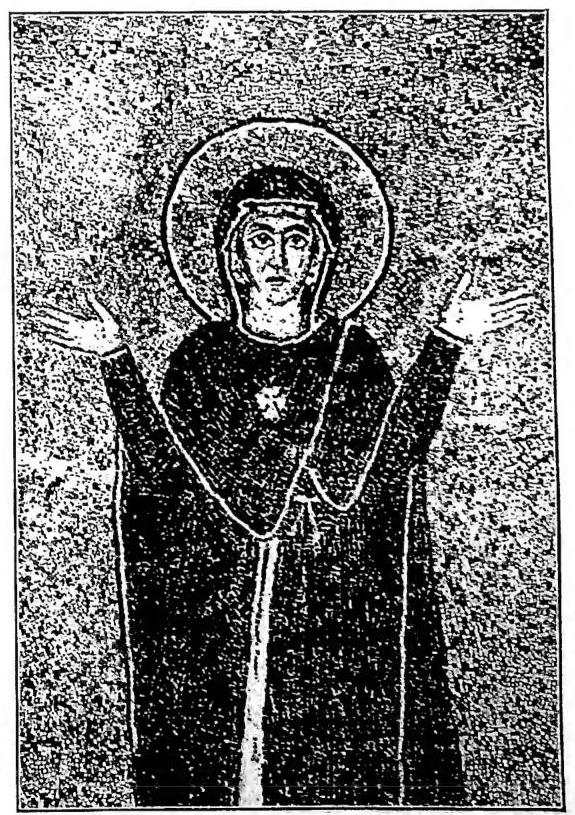
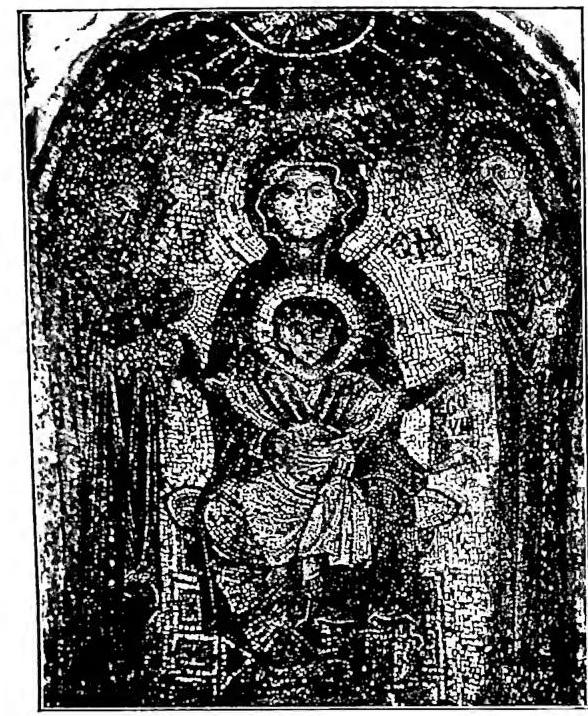
Mariology had reached these goals when the Protestant opposition of the 16th century arose. Traditional Mariology was violently attacked by Luther, Calvin, Zwingli and their followers. Against the innovators fought valiantly St. Robert Bellarmine, St. Peter Canisius with his polemical work De B. Virgine incomparabili, St. Lawrence of Brindisi with his golden Mariale (cf. G. Roschini, La mariologia di s. Lorenzo da Brindisi, Padua 1951), G. B. Novati with the work De eminentia Deiparae, and Father Ippolito Marracci, author of very many Mariological works, strenuous defender of the Immaculate Conception.
After the Protestant opposition arose, far more dangerous because more subtle, the Jansenist opposition, of which three periods can be distinguished: the initial one, that is, of the Jansenists of Port-Royal, that of the codification of the various Jansenist errors through the notorious Monita salutaria B. Mariae ad cultores suos indiscretos of A. Windenfeldt (placed on the Index in 1676), and that of the implementation of the Monita salutaria in the Gallican liturgical reform. Among the Jansenists are to be numbered Launoy (1603-78), Baillet (1649-1706), Tillemont (1637-1750) and in some respects also L. A. Muratori (1672-1750). They fought Mariological Jansenism: St. Louis Grignion de Montfort (1716), St. Alphonsus M. de' Liguori (1787), G. Grasset (1618-92), E. Boudon (1624-1702), Bossuet (1628-1704), Bourdaloue (1632-1704), T. Raynaud (1583-1632), Georges De Rhodes (1661), Contenson (1641-74), P. Poiret (1584-1637). Once Jansenism was vanquished, the idea of the definability of the Immaculate Conception took shape, which was reached with the proclamation of Pius IX in 1854. That was, after the Ephesine definition of Mary's divine Maternity, the second milestone of Mariology, a point of departure and, even more, a point of arrival. In the new period the rigorously scientific progress of Mariology begins, nourished first of all and most richly by the ecclesiastical Magisterium with its encyclicals and other documents. One may cite from Leo XIII the encyclicals Magnae Dei Matris (Sept. 8, 1892), Jucunda semper (Sept. 8, 1894), Adiutricem populi (Sept. 5, 1895), Augustissimae Virginis (Sept. 12, 1897), where Marian doctrine is summarized under the principal aspects of Mother of God, our Mother, Mediatrix (cf. J. Bittremieux, Doctrina mariana Leonis XIII, in Eph. theol. Lovanienses, 4 [1927], p. 359 ff.); from Pius X the encyclical Ad diem illum laetissimum (Febr. 2, 1904) where, on the occasion of the 50th anniversary of the definition of the Immaculate Conception, he sets forth the fruits and the duties that derive from it; from Benedict XV the apostolic letters: Inter sodalicia (March 22, 1918) and Locarni intra fines (Jan. 3, 1919), which dwell on the arguments of Mary's mediation, of the spiritual maternity, of the dispensation of graces; from Pius XI the encyclicals Lux veritatis (Dec. 25, 1931) and Ingravescentibus malis (Sept. 29, 1937) on the divine maternity of Mary and on the Rosary (cf. G. M. Roschini, La Madonna nel pensiero e negli insegnamenti di Pio XI, in Marianum, 1 [1939], pp. 121-72); from Pius XII, the encyclicals Mystici Corporis (June 29, 1943), Auspicia quaedam (May 1, 1948), the apostolic constitution Munificentissimus Deus (Nov. 1, 1950 for the definition of the Assumption of Mary) and the many speeches and radio messages, with which he develops, in a wonderful doctrinal synthesis, the arguments of the divine maternity, holiness, mediation, assumption, queenship, and cult of Mary (cf. Le encicliche mariane, edited by A. Tondini, Rome 1950, with a complete list of Marian documents from 1849 to 1950 on pp. 579-626). To these should be added the publications of patristic and liturgical documents, the Marian study congresses, and the various theological journals.
III. THE CURRENT STATE
Mariology is at present in full development. In various university institutes and theological faculties special chairs have been established, where the Tractatus de B. Maria Virgine, separated from the treatise De Verbo incarnato, has become organic and self-contained. Thus various treatises on Our Lady have come into being, among which mention must be made of those of Scheeben, Jamar, Van Combrugghe, Lépicier, Campana, Müller, Alastruey, Merkelbach, Neubert, Lennerz, Ceuppens, Roschini, Boyer, Bertetto. Various monographs on different mariological questions have been published by J. Bittremieux, Godts, M. Jugie, Lebon, J. M. Boyer, C. Balié, G. Philips, A. Luis. With the aim of ever more promoting the scientific development of mariology, mariological societies have arisen in various nations: in France, in Spain, in Portugal, in Canada and in the United States of North America.
The studies of these various societies are published in their respective bulletins, which constitute a veritable mine for Marian science. To these is added the journal Marianum (Ephemerides mariologiae), published since 1939 by the Servite Fathers of the International College S. Alessio Falconieri in Rome, where an international Marian Center with various initiatives has been established since 1940. Another mariological center is the Franciscan
Marian Commission, established in 1946 and which has already organized various Assumptionist mariological congresses.
IV. MARIOLOGICAL QUESTIONS IN THEOLOGY
The mariological questions treated in theology can be divided into two series: questions of a general nature and questions of a particular nature. Among the questions of a general nature, those that dominate concern the way of organizing a mariological treatise, the sources of mariology and the principles that govern it, particularly the first principle of the entire Marian science. The questions of a particular nature treat: a) the privileges of M.: divine motherhood, immaculate conception, immunity from every sin, fullness of Grace, perpetual virginity, assumption and glorification, cult; b) her mission: spiritual motherhood, universal mediation in its twofold phase, insofar as it signifies cooperation both in the acquisition (correction) and in the distribution of all graces, queenship.
Bibliography7 works
Gabriele Roschini
III. THE MARIAN CULT.
The Marian cult considered in itself, that is, in its intimate constitution, embraces the questions that treat its nature, its constitutive elements, its legitimacy, its usefulness and its necessity.
I. NATURE OF MARIAN CULT
It is expressed by the technical term hyperdulia (cf. Sum. Theol., 3ª, q. 25, a. 5), which means a special honor, superior to that given to the saints, paid to the Most Holy Virgin for her singular excellence, as Mother of God and as Queen of the saints (cf. Denz-U, nn. 1225 ff., 1316, 1570; CIC, can. 1255). This cult of hyperdulia, rendered to M., differs only in degree from the cult of simple dulia, if one takes as the motive of such cult her singular holiness, which is superior in degree, not in kind, to that of the other saints; it differs instead in kind if one takes as the motive of such cult her singular dignity as Mother of God, which places her in an order of her own, specifically superior to that in which all the other saints are found (cf. Sum. Theol., 2ª-2ª, q. 103, a. 3, a. 4, ad 2). The Collyridians erred by excess, who, as St. Epiphanius attests (Adv. haer., III, haer. 78: PG 42, 735), paid to the Virgin a cult of latria or of adoration due to God alone. The Antidicomarianites (4th century), the Protestants (16th century ff.) and the Jansenists erred instead by defect, rejecting as superstitious, idolatrous or at least excessive the cult paid to M.
II. CONSTITUTIVE ELEMENTS
There are principally three acts or constitutive or integral elements of Marian cult, corresponding to the three principal titles of excellence proper to the Most Holy Virgin, namely: veneration, invocation and imitation. As Mother of the Creator and of creatures, she is worthy of a special veneration; as mediatrix between the Creator and creatures, she is to be invoked with the most unlimited confidence; as All-Holy by antonomasia, full of grace and of virtue, she is to be imitated in a particular way.
The cult of special veneration, founded on the singular greatness of M., has its solid foundations both in Sacred Scripture and in tradition. From the Gospel it appears that the angel Gabriel (Lk. 1:28) and St. Elizabeth (Lk. 1:42) address to her words full of profound veneration, words echoed then by all the Christian centuries in the rough paintings of the catacombs from the 2nd-3rd century onward, in the liturgy, in the various temples erected, from the 4th century onward, in her honor and in a special way in the writings of the Fathers and Doctors of every century.
The special cult of invocation, founded on the singular power of intercession of M., finds solid foundations in the ancient tradition of the Church. In an Egyptian papyrus which, according to the paleographic examination of Lobel, dates back to the 3rd century, published by Roberts (in Catalogue of the Greek and Latin Papyri in the John Rylands Library, III, Manchester 1938, no. 470), is contained the very well-known prayer Sub tuum praesidium, which later entered the Roman, Ambrosian, Byzantine and Coptic liturgy, a prayer that is wholly a confident invocation to the protection of the Mother of God in order to be delivered from all dangers. In the 4th century, St. Gregory Nazianzen (d. 389) recounts the confident recourse of a Christian virgin to M. (Or. XXIV in laudem s. Cypriani: PG 35, 1181). Toward the end of the same century, St. Ambrose exhorted virgins to have recourse to the Virgin by antonomasia (De instit. virg., nos. 86-88: PL 16, 339 f.).
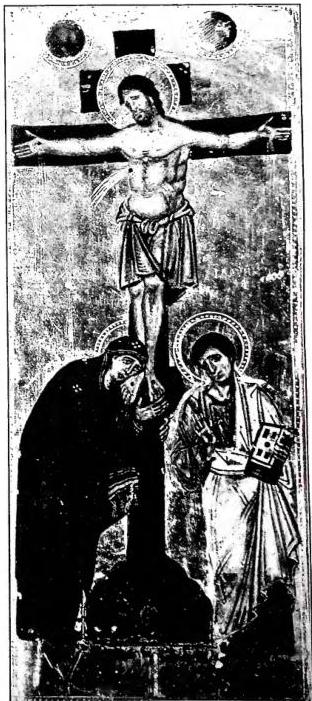
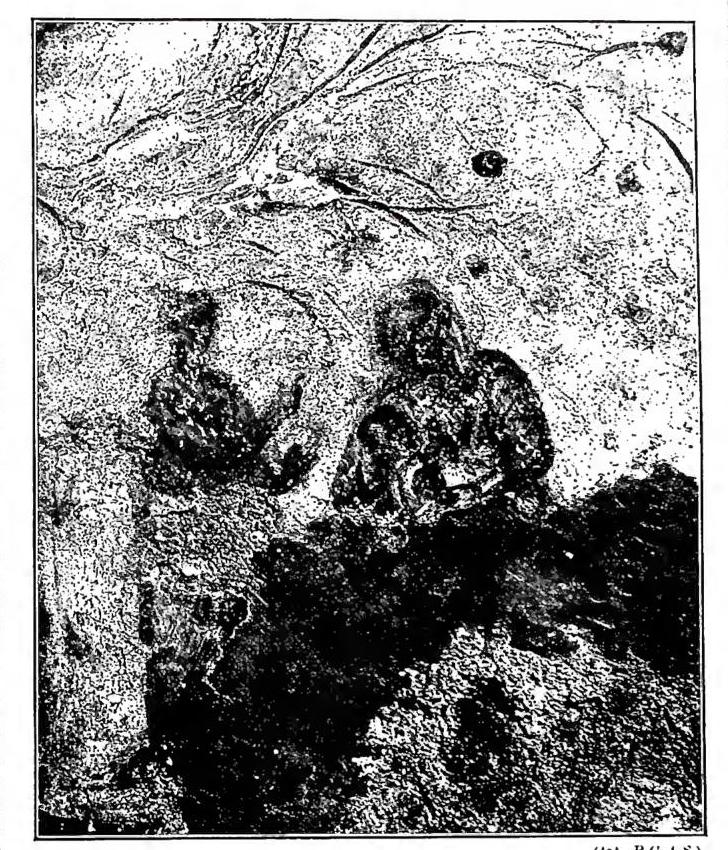
The cult of special imitation, founded on the singular holiness of M., was given great prominence by St. Ambrose, who asserted that "the life of M. alone is a school for all," and therefore exhorts all to imitate her (De Virgin., II, c. 2, nos. 9, 15; c. 3, no. 19: PL 16, 221-23). In a quite particular way the Most Holy Virgin, in Christian antiquity, was proposed as the model of virgins. Thus, in the catacombs of Priscilla, on the Via Salaria, in a cubiculum of the 3rd century, there is depicted a bishop who, in the act of imposing the sacred veil on a virgin, points out to her as a model the Most Holy M. there painted with the child Jesus at her breast. There has not been lacking one who, like Erasmus of Rotterdam, followed by Luther and by others, exaggerating this element of cult, went so far as to say that the actual imitation of the Most Holy Virgin belongs to the essence of Marian cult. Catholics commonly hold that, although the true cult of M. without the purpose or a certain desire of imitating her is not even conceivable, the actual imitation of her, nevertheless, is not essential to her cult, and is rather its fruit.
III. LEGITIMACY OF MARIAN CULT
The legitimacy of the cult paid to the person of M. appears from her most singular and incomparable excellence, since she is the Mother of God, "full of grace," "blessed among all women." For the legitimacy of the cult of the Heart of M., see the relevant entry. The legitimacy of the (relative) cult paid to the relics of the Virgin (should their authenticity be proven), denied with particular acrimony by the Protestants, appears from that psychological law which impels one to venerate not only the person, but also the things that belonged to her (Sum. Theol., 3a, q. 25, a. 6). The legitimacy of the (relative) cult rendered to the images of M. Most Holy (denied by the iconoclasts [8th cent.] and by the Protestants), besides being supported by the decisions of the councils (Second Council of Nicaea and Council of Trent, sess. XXV), by the most ancient use of the Church and by the prodigies wrought through them, appears legitimized by the fact that the image, insofar as it is an image (not insofar as it is a material thing), constitutes one single thing with the one whom it represents, to whom therefore the act of cult ultimately tends.
IV. USEFULNESS
The usefulness of Marian devotion clearly results from the innumerable benefits, both individual and social, deriving from it. The individual benefits extend to life (source of graces, sign of predestination), to death (special assistance) and after death. The social benefits, on the other hand, concern domestic society (source of Grace), civil society (progress of the true, the beautiful and the good, through the progress of the sciences, the arts and good morals) and religious society, that is, the Church (progress and safeguarding of the true faith and of good morals).
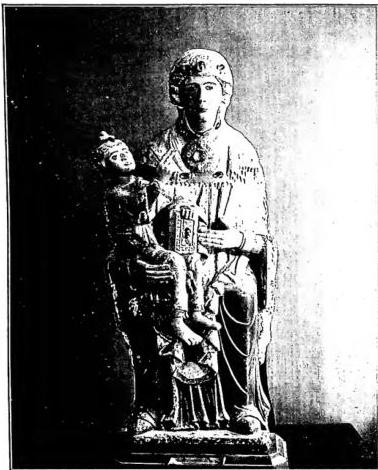
But besides being useful, Marian devotion also appears morally necessary for attaining eternal salvation, contrary to what Ludovico Antonio Muratori taught (Epistolario, ed. by Michele Campori, IV, Modena 1901, lett. 1273, pp. 1471-80), refuted especially by St. Alphonsus M. de' Liguori, who concluded: « Hence one makes a bad prognosis of someone who lives habitually estranged from such devotion » (Selva, ed. napol. 1871, app., point II, p. 230). That a certain devotion toward the Most Holy M. is necessary for salvation appears from the CIC (can. 1276), from liturgical practice and from the fact that such devotion constitutes « a fundamental element in the Christian life » (Pius XII, in the radio message to the Argentine National Marian Congress of 12 Oct. 1947), since the Most Holy Virgin is true Mother of God and our mother, mediatrix of all graces.
Bibliography4 works
Gabriele Roschini
IV. MARIAN LITURGY.
I. ORIGIN AND EARLY DEVELOPMENT OF THE LITURGICAL CULT OF MARY IN THE EAST AND WEST
The history of the primitive liturgical cult of the Madonna can be divided into two periods: I. From the apostolic age to the Council of Ephesus (431); II. From the Council of Ephesus to the Carolingian era.
1. From the apostolic age to the Council of Ephesus (431)
This is the preparatory period that ends in a true liturgical cult. In this evolution one must carefully distinguish between veneration, forms of cult — including liturgical — and feasts properly so called. And it must be said at once that to find a true Marian feast one must go down to the second half of the 4th century in the East, and to the 6th century in the West. For anyone who reflects on how the ecclesiastical calendar was formed in Christian antiquity, this delay is no cause for wonder; and to explain it there is no need at all to have recourse, as some have thought, to supposed precautions aimed at preventing dangerous confusions in a world where the cult of the great mother of the gods, Cybele, was very widely diffused. The ecclesiastical calendar was gradually formed from the apostolic age onward around one central point: Christ and the mysteries of the Redemption; at a second stage, from the 2nd century onward, the witnesses of Christ, the martyrs, were inserted into it. And not even all the mysteries of the Redemption immediately received a liturgical expression; it suffices to think of Christmas, which as a liturgical feast is not earlier than the 4th century.
If, however, a liturgical feast of the Madonna is lacking in the first three centuries, there is by no means lacking, and indeed from apostolic times, a great veneration toward her, considered as the mother of the Savior. Such veneration had its foundation in Sacred Scripture itself. The Acts of the Apostles present her united with the disciples in awaiting the Holy Spirit (Acts 1:14). The Apostolic Fathers (Ignatius, Ephes., VII, 2; Smyrn., I, 1) emphasize her divine motherhood. During the 2nd century, Justin at Rome, Irenaeus at Lyons and Tertullian at Carthage, starting from the Adam-Christ parallel, so strongly inculcated by St. Paul (Rom. 5:12-21), develop the analogous parallel: Eve-M. (B. Capelle, La liturgie mariale en Occident, in Maria. Etudes sur la vie Vierge, Paris 1949, p. 217; for the patristic tradition before the Council of Ephesus, the principal testimonies have been collected by A. D'Ales, in DFC, III, coll. 155-87). The very ancient formula of the baptismal symbol (2nd century) continually recalled to the faithful the greatness of M. as virgin and mother of the Savior: Natus ex Maria Virgine. Various New Testament apocrypha, above all the Protoevangelium of James, contain legendary pages, but full of poetry and admiration for the Madonna. All this goes to demonstrate the singular veneration of the first Christian generations toward her. A significant reflection of such veneration, and at the same time a testimony of trust in the Madonna's intercession, is offered by the copious monuments of Roman funerary art of the 2nd and 3rd centuries, with the images of the Madonna in the catacombs (cf. G. Belvederi-G. Bovini, La catechesi di s. Pietro e il « Credo » della Chiesa antica dell'arte paleocristiana, Vatican City 1950, pp. 48-53). With regard to the invocation of the Madonna, of particular significance is the prayer Sub tuum praesidium, found in a Coptic papyrus of the 3rd century, and which is therefore regarded as the most ancient Marian prayer (cf. C. Cecchelli, op. cit. in bibl., I, Rome 1946, pp. 305-308).
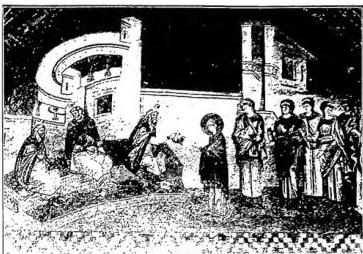
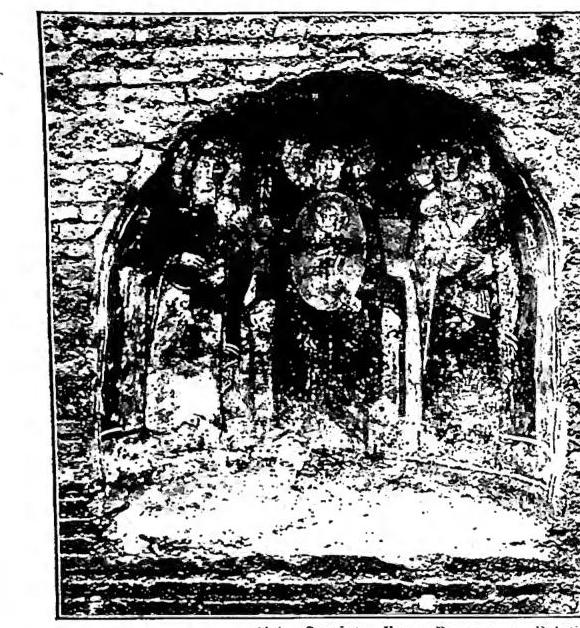
Some gilded glasses are to be considered not much later, in which the Virgin is represented in the midst of two saints, sometimes in the midst of the apostles Peter and Paul as a personage superior to them (R. Garrucci, Vetri ornati di figure in oro, Rome 1858, pl. IX, 6, 7).
There is to be added, moreover, the fact that with the spread, from the 3rd century onward, of the ideal of the ascetic life, the Madonna was considered, above all for her virginity and obedience, as the model of Christian virgins. In a celebrated fresco of the cemetery of Priscilla, known as a representation of a velatio virginis (3rd century), the bishop points out to the consecrated virgin, as a model to imitate, the Madonna seated on a chair and with the child Jesus in her lap. The words that St. Ambrose, speaking of the Madonna, addressed to consecrated virgins could be a commentary on this painting: « Hanc imitamini, filiae » (De instit. virginis, chap. 14: PL 16, 340). Another observation: the development of theological thought concerning Christ during the 4th century brought increasingly into evidence the essential part owed to the Madonna in the Redemption, and at the same time the concept of her supreme holiness was increasingly augmented. From the first half of the 4th century dates the expression πανεγία (= all-holy), used for the Madonna (first example in Eusebius, De ecclesiastica theologia, III, 16: CB, XIV, p. 174, line 31), an expression that would later become common in Byzantine literature. To finally have an idea of the development that Marian piety reached during the 4th century, one should keep in mind the most devout Precaciones ad Deiparam of St. Ephrem the Syrian (d. 373), written by him perhaps for the liturgical use of his monks. And all the great Fathers and Doctors of the 4th and 5th centuries echo him: St. Athanasius, St. John Chrysostom, St. Epiphanius, St. Ambrose, St. Jerome, St. Augustine.
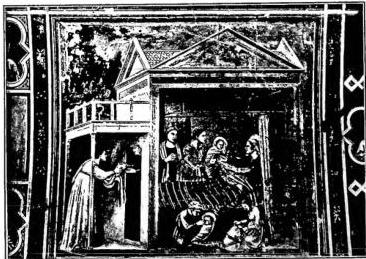
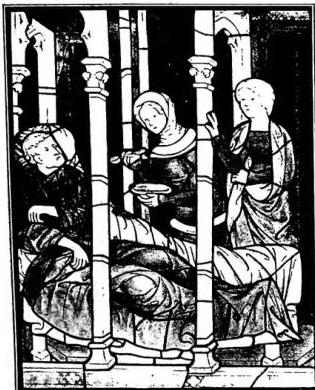
This luxuriant development of Marian piety in the 4th century was not slow to find expressions of a truly liturgical character. In the Communicantes of the Canon of the Mass the Madonna occupies the first place. The last word has not yet been said on the time of origin of this prayer: it certainly existed in the 5th century, but the 4th century is not excluded (cf. C. Cecchelli, op. cit., I, p. 170 ff.). The decisive liturgical step was to be that of the institution of a Marian feast. This seems to have occurred toward the end of the 4th century, in Syria, and precisely in Antioch (cf. M. Righetti, Storia liturgica, II, Milan 1946, p. 241). It is certain in any case that a Marian solemnity existed at Constantinople before the Council of Ephesus. Indeed, a discourse of St. Proclus, patriarch of Constantinople, delivered in 429, in the presence of Nestorius himself, on a day entirely dedicated to the glorification of M., is regarded by most as authentic: « Virginalis solemnitas — thus the discourse begins — linguam nostram hodie, fratres, ad laudis praeconium provocat ». And it continues: « M., I say, handmaid and mother, virgin and heaven, bridge of God to men » (PG 65, 682).
Besides a feast, always before the Council of Ephesus, there were in the East churches dedicated to M., at least that one, as is well known, where the Council of Ephesus was held.
Summing up the history of the Marian cult before the Council of Ephesus (431), it is possible to say that the veneration toward the Mother of God, begun in the apostolic age, became ever more intense, with expressions later also liturgical, with the dedication of churches to her, and finally, at least in Syria and at Constantinople, with a Marian feast which, among the feasts of non-martyr saints, certainly occupies the first place.
2. From the Council of Ephesus to the Carolingian era
The Council of Ephesus, with the solemn proclamation of M.'s divine motherhood, marks a decisive point for the development of Marian worship. This development can be observed through three main elements: churches dedicated to her; her images placed in veneration; the various Marian feasts.
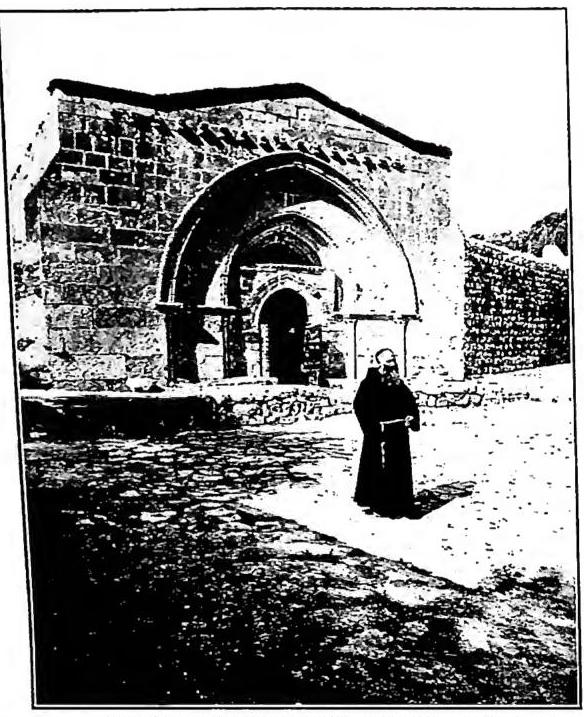
a) The churches. - From the Council of Ephesus onward, in East and West, churches dedicated to Our Lady arose and multiplied everywhere. Some of the principal ones are recalled. Two churches in Palestine during the 5th century, one in Jerusalem on the site pointed out as the tomb of the Virgin, one on Mount Gerizim. In Alexandria in Egypt, the ancient patriarchal church, erected under the patriarch Alexander (313-54), in the 5th century was certainly dedicated to Our Lady. At Ravenna the basilica of St. Maria Maggiore dates back to the time of the archbishop Ecclesius (521-34). More extensive information on the various post-Ephesian Marian churches, in East and West, has been gathered by C. Cecchelli (op. cit., I, pp. 243-73). In Rome the oldest catalogue of churches, the one added to the itinerary De locis sanctis martyrum, of the 7th century (R. Valentini-G. Zucchetti, Codice topografico della città di Roma, II, Rome 1942, pp. 119-22), lists four Marian churches: Basilica quae appellatur Sancta Maria Maior, that is St. Maria Maggiore, the celebrated basilica on the Esquiline, erected by Liberius (352-66), renovated by Sixtus III (432-40), who decorated it with wonderful mosaics that still exist and that must be considered as the historical monument of the Council of Ephesus; Basilica quae appellatur Sancta Maria antiqua, erected in the Roman Forum, which seems to be the oldest Marian church in Rome; Basilica quae appellatur Sancta Maria Rotunda, that is the Pantheon, transformed into a church by Boniface IV (608-15), who dedicated it to the B. Virgin and to all the martyrs; Basilica quae appellatur Sancta Maria Transtiberim, that is the ancient title of Callistus, which at least in the 6th century was already dedicated to the Virgin. In the course of the 7th and 8th centuries there is no city in East or West that did not have a church dedicated to Our Lady. A homily already attributed to St. Cyril of Alexandria (d. 444), but which is instead nothing other than a compilation of the 7th-9th century (cf. A. Ehrard, Eine unechte Marienhomilie des hl. Cyrill v. Alexandrien, in Röm. Quart., 3 [1889], pp. 97-113), offers this precious testimony: « Salve, Maria Deipara... propter quam in civitatibus, in pagis et insulis orthodoxorum fundatae sunt ecclesiae » (PG 77, 1034).
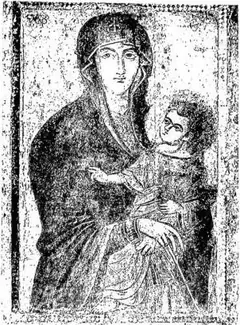
b) The images. - With the erection and dedication of churches to Our Lady, the cult of her images also came into use. Most celebrated in the East was the one attributed to St. Luke and which the empress Eudoxia sent from Jerusalem to Pulcheria, at Constantinople, in 451 (Hodegetria), which then became the type of countless Marian images. In Rome a recent discovery, made in the church of St. Maria Nova, has brought back to light an image of Our Lady, which must come from St. Maria Antiqua, and which is dated back to the 5th century (cf. P. Cellini, Una Madonna molto antica, in Proporzioni [offprint], 1950, no. 3). From this era onward the images of Our Lady placed in veneration are ever more numerous, in the West (see, for example, that of the apse mosaic of Parenzo, 5th century) and even more so in the East.
c) The feasts. - The pre-Ephesian Marian feast, in Syria and at Constantinople, was connected with Christmas. During the 5th and 6th centuries various other Marian festivities appear in the East: the Purification (v.) and the Annunciation (v.), which however were considered as feasts of the Lord, the feast of the Nativity (v.) and that of the Dormition and Assumption of M. (v.). The latter soon assumed a place of pre-eminence among the Marian feasts, and the emperor Maurice, around 600, prescribed its celebration throughout the Empire on the date of 15 Aug.
In the West no Marian feast is found earlier than the 5th century. One is encountered in Gaul in the 6th century. St. Gregory of Tours (d. 594) bears witness to it: « Huius Mariae festivitas sacra, mediante mense undecimo celebratur » De gloria martyrum, chap. 9: PL 71, 713).
Given that the year began with the month of March, the eleventh month was January. Indeed in some recensions of the Martirologio geronimiano (Martyr. Hieronymianum, p. 34), there is found, on 18 Jan., this announcement: Depositio sanctae Mariae; the feast, however, as is known from Gallican liturgical texts, referred to Our Lady in general, without relation to any particular Mystery. In Spain too there is found a Festivitas Sanctae Mariae celebrated in Dec., hence within the framework of Advent. The Tenth Council of Toledo (646) imposed its date by authority: 18 Dec., eight days before Christmas.
In Rome, the «feria IV quattuor temporum Adventus», whose celebration dates from the 6th century, has evident Marian elements. Around the same era there is a particular commemoration of Our Lady within the octave of Christmas (1 Jan.). The Octubus Domini, which was celebrated in St. Maria Rotunda (the Pantheon), presented purely Marian formularies, which in part still survive and which refer principally to the divine motherhood. As for the four great Marian feasts, however: Purification, Annunciation, Assumption, Nativity, at the time of St. Gregory the Great they were still absent from the Roman liturgy. By the close of the 7th century, on the other hand, they had not only already been received into the liturgical books of the City, but had acquired there a great solemnity. Proof of this is a constitution of Sergius I (687-701), reported in the Liber Pont. (I, p. 379): «Constituit, ut diebus adnunciationis Domini, dormitionis et nativitatis Dei genitricis semperque virginis Mariae ac sancti Simeonis, quod Ypapanti Greci appellant, litania exeat a sancto Hadriano et ad sanctam Mariam populus occurrat». Sergius I therefore made those feasts more solemn, though they must already have been in use for some time. Attempts have been made to determine precisely how and when the said feasts entered Rome. The most probable explanation seems to be this: in the first decades of the 7th century various groups of Eastern monks, following the invasions of the Persians and the Arabs, migrated from Palestine, Syria and Asia Minor to Rome. It is a fact that while no Eastern monastery existed in Rome at the time of St. Gregory the Great, at the Roman Synod of 649 the abbots of three Eastern monasteries established in the city appear (Mansi, X, p. 903 ff.). It is clear that these monks brought with them their books and liturgical customs. Thus it seems logical to think that the four great Marian feasts, already in use in the East, passed from these monasteries of Eastern monks in Rome, around the middle of the 7th century, into the use of the Roman clergy (cf. F. Antonelli, La festa dell'Assunzione nella liturgia romana, in Studia Mariana, Atti del Congresso nazionale mariano dei Frati Minori d'Italia, Rome 1948, p. 232 ff.). However that may be, the introduction of the said feasts into the Roman liturgical books, given the diffusion these had, especially following their adoption by Charlemagne, was a decisive element for the rapid spread of the same feasts throughout the West.
To sum up, it can be said that the Council of Ephesus determined a luxuriant and rapid development of the liturgical cult of Our Lady in East and West. Churches dedicated to her arose everywhere, so much so that in the Carolingian era they were counted in every city or country; the Marian images placed in veneration multiplied in the West and even more so in the East; during the 6th century a festivitas sanctae Mariae is finally found also in Gaul, in Spain, in Rome; at the same time the four great Marian feasts are organized in the East, and during the 7th century they find ample hospitality in the Roman liturgy, and from there, in the following century, they spread rapidly throughout the West.
Bibliography
Ferdinando Antonelli
II. MARY IN WESTERN LITURGY FROM THE MIDDLE AGES TO OUR DAYS
1. The Middle Ages
For the cult and devotion to Mary, the Middle Ages constitute a golden age: on the one hand, theological inquiry, especially that of the great scholastics, penetrates ever more deeply into the unique position of Mary in the divine plan of Redemption, coming to establish that to her is owed a cult higher than that of the other saints and angels, a cult which they call hyperdulia. St. Thomas says (2ᵃ-2ᵃᵇ, q. 103, a. 4): «Hyperdulia est potissima species dulae communiter sumptae; maxima enim reverentia debetur homini ex affinitate quam habet ad Deum»; and St. Bonaventure (In III Sent., dist. 9, a. 1, q. 3, in Opera omnia, Quaracchi 1887, p. 206): «Ex hoc enim quod Mater Dei est, praelata est ceteris creaturis, et eam prae ceteris decens est honorari et venerari. Hic autem honor consuevit a magistris hyperdulia vocari». The theological foundation, therefore, for a particular Marian cult was firmly established.
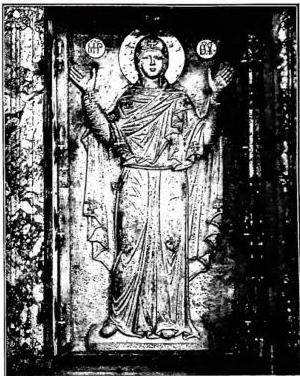
On the other hand, the Christian sense of the people too was ever more strongly drawn by the greatness and magnificence of the Mother of God, and thus there came to be formed, in the Middle Ages, a sum of Marian devotions that penetrated deeply into the whole of religious and profane, ecclesiastical and civil life.
From as early as the 9th century, churches dedicated to the Madonna multiplied without limit; it should be noted that especially many cathedrals bore the title of Mary Assumed. Even churches dedicated under other titles had at least one or more altars in honor of the Madonna. Bells too were dedicated to her name. As a baptismal name (from the time such a custom arose) the name of M. far surpasses even that of the most popular saints. In the late Middle Ages there spread through vast regions of Europe the gentle custom of building sacred Marian aedicules, in cities and in the countryside. Marian sanctuaries arose, goals of many pilgrimages, ordinarily of a local or regional character; better known, among others, Puy-en-Velay in France, Loreto (from the 15th century) in Italy.
Marian devotional literature grew infinitely, even before the invention of printing; preaching loved to set in evidence the greatness and the piety of the Madonna; the most renowned medieval orators and missionaries: St. Bernard, St. Bernardino of Siena and many others, dedicated a M. entire cycles of preaching or conferences. Pious legends spread trust in M.; the arts and crafts organize themselves into Marian confraternities, solemnize her feasts, erect churches, oratories, altars for her; the arts (painting, sculpture) draw from Marian piety their most grandiose and beautiful inspirations.
Entire religious families glory in a particular Marian piety, such as the Cistercians and Premonstratensians; above all the two great mendicant Orders, Dominican and Franciscan, became the strongest Marian propagators of the era, spreading also certain particular devotions (the crown, the joys of M.); the Servites were born for the purpose of spreading veneration of the sorrows of M.; other religious families or knightly orders also placed themselves under her protection.
All this immense medieval Marian movement, of a rather devotional-private, or paraliturgical, nature, evidently also had a great direct influence on the liturgy itself. As early as the 9th century one begins to consider one day of the week, namely Saturday, as dedicated particularly to Our Lady. From the 10th century onward there are the first traces of the Officium parvum, to be recited at first every Saturday, and especially by devout laypeople. But then the Cistercians and Camaldolese also adopted it in common recitation, after the Divine Office, followed also by canons and other ecclesiastical communities; St. Peter Damian became its fervent propagator, and Urban II prescribed it in choir after the Divine Office for all Saturdays. The Officium parvum remained, throughout the Middle Ages, the most popular form, also for confraternities, of venerating M. In the 12th century, moreover, the first popular litanies of Our Lady appeared, in various forms, while the one called "Lauretana," because it spread from Loreto, dates only from the 15th and 16th centuries.
Among the formulas of Marian devotion, the Hail Mary and the Salve Regina hold first place in the Middle Ages. The former (only the words of Sacred Scripture, with the addition "Jesus") is found as a usual prayer formula as early as the 12th century; it began to be completed with various invocations, which then took their present form, as early as the 13th century; but its official introduction into the liturgy belongs to St. Pius V (1568). The Greeks and the Servites still retain the primitive medieval use, without the "Sancta Maria...".
Laypeople, in imitation of the Davidic Psalter, soon used to join 150 Hail Marys in one recitation; and also another smaller number, with various invocations and additions; hence the origin of the various crowns and of the Rosary, which reached their present form toward the end of the Middle Ages and remained most dear to the people. The other Marian formulary most beloved in the Middle Ages was the Salve Regina, known already before St. Bernard; many medieval confraternities arose under the title of the Salve; the Dominicans still sing it solemnly at the end of Lauds and Vespers. Nor should one forget the innumerable hymns, sequences (the Stabat Mater is most celebrated), the rhythmical Offices in honor of Our Lady, and, more popular, the lauds and the sacred representations. From the 13th century onward the practice now called the Angelus Domini also begins; at first there was only the ringing of bells in the morning, then, especially after Callistus III in 1456 expressly prescribed it also at noon to pray against the Turkish danger, it had as its purpose, with the added invocations, to venerate the mystery of the Incarnation; but only during the 16th century was the evening ringing also considered, together with that of the morning and noon, as a single Marian devotion. It is superfluous to say that during this period, so profoundly Marian, the ancient Marian feasts also became ever more solemn, often with vigil and octave, while elsewhere others were added everywhere, under the most varied titles, witnesses of trusting Christian piety toward M.
2. The recent era and the present state
This period too, characterized by the great apostasy of the 16th century, by the Catholic restoration of the 16th and 17th centuries, by the definitive repression of the Turkish danger (17th and 18th centuries) and then by the profound revolutions which, from the 18th century onward, convulsed peoples and States, is marked in a most consoling and providential way by a marvelous Marian movement, still growing. It is based, as is fitting, upon a more careful speculative-theological elaboration of the mystery of Christ and of the Church, from which there necessarily springs ever more limpid and grand the figure of the Mother of God.
Great theologians, among them some "Marian" saints, such as, for example, St. Robert Bellarmine, St. Francis de Sales, St. Louis M. Grignion de Montfort, St. Alphonsus M. de' Liguori, prepared the ground for the latest Marian definitions of the Immaculate Conception and of the Assumption of Our Lady in soul and body (Pius IX, 1854; Pius XII, 1950), truths already widely believed and professed, as the liturgy, art and popular piety attest. The Immaculate above all became the beloved object of Christian piety (also as an anti-Lutheran reaction), especially during the Catholic restoration and the Baroque era. Eloquent witnesses to this are the innumerable images, also by the greatest artists, of the Immaculate, and, in many regions, the characteristic monuments (statuary columns) in the squares, often erected during the period of the Turkish danger, and, above all else, a living and constructive monument, the Marian congregations, born in Rome in 1565 and constituting a continued and ever-renewed Marian apostolate throughout the world and among all social classes. Thus devotion to the Immaculate came to form, in these last centuries, a particular section, and a very fruitful and most popular one, of Marian piety. Innumerable are the pious associations, the recent religious families under her invocation, the churches dedicated to this mystery of hers, and the special prayers and devotions, indulgenced. After the solemn definition of 1854 there came a grandiose heavenly confirmation in the apparitions of Lourdes (1858), which rapidly became a sanctuary of world renown, which continues, with its scientifically controlled healings, to be a beacon of Marian piety. In parallel with devotion to the Immaculate, there also developed devotion to her most pure and immaculate Heart, venerated already previously in private form and in various places. It is to St. John Eudes (d. 1686) that credit belongs for having introduced for the first time public liturgical worship of the Heart of M., a devotion which took deep roots in the Christian people; many flourishing confraternities, especially for the conversion of sinners (Paris, Montmartre), spread throughout the world, are witnesses to it. Finally, during the Second World War, Pius XII, with the solemn and public consecration of the world to the immaculate Heart of M. (1942), and with the consequent extension of the feast to the universal Church (1944), also gave to this Marian devotion its full public liturgical recognition.
During the Baroque era, moreover, devotion to Our Lady of Loreto spread widely, also outside Italy; the "Lauretane" chapels, always with a statue conforming to the original and brought from Loreto, are scattered throughout the world. At the same time the "Lauretane" litanies spread, later becoming the only official Marian litany of the Church. During the 18th century, moreover, again from Italy, one observes the large-scale spread of the image of the Mother of Good Counsel (Genazzano di Roma), received by the people with great trust.
In this same era, again in Italy, the pious practice of the May devotion to Mary originated; it spread, at the beginning of the 19th century, through Belgium, Switzerland, the Austro-Hungarian territories, and then throughout all Christendom—a custom that still draws the people around the altars of the Mother of God. In the southern hemisphere (South America) this same pious practice is carried out in December, the spring month in those regions, while May falls in the depths of winter.
But certain popular Marian practices of the Middle Ages also continued to flourish in the modern era. In the first place, mention must be made of the Marian Rosary, the most popular Marian prayer in existence, and one always brought to new vigor in the great public trials of Christendom. The victories over the Turk, that tremendous danger latent for centuries, are linked to the prayer of the Rosary. The victory of Lepanto (1571), the expulsion of the Turks from Vienna (1683) and from Hungary (1716), are the culminating points of this epic of the Rosary. Its feast was granted precisely in 1571, and extended to the whole Church in 1716. Even recently, in the grave dangers of our times, we witness a vigorous revival of the Rosary. Leo XIII warmly recommended it in a series of encyclicals (1881, 1891, 1895, 1896), as most recently did Pius XII (1951), and since then the custom of dedicating a second month of the year to Our Lady, October, as the month of the Rosary, has become general. Innumerable are the pious associations dedicated to the Rosary, also with various purposes (reparation, suffrage, etc.). The sanctuary of the Rosary at Pompeii, founded by the pious layman Avv. Bartolo Longo (1887), has acquired worldwide fame, and it is known to all how the same M., appearing at Fatima (1917) and also elsewhere, expressly recommends the pious recitation of her Rosary.
Another devotion of medieval origin that has withstood the times is that of the scapular. To the original Carmelite one various other scapulars in honor of Our Lady have been added, and their use, made easier by the substitution of a medal, permitted by Pius X (1910, Dec. 16), remains alive and fruitful. The official collection of indulgences (Enchiridion indulgentiarum, ed. 1950) presents an immense variety of particular devotions and indulgenced prayers in honor of M. Christian piety does not cease to produce ever new flowers, and it is impossible to mention them all. Just as it is also absolutely impossible to list or number the initiatives of every kind, the institutes: scientific, charitable, educational, or the religious families: congregations, sodalities, associations, secular institutes, etc., with purposes that encompass all possible human and Christian activity, born in the modern era, and which have placed themselves under any one of the thousand possible Marian titles or invocations. Christian piety does not cease to venerate the divine Mother with unchanging trust and also under new titles. To conclude, mention is made of a Marian institution of an international character, namely the international Marian congresses, begun in 1902 and continued, until 1914, every two years, then resumed, the last of which was celebrated in Rome in 1950.
One thing is certain: the cult paid to the divine Mother in the Catholic Church, for its vastness and grandeur, truly presents itself as a cult of hyperdulia, while always remaining clearly distinct from the cult of latria, due solely to God himself. It is one of the most grandiose phenomena of the internal history of the Church, and constitutes, in its historical development through the centuries, constant and logical, from the first scriptural germ to its present position, a most valid argument for the perennial vitality of the Church itself.
3. Marian feasts of the universal Church (present state).
le). - At present the universal Church celebrates a total of 17 Marian feasts (not counting vigils or octaves); January, April, May and June are completely devoid of them.
FEBRUARY: 2, Purification, among the four primitive feasts, double of the II class. 11, Apparition of the Immaculate (at Lourdes), greater double; first granted (for Lourdes) 1890; extension to the universal Church: Pius X, 1907 (Nov. 13).
- MARCH: 25, Annunciation, among the four primitive feasts, double of the II class, Seven Dolors (movable feast, Friday of Passion), greater double. Medieval celebration (first record, Cologne, 1423), spread through many places, extended to the universal Church by Benedict XIII in 1727 (Apr. 22). - JULY: 2, Visitation, double of the II class, a feast of Eastern origin, introduced by the Friars Minor in 1263, extended to the universal Church in 1389 (Apr. 6). 16, M. of Mount Carmel, greater double, originally a feast proper to the Carmelites, extended to the universal Church in 1726 (Sept. 23). - AUGUST: 5, Dedication of St. M. "ad Nives", greater double, a particular feast of the basilica of St. Mary Major in Rome, whose dedication it commemorates, later taken up by other churches, extended to the universal Church by St. Pius V. - 15, Assumption, the greatest Marian feast, double of the II class with common octave, among the primitive Marian feasts; it has had a vigil and octave since the 8th century. 22, Immaculate Heart of M., double of the II class, a feast already celebrated on various dates and in various places, but extended to the universal Church by Pius XII, in 1944 (May 4); it replaces the octave day of the Assumption. - SEPTEMBER: 8, Nativity, among the primitive feasts, double of the II class, with simple octave. 12, Name of M., greater double, a feast imposed on the universal Church by Innocent XI in 1683 (Nov. 25) in memory of the liberation of Vienna from the siege of the Turks; it was celebrated on the Sunday within the octave of the Nativity of M., fixed by Pius X to the historic date of the liberation. 15, Seven Dolors, double of the II class. A medieval feast, favored by the Servites, celebrated on the third Sunday of September, extended to the universal Church by Pius VII in 1814 (Sept. 18), raised by Pius X to a double of the II class in memory of his priestly jubilee (1908), then fixed to Sept. 15, replacing the octave day of the Nativity. 24, M. of Mercy, greater double, a particular feast of the Mercedarians, extended to the universal Church by Innocent XII in 1696 (Feb. 22). - OCTOBER: 7, Most Holy Rosary, double of the II class. A feast born in the Confraternities of the Holy Rosary, and celebrated on the first Sunday of October, granted by Gregory XIII in 1573 (Apr. 1), in memory of the victory of Lepanto (Oct. 7, 1571); extended to the universal Church by Clement XI in 1716 (Oct. 13) in memory of the victory over the Turks at Peterwardein (Aug. 5, 1716); double of the II class, Leo XIII, in 1888 (Aug. 5); fixed to the historic date of Oct. 7 by Pius X in 1914. 11, Maternity of M., double of the II class. The divine maternity of M. was proclaimed at the Council of Ephesus, on June 22, 431; a particular feast, on various dates, appears during the 17th century; Pius XI, in memory of the 15th centenary of the Council, extended the feast to the universal Church, fixing it to the date Oct. 11.
(Jan. 6, 1932). - NOVEMBER: 21, Presentation, a feast of Eastern origin, perhaps as the anniversary of the dedication of "St. Mary the New" in Jerusalem, under Justinian in 543; it appears in the West in the 11th century, was celebrated in the papal curia of Avignon in 1373, and was gradually accepted by the whole Church; greater double. - DECEMBER: 8, Immaculate Conception, double of the I class, with common octave; a feast imposed on the universal Church by Sixtus IV in 1476 (Feb. 27); the octave is from 1693, the vigil from 1879. After the definition of the dogma of the Immaculate Conception (1854) it became one of the most popular Marian feasts.
4. Some Marian feasts, "pro aliquibus locis." - After the reform of Pius X (1911-14) the number of Marian feasts in the appendix of the Roman Missal, pro aliquibus locis, was reduced to 21; the best known among them are (according to date):
The Espousal of M. (23 Jan.), a feast that already appeared in 1413 at Chartres, and was approved by Paul II; Mother of Good Counsel (26 Apr.), a title that enjoyed great devotion, especially in the 18th century: it concerns an image of M. painted as a fresco and miraculously appeared at Genazzano, as tradition holds, on 25 Apr. 1467; the first concession of the feast is from 1727; M. Help of Christians (Auxilium christianorum, 24 May), a feast introduced by decree of 16 Sept. 1815 by Pius VII, in memory of his happy return to Rome (24 May 1814): this title had an enormous diffusion through St. John Bosco; Mediatrix of all graces (31 May): first concession, at the request of Cardinal Mercier, archbishop of Malines, of 21 Jan. 1918, a feast accepted by very many churches and religious families; Our Lady of Graces (and similar titles, 9 June and other dates), a title of many Marian sanctuaries, sometimes even going back to the late Middle Ages; Patronage of M. (2nd or 3rd Sunday of Nov., but also on various other dates): granted since the beginning of the 18th century, often in memory of certain public graces attributed to Our Lady; Translation of the Holy House of Loreto (10 Dec.): the feast was granted only in 1632 and extended to the Papal State in 1725, suppressed by Pius X, it was restored by Benedict XV in 1916 and imposed on all of Italy; Expectation of the Birth (18 Dec.), also called the Feast of the O (on this date the "O" antiphons begin); a feast that recalls one of the most ancient Marian festivities of the West; continued in Spain, and from there spread to many places. After the suppression of many particular Marian feasts on the occasion of the reform of Pius X, they were taken up again by many churches and religious families. The well-known liturgist F. G. Holweck succeeded in gathering in a mighty work: Calendarium liturgicum festorum Dei et Dei Matris Mariae (Philadelphia 1925) all or almost all the Marian feasts existing in the Catholic world with historical notices: there are more than 1025.
For the history, and even more for the psychology of popular Marian devotion, it is quite interesting to note the Marian titles that are the most venerated with their own feasts: M. Agonizantium, Auxiliatrix, Mater boni Consilii, Consolatrix (de Consolatione): innumerable were the feasts, under various denominations, of the Heart of M. (Cor purissimum, immaculatum etc.), before the extension to the universal Church; Gratiarum; Humulitas, de Itria (it concerns the celebrated Constantinopolitan icon of the Odigitria), Maternitas, De Pace (Regina Pacis), Patrocinium, de Pietate
(Mater dolorosa), de Providentia, Refugium peccatorum, Salus infirmorum, de Victoria; but the titles with the greatest diffusion are: Divini Pastoris Mater, Miraculorum; de Misericordia and de Succursu (de bono et perpetuo succursu). From these titles one sees how Our Lady is venerated above all as the great benefactress of Christendom, in bodily and spiritual difficulties, the true Mother of men.
Bibliography2 works
(phot. Alinari)
MARY MOST HOLY - Madonna "of the Holy Girdle." Painting attributed to Filippo Lippi (15th cent.) - Prato, Municipal Art Gallery.
ed., Innsbruck 1896; St. Beissel, Die in Deutschland während des Mittelalters, Freiburg im Breisgau 1896; id., Die Verehrung... bis zum Ende des Mittelalters, ibid. 1909; id., Die Verehrung... im 16. und 17. Jahrhundert, ibid. 1910, a work of primary importance; J. F. A. Kronenburg, Maria's Heerlijkheid in Nederland, 8 vols., Amsterdam 1903-14. Index 1931; A. L. Delattre, Le culte de la ste Vierge Marie en Afrique, Paris 1907; M. Artusio, Tesoro mariano, Turin 1913 (description of the pious practices, feasts and various devotions toward M.); K. A. H. Kellner, L'anno ecclesiastico, Italian translation, 2nd ed., Rome 1914, pp. 201-40; B. Bartmann, M. im Licht des Glaubens und der Frömmigkeit, Paderborn 1922; F. G. Holweck, A Biographical Dictionary of the Saints, St. Louis 1924, pp. 671-76; E. Caronti, Il Mariale. Devozionario liturgico della B. Vergine, Turin 1929; A. Salvini, Santuari mariani d'Italia, Alba 1940; id., M. e l'Italia, Rome 1943; E. Campana, M. nel culto cattolico, 2 vols., 2nd ed., Turin 1944; F. Oppenheim, M. nella liturgia cattolica, Rome 1944; C. Cecchelli, Mater Christi, 2 vols., ibid. 1946-48; very useful is the Rassegna bibliografica mariana, Rome, annual (latest ed. 1951).
Giuseppe Löw
III. MARY IN EASTERN LITURGY FROM THE 5TH CENTURY ONWARD
If the beginnings of Mariological doctrine and the first outpourings of Marian piety are to be sought in the Christian East, the same must be said of the liturgical cult of the Mother of God. The first Marian feast is known from an Armenian lectionary (cf. F. C. Conybeare and A. J. Maclean, Rituale Armenorum, and the East Syrian Epiphany rites, Oxford 1905, p. 526)
for the use of the Armenians settled in Jerusalem; it was written around the year 450 and carries the notice: "Aug. 15 is the day of M. Theotokos. At the third mile from Bethlehem, Ps. 132, 8; Is. 7, 10-15; Gal. 3, 29-4, 7 are recited; alleluia, Ps. 110, 1; Lk. 2, 1-7." Furthermore, a homily by Chrysippus, a priest of Jerusalem, delivered on a feast day of the Madonna to his brother monks of St. Euthymius, illustrates the three readings of the Mass, Isaiah, Paul and Luke, which correspond exactly to the pericopes of the Armenian lectionary. Chrysippus was ordained a priest around 455 and died in 479. The homily was published by M. Jugie (PO 19, 336-43). On this problem see B. Capelle, La fête de la Vierge à Jérusalem au Ve siècle, in Le Muséon, 56 (1943), pp. 1-33. And perhaps older is the "memory of the Theotokos" celebrated after the feast of the Epiphany or after that of Christmas when this was introduced in the East, first in Syria and then among the other Easterners, a feast which, like that of Jerusalem, celebrates the divine motherhood of the most pure Virgin (cf. A. Raes, Aux origines de la fête de l'Assomption en Orient, in Orient. christ. per., 12 [1946], pp. 268-74). In the East the great feasts arose and were established first: the Annunciation in the 6th century, the Assumption around the year 600, the Nativity, the Presentation, the Conception in the 7th century. The invocations and hymns to M. are introduced into the Eastern liturgy; the hymn Suò tuum praesidium, for example, is the version of a Greek original of the 3rd century (cf. F. Mercenier, L'Antienne mariale grecque la plus ancienne, in Le Muséon, 52 [1939], pp. 229-33) and the insertion of the name of M. in the Memento of the saints at Mass is reported by Philoxenus of Mabbug (after 522). The great mystery of the divine motherhood of M., solemnly proclaimed at the Council of Ephesus (431), filled the souls of the Easterners with astonishment and admiration: how can M. contain within herself the Infinite, how can the Unbegotten be born from her, how can she call her son the Son of God? Equal feelings are provoked by her virginal motherhood and her inviolate purity. Hence arises the immense confidence with which her intercession before God is invoked for all the needs of men. These are the three ideas that pervade the invocations, prayers and hymns of the Eastern liturgies. However, not all have reached the same level of piety nor the same development in the liturgical cult. The Chaldean liturgy celebrated by the Nestorians, who denied M. the title of Mother of God, is the least rich; the Armenian liturgy, already quite rich, is surpassed by the Syriac and the Maronite, just as the Coptic and the Ethiopic surpass it even more; the Byzantine, definitively elaborated at Constantinople, the true city of M., transcends all the other liturgies in its cult for the Mother of God.
Bibliography5 works
1. Byzantine liturgy
The common Marian feasts of the rite are: the Nativity (Sept. 8), the Presentation (Nov. 21), the Meeting with Simeon and the Purification (Feb. 2), the Annunciation (March 25), the foundation of Constantinople (May 11), the Deposition of the precious robe in the church of the Blachernae (July 2), the Dormition (Aug. 15), the Transfer of the girdle to the Chalcopratia church (Aug. 31), the Saturday of the Akathist hymn (5th week of Lent). Many images venerated in sanctuaries have their own feast and their own liturgical Office; to be cited among the most famous among the Greeks are the "Euangelistria" at Tinos, the
"Fount of Life" at Constantinople (cf. L. Petit, Bibliographie des acolouthies grecques, Brussels 1926, pp. 151-79). Among the Russians: the Iverskaja (Oct. 13), the Kazanskaja (Oct. 22 and July 8), the Consolation of the afflicted (Oct. 24), the Apparition of the Mother of God at Novgorod (Nov. 27), the Vladimirskaia (May 21, June 22 and Aug. 26), the Tichvinskaja (June 26), the Hodigitria of Smolensk (July 28), the Donskaja (Aug. 19); one may add the great feast of the "Pokrov," no longer in the calendar of the Greeks, but much celebrated by the Slavs. Among the Ruthenians: the Pocavskaja (Sept. 8), the Zirovitskaja (May 7). Among the Italo-Albanians, the Hodigitria and the Madonna of Grottaferrata. In the weekly Office, the Mother is celebrated on Sunday beside her risen Son; beside her suffering Son on Wednesday and Friday; but Wednesday is more especially dedicated to the Mother of God. In the daily Office there is no Hour in which one or more troparia are not sung in honor of M. Thus a devout exuberance is manifested in singing her praises or supplicating her: in every litany she is the object of a petition, in every hymn she is celebrated in the last stanza; there exists therefore no ceremony without an invocation to M.; in the Holy Mass she is commemorated already at the Prosommidia with the deposition in her honor of a bread on the discos beside the Lamb, then in the numerous litanies, with a theotokion after the little Introit, with the singing of the "Ἄξιον ἄστι" at the Memento of the Saints during the anaphora; and at every incensation of the iconostasis honor is rendered to her image. Among the Marian hymns special mention is deserved by the "dogmatic" verses, so called because they proclaim the doctrine of the two natures in Christ, of his incarnation and of the divine motherhood of M. The month of M. is that of Aug., in which the people love to sing the little office called the "Paraklesis."
Bibliography6 works
2. Armenian liturgy
Fixed feasts: Nativity, Presentation, Conception, Purification, Annunciation. Movable feasts: Assumption (the Sunday nearest to Aug. 15), Transfer of the veil of the Mother of God (sixth Sunday of the Pentecost period), Transfer of the girdle (third Sunday of the Assumption period). During the week, the Office of Wednesday commemorates M. most particularly. In the daily Office the mentions of her are found at almost all the Hours; the Magnificat is sung at the morning Hour; also in the Holy Mass there are some brief supplications. But above all in the hymns of her feasts the privileges of the Mother of God are celebrated with ardent words and an abundant variety of expressions.
Bibliography2 works
3. Syriac and Maronite liturgy
The period of the liturgical year preceding Christmas is called the Annunciation and commemorates, over six successive Sundays, the announcement to Zechariah, the announcement to Mary, the visit to Elizabeth, the nativity of St. John the Baptist, the revelation to St. Joseph, and the genealogy of the Messiah. The annual feasts are: the Nativity, the Presentation, the Conception, the Felicitations (Dec. 26), the Purification, the Annunciation, the Visitation (among the Maronites only, July 9), and the Assumption. More distinctive are the Marian feasts that fall on the 15th of the month: Our Lady of the Seeds (Jan.), of the Harvest or of the Gathering (May), of the Vines (Aug.), the dedication of the first church to the Madonna (June), and her commemoration (Sept.).
On the Wednesday of each week the Mother of God is specially celebrated in Vespers, at the hour of Matins and of Terce. In the daily Divine Office there are found in her honor a hymn at Vespers, the sedrà of the first Nocturn, and the Magnificat with megalinaria at Matins. Generally, in many hymns the final stanzas celebrate the Madonna, the saints and the departed. Special mention is due to the hymns (tebbùtà) attributed to Rabbula of Edessa, a strenuous defender of the divine motherhood of M. In the Holy Mass the Mother of God is commemorated at the incensation after the preparation of the Oblates in the Offertory, in the sedrà on the day of her feast, among the Maronites only in the entrance chant, then, before the epiclesis, with a solemn Memento, and afterward together with the saints, and finally in the thanksgiving. Among the Syrians and the Maronites too, the titles by which the privileges of M. S.ma are celebrated are very numerous and manifest the profound veneration toward her expressed in their liturgies.
Bibliography7 works
4. Chaldean or Malabarese liturgy
The Nestorians dedicate the four Sundays before Christmas to the Annunciation and celebrate the ancient commemoration of M. S.ma on the Friday after the first Sunday following Christmas; as feasts they know only the Nativity (Sept. 8), the Assumption (Aug. 15) and Our Lady of the Seeds (May 15). But the Catholic Chaldeans have introduced, after the Union, the feasts of the Conception, the Purification, the Annunciation and the Visitation (the latter on June 21). The Malabarese follow the calendar of the Roman Church in everything. Among the Nestorians a single Divine Office serves for the various Marian feasts. In the Hours of the Divine Office, supplications to M. S.ma are rather rare; often a stanza of a hymn, sometimes a petition in the kàrdàxùtà, regularly an invocation in the final prayers. On Wednesday a hymn to the Madonna is sung at Nocturn, and wherever one of the 71 qálè dè-l'ùdrànè is to be sung, the penultimate stanza celebrates M. S.ma. In the Holy Mass a brief commemoration of her is made after the placing of the gifts on the altar, in the Memento of the Saints and in the final hòttamà for the departed. Never do the Nestorians give M. the title of Mother of God; they call her Mother of Christ; but since they see in him more than a man, they do not hesitate to exalt his mother with the most varied and lavish titles and to acknowledge her eminent privileges, especially George Wardà, a poet of the 13th century (cf. G. P. Badger, The Nestorians and their Rituals, II, London 1852, pp. 70-71).
Bibliography
5. Coptic and Ethiopian liturgy
Not content with celebrating all the great Marian feasts, the Nativity, etc., the Copts and the Ethiopians celebrate the Mother of God on the 21st of every month and have a considerable number of particular feasts. Even in the daily office, no Hour or Nocturn is recited without singing at least a theotokion of very ancient composition (cf. O. H. E. Burmester, The Canonical Hours of the Coptic Church, in Or. Christ. per., 2 [1936], pp. 78-100). Among the Ethiopians the invocations and greetings (salám) are even more numerous, also because they introduce with great freedom every kind of liturgical poetry into their Offices (at least among the dissidents). Mention must nevertheless be made of a book containing solely the hymns consecrated to the Mother of God and therefore called Theotokia or Wèddàtè Mùrjám, divided according to the seven days of the week; these hymns are sung first of all in the month of Choiak (Dec.; cf. A. Mallon, Les Théotokies, in Rev. de l'Orient chrét., 9 [1904], pp. 17-31, and, in imitation of this, another book composed in gè'ex by George the Armenian, L'Argànona Dèngèl; cf. the German version by S. Euringer, Die Marienharfe, in Oriens Crist., 3ª serie, 2 [1927], pp. 120-45, 338-55; 3-4 [1929], pp. 79-108, 248-78; 5 [1930], pp. 202-31; 6 [1931], pp. 60-89, 209-39).
In the Holy Mass, besides a commemoration in the Memento of the saints, in the homologia before Communion and in the final blessing, the hymn is noteworthy: "You are the golden censer," which is sung during the incensation at the beginning of the Lessons. More curious is the fact that the Ethiopians have composed two of their anaphoras in honor of the Madonna, one called common, the other by Cyriacus of Behnesi, a bold manner of associating the Mother with the eucharistic sacrifice of her Son.
Bibliography2 works
Alfonso Raes
V. MARIAN ICONOGRAPHY.
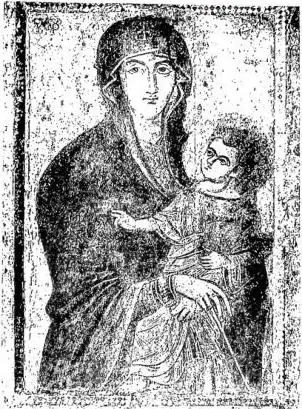
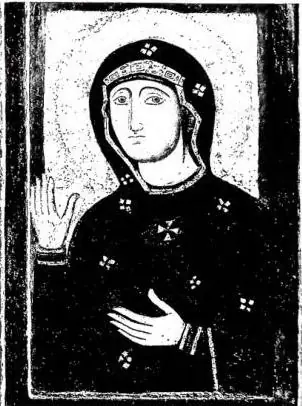
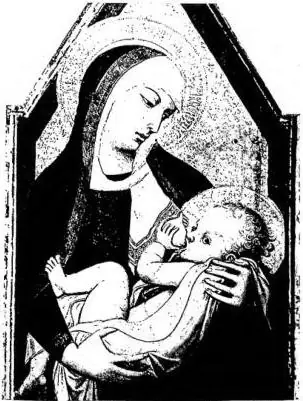
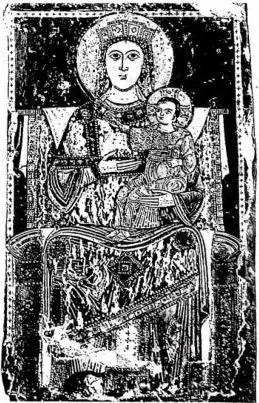
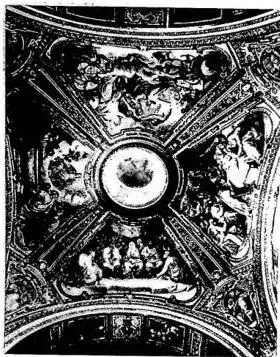
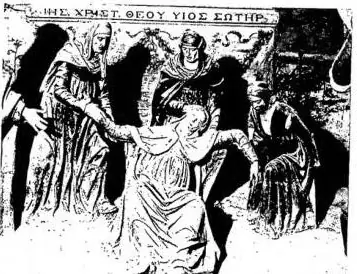
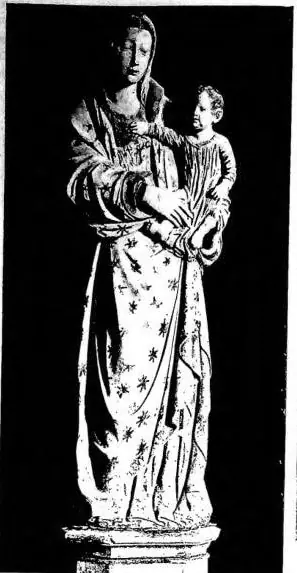
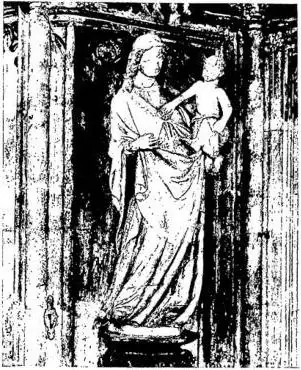
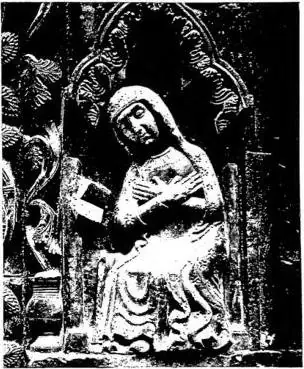
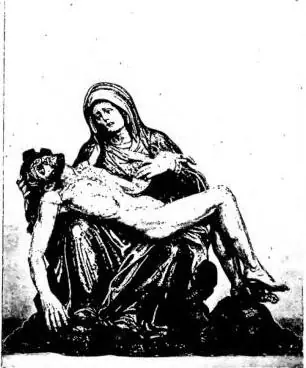
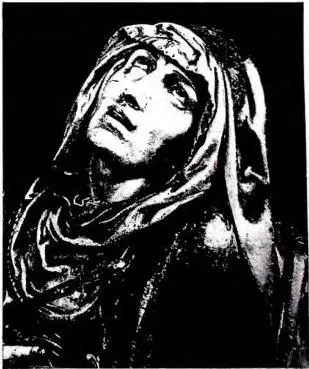
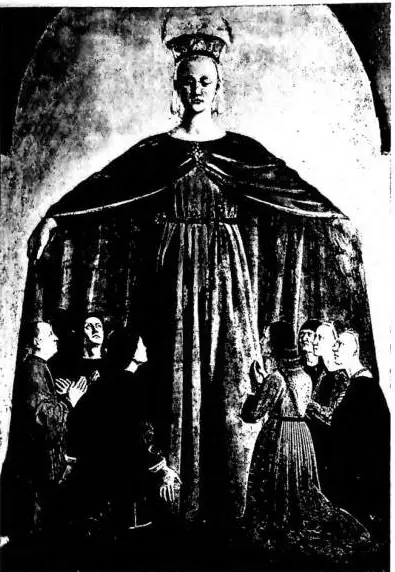
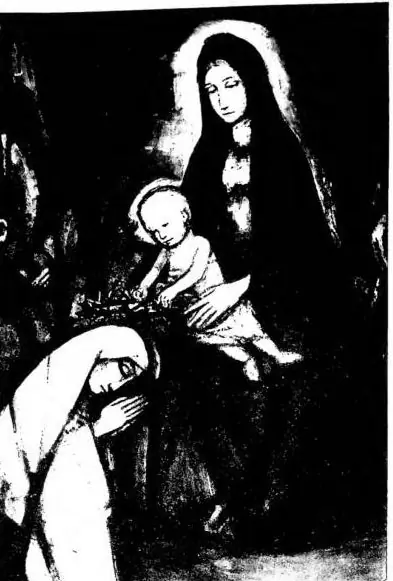
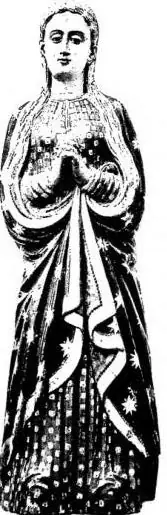
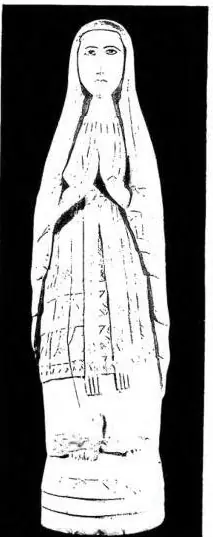
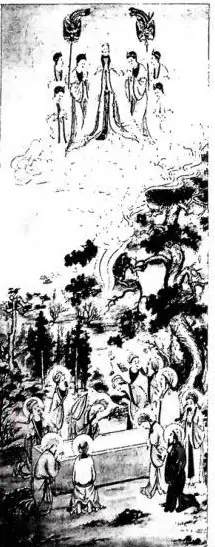
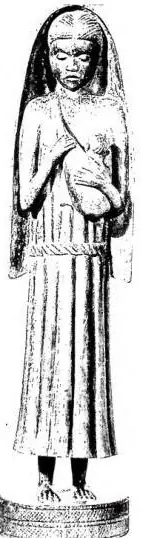
I. THE "MOTHER OF GOD"
In ancient Christian iconography the image of M. appears as "Mother of God" in the Epiphany (v.) painted on the arch of the so-called Greek chapel, in Priscilla (J. Wilpert, Fractio panis, Paris 1896, pp. 24-25, pl. 7; Enc. Catt., V, col. 422). In this scene, so frequent in cemetery art both in painting and in sculpture, M., veiled, is seated on a chair, in profile, while she is frontal in Domitilla (Wilpert, Pitture, pls. 116, 1 and 141), in the act of presenting the child Jesus to the Magi. In the same cemetery of Priscilla there are also found: a) the image of M., veiled and seated, holding the child Jesus and having at her right a prophet (Balaam or Isaiah) who points to the star (id., loc. cit., pp. 52, 175, pl. 22; for the dating of the painting that of P. Styger is preferable, namely the end of the 2nd century [Die römischen Katakomben, Berlin 1933, p. 123 ff.]); b) the image that offers the most ancient example of the Annunciation (Wilpert, Pitture, p. 187 and pl. 45, 2); c) the image in the cubiculum known as that of the veiled woman (dated by Wilpert to the end of the 3rd century or the beginning of the 4th) which represents M. seated with the child Jesus in her arms (id., loc. cit., pl. 81), which some, however, have regarded as a simple scene of maternity (O. Mitius, Ein Familienbild aus der Priscillahatakombe, Freiburg im Br. 1895; a thesis contested by Wilpert in Erlebnisse und Ergebnisse im Dienste der christl. Archäol., ibid. 1936, pp. 86-93).
These cemetery images of M. with the Child show how primitive iconography always represented M. as Virgin and "Mother of God," Theotokos, "MHTHP GEOY," "Sancta Dei Genetrix," as is read in two other later representations: a) that of M. with the Child and the inscription "Sancta Dei Genetrix," discovered by A. Bosio in a niche in the cemetery of St. Valentine on the Flaminia (A. Bosio, Roma sotterr., Rome 1632, pp. 576 and 579) and attributed by Marucchi to the time of Pope Theodore (642-49); b) the similar one, likewise within a niche, with the same inscription, and probably of the same age, in the cemetery of Pamphilus on the Salaria vetere (E. Josi, Il cimitero di Panfilo, in Riv. di arch. crist., 1 [1924], pp. 78-79).
II. "M. ADVOCATA." — In the middle of the 4th century, in the Cimitero Maggiore (v.) on the Via Nomentana there is found the frontal image of M. in prayer, dressed in tunic and dalmatic, with a necklace of pearls and precious stones and pearl earrings; and with the Child before her in a purple tunic, between two facing monograms (Wilpert, Pitture, pls. 207-209). It is the image of "M. advocata" as St. Irenaeus teaches (Contra Haeret., 5, 19; PG 7, 1173). To this image another must be added, much later, of life size, discovered in the cemetery of Commodilla (v.), on the tomb of the widow Turtura: M., seated on a jeweled throne, holds the Child on her knees between the two local martyrs Felix and Adauctus; the latter is in the act of presenting the deceased woman.
III. "M. REGINA." — In non-cemetery art, that is, in the mosaics of the triumphal arch of St. Mary Major, M. appears as "Queen," dressed like the daughter of Pharaoh in the mosaics of the nave, that is, with diadem, necklace, earrings and garments studded with gems, both in the Annunciation and in the Adoration of the Magi, in the Presentation in the Temple and before King Aphrodisius (v. EPEZO, Enc. Catt., V, plate outside the text). M. among the martyrs and therefore "Regina Martyrum" figured on the inner entrance wall of the basilica of St. Mary Major in Rome, as the poem of Sixtus III (432-40) attests, preserved by the epigraphic Syllogae (G. B. De Rossi, Inscript. Christ., II, 1888, p. 71). J. Strzygowski proposed recognizing the type of "M. Regina" in a gold coin representing Flavia Maxima Fausta Augusta, dated between 317-24 (others, instead, see in it an analogy with a gold coin of the mint of Constantinople depicting the empress Licinia Eudoxia, wife of Valentinian III [437-55]). To the second half of the 6th century belongs the unfortunately fragmentary fresco of "M. Regina" in S. Maria Antiqua at the Roman Forum, seated on a throne between two adoring angels (Wilpert, S. Maria Antiqua, in L'Arte, 13 [1910], pp. 1-20; id., Mosaiken, pls. 133-34). There too another image of M., seated, bears the vertical inscription MARIA REGINA (W. De Grüneisen, S. te Marie Antique, Rome 1911, p. 110, fig. 84). The image of M. Regina is also found in the silver capsella of Grado, of the 6th century (A. Morassi, Antica oreficeria italiana, Milan 1936, pp. 33, 67).
Fr. L. Bruzza pointed out that, according to a document of 587, in the basilica of St. Mary in Trastevere there was a chapel dedicated to the B. Virgin (Regato della chiesa di Tivoli, in Studi e Documenti di Storia e Diritto, 1 [1880], p. 130). Later, in the itinerary De locis sanctis martyrum, it is attested that in the middle of the 7th century there was venerated in that basilica an "imago sanctae Mariae, quae per se facta est" (R. Valentini and G. Zucchetti, Codice topogr. della città di Roma, II, Rome 1942, p. 122); evidently it is the same one as in the preceding document. The present image, called that of St. Mary of Clemency, existing in the Altemps Chapel, represents M. Regina seated on a throne between two angels; at the feet of the Virgin a pope is prostrate, perhaps John VII. The image is attributed to the 8th century with later reworkings of the 12th and 15th centuries (Wilpert, Mosaiken, pl. 274). An image of the Ma-
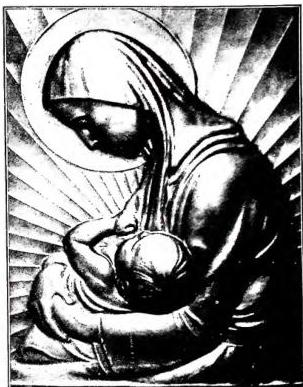
The Madonna "quae Antiqua dicitur" is also mentioned at the Vatican Basilica in a description from the second half of the 8th century (R. Valentini and G. Zucchetti, op. cit., p. 98). G. B. De Rossi believes it was located in the central portico of the basilica (Inscript. Christ., II, Rome 1888, p. 228, nos. 21-23). M. Regina is painted in the chapel of Sts. Quiricus and Julitta in S. Maria Antiqua, not later than the year 741 (Wilpert, Mosaiken, pl. 179). It is found again also in a niche in the underground church of St. Clement; the fresco is dated to the time of Leo IV (847-55; id., loc. cit., pl. 213, 3); in an oratory erected in the upper part of the basilica of St. Hermes in Bassilla, where the Virgin is between the two archangels Gabriel and Raphael and Sts. John the Evangelist, Hermes and Benedict (E. Josi, Scoperta d'un altare e di pitture nella basilica di S. Ermete, in Riv. di Arch. crist., 17 [1940], figs. 3 and 6). To the time of the abbot Epiphanius is assigned the image of M. Regina painted in the chapel of S. Lorenzo al Volturno. A standing, orant image of M. Regina between two archangels is that of the narthex of S. Angelo "in Formis," attributed by Wilpert to ca. 1065 (Mosaiken, fig. 97); from the same period is the fresco of M. Regina, orant, in the crypt of Ausonia. From about the end of the 10th century is the M. Regina, orant between angels and saints, in the apse of S. Maria in Pallara (Wilpert, Mosaiken, pl. 22). To the pontificate of Callixtus II (1119-24) is attributed the fresco of M. Regina in the portico of S. Maria in Cosmedin and the M. Regina, orant between angels, painted in the apse of the chapel of St. Nicholas at the Lateran. To the 13th century must be ascribed the images of M. Regina such as that of S. Maria del Sorbo in Campagnano painted on panel (Wilpert, Mosaiken, pl. 263). M. Regina is also in the apse of S. Maria Nuova at the Roman Forum (Wilpert, Mosaiken, pls. 232-33), from the middle of the 13th century. Very rich is the series of images of M. without the crown on her head, but veiled; no longer on a wicker or wooden chair, but seated on a throne as in the fragmentary vessel of the Museo delle Terme with the adoration of the Magi (R. Garrucci, Storia dell'arte crist., VI, Prato 1881, p. 33, pl. 427, 5-6) and in the marble slab of Carthage with the adoration of the shepherds (Wilpert, Sarcofagi, III, pp. 52-54). On the ampullae of Monza there are examples of M. enthroned, holding the Child between the Magi and the shepherds (R. Garrucci, op. cit., pls. 433, nos. 7, 9; 434, 1). The subject would have been taken, according to Ch. Diehl, from the representation existing on the facade of the basilica of Bethlehem (Manuel d'art Byzantin, I, 2nd ed., Paris 1926, pp. 311-12). Typical is the representation in the mosaics of S. Martino "in caelo aureo," later S. Apollinare nuovo, in Ravenna (496-523) where the Virgin is seated on a throne with the Child on her lap between four angels. To this type are linked: the ivory of Berlin (Venturi, I, pp. 506-508, fig. 384); the apse mosaic of the cathedral of Parenzo (535-43); the apse mosaic of S. Maria in Dominica, in Rome, where M. is enthroned, between two choirs of Angels and at her feet the pope who rebuilt it, Paschal I (817-24; G. B. De Rossi, Musaici cristiani, Rome 1872-93, pl. 23); the contemporary mosaic of the chapel of St. Zeno in S. Prassede, where M. is enthroned between the Apostles Peter and Paul (Wilpert, Mosaiken, pl. 115); the Virgin enthroned with the Child, in Constantinople, to whom Constantine offers the model of the city and Justinian that of Hagia Sophia (A. M. Schneider, Die Hagia Sophia zu Konstantinopel, Berlin 1938, figs. 59-60); the Virgin, between the angels Michael and Gabriel (11th century), at Daphni. In the vault of the presbytery of Notre-Dame-la-Grande, at Poitiers, on the eastern side, stands M., enthroned, with the Child on her lap, within an oval frame containing an inscription, of which only the word Matri remains, to be completed perhaps with "in gremio Matris residet sapientia Patris"; as at Notre-Dame-des-Pommiers, at Beaucaire in the Gard, where two angels fly above and three saints stand below on each side; the fresco is from the 12th century (P. Deschamps, Les peintures du chœur de Notre-Dame-La-Grande de Poitiers, in Comptes Rendus de l'Acad. des Inscr. et Belles Lett., 1949, pp. 288-92). M. enthroned is also at St. Demetrius of Thessalonica (Ch. Diehl, op. cit., p. 102, fig. 91); and in the apse of Hagia Sophia in Constantinople (id., loc. cit., p. 473, fig. 230). Thus M. between two adoring angels is found again in the silver altarpiece of Cividale, donated by the patriarch Pellegrino II (1195-1204); in the gilt-bronze triptych of the Victoria and Albert Museum, with the inscription MP ΘV (12th century); in the painting, from the time of Honorius III (1216-27), on the entrance wall to the so-called Platonia "in Catacumbas" (Wilpert, Mosaiken, pl. 262, 3). M. enthroned, with the crowned Child (Christ the King) on her lap, between two angels, is found at Modena in a 13th-century miniature of the Biblioteca Estense (cod. lat. 461). The same image also in seals, such as those of Cardinal Ranieri (d. 1252) and of the University of Pisan prisoners in Genoa (1284-1300). A statue of M. Regina is that of the cathedral of Solsona (A. Kingsley Porter, Spain or Toulouse? and other questions, in Art Bulletin, 7 [1924-25], pp. 3-25) and the wooden one of the cathedral of Alatri (P. Toesca, Storia dell'arte italiana, II, Turin 1927, fig. 556).
The type of M. Regina between adoring angels is found again also in one of the ivory plaques of the antependium of the cathedral of Salerno from the first half of the 13th century. Constantinople ca. 520 had three centers of veneration of the Blessed Virgin: at the Blachernae, at Chalcoprateia and at the Hodegoi (Theodore the Lector, Hist.: PG 86, 165-68); in the first two were venerated the ribbon or the girdle of the Blessed Virgin; at the Hodegoi the image of M. with the Child in her arms, which Eudocia would have sent from Jerusalem to the empress Pulcheria; it is the image called Hodigitria (ὁδός ἠγέσθαι), the guide, later attributed to St. Luke (Theophanes Kerameus, Homily 20: PG 132, 410; Nicetas Acominatus: PG 139, 744). Cl. Henze, invalidating the current interpretation of the passage of the De Trinitate of St. Augustine (8, 5, 76: PL 42, 932), has attempted anew to attribute to St. Luke the first image of the Hodigitria (Lucas der Muttergottesmaler. Ein Beitrag zur Kenntnis des christlichen Orients, Louvain 1948). Recently, beneath a panel image of M. with the Child in her arms, attributed to the 13th century and preserved in S. Maria Nova, fragments of canvas have been detached which have yielded a representation of M. with the Child attributed by some to the 5th century; but this dating is still debated (P. Cellini, Una Madonna molto antica, in Proporzioni, 1 [1950], pp. 1-6).
To this type belongs the panel in St. Mary Major (12th-13th century), today in the chapel of Paul V. It was held in very great veneration in the Middle Ages, as the "Salus populi Romani." The icon took part in the procession of that of the Most Holy Savior, called the acheropita, on the night of August 15. In 1264 the Insignis Societas Recommendatorum B. M. Virginis (Archconfraternity of the Gonfalone) was erected, charged with the custody of the image. One understands therefore how this icon came to be copied for the minor centers of Latium, such as the Madonna della Carbonara in Viterbo, of the first half of the 13th century, and how it was spread especially by St. Francis Borgia, when, around 1566, he obtained from Pope St. Pius V permission to have copies made in painting and in copper, which were then sent to Portugal, to India, to China, to Brazil, to Ethiopia, where it became the archetype of the Abyssinian Madonna from the beginning of the 17th century (P. Sunu, Hist. de st François Borgia, Paris 1910, p. 414; P. M. D'Elia, Le origini dell'arte crist. cinese, Rome 1939, p. 49, n. 2; U. Monneret de Villard, La Madonna di S. Maria Maggiore e l'illustraz. dei miracoli di M. in Abissinia, in Ann. Lateranensi, 11 [1947], pp. 9-90). To the same group belong the panels of the Madonna del Popolo (Wilpert, Mosaiken, pl. 299, 2); of Tivoli (id., loc. cit., pl. 298), the fresco in SS. Cosmas and Damian (pl. 299, 1); of the Madonna with the standing Child, in the Museo civico of Padua, etc. It is also found on enamel, such as the image of S. Maria in Campitelli, or on embroidery, such as the one donated by Boniface VIII to Anagni, or the other of S. Maria, at Zara (13th century). From the Byzantine Odigitria there then formed the type of M. Eleousa, that is, M. who embraces or caresses the Child whom she carries in her arms. Also Byzantine is the type of M. "Galaktotrophousa" or "Virgo lactans," who nurses the Child, a type later developed also in the Renaissance and which some, on the other hand, hold to be of Egyptian origin, typologically derived from the representations of the pagan "dea nutrix."
M. orans between the apostles Peter and Paul is found in one of the panels of the wooden door of S. Sabina (C. Cecchelli, Note iconograf. su alcune ampolle bobbiesi, in Riv. di arch. crist., 4 [1927], p. 134, fig. 11); and it recurs also in certain gilded glasses. Likewise M. orans appears in the scene of the Ascension of the Evangelary of Rabbülä (a. 586); in those of a fragment of an ampulla from Bobbio (G. Celi, Cimeli Bobbiesi, in Civ. Catt., 1923, III, pp. 37-39); in the apse mosaic of the oratory of S. Venanzio at the Lateran from the time of John IV (640-42); in the scene of the Ascension in S. Clemente from the time of Leo IV (847-55; Wilpert, Mosaiken, pl. 210); at Ravenna in the mosaic of 1112, formerly in the Cathedral, where M. is distinguished by the inscription SCA MARIA (G. Gerola, Il mosaico absidale della Ursiana, in Felix Ravenna, 1 [1912], pp. 185-190); M. orans is likewise in the ivory of St. Gall of the 10th century attributed to the monk Tutilo with the Ascension sanctae Mariae (J. Schlosser, Quellenbuch zur Kunstgeschichte des abendländischen Mittelalters, Vienna 1896, p. 151 ff.); at Murano in the apse of S. Donato and at Torcello, where the orans image is accompanied by the inscription MP ΘV (12th century).
IV. MARY CALCHOPRATIA
The type of the Virgin Calchopratia is the very one that was mentioned in connection with the catacombs of Albano (v.); it recurs in scenes of the Crucifixion, as in the Madonna at the foot of the Cross in the Evangelary of Rabbülä (586); in the fresco discovered by A. Bosio in S. Valentino on the Via Flaminia, attributed by O. Marucchi to the time of Pope Theodore (643-49), and in the well-known fresco in S. Maria Antiqua in the Roman Forum; in the lower church of S. Clemente in the time of Leo IV (Wilpert, Mosaiken, pl. 209, 2), in the Crucifixion of the ivory triptych of Constantine Porphyrogenitus, now in the Museum of Palazzo Venezia; in the Crucifixion of the cycle of S. Angelo «in Formis»; in the cross, formerly of Maastricht, now in the treasury of the Vatican Basilica; in the reliquary cross in gold and enamels of the cathedral of Cosenza (12th century). The panel of Tivoli of the 13th century bears the legend: «Ave gratia plena, Dominus tecum» (Wilpert, Mosaiken, pl. 273). The same image recurs in certain scenes of the Last Judgment (e.g., Torcello). In all these representations the Madonna is shown «stantem non flentem», in the words of St. Ambrose.
V. MARY BLACHERNIOTISSA
Another Constantinopolitan type is that of the Blacherniotissa: the Blessed Virgin standing supports the Child with both hands and holds Him against her breast, as in the image of the three holy Mothers in the niche of S. Maria Antiqua, where St. Anne with the child M., the Blessed Virgin with the Child and St. Elizabeth with the Precursor are represented, and in that outside the chapel of St. Zeno, in S. Prassede, from the time of Paschal I (817-824), surrounded by ten medallions (two saints and eight holy women), and also the type of the Virgin standing with the Child, as in the north portal of Notre-Dame in Paris (1257).
As for the facts and events of M.'s life represented in non-cemeterial iconography, there are: the nativity of the Virgin M. (v.), M. in the arms of St. Anne; M. in the service of the temple of Jerusalem, the Annunciation (v.), the Marriage, the trial of the bitter waters; the journey to Bethlehem, the birth of the Savior (v. NATIVITY of Christ), the adoration of the shepherds, that of the Magi (v. EPIPHANY), the flight into Egypt (v.), the finding of Jesus in the temple among the doctors, the marriage at Cana (v.), the Crucifixion of the Lord, the depositions from the Cross (v.) and into the tomb, the Ascension (v.), Pentecost (v.), the death or dormitio of the Blessed Virgin (v. KOIMESIS), her Assumption into heaven, her Coronation (v.); M. also appears in the Last Judgment or in the tree of Jesse (v.).
Bibliography13 works
Enrico Josi
VI. ICONOGRAPHY
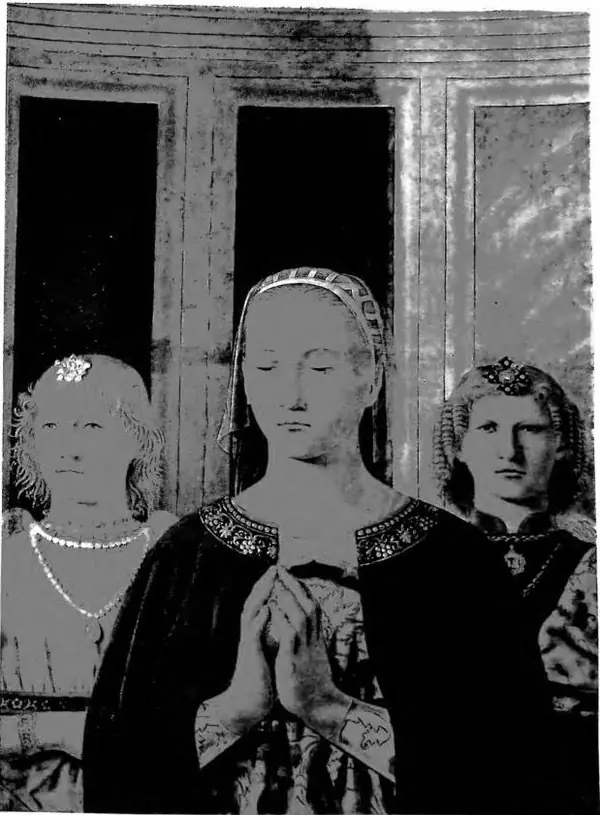
The evolution of the iconographic type of the Virgin had taken place in the early days of Christianity and then during the early Middle Ages with relative slowness. But when one reaches the 13th century this evolution assumes a much faster rhythm, while alongside the ancient themes others take shape which, at least in part, must be understood as a derivation or offshoot of them. This, naturally, is also connected with the new sense of life that established itself in that age, when profound spiritual upheavals and vast reforms in the field of civil life mark the beginning of a new era. And it is the same individualistic sense, by then predominant in consciences, that tends to differentiate the sacred figurations, aided in this also by that "sanctification of all aspects of life" which later in the 15th century would have its fullest expression. On the other hand, the very widespread taste for unusual or new things, and the great value attributed to originality of expression, contribute to or urge the renewal of the ancient schemes. Thus it is that the ancient themes of the Madonna in prayer, of the Madonna in glory, of the Madonna interceding or presenting, of the Madonna with the Child in her arms, standing or seated, and then of the Madonna in the various moments of her earthly life and of her heavenly glory, gradually evolve. And while her figure assumes — by the very virtue of art, which proceeds decisively toward naturalistic expression — ever more real and living aspects, so as to render her almost familiar to the faithful, in their eyes she will soon appear as the sublime being who, together with the most elect movements of the spirit, sums up the noblest ideas and the sweetest human sentiments.
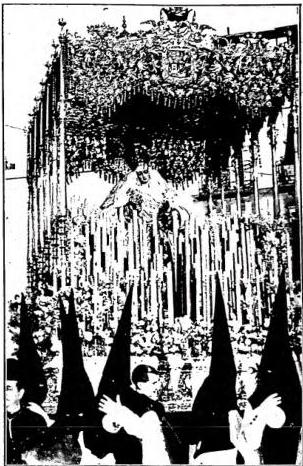
In the Mother of Jesus, in the Queen of Heaven, men will recognize, reflected in the mirror of art, also and above all the common Mother.
In this sense the iconographic development of the various themes proper to antiquity can be summarized more as a perfecting of the preceding figurative schemes than as a continuous surpassing of them. So that the isolated standing figure of the M. Virgin soon became the imposing architectural "Madonna of Mercy" who under the broad wings of her mantle welcomes and protects kneeling faithful and entire cities. Beautiful examples of such a type are found, besides in the panel by Lippo Memmi that is in the chapel of the Corporal in the cathedral of Orvieto, in the decoration of the Gonfaloni (v.) of the Umbrian Confraternities of the 15th century and in the panel by Piero della Francesca that is in the Museum of Borgo San Sepolcro.
The type of the Virgin in the act of pointing or interceding becomes ever less frequent. In such an attitude, however, she will be found ever more often as a full figure in the scenes of the Crucifixion (v.) and in those of the Pietà (v.), as in the others where it is she herself, in the glory of Heaven, who with a pitiful maternal gesture presents or commends saints or faithful to the Redeemer.
Closer to the customary ancient schemes is the scene of the Assumption. In it during the 13th, the 14th and also the 15th century the image of the Virgin is depicted standing or seated within a rayed mandorla surrounded by angels in flight while she ascends toward the empyrean.
In this aspect she is often encountered in Romanesque and Gothic sculpture also beyond the Alps (Paris, Notre-Dame) but is also very frequent in Italy, where the example of the relief by Andrea Orcagna in the ciborium of Orsanmichele in Florence may serve, and in painting, as in the panel by Perugino that is likewise in Florence in the Uffizi Gallery. Then that image frees itself from the schematic rayed mandorla, a residue of medieval customs, to stand resplendent in the sky (Titian, Venice, S. Maria dei Frari). To be connected iconographically with the Assumption is also the representation of the Madonna of the Sacred Girdle, of which there are beautiful examples in a series of 14th-century predellas and in a panel assigned to Filippo Lippi preserved in the Pinacoteca of Prato.
However, the theme most intensely and poetically developed by all Christian art is without doubt that of the Virgin with the Child. Whether she is depicted standing or seated or kneeling in the act of adoring him. The sculpture of the Romanesque and Gothic age has left admirable examples of it in every region, and here it suffices to recall, alongside the French and German sculptures and ivories of that age (Notre-Dame and the Louvre Museum in Paris), the masterpieces of Nicola de Puglia, of Arnolfo di Cambio, of Giovanni Pisano respectively at Pisa, Orvieto, Siena and Padua, depicting precisely the Virgin holding the Child affectionately in her arms. We are in the years when Giotto was asserting his new ideals of beauty and majesty in the great panel of the Uffizi, where the Madonna, who has the blessing Child on her knees, is above all the image of the Mother; of a most human woman superior to every other for moral greatness. Then the Sienese masters, from Duccio to Simone Martini to the Lorenzetti, gave of the theme an interpretation in which, from time to time, according to whether the image was depicted among the angelic choirs and in the splendor of heavenly majesty or in the tender human attitude, they enriched it with the splendors dreamed in their fervid imagination or with the treasures of their affectionate earthly sentimentality.
Already in Eastern art the type of the Madonna who brings her head close to that of the little Jesus had been treated as had been treated the other in which one sees the little Jesus caressing the Mother's face; but now those themes are taken up again and treated with the greater freedom that the conquests of art allow (Unknown Sienese, Turin Civic Museum; Simone Martini, Rome, Palazzo Venezia; Pietro Lorenzetti, Florence, Uffizi), while in the same sense one proceeds to define the representation of a true and proper conversation between Mother and Son. A admirable example is the fresco that is in the lower church of Assisi, the work of Pietro Lorenzetti, where the Madonna, who has the Child in her arms, points out St. Francis to him, while St. John assists at the scene. This type of composition will be the starting point for those Holy Conversations very frequent in art not only Italian toward the end of the 15th century and in the early years of the 16th century, in which saints and faithful surround the Virgin in the act of conversing with her almost always against the background of splendid landscapes.
Likewise Eastern art had hinted, among the effusions of tenderness of the little Jesus toward the Mother, at a true embrace which now in the 14th century is ever more naturalistically expressed (Riminese Master of the 14th century, Munich, Pinacoteca; Ugolino Lorenzetti, Lucca, Pinacoteca). As also in the 14th century the theme of the Madonna of the Milk becomes very widely diffused, of which there is a truly admirable example in the panel by Ambrogio Lorenzetti that is in Siena in the chapel of the Seminary near S. Francesco, a theme which through infinite variations (Francescuccio Ghissi) will reach as far as the beautiful Madonna of the Cushion by Andrea Solario that is in the Louvre in Paris.
On the other hand the Child, sometimes no longer clasped in the Mother's arms, but standing on her knees, gives ever greater ease and vivacity to the composition, in which other figures take part such as St. Anne and St. John the Baptist who converses with the little Jesus even on infant knees (Raphael, Madonna of the Goldfinch, Florence, Pitti; Leonardo, Virgin of the Rocks, Paris, Louvre). But by now with the second the second half of the fifteenth century and more with the sixteenth century, the image of the Virgin as she appears in the narration carried out with ever more naturalistic accents of the various episodes of her life (v. ANNUNCIATION; ASSUMPTION; FLIGHT INTO EGYPT; IMMACULATE CONCEPTION; CORONATION; PRESENTATION; NATIVITY), seems truly to free itself from every preconceived schema in order to be entrusted essentially to the devout interpretation of the patrons and the artists. To list the innumerable sculptures and paintings of those ages and also of later epochs in which the representation of the Virgin assumes a particular interpretation of the ancient theme is almost impossible, but one cannot fail to recall what sublime moral grandeur is reflected in the images of the Virgin that Michelangelo interpreted so many times in his works, what ideal beauty is reflected in those of Raphael, what most human sweetness in those of Correggio. Then a particular theme becomes ever better defined, that of the Madonna of the Rosary which, perhaps, in part, is to be linked iconographically to that of the Madonna of the Holy Girdle, and which is clearly defined in what will be its most widespread aspect during the seventeenth and eighteenth centuries through the work of Michelangelo da Caravaggio (Vienna, Museum) and of Sassoferrato (Rome, S. Sabina). But it was precisely during the Baroque age, when the freedom of the artists' imagination, oriented toward realistic representation, so often also flows into emphasis and rhetoric, that the sacred images of the Virgin move ever further away from traditional motifs.
The theme of the Immaculate (v.) as well, whose dogma was proclaimed in 1854, found in the works of artists from the fourteenth century onward very interesting suggestions for its representation.
During the nineteenth century, after a return to ancient figurative schemas (v. MODERN SACRED ART; NAZARENES; PURISM), the naturalistic tendency of expressions continued on its course. But in very recent times, especially in the last thirty years, it is possible to discern in the sacred images of the Virgin painted or sculpted by the best artists, especially in France, an evident aspiration to restore to her figure the spirituality that medieval and primitive art knew how to infuse into it, even if now expressed in the forms that are proper to the most dramatic language of modern art (H. Matisse, G. Rouault). - See plates VI-XI.
Bibliography5 works
Emilio Lavagnino
VI. MARIAN FOLKLORE.
Popular devotion manifests itself through infinite forms of devotion inspired by an ardent sentiment of absolute trust in the mercy and miraculous power of the Mother of God. She is venerated by the people both in her principal attributes (Our Lady of Sorrows, the Annunciate, the Assumption, Our Lady Help of Christians, the Immaculate, etc., or also Our Lady of Good Counsel, of Mount Carmel, of Divine Love, of Graces, of Mercy, of Peace, of Piety, of Succor, of Suffrage, etc.), and in the particular aspects under which she is made an object of worship for her miraculous images and for the sanctuaries or localities where these are found, or for other causes. Hence the designations of Our Lady of Aspromonte, of Caravaggio, of Loreto, of Monte Nero, of Oropa, of Piedigrotta, of Pompeii, of Schiavonia, of Trapani, of Valverde, etc., in Italy; of Lourdes, of Montserrat, etc., abroad; or also of Our Lady of the Chain, of the Girdle, of the Crown, of the Cross, of the Fever, of Tears, of Light, of the Militias, of Miracles, of Childbirth, of Prayer, of the People, of the Rosary, of Soledad, etc. To each of these designations correspond particular aspects of popular devotion and of the related beliefs and manifestations.
The dedication of churches to St. Mary ad nives goes back to the Middle Ages and is widely diffused in France and in Germany as in Italy. More recent is the tradition of churches and chapels erected in places that would have been indicated by the Madonna herself. The themes and motifs of such indication are more or less similar, and applied indifferently to the different places of worship of the Madonna. For example: the apparition to a little shepherd boy of the Madonna who points out to him the precise place where a church dedicated to her must rise; angelic voices revealing where hidden images of the Madonna are found: the episode of the oxen that refuse to proceed until the image of the Madonna is brought to light and a chapel is dedicated to it, etc. Of particular interest are the legends relating to images found near oaks, grottoes and springs, because they can be indications of the superimposition, in certain places, of Christian worship upon antecedent cults of pagan female divinities.
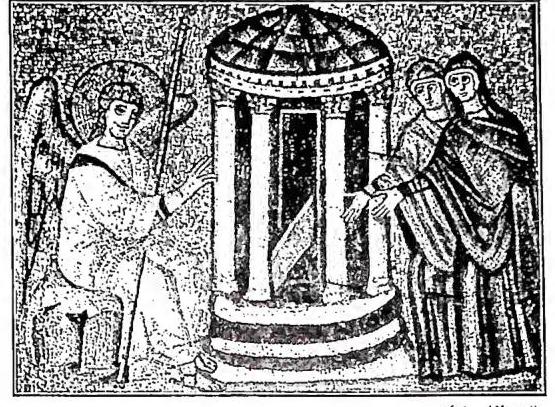
Numerous too are the legends that flourished around the images of the Madonna that move, speak, weep, threaten. An entire legendary of the miracles of the Madonna came into being during the Middle Ages and gave rise to a rich literary production of a devotional and moralizing character, both in Latin and in the Romance and Germanic languages: it suffices to recall the Liber de miraculis s. Dei genitricis Mariae (called the "Perez Collection" from the name of its first editor) and the Mariale magnum, in the seventh book of the Speculum historiale of Vincent of Beauvais: one of these compilations brings together as many as 105 legends of miracles of the Virgin. From this literary production the principal motifs and themes descended into oral tradition, inspiring numerous "stories" and narrative songs. The influence of popular fantasy is particularly recognizable in the legends in which the Madonna assumes entirely earthly functions and is placed in relation with the discovery of treasures, or with banal occurrences of daily life. Very well known in the Romance world as in the Germanic one is the legend of the Madonna who, disguised as a knight, fights in a tournament on behalf of an innocent man, and wins. The whole life of the Madonna from infancy to her passing has inspired popular poetry in graceful lullabies, in brief songs and also in long narrative poems.
The protection of the Madonna is invoked for every circumstance of life; but in particular in childbirth and in the dangers of war. For women in labor there exist in the oral tradition of various countries invocatory formulas and brief prayers in verse. At the beginning of labor a candle or a lamp is lit before her image, and after this has taken place, an offering is made: a legend recounts that a woman in childbed offered the Madonna a candle as thick as the circumference of her body in the state of motherhood. The Madonna was invoked in battles, both by individual combatants and by the entire army. In the tablets of the ex-voto the effigy of the Madonna is almost obligatory. The use of painted or sculpted images of the Madonna on facades, in niches, on corners or above the doors of private dwellings, with the offering of flowers and the lighting of lamps, dates back to the Middle Ages. This form of veneration is integrated with the little shrines or "maestà" at crossroads or at particular points along the streets of town and countryside; and they are never without the offering of candles or flowers by humble folk. But only in the centuries closer to our own, with the dedication of the month of May to M., did the Madonna replace the "queens of May" in popular tradition; and her altars took the place of the little thrones on which these "queens" received the offerings of flowers and the small gift from the groups of "maggiaioli". In Romagna this offering took the specific name of Maduné, that is, homage to the Madonna.
For the Madonna's garments the preferred color is dark blue. The connections between the Madonna and the days of the week appear ancient: Saturday is particularly dedicated to her; the belief that "there is no Saturday without sun" is widely diffused, precisely to please the Mother of God, who on that day washed the swaddling clothes of the infant Jesus and put them out to dry. According to another tradition she was born on a Saturday. Various plants and herbs are named after the Madonna: in popular beliefs certain trees, such as the oak and the linden, are particularly connected with her. For the gathering of medicinal herbs the Marian feast days are favorable: the Conception, the Purification, the Annunciation, the Assumption and the Nativity; these days are also propitious for the most delicate actions, such as weaning a child from its mother's milk. Little medals, "brevi" or woodcuts with the image of the Madonna are considered talismans and used in the treatment of various illnesses: to stop a nosebleed, one would press on the tip of the nose a medal bearing the effigy of M.
It may be that in the popular tradition of certain countries the substitution of Marian worship for that of the ancient pagan female divinities did not succeed in completely erasing the traces of the earlier cults; but the repeated attempts made to link certain attributes of the Madonna directly to those of mother goddesses or sacred virgins of classical or Germanic mythology have proved, on objective criticism, to lack solid and certain demonstration. See also the entries: ASSUMPTION; POPULAR RELIGIOUS FEASTS.
Bibliography13 works
Paolo Toschi
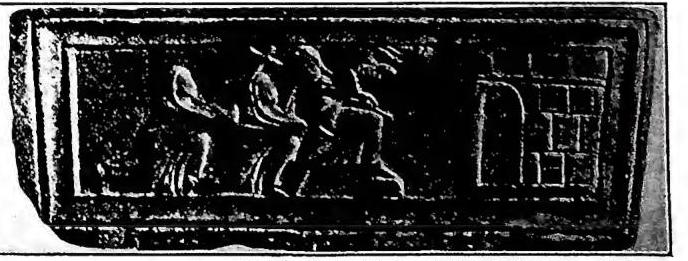
1. Sister of Moses, firstborn of Amram and Jochebed (Ex. 6:20; Num. 26:59; 1 Chron. 6:3). She watched over her little brother exposed on the waters of the Nile and cleverly managed to have his own mother given to him as a nurse by the daughter of Pharaoh (Ex. 2:4-10). At the crossing of the Red Sea, M. was 90 years old (Ex. 7:7) and as a prophetess led, under divine influence, the dances and songs of joy and thanksgiving to Yahweh (Ex. 15:20 ff.; Mic. 6:4; cf. Num. 12:2). In the desert, at Hazeroth, she murmured with Aaron against the authority of Moses, as though they too were not prophets, made jealous by the influence that Zipporah had over Moses, whom M. called, perhaps out of contempt, a Cushite. Yahweh punished M. with leprosy; healing her, however, through the immediate intercession of Moses; she nevertheless had to remain 7 days outside the camp (Num. 12:1-15). She died at Kadesh shortly after the arrival of the Hebrews and was buried there (Num. 20:1).
2. Woman of the tribe of Judah (1 Chron. 4:17); but the text is uncertain. The Septuagint translates Μερών; some think it refers to a man (cf. W. Gesenius-F. Buhl, Hebr. und Aram. Handwörterbuch, 17th ed., Berlin 1949, p. 462).
3. Sister of Lazarus, always at Bethany, in an attitude of quiet contemplation at the feet of Jesus (Luke 10:39-42), or of grateful love at the supper after her brother's resurrection (John 11:1-33), when she anointed the head and feet of the Lord (John 12:1-8; Matt. 26:6-13; Mark 14:3-9). She merited from Jesus the praise of having chosen "the better part," the one thing truly necessary (Luke 10:42), and of having anticipated in the anointing the burial preparation of his most sacred body, defending her against the venal discontent of Judas (John 12:8; Matt. 26:6-13; Mark 14:6-9). She thus appears clearly distinct from M. of Magdala and from the unnamed sinner who in Galilee anointed the Lord about a year earlier (Luke 7:36-50); v. MARY MAGDALEN.
4. Wife of Clopas (John 19:25), mother of James the Less and of Joseph (Matt. 27:55; Mark 15:40-47; Luke 24:10), cousins of the Lord (Mark 6:3 etc.). She is at Calvary with the Mother of Jesus (John 19:25); she remains there after the death of the Lord and witnesses the burial (Matt. 27:56-61; Mark 15:40-47). On the morning after the sabbath she goes to the tomb to anoint the Lord, and on her return she shares with the other pious women the favor of seeing the Risen One (Matt. 28:1-9; Mark 16:1; Luke 24:10). It is difficult to define the exact degree of kinship of M. to the Madonna; John 19:25, "sister," among the Hebrews has a broader meaning. Modern scholars consider her a sister of St. Joseph (J. Vosté, A. Durand, J. Lebreton, F. Prat) or his sister-in-law (P. Dausch, D. Buzy). For Clopas-Alphaeus (Matt. 10:3), v. respective entries.
5. Mother of the evangelist John Mark, in whose house St. Peter went as soon as he was miraculously freed from prison (Acts 12:12).
6. Christian woman of Rome, to whom St. Paul sends his greeting, recalling her zealous activity on behalf of those faithful (Rom. 16:6). - See plate XII.
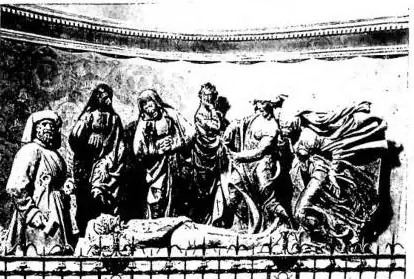
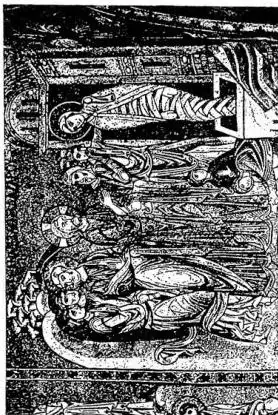
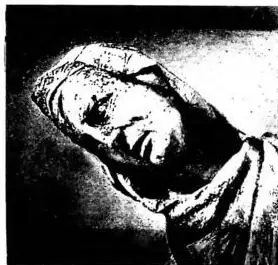
Bibliography2 works
Francesco Spadafora